Iulia Stefan, Lia Pop, Teodora Praja, Nicolae Costea (2023). Virtual Reality for Adult Training. In: Augmented, Virtual and Mixed Reality Simulation. AHFE Open Access, vol. 118, pp. 59–68. https://doi.org/10.54941/ahfe1004441
In many different industries including IT, business, medicine, engineering, and many more, technology refers to a collection of methods and information that are used to develop, produce, and improve services and products. Technology has evolved quickly in recent years, and innovations have completely changed how we work, live, and interact with the world. For instance, the Internet has made it possible to access a vast quantity of information and quick communication through a variety of applications like Facebook and Instagram, and being able to swiftly access it on our phones enables us to be constantly connected to social networks and various other resources. As such, digital technologies offer a unique opportunity to improve educational standards. On the one hand, teachers and trainers become equipped with cutting-edge tools that help them engage their classroom with contextualized information in a way that is not only personalized and differentiated according to everyone's distinctive progress and needs but also time-efficient. Alternatively, students benefit from a customized learning experience that is also sensitive to their performance, sometimes through an immersive experience, to be able to go on and use their education to contribute to the society they will live in in the future. As such, the advantages of integrating digital technologies with pedagogy to develop an elevated learning environment have become increasingly apparent. Virtual reality is one of the most recent developments in technological innovation that is being used as a tool for educators in the educational process in nations with more developed economies. People are captivated by virtual reality because of the intriguing images, the distinctive experience it provides, and the way it captures their attention consistently. Immersion in a virtual space becomes an experience through which users can unconsciously integrate the knowledge, images, and content they are exposed to, which has a real and positive effect on their mental health. Training in fields where the direct experience could provoke more cognitive and behavioral damage is training teachers for children with special needs. As it offers a realistic and interactive experience in a regulated and safe setting, virtual reality can be a highly beneficial tool for the training and education of teachers working in such environments. In such an immersive environment, teachers can learn how to react appropriately and deal with challenging situations because a virtual reality application can simulate scenarios that imitate the distinctive behaviors of children. In these scenarios, each child's particular needs and preferences may be attended to, which might be challenging to imitate in the real world. The current work seeks to create experimental game scenarios tailored for special needs classroom training, assess their usefulness, and examine how they affect the growth of children's social and communicative abilities. The game scenarios are based on real teaching practice in different contexts working with special needs children and integrate practical innovative methodologies in instruction. Functionalities to help adults learn and recognize easily real-life scenarios in the classroom context and instruments to manage difficult emotional and behavioral manifestations of children between 3-6 years old make the approach a solution to consider for future training of specialized personal and not only.
The current work aims to investigate and create 2 experimental scenarios that reflect the needs and unique characteristics of autistic children teaching environment in the Virtual Reality (VR) Unity environment, with a focus on their usage in the education of educators who work with them. In their case, interactive scenarios in Unity offer special learning and development opportunities that help the learning process without the on-site side effects. When learning by practicing in real environments, the chances of exposing the children to mistakes in applying the methodology with possible side-effects and worsening the social abilities of the children is increasing.
To be able to incorporate this technology into educational practice, teach- ers must be properly taught and provided with useful scenario models. Therefore, the objective of the research is to create an experimental VR appli- cation prototype with 2 identified learning scenario models for educators, to learn specific applicable methods for interacting with autistic children.
To create non-intrusive intervention strategies that give teachers interac- tive and interesting tools to support the teaching for the adult students to acquire skills and help improve the development of social, communication, and cognitive skills of children with autism is essential. Utilizing VR is one of the most approachable and appealing options for learners. An unique and effective solution can be achieved by customizing play circumstances to the needs of these educational practices.
The approach of the video game alike virtual application is based on a tuto- rial first and game practice second method. After an animation is displayed, the user is invited to finalize an exercise that attempts to mimic a classroom behaviour and use the concepts learned in the instruction part.
A variety of not obvious changes in the environment, but important in this specificity of autism spectrum, can cause an autistic youngster to behave inappropriately. The user will receive a warning and a hint in the program every time he takes a bad turn or does something different that could result in that unwanted conduct (Fouse & Wheeler, 2005). For a next prototype, some behaviours must carry more warnings than others, each significant, depending on their usefulness.
The next sections will provide a short introduction to the definition and specific context of autistic disorder, the educational needs, the VR input for education, the specificity of VR classroom creation proper for the autistic children and the description of the scenarios; the paper will end with specific conclusion, acknowledgements, and a list of references.
WHAT IS AUTISM People with disabilities have always been treated more or less differently than those who conform to social expectations (Zapata & Worrell, 2023; Kim, 2020; Vornholt, Uitdewilligen, & Nijhuis, 2013). Recently, Leo Kanner defined the criteria of autism, in a crucial study he wrote in 1943. A year later, Hans Asperger identified a different group of kids who shared many similarities with the autistic kids but had a “higher level of functioning” (Santangelo & Tlatoanis, 2005). Autism is a disorder
Virtual Reality for Adult Training 61
that is typically identified in the early stages of childhood. There have been more children diagnosed with autism in recent years, and it is thought that 1% of people may have an autistic spectrum disorder (AS). Autism is a com- plex neurodevelopmental profile and is distinguishing itself by stereotypes, repetitive habits and interests, limited communication and language, qualita- tive harm to social interactions, and these (Andreica-Sandica, Patca, Panaete, & Andreica, 2011).
Characteristics of Autism Some of the common characteristics of children with autism are difficulties in communication and social interaction, repetitive behaviour, and restricted interests. For each child, these aspects manifest themselves differently, vary- ing in their intensity. A case where the child shows evidence of repetitive behaviour is when he repeatedly moves his hands, generally by clapping them or by shaking his fingers in a specific rhythm. In addition, this act can be observed in different situations, such as during gaming or stressful activities. Few people with autism show aggressive comportment, increasing the chal- lenge of the educators in helping with their integration or with defending their rights in the society. In such cases, the specific manifestations are screaming, biting, hitting their heads, tearing their clothes, or hitting a person/himself. These behaviours affect aspects of their lives, among which communication, social interaction, flexibility, and adaptation (Muraru-Cernomazu, 2005).
Children with autism face difficulties in communication, demonstrating problems in understanding, using, both, verbal and non-verbal language, delays in the development of speech, and expressing emotions. Due to their different actions and specific needs, these children also struggle with social interaction, consequently, interpreting and responding to emotions.
Educational Approaches for Special Needs A case study, that evaluated various aspects of the institutions with desig- nated classes was taken in several countries, with extensive research and discussions with teachers who work with these special educational needs. The study included the analysis of the school unit, referring to services, facil- ities, organization, analysis of the classes, the attitude of the teacher, as well as the activities’ structuring in the classroom (Bondy, 2010).
A schedule of class activities was created as a result (Pop, 2018). According to the specifics identified in the classroom, successive changes were made to the program’s shape and content. The therapy balls that the students would sit on represent one unique item to the program that is helpful in the context. Numerous benefits include lowering stress and anxiety, helping with sensory control, and enhancing focus and attentiveness. The arrangement of the class- room’s activity areas—which might include group, individual, technology, free space, and leisure areas—is another choice in this program.
Also, pictograms are crucial for children with special needs in a classroom setting, so it is important to not undervalue their significance.
62 ¸Stefan et al.
The Priority of Teacher Training The challenges that the educational system is currently facing on a global scale have made it necessary to shift the educational paradigm. To sup- port and facilitate lifelong learning, at governmental level, there is a focus on law changes (European Parliament, European Council, Europeean Commission, 2023) to sustain investments in education and professional training (European Union Council, 2021). The development of human resources is essential in all disciplines; each person must align with devel- opments in their field to remain adaptable. In a world where educators prepare young people for a continuously changing job market and socio- economic context, their skills must stay up to date with these changes and adapt to fulfil the educational demands of pupils. The necessity of updating knowledge and professional skills, and the need to improve edu- cational acts from the perspective of adaptability to the needs of today’s society, all highlight the significance of ongoing training for teaching per- sonnel (N. Turcan, 2018). The training could be addressed not specifically only for autism educational professionals, but for parents and for a large range of education professionals, in need of a better understanding of the challenges.
Every student needs to have a teacher who is motivated to support his/hers development and who takes an active role in his/hers education, without for- getting one of the most fundamental requirements: the desire to be involved. This is generally true for all students, but it is particularly evident for those with specific needs. Their family is the first group severely affected also by the context (N. Turcan, 2018).
In a study in which 20 individuals participated to identify and analyse the lives of parents who learned about their child’s condition, 75% of the parents were found to be in the acceptance stage, 5% to be in the stage of negotiation, 10% to be in the stage of anger, and 10% to be in the stage of depres- sion. For these parents, the teachers who work with their children to have advanced training to assist the child’s symptoms improve and acquire proper conduct for society integration is more than beneficial (Andreica-Sandica, Patca, Panaete, & Andreica, 2011).
When teaching students with disabilities, it’s critical for the teacher to be knowledgeable about all helpful techniques as well as how to modify and adjust the classroom setting and curriculum to the needs of the students. A teacher who lacks the proper skills can cause inappropriate behaviours, reinforce the undesired behaviour and more than that, a deterioration of their general condition. For instance, if an autistic individual acts inappro- priately in class, the specifically trained teacher should know how to handle the situation to explain to the child, in his/her specific maybe non-verbal situation what is wrong with his/her actions and why she/he should not repeat them. Another illustration is rewarding good behaviour; if the teacher fails, the child may exhibit more inappropriate manners or stop differentiat- ing between appropriate and not adequate actions (Snell, Chen, & Hoover, 2006).
Virtual Reality for Adult Training 63
EDUCATION AND AUTISM The teacher represents a big part in the education of any student. For autistic kids, the teacher must have specific abilities, to be used without harming their disposition, and help them develop and improve their communication skills with any person that they might face. Autistic children present specific needs and the teacher should: make each message clear, should be able to under- line what is good, what is wrong, without sarcasm or too much pressure, for extended time periods, should be able to communicate what activities are next to be attending in the classroom, should be able to empower the child to signal his/her needs, and to be able to manage crises situation. More than that, it is already known that in case of autism, alternative and aug- mentative communication is one of the most used educational strategies in order to promote adaptative behaviours in case of atypical developmental profiles (Elsahar, Bouazza-Marouf, Kerr, & Mansor, 2019; Beukelman & Light, 2020; Crowe, Machalicek, Wei, Drew, & Ganz, 2022).
The interventions during school could be divided into 3 subcategories: the teacher must promote a friendly environment, to ensure an educa- tional environment, and to provide functional interventions. For the first category, an example is the ability of the teacher to create a bond with the student, a personal connection, communicating with the parents, tracking the progress students made, for the least. Part of the educative interventions is explaining and repeating the rules and expectations the teacher has for the students and structuring the tasks and the program. Functional interventions include spending time with the student, making a greeting when entering the house, rewarding positive behaviours, and ignoring some attitudes that can be ignored (Pop, 2018). The ability to correctly use theoretical background comes with directly applying them. With the autistic children, the risk is to add more damage, by not accurately adapting to the situation. To help exper- imenting the theoretical frameworks, a solution could be given by a realistic application using virtual reality environment, with different scenarios and functionalities that would help the trainee teacher understand easier what the right decision is in different circumstances, but also comfortable for students to visualize the situations, add physical movements to increase the retention of the know-how, add a stronger similarity to the real environment without the side effects, prior to an actual working experience.
EDUCATION AND VR The ability to control virtual reality world objects with controllers like the Oculus Touch is a significant advancement in the field of virtual reality, enabling users to practice and learn by engaging more with virtual world elements. The possibilities for this technology’s employment are endless, including training with simulators, surgical procedure simulation, architec- ture, archaeology with site restoration, virtual museum visits, the treatment of phobias, and numerous learning methods. The same can be achieved in the field of education, just as flight simulation, which has long been recognized for its efficacy in helping learn to fly, when supplemented to the actual flights
64 ¸Stefan et al.
(Elmqaddem, 2019), dentistry training, bone surgery (Boyles, 2017) expo- sure therapy for changing undesired behaviour as, for example, anxiety (Li, 2017). The users can fully immerse themselves in a simulated world by fusing a variety of different technologies, such as a head-mounted display (HMD) with head-tracking systems, headphones for the sound and noise-cancelling headphones, such as well as manipulation or navigation devices. Considering the potential usage for impacting the cognitive aspects of the personality, fur- ther critical investigations need to be undertaken regarding the impact of the appropriate design and time duration of VR technology usage and specific functionalities, within a day, for a person, at a large-scale implementation. Virtual reality is a cutting-edge technology with a strong potential impact on the educational field. Through virtual reality, teachers and students may create dynamic, immersive learning environments that let students immerse themselves in new concepts and worlds. With the use of technology, the teach- ers can learn through practicing without being constrained by time or space restrictions. Therefore, by using virtual reality in the classroom, the user can interact directly with learning resources, carry out experiments, and take part in challenging simulations in a secure setting. The user’s attention, motiva- tion, and engagement are increased by this active and experiential method of teaching, which results in deeper knowledge and the development of use- ful skills. According to a 2018 study’s findings, virtual reality is generally regarded by teachers as engaging, motivating, and appropriate for students with schematic and visual thinking styles, giving students a general under- standing of the subject, and improving the understanding of information, making learning easier, but also requiring concentration (Serin, 2020).
Next, the current VR application for adult training classroom creation aspects and scenarios to play will be discussed.
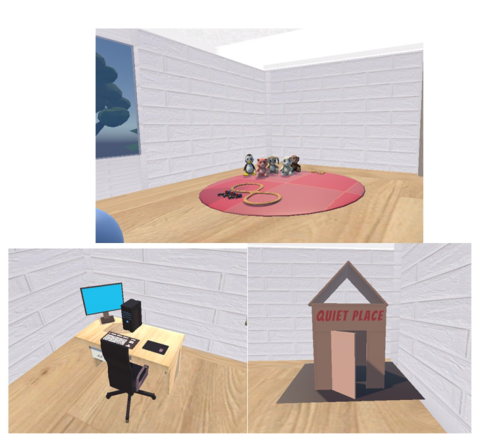
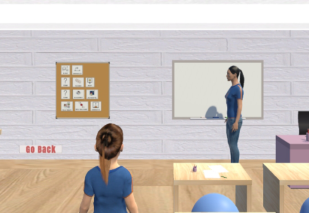
Classroom Creation The 3D classroom was created first to be an important part of the educa- tional context, through the usage of Unity tools and environment, Blender, Metahumans, etc. Not only a place for a lesson, the VR classroom type must underline functionalities as being welcoming and accommodative for its users, with different special areas created with a specific purpose: for exam- ple, a Technology, Information and Communication (TIC) workshop, an alternative and augmentative communication (AAC) workshop, a play work- shop, a retreat area, where the autistic children are able to be kept apart from all different visual stimuli inside the classroom, when needed and/or choose to use it. The next figure present views from the 3D virtual classroom, in Figure 1 being visible different corners of the room: play area, technology area and the place for reduced sensory inputs. The chosen setup underlines the need for a specific specialty and more than that, shows to the trainee what real exiting resources can be used with imagination and ease to accommodate the children.
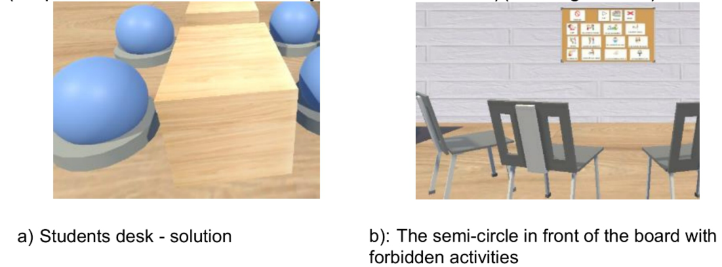
Some chairs can be replaced by therapeutic balls often used and proven to be effective in easing symptoms and assisting kids with special needs (Taipalus, Hixson, Kanouse, Wyse, & Fursa, 2017) (see Figure 2 a).
Virtual Reality for Adult Training 65
Figure 1: Workshops in the classroom.Figure 2: Specificity of furniture in the classroom.
While the teacher explains the activities to them, using images and the boards displayed on the walls or whiteboards, the children should sit in semicircle, the chairs must be previously prepared in the set-up; the teacher should repeat the explanation for each panel as many times as necessary (see Figure 2b). Images on the walls are crucial because children with this type of cognitive impediment respond more easily to them. One of the approaches that VR could help develop is the ability to rapidly use the images, put them in front of the child and disrupt the focus towards an ongoing unde- sired behaviour, not on crises situation. The time for these teacher actions should follow a rule: around 3 seconds between the starting of the undesired behaviour and the image positioning in front of the child.
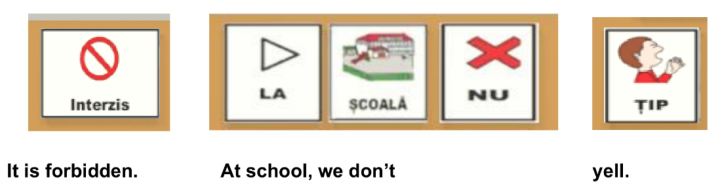
In the end, these images placed one after the other on a board can allow the teacher to create sentences using images as seen in Figure 3:
66 ¸Stefan et al.
Figure 3: Example of image-based message composition.
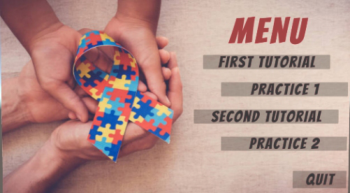
Experimental Animations Tutorials were created to demonstrate through animated picture how an action should be performed and what user-learnable functions are there to be retained. The two experimental animations and game scenarios focus on learning two aspects: to greet the children in the morning by using the images and to train the need for always pointing to each image and presenting it ver- bally, when near the board. At this point of the experimental application, the animations and game for learning functionalities can be accessed through a main menu (Figure 4):
Figure 4: Main menu.
For each practice, experimental, a set of 2 hints were created for a better understanding of the appropriate actions in the learning environment, when the actions were not completing the needed learning steps. Avatars for chil- dren and teachers were implemented (see Figure 5). Humanoids objects were also used for realizing the explicit animations for tutorials, not only for rep- resenting the users’ actions when playing “the game” of practicing teaching in the environment.
Figure 5: Avatars.
Virtual Reality for Adult Training 67
Testing and Evaluation At this point, several unit tests, integration tests, and system tests were conducted, proving the correct implementation of the experimental app functionalities. Further investigation is needed to be conducted for accep- tance testing using professionals in special educational needs teaching classes and/or other categories of education professional, for a first stage feedback related to VR usage in education.
Their feedback will additionally emphasize the value of a customized strat- egy adapted to the requirements of autistic children to enhance educational outcomes and encourage interactive and interesting learning.
CONCLUSION
The current work was conducted to identify specific possibilities to develop an adult training designated VR environment through specialized know-how, both in special needs education training and VR technology development. The work shows the potential that the VR technology is offering, in a context where, at European and global level, the need for inclusion is more than obvious and promoted at all levels and the need for training the trainees requires new technologies for broad delivery of the content. The menus and functionalities must be kept as simple as possible, for inclusion of all ages and digital abilities trainees. As presented in (Rong, Lian, & Tang, 2022), the possibility to include AI for VR development should be analysed, but critical assessment needs to be conducted on specific functionalities to be addressed through AI when specialised developmental knowledge is under discussion.
Currently, based on our research, there is no similar tool for VR train- ing for educators in this domain, but there are digital tools for using in the classroom by the autistic children (Boucenna, 2014; Khaoula & Touhami, 2018).
REFERENCES
Andreica-Sandica, B., Patca, S., Panaete, A., & Andreica, S. (2011). Impact of Autism Diagnosis on Families, in Romanian “IMPACTUL DIAGNOSTICULUI DE AUTISM ASUPRA FAMILIEI. Bucuresti. Beukelman, D. R., & Light, J. C. (2020). Augmentative & alternative communica-
tion: Supporting children and adults with complex communication needs (Fifth edition). Paul H. Brookes Publishing Co. Bondy, A. (2010). The Pyramid Approach to Education. Brighton: Pyramid Educational Consultant, Inc. Boucenna, S. (2014). Interactive Technologies for Autistic Children: A Review,
Cognit Comput, 6(4), 722–740. Doi: 10.1007/s12559-014-9276-x. Boyles, B. (2017). Virtual reality and augmented reality in education. Center For Teaching Excellence, United States Military Academy, West Point, NY, vol. 67. Crowe, B., Machalicek, W., Wei, Q., Drew, C., & Ganz, J. (2022). Augmentative
and Alternative Communication for Children with Intellectual and Developmental Disability: A Mega-Review of the Literature. Journal of Developmental and Physi- cal Disabilities, 34(1), 1–42. Retrieved from https://doi.org/10.1007/s10882-021- 09790-0.
68 ¸Stefan et al.
Elmqaddem, N. (2019). Augmented Reality and Virtual Reality in Education. Myth or Reality?, International Journal of Emerging Technologies in Learning, 14(3), 234. Elsahar, Y. H., Bouazza-Marouf, K., Kerr, D., & Mansor, A. (2019). Augmentative
and Alternative Communication (AAC) Advances: A Review of Configurations for Speech Disabled Individuals [Preprint]. ENGINEERING. European Parliament, European Council, Europeean Commission. (2023). European Declaration on Digital Rights and Principles for the Digital Decade. Official Journal of the European Union, C 23/1. European Union Council. (2021). Council Resolution on a strategic framework for
European cooperation in education and training towards the European Education Area and beyond (2021-2030) 2021/C 66/01. Offical Journal of the European Union, c (66). Fouse, B., & Wheeler, M. (2005). A Treasure Chest of Behaviour Strategies for Individuals with Autism. Arlington, Texas: Future Horizont. Khaoula, M., & Touhami, A. A. (2018). Effect of a serious game JeStiMulE in emo-
tion recognition of Moroccan autistic children. Journal of Educational, Health and Community Psychology, 7(17). Kim, S. Y. (2020). The Development and Pilot-Testing of the Autism Attitude Acceptance Scale: An Instrument Measuring Autism Acceptance. Autism in Adulthood, 2:3, 204–215. Li, L. (2017). Application of virtual reality technology in clinical medicine. Am J
Transl Res, 9(9), 3867–3880. Muraru-Cernomazu, O. (2005). Aspecte generale ale patologiei autiste. Pop, L. M. (2018). PhD Thesis, The effectiveness of alternative and augmentative means in the process communication in students with severe learning disabilities. Bucuresti. Rong, Q., Lian, Q., & Tang, T. (2022). Research on the Influence of AI and VR
Technology for Students’ Concentration and Creativity. Frontiers in Psychology, 13. Santangelo, S. L., & Tlatoanis, K. (2005). What is Known About Autism. American Journal of Pharmacogenomics, 5(2), 71–92. Doi: 10.2165/00129785- 200505020-00001. Serin, H. (2020). Virtual Reality in Education from the Perspective of Teachers.
Revista Amazonia Investiga, 9(26), 291–303. Doi: 10.34069/AI/2020.26.02.33. Snell, M., Chen, L., & Hoover, K. (2006). Teaching augmentative and alternative communication o student with severe disabilities: A review of international research 1997–2003. Research& Practice for Persons with Severe Disabilities, 31, 203–214. Taipalus, A. C., Hixson, M. D., Kanouse, S. K., Wyse, R. D., & Fursa, S. (2017).
Effects of therapy balls on children diagnosed with attention deficit hyperactivity disorder. Behavioral Interventions, 32(4). Doi: 10.1002/bin.1488. N. Turcan. (2018). Actualitatea si importanta programelor de formare continua a cadrelor didactice. Materialele Conferin¸tei Republicane a Cadrelor Didactice, (pp. 225–229). Vornholt, K., Uitdewilligen, S., Nijhuis, F. (2013). Factors Affecting the Acceptance
of People with Disabilities at Work: A Literature Review. J Occup Rehabil, 23, 463–475. Zapata, M. A., & Worrell, F. C. (2023). Disability Acceptance and Affirmation Among U. S. Adults With Learning Disabilities and ADHD. Journal of Learning Disabilities.
LISTED IN THE AHFE DIGITAL BOOKSTORE CATALOGUE
Explore the complete digital volume
Augmented, Virtual and Mixed Reality Simulation
Read this individual research paper free through the original publisher, or explore the full digital proceedings book.
ISBN 978-1-958651-94-0
Explore this ISBN in the AHFE Bookstore ↗Listed in the July 2026 bookstore catalogue; search by ISBN to confirm current availability · Digital book purchase optional