Yun-hwan Lee, Jongbae Kim, Yeong-hun Kwon, Hyo-jun Lee, Yohan Ko, Yebon Kim, Soyeong Park, Daehoon Son, Jongsung Kim (2023). Physical human factor for the development of universal XR platform to build a metaverse supporting digital inclusive leisure & culture. In: Augmented, Virtual and Mixed Reality Simulation. AHFE Open Access, vol. 118, pp. 80–87. https://doi.org/10.54941/ahfe1004443
Leisure refers to non-obligatory activities that are driven by intrinsic motivation allowing individuals to freely allocate their time based on personal interests including sports, culture, and artistic engagement. Participation in leisure activities is one of the important factors that affect an individual's well-being, including the management of physical and mental health, the ability to cope with stress, and the improvement of quality of life. According to a 2021 survey (10,000 people over 15 years old) by the Ministry of Culture, Sports and Tourism of South Korea, approximately 80% of respondents continue to engage in sports, hobbies, and entertainment activities, and the trend is increasing every year. The government of South Korea is carrying out policies to guarantee fundamental rights to leisure and culture and improve their quality of life. Koreans’ interest in leisure and cultural activities is steadily increasing. Thus, the government is striving to promote the health and well-being of its citizens by implementing policies to guarantee these rights.Metaverse has recently emerged as a future industry. Various digital contents based on the metaverse are emerging to provide leisure services such as exercising, playing games, and watching performances. South Korea is also introducing the metaverse to public services including the cultural sector, to provide universal public services to people. Recently, there has been a growing interest in XR (eXtended Reality) technology, which encompasses immersive technologies such as VR (Virtual Reality), AR (Augmented Reality), and MR (Mixed Reality). This can increase the sense of immersion and realism, so users can have an experience that is very similar to reality through the fusion of XR technology and the metaverse space.However, the current metaverse users in South Korea are overly concentrated in their teens and 20s. In addition, there is a limited amount of content that spans different generations. This is a major obstacle to the universalization of the metaverse for the public and the development of related industries. Moreover, since Korea entered an aging society, the number of elderly people has been steadily increasing every year. This trend can lead to societal problems such as digital exclusion and digital illiteracy. As the aging process progresses, human physical and cognitive functions deteriorate rapidly, which can significantly limit the adaptation and utilization of rapidly evolving technologies. To build a metaverse space that is universally accessible to everyone, it is necessary to take into account the differences in physical and cognitive functions that occur due to aging.Based on the requirement, we are currently developing an XR technology-based metaverse platform and content that allows juniors and seniors to enjoy leisure activities together. The research consists of the development of a metaverse platform based on XR technology, three types of sports (bowling, golf, walking), and three types of games (puzzle, escape, adventure). First, utilizing related devices such as head-mounted displays (HMDs), log data, and Unity plugin-based acquisition technology, we acquire user data related to physical and cognitive abilities while performing six types of content. Subsequently, we will apply data mining techniques to extract significant characteristics in physical and cognitive abilities between junior and senior generations. Finally, we aim to define relevant human factor parameters by analyzing intergenerational differences in these features. The extracted human factor parameters are used in the process of correction and augmentation of intergenerational differences in physical and cognitive abilities.In this study, we aim to provide a detailed description of the concept and process of our ongoing research and introduce our research future directions. In particular, we focus on the human factor extraction process related to six types of content.
Leisure refers to non-obligatory activities that are driven by intrinsic moti- vation allowing individuals to feely allocate their time based on personal interests including sports, culture, and artistic engagement (Boop et al., 2020). Participation in leisure activities is one of the important factors that affect an individual’s well-being, including the management of physical and mental health, the ability to cope with stress, and the improvement of quality of life (Yu et al., 2021).
According to a survey (10,000 people over 15 years old) by the Min- istry of Culture, Sports and Tourism of the Korea, approximately 80% of
Physical Human Factor for the Development of Universal XR Platform 81
respondents continue to engage in sports, hobbies, and entertainment activ- ities, and the trend is increasing every year (Ministry of Culture, Sports and Tourism, 2023). The government of the Korea is carrying out policies to guarantee fundamental rights to leisure and culture and improve their qual- ity of life (Lee, 2021). Koreans’ interest in leisure and cultural activities is steadily increasing. Thus, the government is striving to promote the health and well-being of its citizens by implementing policies to guarantee these rights.
Metaverse has recently emerged as a future industry. Various digital con- tents based on the metaverse are emerging to provide leisure services such as exercising, playing games, and watching performances. Korea is also introducing the met averse to public services including the cultural sector, to provide universal public services to people (Lee, 2021). Recently, there has been a growing interest in XR (eXtended Reality) technology, which encompasses immersive technologies such as VR (Virtual Reality), AR (Aug- mented Reality), and MR (Mixed Reality) (Lee, 2019). This can increase the sense of immersion and realism, so user can have an experience that is very similar to reality through the fusion of XR technology and the metaverse space.
However, the current metaverse users in Korea are overly concentrated in their teens and 20s (Korea Creative Content Agency, 2021). In addition, there is a limited amount of content that spans different generations. This is a major obstacle to the universalization of the metaverse for the public and the development of related industries. Moreover, since Korea entered an aging society, the number of elderly people has been steadily increasing every year (Korea Statistics, 2022). This trend can lead to societal problems such as dig- ital exclusion and digital illiteracy. As the aging process progresses, human physical and cognitive functions deteriorate rapidly, which can significantly limit the adaptation and utilization of rapidly evolving technologies. To build a metaverse space that is universally accessible to everyone, it is necessary to consider the differences in physical and cognitive functions that occur due to aging.
We are currently developing an XR technology-based metaverse platform and content that allows juniors and seniors to enjoy leisure activities together. The research consists of the development of a metaverse platform based on XR technology, three types of sports (bowling, golf, walking) and three types of games (puzzle, escape, adventure). First, we acquire user data related to physical and cognitive abilities while performing six types of content. Subse- quently, we will extract significant characteristics in physical and cognitive abilities between junior and senior generations. Finally, we aim to define rel- evant human factor parameters by analysing intergenerational differences in these features.
In this study, we aim to provide a detailed description of the concept and process of our ongoing research and introduce our research future directions. In particular, we focus on the physical human factor extraction process in three types of sports (bowling, golf, and walking).
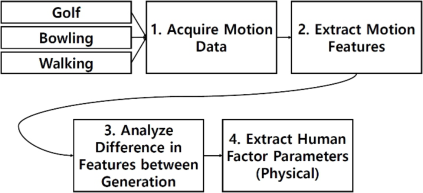
FRAMEWORK FOR EXTRACTING HUMAN FACTOR PARAMETERS RELATED TO PHYSICAL FUNCTION Currently, we are in the early stages of developing an XR platform and conducting research to extract human factor parameters related to physical function. Therefore, we aim to primarily focus on the process of extract- ing human factor parameters related to body movements in this study, and the framework for this is illustrated in Figure 1. First, various devices such as HMDs and trackers, Unity plugin-based software, and Steam VR contents utilized to acquire motion data. Motion data be acquired from healthy senior and junior generations. Second, Data mining techniques applied to extract intergenerational body motion characteristics based on the acquired data. Thirdly, significant human factor parameters extracted related to the physical function during the performance of the three types of sports by analysing the differences in the characteristics of motion data between generations. These results will be utilized in the subsequent stages of correction and augmenta- tion, ultimately aiming to allow each generation to overcome differences in physical abilities and enjoy leisure activities within the XR platform.
Figure 1: Framework for extracting human factor parameters (physical).
COMPOSITION AND SCOPE OF SPORTS CONTENTS According to a leisure activity survey conducted by the Ministry of Culture, Sports, and Tourism of Korea, the primary leisure activity for the citizens is walking excluding watching the TV and OTT Contents. Additionally, a significant portion of the people continuously engage in sports activities (Ministry of Culture, Sports and Tourism, 2023). Bowling is an indoor sport that anyone of any age can easily participate in. So, it is considered a pop- ular sport in Korea and interest is continuously increasing (Byun and Yoon, 2022). Golf known for its environmentally friendly nature is experiencing a significant influx of young generations in Korea and is gradually becoming a more popular and mainstream sport (Lee and Lee, 2022). Therefore, walking, bowling, and golf adopted to create content that can be enjoyed by various generations and align with the current trends in Korea.
MOTION DATA ACQUISITION Devices and Experimental Setup
VR devices and Steam VR content were utilized to acquire data for the three types of sports within virtual reality. The Head-mounted Display (VIVE pro
Physical Human Factor for the Development of Universal XR Platform 83
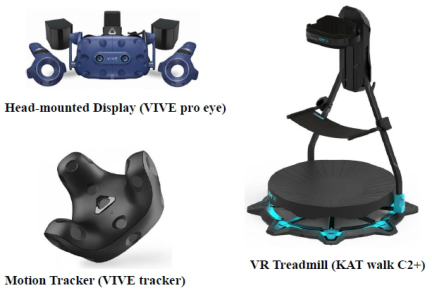
eye, HTC) used provides a refresh rate of over 90fps, a field of view of 110 degrees, and a resolution of 1440x1600 per eye. VIVE Controllers are used to enable interaction within the virtual environment. Also, VR treadmill (KAT WALK C2+, KAT VR) is used to obtain 2D coordinate values during walking (see Figure 2).
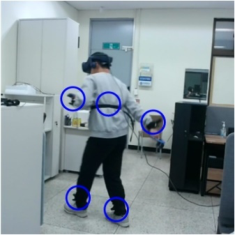
Figure 2: VR devices and location of tracker attachment.
A total of five trackers (VIVE tracker, HTC) attached on the wrist, foot, and trunk to acquire real-time 3D coordinates of rotation and position values during performing activities in the virtual environment (see Figure 2). The acquired 3D coordinates will be subsequently transformed into motion data by the researchers.
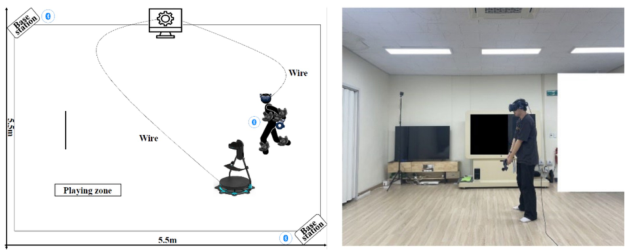
In order to collect motion data, experimental environment established within a controlled setting. An empty space ensured to elimination of motion- sensing errors caused by the occlusion of the surrounding object. For the motion detection, two base stations were positioned diagonally at a height of 2 meters and with a 110-degree angle from the participant. Bowling requires enough space to perform swing and steps. The 4-step approach is the most preferred during swing phases as it provides body stability (Kim, 2015). 1 male who matched the average height of men in Korea (175cm) and instructed him to perform steps and swings based on the 4-step approach (Size Korea, 2022). Through this process, we determined the required space size (5.5m x 5.5m) (see Figure 3).
Unity Based Motion Data Acquisition Software Objects for multiple trackers linked were created using Open XR SDK in the Unity environment to extract the position and rotation values of major body segments (hands, feet, trunk). A red cube-shaped object was created and tagged for each location of the five trackers attached in unity after linking the HMD. Subsequently, the linking of movements with the trackers and data acquisition was confirmed by performing the bowling (swing, steps). The position and rotation value of each tracker attachment point can be obtained through the logs (see Figure 4). This will be expanded to include golf and
walking in the future. Furthermore, we are conducting research to acquire motion data in.csv format as well as logs. And also aim to label the acquired data according to the key segments of each activity.
Figure 3: Experimental setup for motion data acquisition.Figure 4: position and rotation data of moving objects through the tracker.
Experimental Protocol for Data Acquisition The experiment to collect data will be conducted with 80 participants from the local community. Participant groups were distinguished through opera- tional definitions. The groups were divided into senior and junior groups, with 40 years old as the dividing point taking into consideration that the current median age in Korea is 45 (see Table 1) (Korea Statistics, 2022).
Table 1. Operational definition of participants group.
Table available in the original PDF paper.
Group Range of age N Junior 12 ∼19 20 20 ∼39 20 Senior 40 ∼59 20 60 over 20
Physical Human Factor for the Development of Universal XR Platform 85
Individuals with musculoskeletal disorders, cognitive impairments, or those who have difficulties using VR equipment due to vestibular system damage are excluded.
The experiment is conducted within the devices and environment presented in Figure 2 and Figure 3. Prior to the experiment, the researchers explain the purpose of the study to the participants and confirm their consent to par- ticipate. Researchers will explain the movements intended to be measured to the participants and provide them with approximately 10 minutes of practice time (see Table 2).
After practicing, the subject wears the device and performs the sport within Steam VR content. At this time, the positions and rotation values of the shoulders, arms, and trunk sensed by the trackers are stored within the data acquisition software. After performing the activities, the participants take off the devices and the study concludes.
FEATURE EXTRACTION AND DIFFERENCE ANALYSIS OF MOTION DATA TO DERIVE HUMAN FACTOR PARAMETERS Data mining techniques are applied to extract motion features between junior and senior on each activity. The data obtained through the experiments for each activity are labeled according to the detailed motion (see Table 2). The acquired rotation and positional values are transformed into motion data, and statistical analysis is conducted to identify significant features. Various classification techniques including decision trees are applied to create models for extracting motion features between junior and senior. and then the model with the highest accuracy is selected. Subsequently, the differences in motion features during performing activity are analysed to derive the physical human factor parameters that require correction and augmentation.
CONCLUSION
There is a continuous increasing in interest in the leisure and culture of the citizens in Korea. In post-COVID-19, various untact interaction-based dig- ital contents that minimize face-to-face engagement and allow individuals to enjoy leisure activities have been emerging. Also, the demand and sup- ply for extended reality beyond virtual reality is increasing. We are currently
developing an XR technology-based metaverse platform that allows every- one to enjoy leisure and culture beyond generational differences in physical and cognitive ability. To achieve this, research on human factor parameters is being conducted within the 3 sports content (Bowling, golf, and walking) to derive the differences in physical ability between juniors and seniors. First, three sport contents were adopted considering the recent trends in Korea. Secondly, VR equipment and Unity-based software will be utilized to acquire motion data for the three sports contents across different generations. For this purpose, an experimental environment and protocol were established. Thirdly, the acquired data will be used to create models based on classifi- cation algorithms to extract the features of intergenerational differences in physical abilities. We plan to analyse the differences in generational abilities based on the extracted features and derive the relevant human factor parame- ters that should be considered during the performance of the 3 types of sports. As this research is still in the early stages, we primarily focused on describ- ing the concept of process to derive physical human factor parameters in this paper. we intend to expand this process to extract cognitive parameters that should be considered when performing types of games (puzzle, escape, and adventure) in the future.
ACKNOWLEDGMENT
This research was supported by Culture, Sports and Tourism R&D Program through the Korea Creative Content Agency grant funded by the Ministry of Culture, Sports and Tourism in 2023 (Project Name: Development of univer- sal XR platform technology to build a metaverse supporting digital cultural inclusion, Project Number: RS-2023-00270006, Contribution Rate: 100%).
REFERENCES
Boop, C., Cahill, S. M., Davis, C., Dorsey, J., Gibbs, V., Herr, B., Kearney, K., Metzger, L., Miller, J. & Owens, A. (2020). Occupational therapy practice framework: Domain and process fourth edition. AJOT: American Journal of Occupational Therapy, Volume 74, pp. 1–85. Byun, H. J., Yoon, J. W. (2022). Analysis of interest in bowling using internet por-
tal search term statistics. The Korean Journal of Physical Education, Volume 61, Number 5, pp. 267–274. Kim, S. D. (2015). Kinematic analysis of the step-type when bowling throwing motion. The Korea Journal of Sports Science, Volume 24, Number 6, pp. 1517–1528. Korea Creative Content Agency. (2021). Research on content usage trends in the
digital transformation. https://welcon.kocca.kr/ko/info/trend/1951143 Korea Statistics. (2022). Statistics on the aged. https://kostat.go.kr/board.es?mid= a10301010000&bid=10820&tag=&act=view&list_no=420896&ref_bid Lee, B. K. (2021). The metaverse world and our future. The Journal of the Korea
Contents Association, Volume 19, Number 1, pp. 13–17. Lee, H. W., Lee, J. E. (2022). A study on changes in golf lesson perception using big data analysis: Based on COVID-19, Volume 61, Number 4, pp. 161–175.
Physical Human Factor for the Development of Universal XR Platform 87
Lee, K. T. (2019). Trends of XR (eXtended Reality) convergence technology. The Journal of Korean Institute of Communications and Information Sciences (Infor- mation and Communications Magazine), Volume 37, Number 10, pp. 17–22. Ministry of Culture, Sports and Tourism. (2023). 2022 National Leisure Activ-
ity Survey. https://www.mcst.go.kr/kor/s_policy/dept/deptView.jsp?pSeq=1898& pDataCD=0406000000&pType= Size Korea. (2022). The 8th Korean Anthropometric Survey. https://sizekorea.kr/h uman-info/meas-report?measDegree=8 Yu, J., Mock, S. E. & Smale, B. (2021). The role of health beliefs in moderating
the relationship between leisure participation and wellbeing among older Chinese adults. Leisure Studies, Volume 40, pp. 764–778.
LISTED IN THE AHFE DIGITAL BOOKSTORE CATALOGUE
Explore the complete digital volume
Augmented, Virtual and Mixed Reality Simulation
Read this individual research paper free through the original publisher, or explore the full digital proceedings book.
ISBN 978-1-958651-94-0
Explore this ISBN in the AHFE Bookstore ↗Listed in the July 2026 bookstore catalogue; search by ISBN to confirm current availability · Digital book purchase optional