Fariri Khalid, Hraira Thami, Ettaki Jalal, Doumi Khalid, Maaroufi Manal, Belghyti Driss, Ghizlane Ztit, Khadija El Kharrim (2024). Statistical assessment of physico-chemical pollution of Sebou river in Mechraa Bel Ksiri, Morocco. In: Intelligent Human Systems Integration (IHSI 2024): Integrating People and Intelligent Systems. AHFE Open Access, vol. 119, pp. 314–323. https://doi.org/10.54941/ahfe1004495
The pollution of groundwater and surfaces is a major problem around the world. In Morocco due to population growth, industrial, agricultural and climate change the country is currently experiencing water stress (less than 1000 m3 / inhabitant / year) and is expected to experience a water shortage in 2025 (less than 500 m3 / inhabitant / year). In addition, according to the WHO, around 30,000 people per day, approximately 10 million per year, die due to insufficient or poor qualities water supply and deplorable hygienic conditions (WHO, 1977).The Sebou basin is located in the western region of Morocco, which is a very important agricultural area and therefore experiences high pollution. The aim of this study is to carry out an updated survey on the pollution of the Sebou by Urban, Agricultural and Industrial activities. To achieve this objective, several series of samples of the Sebou waters and their physicochemical analyses were carried out (pH, Ca++, Na+, Mg++, Cl-, SO4--, NO3-, BOD5, COD ...).To verify the hypothesis of pollution of the Sebou river by domestic and industrial wastewater and by its tributaries, we compared its physico-chemistry with those of the two main rivers, namely the Oued Beht and the Oued Ouergha. The results show that Oued Sebou is very loaded with salts (10581 µs / cm or 11g / L). On the other hand, the waters of Oued Beht are less polluted by nitrates (14.34 mg / L) and sulphates (51.51 mg / L) but more loaded with Potassium (55.87 mg / L) and Magnesium (107.62 mg / L). Finally, the waters of Oued Ouergha are even cleaner than other rivers.
Physical, chemical, and biological characteristics characterize water quality, but so does its use. Thus, unfit for human consumption water can be repur- posed for irrigation, fish farming, or cooling industrial circuits (Boutin and Dias, 1987; Abouzid and Outair, 1991; Benyakhlef, et al. 2011). For local decision-makers to adopt a fair policy that takes into account the importance of this resource and the difficulty of growing water resources, the sensible
Statistical Assessment of Physico-Chemical Pollution of Sebou River 315
management of water resources in the Kenitra Gharb region has emerged as the primary concern.
The Oued Sebou (Sebou River) and its tributaries provide 34,000km2 of drainage. It began as Oued Guigou and stretches over 600km, starting in the Middle Atlas.
Its 35km-long estuary empties into the Atlantic Ocean in Mehdia, Kenitra. The guard dam, which is situated directly downstream of Sidi Allal Tazi, stops the rise of marine waters. (ORMVAG, 1994).
Furthermore, a multitude of pollutant discharges from diverse sources occur in the Sebou river. The Sebou watershed is among the most impacted places in Morocco and is a highly significant area from a socioeconomic per- spective. The primary reasons for the decline in the quality of Sebou waters are the presence of two of the nation’s principal agricultural plains (The Gharb Plain and the Sais Plain), as well as the quantity and variety of indus- trial facilities and urban wastewater effluents in the basin’s major cities (Fez, Meknes, Mechraa Bel Ksiri, Dar Gueddari, and Kenitra), not to mention the careless disposal of household waste.
The aim of this study is to investigate the physic-chemical surface water of the Lower Sebou sub-basin, which is located between Kenitra and Mechraa Bel Ksiri. Monitoring the pH, electrical conductivity (EC), ammonium, sodium, potassium, magnesium, calcium, bicarbonate, chloride, sulphate and nitrates are the methods used to characterize the amounts and concentrations of the organic and mineral loads of Sebou raw water.
MATERIALS AND METHODS
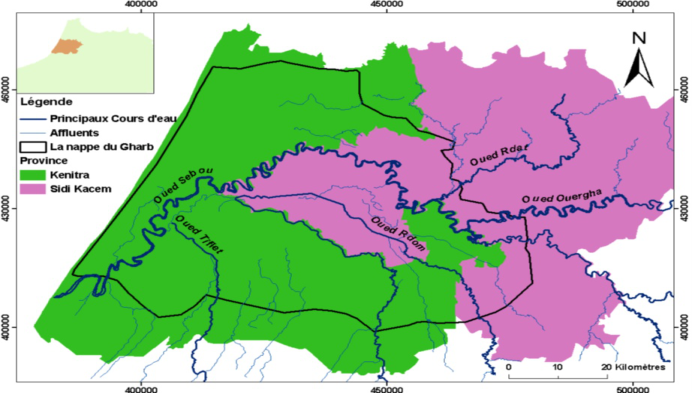
Study Area The Gharb region, delineated by the pre-Rif hills to the north, the Maâmora plateau to the south, and the Atlantic Ocean to the west (see Figure 1), encompasses a diverse geographical composition. This includes the central alluvial plain of the lower Sebou, the primary Oued (river), continental boundaries, and a coastal zone characterized by dune cordons, flooded depressions, and internal dunes. The Sebou Basin, situated between the Fez-Taza corridor in the east, the Atlantic Ocean in the west, the Rif in the north, and the Middle Atlas and the Meseta in the south, spans an approximate area of 38380 km2. As the most significant basin in the coun- try, it is home to approximately 5.73 million inhabitants, with a slight majority (51%) residing in rural areas and the remainder (49%) in urban locales. The region’s economy, primarily driven by industrial and agricul- tural sectors, plays a substantial role in bolstering the country’s economy (see Figure 2).
The entire basin is characterized by a Mediterranean climate, influenced by oceanic elements, although the climate within the basin progressively assumes a more continental nature. Industrial activity within the Sebou basin is notably advanced, with large-scale units such as the textile sector, cement plants, oil refineries, tanneries, sugar, paper, and oil mills contributing significantly to the basin’s economy.
The procedure of water sample extraction is a delicate process that requires meticulous care due to its impact on the interpretation and analytical results. For a sample to be deemed representative, it should ideally be homogeneous and should not alter the physicochemical properties of the water, including dissolved gases and suspended particles (Rodier, 1996).
Sampling equipment necessitates specific attention. The nature of the intended analyses dictates the cleaning procedures for the flasks. Instant sam- pling is the most commonly employed technique for sample collection. The vials are filled without agitating the water and, in some instances, without exposure to air (ONEP, 1998; Belghyti et al., 2013).
Figure 1: Localization of sebou river and gharb basin.
Statistical Assessment of Physico-Chemical Pollution of Sebou River 317
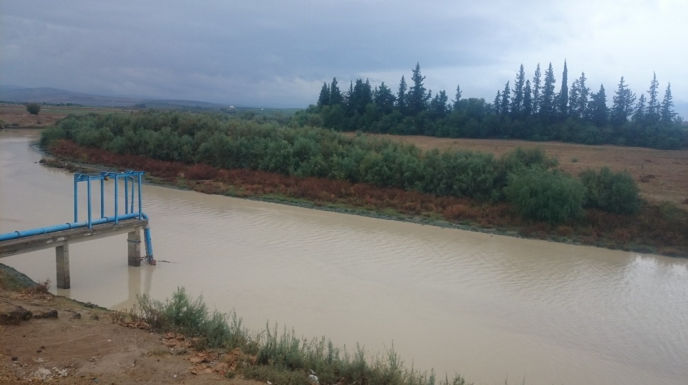
Figure 2: Sebou river and sampling area.
Study Method Sampling Waters Initially, polyethylene bottles with a capacity of 1000 ml were cleansed using distilled water, subsequently filled with water samples from the field. Sam- pling was conducted in areas with both flowing and non-stagnant water. To minimize contamination and prevent changes in the sample, a total immer- sion technique was employed, ensuring the bottles were filled to the brim, devoid of air bubbles. The collected water samples were transported to the laboratory in portable coolers, maintaining a low temperature of 4
C for analysis. Moreover, for consistency, samples were gathered from the same station, approximately at the same time and location, throughout the campaigns.
The present study conducted an examination of the following parame- ters: pH, electrical conductivity (EC), calcium (Ca++), magnesium (Mg++), sodium (Na+), potassium (K+), carbonate (CO3--), bicarbonate (HCO3-), chlorides (Cl-), sulphates (SO4--), ammonium (NH4+), and nitrate (NO3-). The instruments utilized for these assays included a C831, a Jenway flame photometer, a NOVASPEC II pharmacy-grade spectrophotometer, and a UV- Visible spectrophotometer (Benkabbour, 2002; Bentouati and Bouzidi, 2011; Martini et al. 2012; El Hammoumi and Belghyti, 2012).
The determination of carbonates and bicarbonates is achieved by utiliz- ing a 0.02N sulfuric acid solution, with phenophthalein and bromocresol green serving as color indicators.
The quantification of combined chloride in its chloride state is facili- tated by the use of silver nitrate in the presence of a potassium chromate solution.
The concentrations of calcium and magnesium are ascertained through complexometric titration with EDTA, using Eriochrome black T as an indicator.
The determination of nitrates and ammonium ions is carried out via dis- tillation, employing magnesium oxide and DEVARDA alloy as catalysts, respectively.
The measurement of sulfates is conducted through colorimetry, precipi- tating sulfate ions as barium sulfate in a hydrochloric acid medium using barium chloride. Following the collection of NH4+ and NO3−ions in a boric acid solution, H2SO4 is utilized in the subsequent analysis.
RESULTS AND DISCUSSION
Several physicochemical parameters were assessed to gauge the level of pollu- tion in the raw water of the lower Sebou. This evaluation, conducted during our internship at the Regional Office of Implementation Agricultural Value of Kenitra, serves to enhance the foundational data collected on the Sebou basin and provides a clearer understanding of its pollution levels.
Tables 1 and 2 suggest that the lower Sebou River subbasin is susceptible to various types of pollution. The primary sources of this pollution are natural, predominantly mineral-based (stemming from the dissolution of the natural substrate and Atlantic tides), and anthropogenic, which includes agricultural, industrial, and urban pollutants.
The thermal regime of the Sebou hydrographic network mirrors the Mediterranean’s, with lower temperatures in November and higher temper- atures in June. The water, after traversing the basin’s defining limestone and marl-limestone soils, possesses an alkaline pH that oscillates between 8.1 and 8.78, as indicated in Tables 2, with no significant variations (see Table 3). Tables 1, 2, and 3 illustrate that mineralization is directly proportional to levels of salinity, chloride, dissolved salt, sodium, and potassium. The pri- mary causes of this mineralization are the leaching of karstic limestone, the presence of kelp-like terrain, and the impact of ocean spray. According to AH (1996), Hilali (2002), and Akhiar (2009), the electrical conductivity (EC), a
Statistical Assessment of Physico-Chemical Pollution of Sebou River 319
measure of salinity, ranges from 628µs/cm to 22761µs/cm (see Table 1). This range significantly exceeds Morocco’s standard for irrigation water, which is greater than 2700µs/cm.
Table 1. Cations and other physical-chemical information on the lower Sebou’s raw waters.
There is a paucity of hydraulic and hydrological studies pertaining to Moroc- can rivers. The current study proposes a characterization of the physico- chemical properties of surface water in the lower Sebou subbasin of Kenitra. The raw waters of the Sebou were subjected to physico-chemical analysis,
revealing a high concentration of organic and mineral materials. The chemi- cal composition exhibited significant variability, with electrical conductivity (EC) ranging from a minimum of 628µS/cm to a maximum of 2371µS/cm. The pH values averaged between 8,10 and 8.78, indicating a slightly basic nature, yet remaining suitable for irrigation purposes.
In terms of surface water quality, the water was classified as poor qual- ity in 35% of cases and medium grade in 65% of cases. The concentration of ammonium varied between 0.05mg/L and 2.67mg/L. Nitrate (NO3-) concentrations spanned from a minimum of 0.25mg/L to a maximum of 886.80mg/L. Furthermore, the concentration of chloride ions (Cl-) was found to range from 145.56mg/L at its lowest to 476.42mg/L at its highest.
Table 3. Physico-chemical characteristics of the waters of Sebou river.
Table available in the original PDF paper.
Stations T
C pH CE µs/cm COD mg/L NTU Cl- mg/L Salinity g/L TH
The concentrations of sulfate ions (SO42−) in the water range from a maximum of 359.28mg/l to a minimum of 37.63mg/l. The bicarbonate ion concentrations adhere to the irrigation standard, with values ranging from a maximum of 362.35mg/l to a minimum of 75.65mg/l. The calcium ion (Ca2+) content varies between 220.5mg/L and 97.7mg/L. The magnesium ion (Mg2+) concentrations comply with the irrigation standard, with a max- imum value of 124.09mg/L and a minimum value of 17.29mg/L. Sodium ion (Na+) concentrations in the water range from 2540mg/L to 52mg/L, while potassium ion (K+) concentrations in surface waters vary from 17.56mg/L to 2.55mg/L.
Statistical Assessment of Physico-Chemical Pollution of Sebou River 321
This study’s findings indicate that despite the high mineral load, the waters of the lower Sebou remain within the Moroccan irrigation standards. However, the waters of the Sebou are heavily polluted. Therefore, it is rec- ommended to properly treat all residential and commercial wastewater to mitigate its adverse effects on the local ecosystem and compensate for the loss of this valuable water resource.
The waters of the Lower Sebou sub-basin contain significant concentra- tions of nitrates and sulfates, which are introduced into the water stream through runoff and leaching of nitrogenous and phosphorus fertilizers and phytosanitary products due to nearby agricultural activities (Nisbet and Verneaux, 1970; Laferriere et al. 1996; ONEP, 1999). The distribution of physicochemical characteristics upstream and downstream suggests a decrease in salt and chloride levels in the water due to the influx of marine saline waters.
While this study has highlighted the poor quality of the waters in the lower Sebou, it is not comprehensive. Further investigation is needed, including analyses of pesticides and trace heavy metals, to provide decision-makers with the necessary scientific and technological basis (OMS, 1986; MATUHE, 2001; ABH, 2011).
ACKNOWLEDGMENT
The authors acknowledge all people from ORMVAG who have aided in accomplishing the analysis.
REFERENCES
A. B. H. S. (2011): Etude d’actualisation du plan directeur d’aménagement integer des resources en eau du basin hydraulique du Sebou. Note de synthèse, Septembre 2011, Agence du Bassin Hydraulique du Sebou, Fès, Maroc. Abouzid, H. et Outair, A. (1991): Les Nitrates dans les eaux, 7ème Congrès Mondial
des ressources en eau, Rabat, Maroc, 13–18 Mai 1991, Volume 2. Administration Hydraulique (AH) (1996): Etat de la qualité des ressources en eaux dans le bassin du Sebou, année 1989-1990, Ministère des Travaux Public, de la Formation Professionnelle et de la Formation des Cadres. Akhiar, S. 2009 : “Caractérisation des eaux souterraines de la ville de Mechraa Bel
Ksiri”. Mémoire Master Eaux usées. Université Ibn Tofail, Kénitra. Alemad, A., Nagi, M., Ibeda, A., Nasser, R., Alwathaf, Y., Elrhaouat, O., Elkharrim, K., Babaqi, A., Belghyti, D. (2013): The impact of sana’a solid waste on the quality of groundwater in Yemen, 2nd Intemational Conference on Water and Society, 4 - 6 September 2013, New Forest, UK, Paper DOI: 10, 2495/WS130151. Belghyti, D., Daifi, H., Alemad, A., Elkharrim, K., Elmarkhi, M., Souidi, Y., Benel-
harkati, F., Joti, B., Elmoukrifi, Z., Ibeda, A., Azami-Idrissi, Y., Baroud, S., Elkhayyat, F., Elrhaouat, O., Sadeq, S., Taboz, Y., Sbai, H., Naser, R., Chigger, H., Derwich, N., 2013: Groundwater management for sustainable production of drinking water quality in Maamora, 2nd International Conference on Water and Society, 4 - 6 September 2013, New Forest, UK, 2013, Vol 178, pp. 242–254, doi:10.2495 / WS130201, 2013.
Benkabbour, B. : ≪Exploration, évaluation et protection des ressources hydriques en zones côtiers Marocaines : Approche Géophysique, Hydro chimiques, modéli- sation et S. I. G : Cas de la Maàmora occidentale (Bassin du Rharb-Maàmora) ≫. Thèse de Doctoral National, (2002), Université Ibn Tofail. Bentouati, L. et Bouzidi, A. : étude de la qualité des eaux souterraines de la wilaya
de Sétif, algésaire, (2011). Journal Scienceslip. Benyakhlef, M., Naji, S., Belghyti, D., Elguamri, Y. et Hassouni, T. : Qualité de l’eau de boisson dans la région du Gharb (Kénitra, Maroc) (2011). Boutin, C., Dias, N. : ≪Impact de l’épandage des eaux usées de la ville de Marrakech
sur la nappe phréatique≫, Bull. Fac. Sci. Marrakech (Sect. Sci. Vie), 3 (1987). pp. 5–25. Coyne, M. S. and Howell, J. M. : ≪Agricultural Impacts on Fecal Contamination of Shallow Groundwaters in the Bluegrass Region of Kentucky≫, Soil Science News and Views, 15 (6) (1994), pp. 1–3. El Bouqdaoui, K., Aachib, M., Blaghen, M., et Kholtei, S. : Modélisation de la
pollution par les nitrates de la nappe de Berrechid, au Maroc, (2009). El Hammoumi, T.et Belghyti D., 2012 : Caractérisation physicochimique des eaux potables Produit Par la station de traitement de Mkansa (Maroc, 2012). Hilali, M. 2002 : Hydrogéologie et modélisation de l’intrusion marine dans les
aquifères côtiers de Martile et de sahel- Maroc”. Thèse de Doctorat en Sciences Appliquées. Université. Mohammed V-Agdal, Ecole Mohammedia d’ingénieurs, 158p. Krira Chakour, A. B. et Fouta, H. : ≪Intensification de l’agriculture et son impact sur l’environnement. Cas des nitrates dans la nappe phréatique de M’nasra du Ghab≫, Actes 1er Colloq. Sur le Développement agric. Rech. Agron. Au niveau de la région du Ghab, (2001). Laferriere. M, Minville, J. J., Lavoie J., et Payment, P. : ≪L’industrie porcine et les
risques reliés à la santé humaine ≫, Bull. Information Santé Environnem, Québec, 7 (2) (1996) 1–4. Matini, L., Moutou, J. M. et Kongo-Mantono, M. S. : Evaluation hydro-chimique des eaux souterraines en milieu urbain au Sud-Ouest de Brazzaville, Congo, (2012). Matuhe, 2001 : Rapport sur l’Etat de l’Environnement du Maroc (REEM), Ministère
de l’Aménagement du Territoire, de l’Eau et de l’Environnement, Département de l’Environnement, Observatoire National de l’Environnement du Maroc (ONEM), Octobre, Ed, 2 (2001) 296. MPCI, 2005, Impact environnemental de l’usage des eaux usées d’assainissement dans l’irrigation des agricultures, ministère de la planification et de la coopération internationale, juillet 2005. Nisbet, M. et Verneaux J., 1970: Composantes chim- iques des eaux courantes : discussion et proposition de classes en tant que bases d’interprétation des analyses chimiques, Annal Limnol, 6, 2. O. N. E. P 1998: Méthodologie d’analyse de l’eau au laboratoire. Mode opératoire: Contrôle de la pollution des eaux destinées à l’alimentation en eau potable. (1998). O. N. E. P, Alimentation en eau potable, Menaces de pollution. (1999). Organisation Mondiale de la Santé (O. M. S.), ≪Charte d’Ottawa pour la promotion
de la santé≫, Copenhagen : Bureau régional de l’Europe, (1986). ORMVAG, Office Régional de mise en Valeur Agricole Gharb Maroc : Etude pédologique au 1/20 000 de la Troisième Tranche d’Irrigation (TTI) sur une super- ficie de 100.000 ha. Zone M’nasra, Z1-Z2. Kénitra, Maroc, Rapport inédit, (1994), 180 p.
Statistical Assessment of Physico-Chemical Pollution of Sebou River 323
Rodier, J.1996: ≪L’analyse de l’eau: eaux naturelles, eaux résiduaires, eau de mer: physico-chimie, bactériologie et biologie ≫, Ed. Dunod, Paris, France, 8 (1996) 1383p. Saadi, Z, Maaslouhi, A. Zeraouli, M. et Gaudet, J. P : ≪Analyse et modélisation des
variations saisonnières des concentrations en nitrates dans les eaux souterraines de la nappe Mnasra, Maroc ≫, C. R. Acad. Sci., Sér. 2, Sci. Terre Planètes, 329 (8) (1999), pp. 579–586. Secrétariat d’Etat chargé de l’Environnement, ≪Etude pour programme d’action visant à minimiser et à contrôler l’impact des engrais et des pesticides sur l’environnement du bassin de Sebou ≫, PPES (Projet de l’environnement du Sebou), Secrétariat d’état chargé de l’environnement, (Maroc), (1999), 43p. Zeraouli, M. : ≪Pollution par les nitrates. Premiers résultats de la situation actuelle
dans la nappe des Mnasra (décembre 1992-janvier 1993) ≫, Office régional de mise en valeur agricole du Gharb, Département de développement agricole, Ser- vice des études de développement agricole, Bureau Agro-Pédologique, Publication interne ORMVAG, septembre, (1993). Zilliox, L., Schenc, C., Kobus, H. et Huwe, B. : ≪Pollution par les nitrates: Quels remèdes? Supplément ≫, La Recherche Suppl. les enjeux de l’agriculture en Europe, 227 (1990), pp. 18–21. Zouhri, L.2000: “Structure et modélisation hydro dynamique del’aquifère de la Maamora
(Maroc)”. Thèse, Univ, Lille I, (2000), 218p.
LISTED IN THE AHFE DIGITAL BOOKSTORE CATALOGUE
Explore the complete digital volume
Intelligent Human Systems Integration (IHSI 2024): Integrating People and Intelligent Systems
Read this individual research paper free through the original publisher, or explore the full digital proceedings book.
ISBN 978-1-958651-95-7
Explore this ISBN in the AHFE Bookstore ↗Listed in the July 2026 bookstore catalogue; search by ISBN to confirm current availability · Digital book purchase optional