Stefan Neubauer, Simon Schwerd, Axel Schulte (2024). Integrating Rasmussen´s SRK Taxonomy in a Future Fighter Cockpit Design Process. In: Intelligent Human Systems Integration (IHSI 2024): Integrating People and Intelligent Systems. AHFE Open Access, vol. 119, pp. 402–411. https://doi.org/10.54941/ahfe1004504
In this article, we describe how we integrated Rasmussen's SRK (Skill, Rule, Knowledge) taxonomy into the design process of an information concept for a cockpit display of a future fighter aircraft, focusing on Manned-Unmanned Teaming (MUM-T) missions. We utilized Endsley's goal-directed task analysis to identify necessary information for different scenarios. We then applied cognitive design methods, consisting of Rasmussen's SRK taxonomy and Wickens’ design principles, which helped us to determine the required level of detail of the information and how it should be presented to the pilot. Then interface elements to represent the information are created. We implemented the elements into a MUM-T fighter jet research simulator and conducted online evaluations with three German Air Force fighter pilots. The results showed that the created elements resulted through the design process were well received by the fighter pilots. The designed interface elements were evaluated as helpful to support the pilot in scenarios such as delegation, air-to-air and air-to-ground tasks of UAVs.
In the changing landscape of modern warfare, the role of the fighter pilot is undergoing a profound transformation. In addition to traditional air combat skills, the pilot is increasingly called upon to manage not only manned aircraft but also unmanned teams (MUM-T), adding a new dimension as a battlefield manager to his responsibilities (Lindner et al., 2022). The challenge we face is now to display relevant information in an appropriate way to the fighter pilot within a networked system, such as a fighter jet. It is therefore neces- sary to develop a design process for the creation of an information concept for a cockpit display that identifies the relevant information and considers the limited capacity of human information processing. The process should there- fore be based on cognitive models and principles. To face this challenge, we present a process for designing cockpit information that not only focuses on displaying the relevant data, but also supports the pilot on all three levels of behaviour - Skill, Rule, Knowledge according to Rasmussen’s SRK-taxonomy (Rasmussen 1983) - to achieve mission objectives. In the following sections
Integrating Rasmussen’s SRK Taxonomy in a Future Fighter Cockpit Design Process 403
we provide a description of our applied design process, followed by a case study, evaluation results, and a discussion.
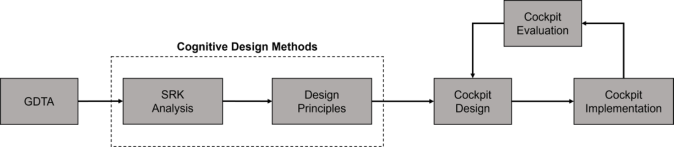
DESIGN PROCESS With the increasing automation and networking of a future fighter aircraft, a Goal-Directed-Task-Analysis (GDTA) (Endsley 2011) is used to identify rel- evant information for the user. Then, cognitive design methods consisting of Rasmussen’s SRK taxonomy (Rasmussen 1983) and Wickens’ design princi- ples (Wickens et al., 2013) are applied, to determine how to communicate the information to the user. Following this step interface elements which contain this information need to be designed. Subsequently, they must be imple- mented in a cockpit interface to evaluate and optimize the designed interface elements. In the following section, we will outline the steps presented in the design process (see Figure 1).
Figure 1: Applied design process.
Goal-Directed-Task-Analysis A task analysis refers to the process of identifying and examining the tasks that people perform when interacting with systems (Kirwan and Ainsworth 1992). A variant of task analysis is the GDTA, which has already found appli- cation in civil aviation (Endsley 2011). The focus is on the goals that the user must achieve to successfully perform the task, the decisions that must be made to achieve those goals, and the information requirements needed to make those decisions. The methodology relies on unstructured interviews with sub- ject matter experts that focus on goals and information requirements rather than technology requirements. Using the analysis, the goals, the decisions and the associated information can be transferred into a tree-like structure (Endsley 2011). We use a GDTA in this design process to ensure that the cockpit interface is aligned with the fighter pilot’s objectives and required information.
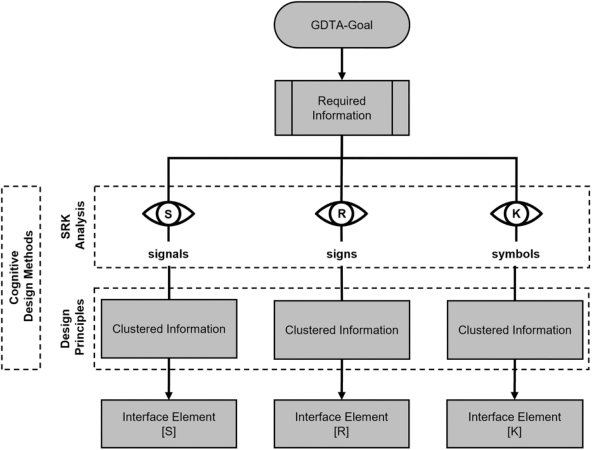
Cognitive Design Methods Although the GDTA identifies the relevant information, the effective visual- ization of this data and the avoidance of data overload in the cockpit remains a challenge. For this purpose, the cognitive design methods are applied, as shown in Figure 2.
Figure 2: Applied cognitive design methods.
The cognitive design methods of the process, consisting of the SRK analysis based on Rasmussen’s SRK taxonomy and Wickens’ display design princi- ples, are focused on optimising the pilot’s information processing. The SRK analysis determines the level of detail and the form of presentation of the information displayed to the pilot to provide targeted support depending on the current situation, the task, and the level of behaviour at which the pilot is acting. Wickens’ design principles guide the design of the information presentation so that it can be correctly understood with minimal cognitive effort.
SRK Analysis In this step the information obtained from the GDTA is viewed through dif- ferent perspectives of the SRK taxonomy which helps determine how the information can be displayed to support the user on all three levels of cogni- tive control: Skill-, Rule- and Knowledge-based behaviour (Rasmussen 1983; Vicente and Rasmussen 1992).
Skill-based behaviour (SBB) means in the context of ecological interface design, that the user “should be able to act directly on the interface” (Vicente 2002). The SBB of the user can be supported by providing information as sig- nals (raw data) in the form of time-based spatial representations (Johannsen 1993; Kilgore and St-Cyr 2006; Rasmussen 1983). This enables the user to perceive trained feature formations and trigger subconscious sensorimotor actions to act quickly in the current situation (Rasmussen 1983).
Rule-based behaviour (RBB) involves “a consistent one-to-one mapping between the constraints of the workspace domain and the perceptual infor- mation of the interface.” (Vicente 2002) The RBB of the user can be
Integrating Rasmussen’s SRK Taxonomy in a Future Fighter Cockpit Design Process 405
supported by providing information as signs (information contained) in the form of isomorphic mapping between display geometries and system states (Johannsen 1993; Rasmussen 1983; Vicente and Rasmussen 1990). If the user has the necessary competencies to use these signs, stored patterns can be used to execute routine rules (Kilgore and St-Cyr 2006; Rasmussen 1983).
Knowledge-based behaviour (KBB) takes place in unfamiliar contexts, where the interface should serve as an externalized mental model for problem solving to “represent the work domain in form of an abstraction hierarchy” (Rasmussen 1983; Vicente 2002). To support KBB of the user, informa- tion must be perceived in symbols (meaning in context) so the interface should enable users to integrate various information sources for the pur- pose of predicting future system conditions and the development of strategies (Johannsen 1993; Kilgore and St-Cyr 2006).
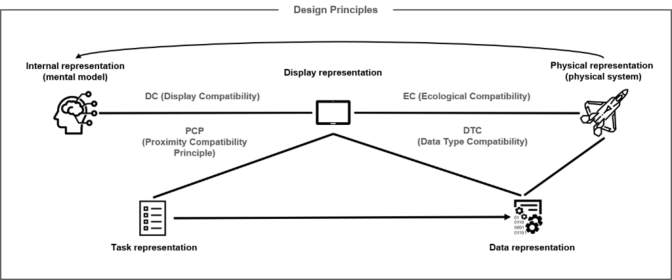
Design Principles In this step the design principles from Wickens et al., (2013) - display com- patibility, ecological compatibility, proximity compatibility and data type compatibility – are applied to present the analysed information from the previous step in a user-friendly and efficient manner.
Figure 3: Design Principles (adapted from Wickens et al., 2013).
The following principles are taken from Wickens et al., (2013). To achieve display compatibility, it is important to have a clear associa- tion between the pilot’s mental model and the visual representation on the display interface. This helps the pilot understand how a system works, when to engage it, and what it does in different phases.
To increase the pilot’s understanding of the physical system, it is crucial to establish ecological compatibility. To achieve this, the interface information must correspond to the system’s dynamics.
Proximity compatibility enables efficient attention allocation assistance. When the pilot must carry out tasks involving multiple aspects, it is essential to have all the relevant information displayed in one place. This facilitates selective attention. However, if the pilot needs to perform more specific tasks
it is better to present the information in a separate format. This approach supports focused attention (Wickens 2021).
The data type compatibility aligned the display representation and the characteristics of the data to be visualized. There are four categories of data structures: tabular, dimensional, network, and hierarchical. A good data type compatibility ensures a solid mapping between data representation and its underlying structure.
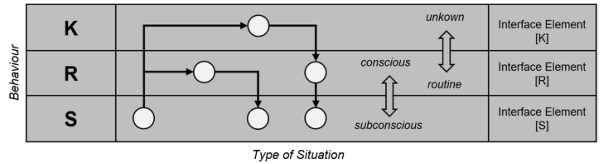
Interface Elements After determining how to display information within the cognitive design methods, the next step is to map this information to interface elements. It can be noted that frequently required information should be easily accessible, while less frequently required information can be accessed via a submenu, for example, to gain a comprehensive insight. The selection of where to map the information can be derived from models such as the SEEV model by Wickens and McCarley (2019), as this article primarily focuses on information pre- sentation. Figure 4 shows the correlation between the behavioural levels and the interface elements.
Figure 4: Correlation of behavioural levels and interface elements.
CASE STUDY: MANAGEMENT OF UAVS We show the described process in a case study of an information concept for a cockpit display to support a fighter pilot in the management of UAVs. In the following, we step through the process and describe our results.
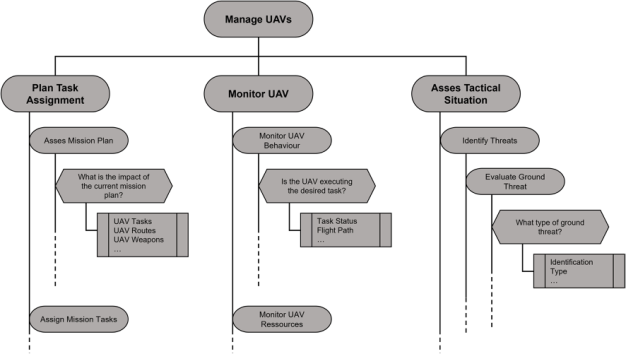
Goal-Directed-Task-Analysis To structure the interview with subject matter experts, we created different scenarios and systematically progressed through mission phases to identify relevant decisions. For each decision, we requested necessary information. The interviews were conducted with three German Air Force fighter pilots. Each pilot was interviewed individually in sessions that lasted about two hours. Figure 5 shows an excerpt from the GDTA with the main objective “Manage UAVs”.
Cognitive Design Methods Based on the task analysis, we used the SRK analysis and design principles to determine the level of detail and how the information should be displayed to
Integrating Rasmussen’s SRK Taxonomy in a Future Fighter Cockpit Design Process 407
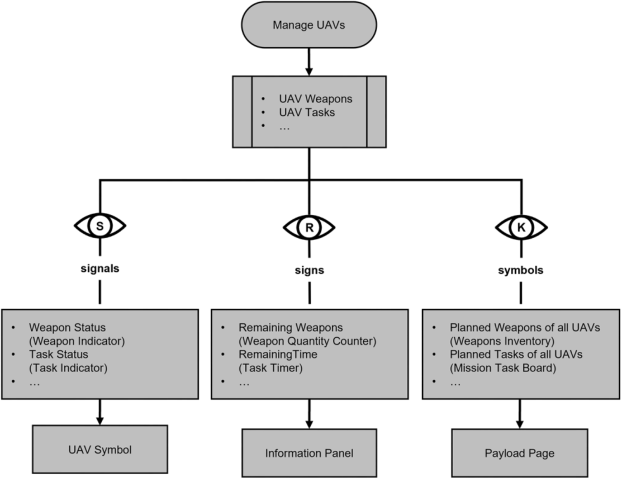
the pilot (see Figure 6). To be able to perform quick actions directly on the interface, we have integrated information that supports primarily skill-based behaviour into the interface element UAV Symbol. We selected the interface element Information Panel to primarily display information that supports the rule-based behaviour for executing stored patterns. For knowledge-based behaviour support, we chose a Payload Page that displays information, so it serves as an external mental model.
Figure 5: Excerpt from the GDTA.Figure 6: Excerpt from the SRK analysis.
COCKPIT DESIGN The information has now been mapped to interface elements. We will first describe the specific interface element and its characteristics and then consider the impacts of the cognitive design methods.
Interface Element: UAV Symbol For the design of the UAV Symbol, existing symbols in the field of military aviation and remotely piloted aircraft systems were analysed (Calhoun et al., 2017; NATO 2017). As a result, the circular structure, and the concept of integrating information into the symbol were therefore incorporated into the design. The final UAV Symbol is shown in Figure 7 with numbering indicat- ing the integrated information. The circular design of the UAV was chosen to maintain horizontal readings despite changes in the UAV’s heading. The UAV’s identity can be recognised by the colour of the heading indicator (2). We have incorporated a speed indicator (1), two colour coded bars (3) to inform the pilot about the status of the weapon and a symbol (4) visualiz- ing the current task of the UAV. We have also added a status indicator (5) to allow the pilot to react quickly to significant resource changes.
Figure 7: UAV symbol in dynamic configurations.
The UAV Symbol is displayed on the tactical map and thus provides infor- mation about its position. The symbol is designed to support the skill-based behaviour of a fighter pilot to trigger sensorimotor actions to act quickly in dynamic situations. In this design, we primarily applied ecological compati- bility and display compatibility by increasing the speed indicator as the UAV accelerates and decreasing it as it decelerates. In addition, the design pro- vides proximity compatibility, as the pilot has immediate access to important information such as weapon and task status, which supports integrated tasks.
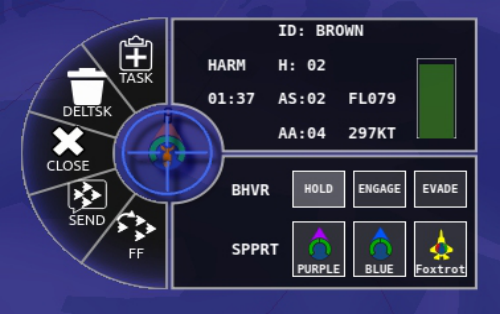
Interface Element: Information Panel In cases where the pilot needs to execute tasks typically done on a rule-based level, we have implemented an information panel that can be accessed by clicking on the UAV. The information panel (see Figure 8) shows the UAV ID and UAV-related information clusters presented in a tabular structure:
Task cluster (task, time)
Weapon cluster (weapon type, weapon quantity)
Integrating Rasmussen’s SRK Taxonomy in a Future Fighter Cockpit Design Process 409
Flight status cluster (flight level, speed)
Fuel cluster (fuel level)
Figure 8: UAV information panel.
The information panel supports integrated tasks through the proximity compatibility and data type compatibility, which is achieved through a tab- ular structure. It allows pilots to ensure task alignment with mission rules, supporting rule-based behaviour. In addition, the fighter pilot can access rel- evant information without diverting his attention from the tactical map, thus maintaining situational awareness.
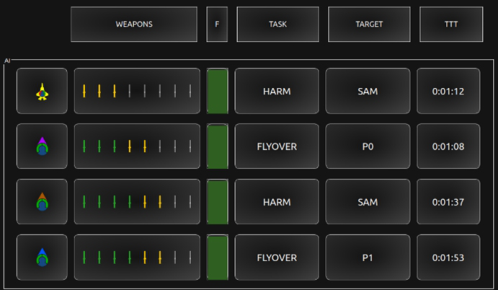
Interface Element: Payload Page The payload page (see Figure 9) displays the status of the own fighter and all UAVs, including fuel, (planned) weapons, and (planned) task information. To give the pilot an integrated view of this information, we used a tabular format, to achieve data type compatibility. This detailed information can support knowledge-based behaviour.
Figure 9: Payload page.
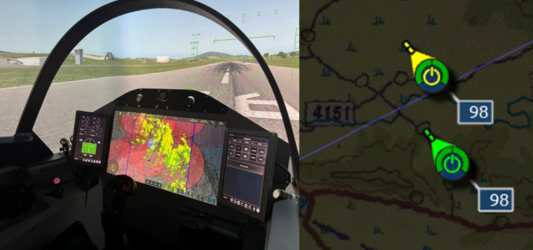
Implementation The described interface elements were implemented in a research cockpit simulator to evaluate the results with fighter pilots.
Figure 10: MUM-T Jet Simulator with UAV symbols on the tactical map.
Evaluation To evaluate our design, we assessed our interface with three experienced fighter pilots (mean 1500 flight hours) in an online evaluation. The pilots interacted with simulator screens, including delegation, air to air, and air to ground tasks. After each scenario, pilots subjectively rated the usability of the interface elements in unstructured interviews. To further evaluate our design, we are planning an experiment with 10 fighter pilots. In this experiment, they will use these interface elements in various scenarios.
RESULTS AND DISCUSSION
Overall, the interface elements and the information concept received positive feedback from the pilots. The UAV Symbol and its integrated functionalities have rated to be beneficial as they provide the fighter pilot with valuable information directly on the tactical map. The assessment by the fighter pilots shows that the payload page is a valuable resource that provides detailed information. The information panel was rated positively, but pilots found it challenging when engaging with targets on the map behind the panel. This raises concerns about design principles, especially proximity compatibility. To address this, we are exploring an adaptive information panel that changes position based on the task (e.g., status bar during combat, UAV position for information gathering).
LIMITATIONS The GDTA in this study has limitations. First, only one round of interviews was conducted. Secondly, the task analysis results were not validated by experts, so no claim to completeness can be made. However, a reasonable and initial structuring of the necessary information was achieved, which was used to demonstrate the design process.
Integrating Rasmussen’s SRK Taxonomy in a Future Fighter Cockpit Design Process 411
CONCLUSION
The applied design process shows a systematic approach for the creation of an information concept for a cockpit display. This approach helps to identify relevant information within a networked system and shows a way to com- municate this information in an efficient way to support the user on all three behavioural levels. It is important to conduct further usability testing of the cockpit design in situations where the pilot is physically present in the cockpit and exposed to mission stressors to ensure its effectiveness.
REFERENCES
Calhoun, G. L., M. A. Goodrich, J. R. Dougherty, and Adams. 2017. “Human- Autonomy Collaboration and Coordination Toward Multi- RPA Missions.” In Remotely Piloted Aircraft Systems: A Human Systems Integration Perspective, edited by John Wiley & Sons, Ltd., 109–136: Wiley. Endsley, M. R. 2011. Designing for Situation Awareness: An Approach to User-
Centered Design, Second Edition. Hoboken: Taylor and Francis. Johannsen, G. 1993. Mensch-Maschine-Systeme. Berlin, Heidelberg: Springer. Kilgore, R., and O. St-Cyr. 2006. “The Srk Inventory: A Tool for Structuring and Capturing a Worker Competencies Analysis.” Proceedings of the Human Fac- tors and Ergonomics Society Annual Meeting 50 (3), 506–509. https://doi.org/ 10.1177/154193120605000362. Kirwan, B., and L. K. Ainsworth. 1992. A Guide To Task Analysis. CRC Press. Lindner, S., D. Mund, and A. Schulte. 2022. “How Human-Autonomy Teams change
the Role of future Fighter Pilots: An Experimental Assessment.” In Proc., AIAA SCITECH 2022 Forum, Reston, Virginia. https://doi.org/10.2514/6.2022-2551. NATO. 2017. APP-6(D): Joint Military Symbology. NATO Standardization Office. Rasmussen, J. 1983. “Skills, rules, and knowledge; signals, signs, and symbols, and other distinctions in human performance models.” IEEE Trans. Syst., Man, Cybern. SMC-13 (3), 257–266. https://doi.org/10.1109/TSMC.1983.6313160. Vicente, K. J. 2002. “Ecological interface design: progress and challenges.” Human
factors 44 (1), 62–78. https://doi.org/10.1518/0018720024494829. Vicente, K. J., and J. Rasmussen. 1990. “The Ecology of Human-Machine Systems II: Mediating ‘Direct Perception’ in Complex Work Domains.” Ecological Psychology 2 (3), 207–249. https://doi.org/10.1207/s15326969eco0203_2. Vicente, K. J., and J. Rasmussen. 1992. “Ecological interface design: theoretical foun-
dations.” IEEE Trans. Syst., Man, Cybern. 22 (4), 589–606. https://doi.org/10. 1109/21.156574. Wickens, C. 2021. “Attention: Theory, Principles, Models and Applications.” International Journal of Human–Computer Interaction 37 (5), 403–417. https://doi.or g/10.1080/10447318.2021.1874741. Wickens, C. D., J. G. Hollands, S. Banbury, and R. Parasuraman. 2013. Engineering
psychology and human performance. Boston, Munich: Pearson. Wickens, C. D., and J. S. McCarley. 2019. Applied Attention Theory. CRC Press.
LISTED IN THE AHFE DIGITAL BOOKSTORE CATALOGUE
Explore the complete digital volume
Intelligent Human Systems Integration (IHSI 2024): Integrating People and Intelligent Systems
Read this individual research paper free through the original publisher, or explore the full digital proceedings book.
ISBN 978-1-958651-95-7
Explore this ISBN in the AHFE Bookstore ↗Listed in the July 2026 bookstore catalogue; search by ISBN to confirm current availability · Digital book purchase optional