Wei Xiong, Liuxing Tsao, Liang Ma (2024). Preferences for the decision weight and accountability assignment in risky decision-making under human-machine collaboration contexts. In: Intelligent Human Systems Integration (IHSI 2024): Integrating People and Intelligent Systems. AHFE Open Access, vol. 119, pp. 532–540. https://doi.org/10.54941/ahfe1004518
Collaboration between humans and machines has demonstrated considerable potential. In the future, we can assume that humans and machines will collaborate in partnerships and sharing decision outcomes. This prompts us to examine the extent to which machine inputs are introduced and to clarify the accountability for both positive and negative outcomes. We conducted a questionnaire survey through social networks, collecting 123 valid responses. Respondents were tasked with imagining a collaborative scenario with an intelligent machine for a risky decision-making task. We compared decision weights and accountability assignments for decision outcomes (profit and/or loss) under different risky decision-making descriptions. We also analyzed accountability assignments under a range of human-machine partnerships with given decision weights. Our results revealed the preference of humans to take the lead in human-machine partnerships and they were willing to assume more accountability. We also observed significant differences between decision weight and the assignment of accountability for decision outcomes. Interestingly, a gender-based analysis indicated that women tended to favor higher decision weight in scenarios involving loss-sharing descriptions and were more likely to assume more accountability for negative outcomes. Furthermore, under given human-machine decision weights, both men and women participants took more accountability for profits than for losses. In particular, women compared to their male counterparts, tended to attribute significantly more accountability to themselves for losses. This study would facilitate work designs for human-machine teams and contribute to fostering better human-machine relationships.
The potential of human-machine collaboration has been prominently show- cased in risky decision-making (Patel et al., 2019; Xiong et al., 2022). Machines can have an advantage in gathering information and assessing
Preferences for the Decision Weight and Accountability Assignment 533
uncertainty and can communicate key information to human decision- makers to save people’s cognitive resources. Thus, developing suitable human-machine work design is of paramount importance.
Considerable research explored introducing machine input to varying degrees to achieve better performance or higher acceptance in human- machine teams (HMTs). Haesevoets et al., (2021) demonstrated that man- agers exhibited a preference for partnerships in which they held a majority vote regarding managerial decision-making outcomes. Their research indi- cated that a minimum of 70% human decision weight was necessary to achieve a sufficiently high level of acceptance, and any further increase in involvement did not yield additional gains in acceptance. De Cremer and McGuire (2022) indicated that individuals tended to favor a 60-40% human- algorithm partnership and perceived collaboration with autonomous algo- rithms as unfair when the algorithm takes the lead in decision-making. Our previous research (Xiong et al., 2023) also provided evidence that a 50-50% partnership outperformed individual human or machine decision-making in sequential risky decision-making.
Researchers also noticed the necessity of clarifying the accountability for both positive and negative outcomes. On the one hand, accountability assign- ments will influence people’s satisfaction and acceptance of algorithms (Shin and Park, 2019). On the other hand, it will also impact human-machine relationships and HMT effectiveness. Dietvorst et al., (2015) demonstrated that people would lose confidence in imperfect machines when they witness them making mistakes and even choose a suboptimal human decision-maker instead. Shin and Park (2019) provided evidence to support the hypothesis that users would experience greater satisfaction when algorithms are held for the outcomes. As such, accountability assignments are critical aspects to consider in human-machine collaboration.
In the future, a greater variety of human-machine partnerships will emerge and human-machine collaboration will also face increasingly complex tasks. The increased risks and uncertainties place higher requirements on the attribution of authority and accountability in risky decision-making.
This paper aims to investigate how much weight and accountability humans prefer to cede to machines in risky decision-making under human- machine collaboration contexts. We examined preferences across different gender populations as well as under different risky decision-making descrip- tions. We also compare the human-machine accountability assignment under given human-machine decision weights.
METHOD
Questionnaire Design Respondents were asked to imagine that they would be working with an intel- ligent machine (understood as APPs or products and/or the AI technology behind them) on a risky decision-making task.
The survey mainly included three parts: (1) basic information collection (gender, age, education level, job and major);
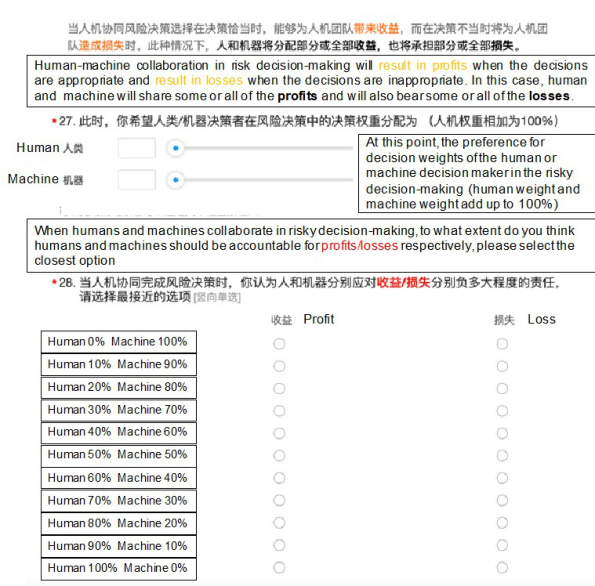
(2) questions about decision weights and accountability assignment for decision outcomes (profit and/or loss) under different risky decision descrip- tions (no profit and loss sharing information, profit-sharing information only, loss-sharing information only, information on profit-sharing and loss- sharing). An example is shown in Figure 1.
Figure 1: A schematic diagram of questions about decision weights and accountability assignment under scenarios with information on profit-sharing and loss-sharing.
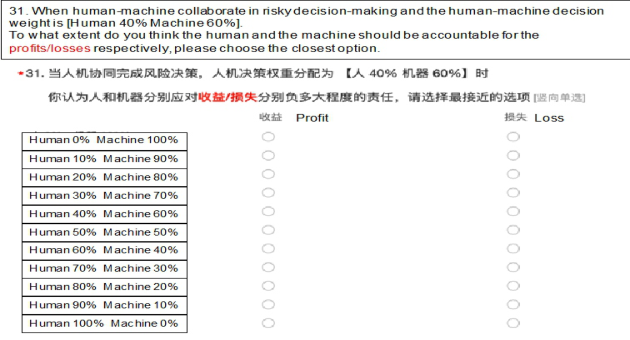
(3) questions about accountability assignment for decision outcomes (profit and loss) under a series of partnerships with given human-machine decision weights (human-machine: 0-100%, 10-90%, 20-80%, 30-70%, 40-60%, 50-50%, 60-40%, 70-30%, 80-20%, 90-10%, 100-0%). An example is shown in Figure 2.
Participants We conducted a questionnaire survey through social networks. 127 questionnaires were returned. After removing invalid responses (exces- sive response time, more than 1200 seconds), 123 valid responses were retained. The average length of time spent answering the questionnaire was 439.67 seconds (SD = 192.15). Table 1 presents detailed characteristics of participants.
Preferences for the Decision Weight and Accountability Assignment 535
Figure 2: A schematic diagram regarding questions of accountability assignment of profits/losses under a 40-60% human-machine decision weight.Table 1. Characteristics of participants (n = 123).
PREFERENCES FOR HUMAN DECISION WEIGHT AND ACCOUNTABILITY FOR OUTCOMES In this section, we use the following abbreviations to indicate different ways of describing risk decisions: NoPL= No information about profit and loss; Ponly= Profit-sharing information only; Lonly=Loss-sharing information only; PL=Information on profit-sharing and loss-sharing.
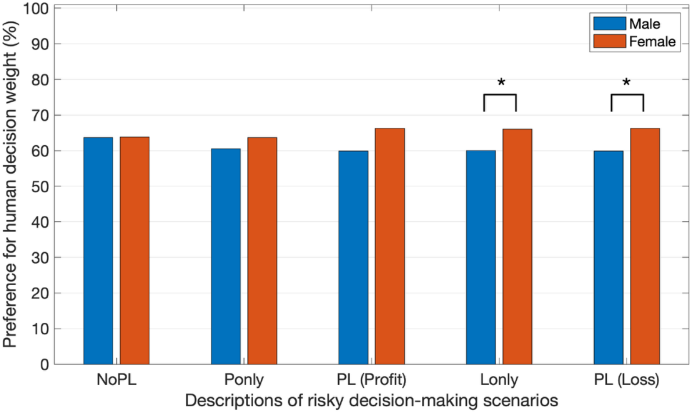
Preferences for Human-Machine Decision Weight We performed the Scheirer-Ray-Hare test and found a significant effect in gender (p < 0.01), an insignificant effect in risky decision-making scenarios
(p > 0.05) and an insignificant interaction effect on preference for human decision weight (H = 4.32, p = 0.23). The Kruskal-Wallis test showed that women tended to favor higher decision weight in scenarios involv- ing loss-sharing descriptions (p < 0.05). Figure 3 showed preferences for human decision weights of male and female participants under different descriptions of risky decision-making scenarios. Detailed data are listed in Table 3.
Figure 3: Preference for human decision weight across descriptions of risky decision- making scenarios (the level of significance in ANOVA or Non-parametric analysis: ∗= p < 0.05).
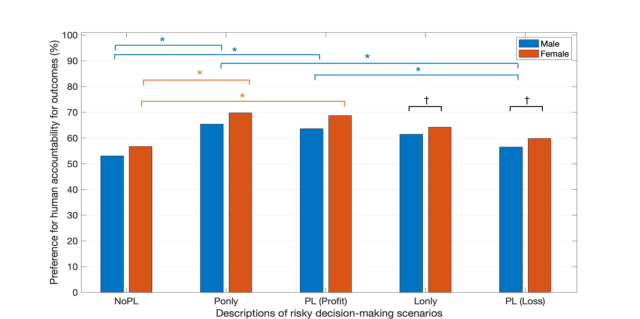
Preferences for Human-Machine Accountability Assignment We performed the Scheirer-Ray-Hare test and found significant effects in gen- ders and descriptions of risky decision-making scenarios (p < 0.05) and an insignificant interaction effect on preference for accountability for decision outcome (H = 0.94, p = 0.79).
As for the effects of gender, the Kruskal-Wallis tests showed that women were more likely to assign more accountability to themselves. In addition, men tended to assume more accountability under risky decision-making sce- narios involving profit-sharing information compared to Lonely and NoPL scenarios (ps < 0.05), while women exhibited significantly different prefer- ence for human accountability between NoPL and scenarios involving profits (Ponly and PL) (ps < 0.05). Figure 4 showed preferences for accountabil- ity for decision outcomes of male and female participants under different descriptions of risky decision-making scenarios. Detailed data are listed in Table 3.
Preferences for the Decision Weight and Accountability Assignment 537
Figure 4: Preference for human accountability for decision outcomes (profits/losses) across descriptions of risky decision-making scenarios (the blue/red color represents the comparison results across different descriptions of risky decision-making scenar- ios in male/female participants, respectively; the level of significance in ANOVA or Non-parametric analysis: † = p < 0.1; ∗= p < 0.05).
Differences Between Decision Weight and Accountability Assignment We used paired t-tests (or the Wilcoxon signed-rank test when the normality assumption was violated) to compare preferences for human decision weight and human accountability of male and female participants. All the differences were significant (ps < 0.05).
Table 2. Detailed data on preferences for human decision weight and accountability for outcomes.
Table available in the original PDF paper.
Sig
Human decision weight(%) Mean (SD)
Human accountability of profits/losses(%) Mean (SD)
Gender Descriptions of risky decision-making scenario
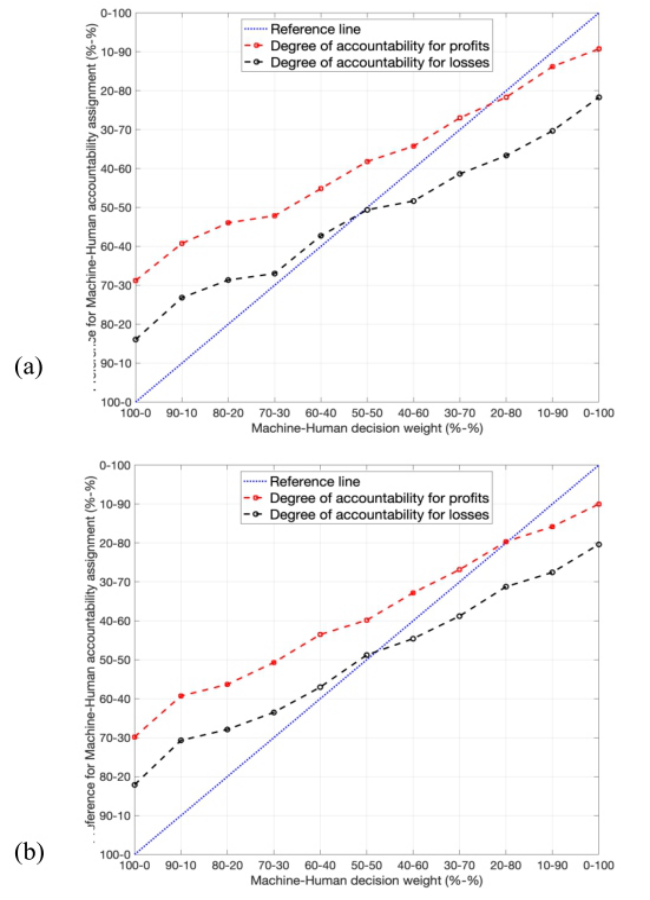
PREFERENCES FOR ACCOUNTABILITY ASSIGNMENT UNDER GIVEN DECISION WEIGHTS We draw preferences for accountability assignment for profits and losses under given human-machine decision weights of male and female participants in PL scenarios (shown in Figure 5 (a)(b)). The intersection point between the two curves and the reference line means the point at which the subject con- siders the decision weight to be equal to the assignment of accountability (50-50% partnership).
Figure 5: Preferences for accountability assignment for profits and losses under given human-machine decision weights: (a) male participants; (b) female participants.
Preferences for the Decision Weight and Accountability Assignment 539
The Wilcoxon signed-rank tests showed that both men and women par- ticipants attributed more accountability to themselves for profits than for losses (ps < 0.05). In particular, women tended to attribute more account- ability to humans for losses, in comparison to their male counterparts (p < 0.05).
DISCUSSION AND CONCLUSION Our paper revealed that humans do not want to exclude machines in col- laborative risky decision-making but prefer to take the lead. This reflected the demand for control over the outcomes of the partnership (Zanatto et al., 2021). The significant difference between preferences for human deci- sion weight and human accountability indicated HMT design cannot simply assume or set the two as consistent. This required further investigation and demonstration.
This study also focuses on the differential effects of gender and deci- sion outcomes (positive and negative) on decision weight and accountabil- ity assignment. The gender difference in which female participants prefer higher human decision weight under loss-sharing scenarios represented more risk aversion, which was consistent with previous research (van Dolder & Vandenbroucke, 2022). From the results of different descriptions of scenar- ios (involving loss-sharing information or not) and preferences for human accountability for decision outcomes (profits and/or losses), female partici- pants were found to make more altruistic attributions compared to their male counterparts (Lei & Rau, 2021). That is, they assigned less accountability to their machine partners. In addition, both male and female participants exhib- ited self-serving bias (Miller & Ross, 1975) when assigning accountability profits and losses. They assigned more positive outcomes (profits) to them- selves and more negative outcomes (losses) to external factors (i.e., machine partners).
This work also has some limitations. Firstly, the sample size could be expanded to yield more comprehensive and generalizable results. Secondly, limited by the method of questionnaire survey, the lack of actual human- machine interactions might affect participants’ perceptions and ultimate results. Thirdly, more characteristics (such as age, and education level) should be considered to give a thorough analysis of human-machine decision weight and accountability assignment.
Our paper illustrates the preference of humans to take the lead in human-machine partnerships in risky decision-making and they are will- ing to assume more than half the accountability. Moreover, our analy- sis indicated female participants tended to be more risk averse and thus prefer more decision control over decision outcomes. Both female and male participants exhibited self-serving bias and assume more account- ability for positive outcomes (profits). Female participants also make more altruistic attributions under scenarios involving loss-sharing descrip- tions compared to male counterparts. This study would facilitate work designs for HMTs and contribute to fostering better human-machine relationships.
ACKNOWLEDGMENT
We appreciated the support from the National Natural Science Foundation of China (Grant Nos. 72192824 and 71942005).
REFERENCES
De Cremer, D., & McGuire, J. (2022). Human–Algorithm Collaboration Works Best if Humans Lead (Because it is Fair!). Social Justice Research, 35(1), 33–55. https://doi.org/10.1007/s11211-021-00382-z Dietvorst, B. J., Simmons, J. P., & Massey, C. (2015). Algorithm Aversion: People
Erroneously Avoid Algorithms After Seeing Them Err. Journal of Experimental Psychology: General, 144(1), 114–126. https://doi.org/10.1037/xge0000033 Haesevoets, T., De Cremer, D., Dierckx, K., & Van Hiel, A. (2021). Human-machine collaboration in managerial decision making. Computers in Human Behavior, 119, 106730. https://doi.org/10.1016/j.chb.2021.106730 Lei, X., & Rau, P.-L. P. (2021). Should I blame the human or the robot? Attribu-
tion within a human–robot group. International Journal of Social Robotics, 13, 363–377. Miller, D. T., & Ross, M. (1975). Self-serving biases in the attribution of causality: Fact or fiction? Psychological Bulletin, 82(2), 213. Patel, B. N., Rosenberg, L., Willcox, G., Baltaxe, D., Lyons, M., Irvin, J., Rajpurkar,
P., Amrhein, T., Gupta, R., Halabi, S., Langlotz, C., Lo, E., Mammarappallil, J., Mariano, A. J., Riley, G., Seekins, J., Shen, L., Zucker, E., & Lungren, M. P. (2019). Human – machine partnership with artificial intelligence for chest radiograph diagnosis. Npj Digital Medicine, 2(1), 1–10. https://doi.org/10.1038/s41746-019- 0189-7 Shin, D., & Park, Y. J. (2019). Role of fairness, accountability, and transparency in algorithmic affordance. Computers in Human Behavior, 98, 277–284. https://doi.org/10.1016/j.chb.2019.04.019 van Dolder, D., & Vandenbroucke, J. (2022). Behavioral Risk Profiling: Measuring
Loss Aversion of Individual Investors. Available at SSRN. Xiong, W., Fan, H., Ma, L., & Wang, C. (2022). Challenges of human–machine collaboration in risky decision-making. Frontiers of Engineering Management, 9(1), 89–103. https://doi.org/10.1007/s42524-021-0182-0 Xiong, W., Wang, C., & Ma, L. (2023). Partner or subordinate? Sequential risky
decision-making behaviors under human-machine collaboration contexts. Com- puters in Human Behavior, 139, 107556. https://doi.org/10.1016/j.chb.2022. 107556 Zanatto, D., Chattington, M., & Noyes, J. (2021). Human-machine sense of agency.
International Journal of Human-Computer Studies, 156, 102716–102716. https://doi.org/10.1016/j.ijhcs.2021.102716
LISTED IN THE AHFE DIGITAL BOOKSTORE CATALOGUE
Explore the complete digital volume
Intelligent Human Systems Integration (IHSI 2024): Integrating People and Intelligent Systems
Read this individual research paper free through the original publisher, or explore the full digital proceedings book.
ISBN 978-1-958651-95-7
Explore this ISBN in the AHFE Bookstore ↗Listed in the July 2026 bookstore catalogue; search by ISBN to confirm current availability · Digital book purchase optional