Hanzhang Dong (2024). Analyzing the symbolic significance of Angelopoulos’ films from the perspective of semiotics. In: Intelligent Human Systems Integration (IHSI 2024): Integrating People and Intelligent Systems. AHFE Open Access, vol. 119, pp. 570–580. https://doi.org/10.54941/ahfe1004522
Symbolic communication is an interdisciplinary field that investigates the meaning and function of symbols in the communication process. Within the framework of symbolic communication studies, symbols are seen as tools individuals employ to convey meanings and values. As a crucial cultural artifact and visual medium, film combines various symbolic elements—including imagery, sound, and plot—to create a distinctive and intricate symbolic system, thus conveying specific meanings through symbol construction. In the films of Angelopoulos, the allure of “symbolic symbolism” is reflected through flowing long shots, captivating mise-en-scène, the manipulation of time, layered spaces with poetic overlays, a blank film reel, the emergence of a giant sculpture hand from the sea, thundering trains, alienating narrative structures, obscure metaphorical symbols, and unique poetic aesthetics. These key elements encompass the crux of deciphering Angelopoulos’ films. The analysis of symbolic symbolism in Angelopoulos’ films can be approached from different perspectives.Firstly, one can utilize the basic model of symbolic communication as a framework for research. This model encompasses six elements that constitute any communicative event. These consist the elements of the speaker and listener, who are the primary participants in symbolic communication. The element of information represents the content conveyed through symbols. Code elements give form to information. In the process of communication, not only the information itself is needed, but also contact elements are needed. Contact media can take various forms. Additionally, both speaker and listener must share a context within which the transmitted information can be comprehended. In the context of Angelopoulos’ films, the films themselves function as the “speaker,” while the audience assumes the role of the “listener”. Furthermore, the specific film products and services constitute the information being communicated, embodying the purpose and communication needs. Contact pertains to the media and settings employed in film communication, while codes encompass the symbolic forms of film, such as words, sounds, images, and colors. Symbolic communication in film is additionally influenced by cultural, social, and historical backgrounds, which may cause symbols to assume differing meanings and interpretations within contexts and for distinct cultural audiences. Secondly, Bakhtin’s theory of symbols suggests that symbolic cognition involves a process of decoding, which comprises four cognitive stages: symbol perception, conceptual cognition, contextual cognition, and dynamic dialogue. By analyzing the narrative structure employed in Angelopoulos’ films, one can construct a word cloud of pertinent cognition through semi-structured interviews and literature research. This approach yields a discussion of the specific visual, tactile, auditory, gustatory, and other symbolic symbolism techniques utilized within the functional spectrum of each narrative stage.In conclusion, the creation of symbolic meaning in Angelopoulos’ films, when viewed through the lens of symbolic communication, represents a multifaceted and diverse process. It encompasses the polysemy, combination, and organization of symbolic elements, alongside the influence of cultural, social, and historical backgrounds. An in-depth exploration of the construction of symbolic meaning in films enables a profound comprehension of the symbolic symbolism employed by Angelopoulos and the consequential impact and significance on the audience.
The history of cinema has spanned more than a hundred years from the late 19th century to the 21st century. No matter what era, film is an impor- tant carrier to convey and reflect thoughts and emotions to the audience. The long-term development of film cannot be achieved without the commu- nication with the audience, which must be supported by the transmission mode based on the agreement between the film and the audience. The research angle of symbolic communication is the process of analyzing and summarizing the content of film products symbolized and informationized in combination with the characteristics of media and the cognitive process of the audience. Angelopoulos, a world-class Greek film master, advocated the complete presentation of human relations in space and the emphasis on the authenticity of narrative. Alienated plots, obscure metaphorical symbols and unique poetic aesthetics are the three most prominent features of his image construction style. The symbolic communication field of view pro- vides a systematic vein for reading the vast amount of symbolic symbolism in his films.
Analyzing the Symbolic Significance of Angelopoulos’ Films 571
DESKTOP STUDY -- THE BASIC CONCEPT OF SYMBOLIC COMMUNICATION Semiotics is the study of signs, objects, and meanings. Symbol is a kind of perception bearing meaning, meaning must be expressed by symbols, and the purpose of the existence of symbols is to express meaning.
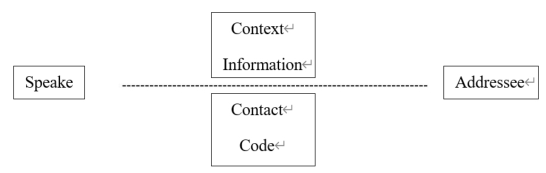
Any communication is carried out through the information conveyed by the symbol. In communication, the “message”does not provide the full mean- ing of the exchange, and communication depends largely on the context, the code, and the method of contact. Among the six elements of symbol communication, the speaker and the addressee are the subjects of symbol communication. Context, information, contact, and code are the content of the sign. These are the six components of any spoken event proposed by Jacobson (Roman Jakobson, 1974).
Figure 1: Symbol propagation diagram.
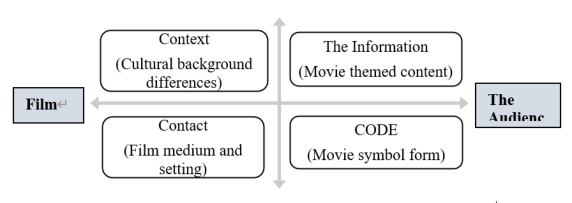
The movie-watching process can be understood as the process of communi- cation between the audience and the film product, which can be diagrammed as the following relationship. The “speaker” is the film, the sender of the symbol; The audience is the “speaker”, the receiver of the symbols; The infor- mation refers to the specific movie content and service, which is the original motivation of the speaker and the receiver, reflecting the purpose and demand of communication; Contact refers to the medium and scene of film transmis- sion; Code refers to the symbolic representation of the film, which can be in the form of words, sounds, pictures, colors, etc. Symbolic communication in films is also influenced by different contexts such as cultural, social and his- torical backgrounds, forming a unique system of symbolic communication in film.
Figure 2: Symbolic propagation model diagram applied in the field of film symbols.
572 Hanzhang
RESEARCH ON INTERNAL FACTORS -- RELATED FACTORS AFFECTING THE TRANSMISSION OF FILM SYMBOLS BY ANGELOPOULOS First of all, there is no universal grammar for film, there is only one method called stylization. Theo Angelopoulos was born in the ancient Greek city of Athens. His childhood and youth were marked by World War II and the Greek Civil War, themes explored in his early films.
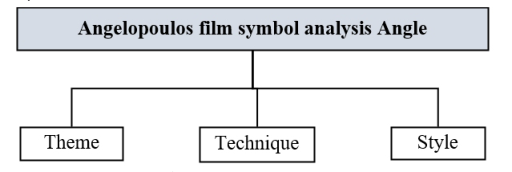
In 1967, Angelopoulos began making films, a career that would last almost half a century, with his debut film setting the tone for everything he did there- after. By his own admission, he spent his entire life making one genre, even the same film. His filmmaking as a whole takes on a seriality. Take his “Frontier” trilogy (The Suspended Step of the Stork, Ulysses’ Gaze, Eternity and a Day) as an example. They are code universes with an Angelopoulos touch. This article will interpret Angelopoulos’s works from three perspectives: theme, technique and style.
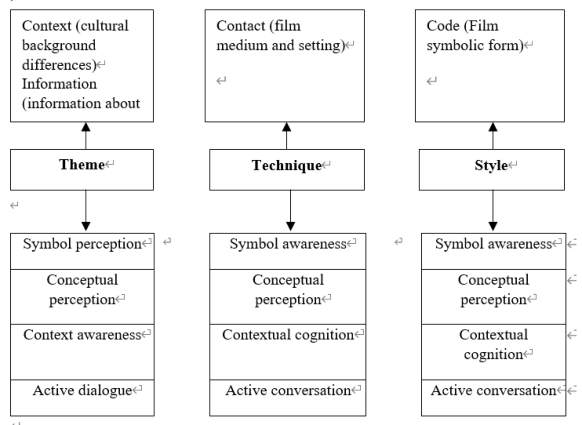
Figure 3: The angle from which the angelopoulos film conducts semiotic analysis.
Secondly, the transmission of symbols between the speaker and the receiver is a process, which is completed by four elements: information, contact, code and context. Specific elements can realize specific functions in the process of symbol transmission. The theme, technique and style of the film will have dif- ferent dominant elements from three different communication angles. We can achieve different communication purposes by emphasizing different leading elements.
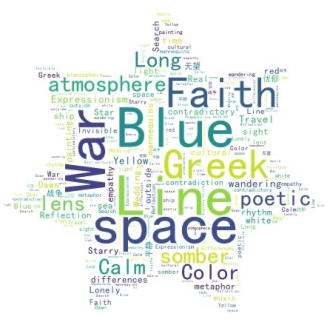
Taking his Border trilogy as an example, stratified random sampling in the sampling method was used to select professional film critics and ordinary moviegoers as sample sources. The word cloud is formed by collecting the comments and viewing feelings of Angelopoulos’ Border trilogy. Then it is classified into three angles of film interpretation, and the secondary factors of each Angle are preliminarily determined, and which elements of symbol transmission are the dominant elements in each Angle.
Data acquisition and preprocessing: According to the selected research objects, Collect relevant online user reviews, including user names, content of reviews, sources and dates, from Metacritic, which has more professional film critics, Douban, which has more film lovers, professional journal papers, Weibo, YouTube, Bilibili and other platforms that are more topical. A total of 538 reviews were collected. Select 5 of these comment information as examples.
Analyzing the Symbolic Significance of Angelopoulos’ Films 573
Table 1. Sample comment information.
Table available in the original PDF paper.
Username Comment content Sources Dates Serial number Metacritic 04/10/1998
1 Scott The mood is somber, brooding and visually magnificent, a cinematic poem
Metacritic 09/09/1999
2 Rickey In Ulysses’ Gaze, the man of the house recalled many things of the past, when he was a little boy, the family spent New Year’s Eve together, his father was released home, his uncle was taken away, his father got permission, the People’s Confiscation Committee confiscated the furniture and piano, the family photo...... Six events, completely condensed into an environment to shoot, only through the transition of a few simple lines or characters reached.
02/17/2008 New York Times
3 Maslin Elaborate long shots and mesmerizing camera action; And a haunting expressionist mood and vision.
Douban 08/11/2013
4 Wang In The Suspended Step of the Stork the dead body was floating on the sea. The moment lasted a few seconds, but solidified the end of one journey and the beginning of another.
Douban 05/06/2018
5 Muto In Eternity and a Day, the scene of an old man and a child on a bus is very symbolic. They see all kinds of real and false people on the bus, which symbolizes that they will meet all kinds of people on their way of life.
In view of the large number of network words contained in the user’s online comments, word segmentation is carried out to improve the accuracy of the user’s online comments. Decompose a sentence into multiple words and form word clouds.
Figure 4: Online user comments related word clouds.
574 Hanzhang
The pre-processed words correspond to the three angles of film interpre- tation, so as to deduce the categories of symbols under each Angle, and point out the dominant elements of symbol propagation under each Angle.
Table 2. Elements of symbol propagation under the five angles of film interpretation.
Table available in the original PDF paper.
Interpretation Angle
Example Keywords Symbol Category
Dominant elements Message Context Exposure Code Context (differences in cultural context) Message (information about the theme of the film)
Theme Evolution; Contradiction; Sparse Ebb and Flow; Scatter; Cause and Effect; Time and Space; Dual Lines; Multi-Layered; Side by Side; Lyrical Poetry; Inner and Outer Politics; War; Borders; Journeys and Exile; No Ending Ends; Confrontation; Faith and Reflection; Forgotten Suffering......
From the point of view of the theme, the keywords are about the social and cultural background and the spiritual core and narrative level of the director. War is one of the motifs of Angelopoulos’ films. Greece’s modern troubles and national suffering nourished his film creation. Viewers must understand such information and understand such context in order to enter the good state of movie-watching. The symbolic communication from this perspective is dominated by the elements of context (cultural background differences) and information (film theme information).
From the technical point of view, the keywords revolve around the char- acteristics of the carrier, the characteristics of the scene, the operation of the mirror and the scene scheduling. In the viewing scene, the audience entering the viewing state influenced by the expressive force of the media. The symbol transmission from the technical point of view is dominated by the elements of contact (Film medium and setting).
From the perspective of style, keywords revolve around the elements of time and space. The concept of time and space in Angelopoulos’ films is con- nected with the traditional view of time and space in European art films. All of Angelopoulos’s cinematic language is based on this concept. There’s a lot
Analyzing the Symbolic Significance of Angelopoulos’ Films 575
of visual and auditory language to it. The stimuli transmitted to the audi- ence through the medium of film are symbols in various forms. This angle are transmitted through the stimulation of the five senses. The propagation takes the code (film symbol form) element as the leading element.
In addition, viewers’ cognitive behavior of symbols will also affect the result of symbol transmission, and viewers with different backgrounds will have different understandings of symbols. symbol understanding is a process of decoding. This process is divided into four stages; The first stage of symbol cognition is the perception of physical symbols, such as words, colors, and spatial forms. In the second stage of symbol cognition is the understanding and recognition of symbol content. The third stage is the recognition of the ascending meaning of the symbol. The fourth stage is an active dialogue with the sign-sender.
Figure 5: Schematic diagram of symbol cognition process.
Figure available in the original PDF paper.
To sum up, from the three perspectives of film symbol communication, each perspective will experience four cognitive stages: symbol perception, concept cognition, context cognition and active dialogue. And this process is based on the four symbolic elements of information, contact, code and context to connect the speaker and the addressee, that is, Angelopoulos’ films and viewers.
Figure 6: Schematic diagram of film interpretation angle and symbol cognition pro- cess.
576 Hanzhang
EXTERNAL SITUATION STUDY -- THE PROCESS OF SYMBOL INTERPRETATION IN ANGELOPOULOS’ FILMS From the perspective of theme
Context elements: After the collapse of the Soviet Union and the upheavals in Eastern Europe, the Cold War changed. Once again, the Balkans became the source of all kinds of religious and ethnic problems. The end of the Cold War intensified ethnic problems in the Balkans, and refugees flocked from Eastern Europe to Western Europe. Angelopoulos had to pay attention to such a background. The story background of The Suspended Step of the Stork is the Balkan refugees after the drastic change in Eastern Europe; Ulysses’ Gaze is set against the backdrop of war in the Balkans; Eternity and a Day is set against the backdrop of the Albanian War. In Angelopoulos’s Border trilogy, War becomes a motifs, focusing on the problems of border and war in Greece and the Balkans. But his theme of war is expressed with a deafening silence.
Elements of the message: Angelopoulos’ film, which focuses on borders and refugee exile. It shows his left-wing political outlook, a kind of utopian spirit. In his utopia, there are no enforced borders and communication is not artificially suppressed.
1. Borders, from the borderline of the country in The Suspended Step of the Stork, to the homeland caught in the crossfire of war in Ulysses’ Gaze, to the terminally ill old man in Eternity and a Day, Angelopoulos’s attitude towards exploring the concept of borders has changed somewhat over time.
The “boundary” of space -- the geographic boundary in the film is very clear, blue, white and red border, the reporter in the “goose feet hanging in the air” to appreciate the significance of this step, a distinct dividing line, a bridge, a couple, a road into two halves. The director tried to interpret the meaning of the national border, take a step more, is death.
The “boundary” of time -- the time when the politician disappeared is assumed to be December 31, 1999, which is a “boundary” of time. The next moment will open a new era, but does the boundary of time have any meaning? Does the new time mean that a whole new situation will be opened?
Interpersonal “boundaries” -- apart from time and space, what separates people from each other? The Suspended Step of the Stork begins with the tragic events of Piraeus: The Greek government refuses to help the stow- aways, who drown in the high seas. Journalists begin to visit The town, which was formed by the refugees at the time, and is called “The Waiting Room.” It was just a stop for the refugees as they waited to be sent out. It was a place of nostalgia, resentment and sorrow. However, people of different faiths can maintain their own national characteristics and independent market order in this independent “peach blossom land”, and different cultures blend and communicate with each other. It seems that people can coexist with each other, and the borders here are contradictory, full of conflict but temporary harmony.
The “boundary”of elimination -- “In dealing with national borders, mixed cultures and languages, abandoned refugees, I tried to create a new human- ism, a new path,” Angelopoulos claimed. He expresses a kind of silent hope
Analyzing the Symbolic Significance of Angelopoulos’ Films 577
in The Suspended Step of the Stork and Eternity and a Day. Yellow raincoat appears repeatedly in The Suspended Step of the Stork and until finally, in the grand looking panorama, the repairman on the pole in yellow raincoat, with the same hesitatance, the director conveys hope through the images. In Eternity and a Day, a terminally ill old man becomes friends with an Alba- nian refugee child, and the old man sees his dead wife at the end of his life. Straddling life and death, the two dance in the present and future tenses.
The boundaries in Angelopoulos’s films are either geospatial borders or ideological differences versus the more metaphysical ones of time and death.
2. Refugees, European shoals, the recent history of Greece’s decay, the aftermath of the great political battles, the showmen executed on hangers and barbed wire, the suppressed simplicity of male and female emotions, the soldiers who cannot see their faces, and more constitute the tone of the bor- der trilogy. It tells the story of displaced people against a grand background, reflecting on the state and society from the relationship between people. The collapse of the world is silent and slow, and man is powerless and pushed forward in front of the tide of The Times. In the process of moving forward, the loss is not only the home, but also a kind of memory related to people. Perhaps the human status quo is like the stork, hesitate to move forward, But there will be a new journey, and before there is more suffering, love and dance.
In addition to having reasonable symbolic elements, the transmission of the theme should conform to the cognitive process of the viewer and arouse resonance. Enter the immersive “viewing state”. In Angelopoulos’s border trilogy, a large number of visual symbols about war, ruins, gloom, suffering, depression, indifference and other visual symbols are used to arouse viewers’ instinctive reactions, complete the first stage of symbol recognition, and form a basic recognition of the physical background of the film;There are also a large number of metaphors of characters and events throughout the trilogy, such as refugees, soldiers, corpses executed in performance style, people wear- ing yellow jumpsuits, the elderly and children appear in all three films. This kind of use of the same elements in different films emphasizes the same story background and sense of series.By completing the second stage of symbolic cognition, the audience has a better understanding and clearer understanding of the theme content.; As the main clues in the three films, the old people and children are chosen. The old people and children symbolize a kind of reincar- nation and pure freedom of thinking and feeling. It is easier for the audience to follow their eyes and think carefully to feel the theme content and interact with the spirit of the film. Enter the third stage of symbol cognition, the rise and identification of meaning.
From the technical point of view Contact elements: The long lens is undoubtedly the most striking label of Angelopoulos. His long shots are based on his unique sense of time and space. In Eternity and a Day, time and space shift and interlace in the same shot many times to convey meaning. When Alexander listened to his daugh- ter read the letters left by his wife Anna, he got up and walked to the balcony and opened the curtain to see Anna’s back. At this time, he has completed the transformation from the real time and space to the memory time and space.
578 Hanzhang
Alexander went downstairs from the balcony to comfort the sad Anna. When they snuggled up, Anna inserted a sentence from the letter (real time) into the dialogue: “I really want to keep this moment, so that it cannot fly away like a butterfly.” This moment forms a staggered expression of time and space, sound, picture and text shine together, so that the character’s psychology can be truly conveyed; At the end of the film, Alexander returns to the old house by the sea, and the camera rotates 180
clockwise -- backward -- counter- clockwise with Alexander’s eyes to the right side of the picture. The real time and space have been transformed into the memory time and space. The cam- era cuts out the window and moves to the far sea through the difficult route of horizontal advancement -- vertical descending -- horizontal advancement. At last, with the call of the mother in the dream, the whole film ends at this beach full of beautiful memories.
On the other hand, the motion form of Angelopoulos’ lens is also con- stantly changing in different periods. In the early stage, simple panning is dominant, one or two slight push-pull lenses, no lifting lenses, and very few zoom lenses. In the opening passage of Ulysses’ Gaze, the camera follows the hero through the streets of a mass rally and witnesses refugees crossing the border on the road to Albania, which he shows by pushing, pulling and panning instead of the original panning. Also in Ulysses’ Gaze, the hero runs through the desolate city streets, and as he runs deeper, the camera zooms back, highlighting and magnifying the menacing circumstances and isolation of the hero.
The lens is a contact medium that connects the viewer to the picture. The use of lens is a kind of language, and it becomes a means to express memory and reality, past and present, life and death. It can guide the audience’s vision, stimulate the audience’s association, tell the audience and communicate with the audience.
Interpretation from the perspective of style Code elements: Angelopoulos’ films have the style of open space. This invisible space can break through the limitations of a single scene. The end of Ulysses’ Gaze uses this style, with the hero walking through the foggy streets of Sarajevo and into the fog. The voiceover hears the sounds of mil- itary vehicles and soldiers, shouts, gunshots, bodies being thrown into the river, military vehicles driving away. A family is heard being killed, and the characters are portrayed through the voice. When the event is completely removed from the picture, the attention is more on the hearing. The direc- tor creates open Spaces outside the picture and draws the viewer’s attention through sound symbols that emphasize the brutality of the war. The audience is brought into an immersive state of watching the movie.
The control of distance is another unique style of Angelopoulos. the nar- rative style of Angelopoulos’ films is different from the Hollywood Montage. The film camera keeps a far distance from the actors, and the immersion of the film does not rely on a large number of close-ups and fast-changing story- board to inculcate information to the audience. Instead, he uses a larger scale scene production and a longer single-frequency shot to guide the camera past these backgrounds with the protagonist. Just as Aristotle said, “every man is
Analyzing the Symbolic Significance of Angelopoulos’ Films 579
a political animal.” The life and death of one man is the natural manifesta- tion of biology. The life and death of 10,000 people is politics. The narrative perspective chosen in the trilogy is not from the point of view of an individ- ual, but rather maintains a certain distance between the characters and the progress of events to uncover the tragic narrative of no one is immune. The immense sense of powerlessness and repressed pathos allow the audience to enter the second stage of symbol recognition more freely and with a broader vision, to understand and recognize the special background and connotation of the film.
Another aspect of the sense of distance is the freedom left for the director. such as: A man in a yellow jumpsuit appears in each of Angelopoulos’s films. This element, according to the director himself, is an element with no mean- ing. It does not contribute anything to the narrative, but this uninterpretable element has its function: it maintains the neutrality of the above key elements and the right to interpret the narrative perspective. The yellow undermine the audience’s progressive sense of intimacy with the director from off-screen. The presence of the yellow marks the ownership of the movie world, keeping the audience in the perspective of the guests. On the contrary, this distance gives the audience more freedom to interpret the space.
CONCLUSION AND OUTLOOK Watching Angelopoulos’s Border trilogy is a heavy journey of life, and the audience experiences the silence of life in his light and shadow. Feel the philosophical speculation in his mirror language, and read the modern Greek mythology of Greece in his narrative. Through his unique and poetic method, Angelopoulos takes the audience through the darkness of history, insight into the cruelty of politics, and embark on the process of discovering oneself one period after another. In addition to narrative techniques, camera use, sym- bol code and poetic sentiment, he also focuses on how to fit the audience’s cognitive habits and stimulate the audience’s viewing state.
REFERENCES
Bakhtin, M., (2014). The problem of speech genres. In Modern genre theory (pp. 82–97). Routledge. Bakony, E., (1974). Non-verbal Symbolism in the Feature Film. Journal of the
University Film Association, pp. 34–38. Buckland, W., (2000). The cognitive semiotics of film. Cambridge University Press. Horton, A., 2016. The films of Theo Angelopoulos: A cinema of contemplation (Vol.
42). Princeton University Press. Jakobson, R., (2007). Poesie der Grammatik und Grammatik der Poesie: Sämtliche Gedichtanalysen. Kommentierte deutsche Ausgabe. Band 1: Poetologische Schriften und Analysen zur Lyrik vom Mittelalter bis zur Aufklärung. Band 2: Analysen zur Lyrik von der Romantik bis zur Moderne. Walter de Gruyter. Koutsourakis, A., (2012). History as transition: Brecht’s Historisierung in Straub/Huillet’s Not Reconciled (1965), and Angelopoulos’ The Hunters (1977). Studies in European Cinema, 9(2-3), pp. 169–179. Metz, C., (1991). Film language: A semiotics of the cinema. University of Chicago
Press.
580 Hanzhang
Makriyannakis, V., (2023). Nostalgia for utopia in the films of Theo Angelopoulos. Journal of Greek Media & Culture, 9(1), pp. 41–55. Nakassis, C. V., (2023). Seeing, being seen, and the semiotics of perspective. Ethos. Pomeroy, A. J., (2011). The sense of epiphany in Theo Angelopoulos’ Ulysses’
Gaze. Classical Receptions Journal, 3(2), pp. 213–226. Panagopoulos, I., (2019). Reshaping Contemporary Greek Cinema Through a Re-evaluation of the Historical and Political Perspective of Theo Angelopoulos’s Work (Doctoral dissertation, University of Central Lancashire). Valkola, J., (2021). The Audiovisual Design and Aesthetics of the Films of Theo
Angelopoulos. Glimpse, 22(1), pp. 110–123. Winkler, M. M., (2009). Cinema and classical texts: Apollo’s new light. Cambridge University Press.
LISTED IN THE AHFE DIGITAL BOOKSTORE CATALOGUE
Explore the complete digital volume
Intelligent Human Systems Integration (IHSI 2024): Integrating People and Intelligent Systems
Read this individual research paper free through the original publisher, or explore the full digital proceedings book.
ISBN 978-1-958651-95-7
Explore this ISBN in the AHFE Bookstore ↗Listed in the July 2026 bookstore catalogue; search by ISBN to confirm current availability · Digital book purchase optional