Liza Wohlfart, Adrian Sins, Carmen Antuña Rozado, Martin Maga (2024). Driving Citizen Frugal Innovation: Leveraging Insights of the FRANCIS Project to Improve the Engagement of Marginalized Groups in Innovation Challenges. In: Creativity, Innovation and Entrepreneurship. AHFE Open Access, vol. 125, pp. 68–78. https://doi.org/10.54941/ahfe1004722
Publisher statistics will load when you open Metrics.
AHFE OPEN ACCESS OPEN ACCESS CONFERENCE PROCEEDINGS PAPER
Driving Citizen Frugal Innovation: Leveraging Insights of the FRANCIS Project to Improve the Engagement of Marginalized Groups in Innovation Challenges
The EU-funded FRANCIS project explores the potential of citizen frugal innovation (CFI), i.e. the ability of citizens to create simple high-value yet affordable solutions with limited resources. It does so by engaging citizens in idea challenges focused on everyday needs. In total, the project will run two challenges. The first challenge was completed in late 2023, the second one is scheduled to begin in the summer of 2024. The paper presents facts, figures, insights and lessons learned from the first FRANCIS challenge, which addressed kitchen and household items. Additionally, it outlines modifications that are planned to leverage the knowledge generated so far in the upcoming second challenge targeting hotel and travel experiences.The initial challenge aimed at involving a diverse group of participants, with a particular emphasis on including marginalized communities. To gain a deeper understanding of the actual participation of citizens in the challenge, i.e. the success to address the target groups, the paper will delve into participant data. This includes demographics, survey responses, and user interactions on the chal-lenge platform. By analyzing this multifaceted data set, the project will uncover valuable findings and identify key factors that either hinder or facilitate citizen participation in frugal innovation. Ultimately, these insights will be condensed into actionable lessons learned, informing the development of future initiatives. The paper will also examine the impact dimension of the project with respect to sustainability as well as responsible research and innovation.The second FRANCIS challenge will focus on the hospitality sector in three tar-get countries, building upon the lessons learned from the previous challenge. The project again aims to delve into the specific needs and perspectives of di-verse, marginalized target groups such as elderly travelers and hotel staff. The new challenge aims at impactful frugal innovations for the hotel, travel and outdoor industry. The paper will detail the specific modifications intended for the second challenge, based on the lessons learned from the first. These modifications will concentrate on improving and streamlining workflows and tasks, as well as further increasing the fit of the methods and tools to the needs of the target group. By consistently enhancing its methodology, the FRANCIS project aims to maximize the effectiveness of citizen engagement in promoting impactful and inclusive frugal innovation.This paper provides valuable insights for researchers, practitioners, and policy-makers interested in promoting citizen frugal innovation. It showcases the ef-fectiveness of collaborative problem-solving and emphasizes the significance of inclusive participation in addressing global challenges through resource-conscious design. In addition, it explores how a closer interaction between companies and marginalized users can be created and illustrates the benefits of doing so.
The ever-growing global population, coupled with resource limitations and environmental concerns, requires a change in the way we approach inno- vation. Conventional innovation models often prioritize cutting-edge tech- nology and extensive resources, usually excluding a significant portion of the population and neglecting the potential of readily available solutions. They tend to focus on technological aspects alone, while neglecting other types of innovation such as new processes, business models, and marketing approaches, as well as local adaptations. In this context, frugal innovation emerges as a powerful alternative, emphasizing sustainable designs and devel- opment of high-quality solutions with limited means (Weyrauch and Herstatt, 2017). Frugal innovation thrives in environments where resources are scarce, prompting individuals and communities to find creative ways to address everyday challenges. This approach often results in simple yet highly effective solutions that prioritize functionality and affordability. The concept of fru- gal innovation extends beyond mere cost-cutting measures. It encompasses
Driving Citizen Frugal Innovation: Leveraging Insights of the FRANCIS Project 69
resourcefulness, user-centric design, and adaptability. Frugal innovations can have a significant positive impact, not only for individuals and communities facing resource constraints but also for broader societal issues such as the lack of consideration that is given to marginalized groups.
Although research already gives a voice and an active role to citizens from all groups of society in so-called Citizen Science initiatives, they usually stay in a more supportive role in these settings. With its focus on limited means and simple solutions, Frugal Innovation offers a way to identify and promote citizens with an inventive mindset, and to bridge the gap between grassroots and corporate frugal innovators (Wohlfart et al., 2016).
The EU-funded FRANCIS (www.francis-project.eu) project taps into the immense potential of Citizen Frugal Innovation (CFI), i.e. linking Frugal Innovation and Citizen Science. CFI leverages the collective ingenuity of citizens to create impactful solutions through collaborative innovation chal- lenges (Rozado et al., 2022). The project aims to engage diverse citizen groups, particularly those from marginalized communities, to harness their unique perspectives and lived experiences. This inclusive approach ensures that the solutions developed are not only effective but also cater to the specific needs of a broader population segment.
The first of two FRANCIS challenges, completed in late 2023, served as a launchpad for exploring the power of CFI. Focusing on the domain of kitchen and household items, the challenge aimed to generate innovative solutions that addressed common needs within these areas. By encouraging partici- pation from citizens of diverse backgrounds, the project sought to unlock creative ideas and foster a sense of ownership among participants. This paper will discuss the methodology used for the first challenge and analyze the key findings. The planned modifications for the second challenge, starting in the summer of 2024 and targeting the hospitality sector, will then be presented and the anticipated outcomes will be discussed.
The consortium of FRANCIS involves six partners from five European countries. It includes renowned research organizations Fraunhofer, Germany, and VTT, Finland. The French company Agorize hosts the challenge platform. The Behavioural Insights Team, a company located in Great Britain, collects insights on behavioral success factors of the challenges. Bosch Home Appli- ances Turkey is one the project’s industry coaches that mentors the first chal- lenge. Frugal Innovation and startup expert InnoFrugal, located in Finland, manages the project’s communication, dissemination, and exploitation.
CONCEPT: CITIZEN FRUGAL INNOVATION The FRANCIS project utilizes a Design Thinking approach based on the one proposed by Stanford University (2020) that integrates early idea defini- tion before conducting consumer research. It is based on an interdisciplinary approach that leverages the diverse expertise of consortium members, includ- ing social scientists, frugal innovation specialists, industry experts, and IT professionals, to engage citizens in the innovation process. An External Advi- sory Board provides additional knowledge on topics such as ethics, IPR, and sustainability.
Behavioral experiments will be conducted at different stages to test inter- ventions that can overcome participant barriers (Wohlfart et al., 2023). The project aligns with the Responsible Research and Innovation (RRI) framework and the Sustainable Development Goals (SDGs) of the United Nations to pursue a comprehensive approach to responsible and sustainable innovation.
METHODOLOGY: INNOVATION CHALLENGES The following is an overview on the methodology of FRANCIS. This method- ology was used in the first challenge. The second challenge will leverage the lessons learned to set up an adjusted approach.
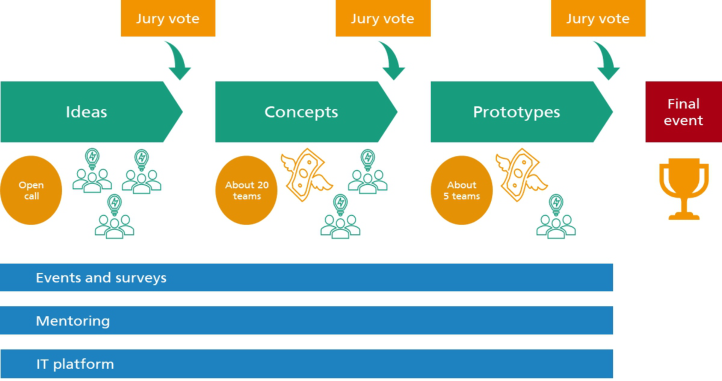
The FRANCIS project hosted one challenge already and will host another one this year. Each challenge has three rounds, aimed at fostering Frugal Inno- vation. The challenges start by inviting ideas through an open call, expecting participation from around citizens across three target countries (first round). These citizens can register as either ’participants,’ who will develop ideas, or as ’supporters,’ who will provide feedback to the participants’ ideas.
Challenge Process and Participants Each challenge is expected to attract participants forming teams of people. The project will assist in forming multidisciplinary teams of participants based on complementary skills. Teams may just include one person but are open to a maximum of five people. The teams are invited to submit their ideas during the first round. A jury will select the best 12 to 20 ideas at the end of the round and invite them to proceed to the next one aimed at detailing the ideas into concepts, encouraged by a financial grant. Participants are strongly supported by the mentors (see below) in this step, both with scientific meth- ods (the so-called ’Citizen Frugal Innovation toolbox’) and industry as well as business insights.
Figure 1: Challenge rounds.
Driving Citizen Frugal Innovation: Leveraging Insights of the FRANCIS Project 71
At the end of the second round, another jury voting will identify four to five concepts that proceed to the last round, again assisted by a financial grant. These teams will refine their concepts and create simple demonstrators, which will be showcased at an award ceremony. Participants receive a prototyping kit for this task that includes various crafting materials such as cardboard and modeling clay.
Mentors and Outreach Partners Each challenge is mentored by an ‘industry coach’, i.e. a company that assists the participants with technical and business insights and investigates scaling options for the final teams. Additional support is provided by local teams of project partners that assist with methodological training. As some teams may struggle with hands-on activities such as setting up convincing presen- tations, every team has a ‘challenge buddy’, i.e. a student assisting them throughout the challenge. The local teams use so-called ‘outreach partners’, i.e. organizations in the target countries with access to the target groups, to get participants and supporters involved.
Evaluation and Impact Measurement To measure the success of the concept of the FRANCIS project, the project tracks selected KPI with respect to participant demographics such as the percentage of marginalized groups and women involved in the project. The project has also set up goals with respect to the number of frugal innovations resulting from the project and the number of similar initiatives inspired by it.
Lessons learned on the success of the concept were collected in internal team meetings as well as interviews and surveys, which also included external stakeholders such as the participants of the challenge and the jury. To capture the project’s implications with respect to ethics and sustainability, FRANCIS uses a framework based on the so-called MoRRI indicators on Responsible Research and Innovation (MoRRI, 2018) and the United Nation’s Sustain- able Development Goals. The envisaged project results include both the tool and the data generated by it. As mentioned above, this paper focusses on insights derived from an analysis of the participation data (KPI) as well as an internal session on lessons learned during one of FRANCIS consortium meetings.
REVIEW OF THE FIRST CHALLENGE The first challenge was run in 2023. The following is an overview on its scope, its mentoring, and its outreach activities. It details the success of meeting the aims that the methodology aimed at and the proposed changes to be implemented in the second challenge.
Challenge One Scope: Household and Kitchen The first FRANCIS challenge, led by Bosch Home Appliances as the indus- try coach, focused on kitchen and household solutions. The challenge invited
participants from India, Germany, and Turkey to develop innovative solu- tions tailored to the distinct needs of families with limited income (‘trou- bled families’), individuals embracing a sustainable, minimalistic lifestyle (‘green minimalists’), and elderly people managing their own household (‘independent senior citizens’).
Participation Data The following is an overview on some of the participation data related to the project’s KPI. Relevant KPI presented in this chapter are the number of participants in each challenge round as well as their demographics (link to marginalized groups, countries of residence, gender).
The first challenge was launched in January 2023 on the project’s online platform. Participants were able to register and form teams. Offline events were arranged in all target countries to assist with registration. A total of 111 participants registered on the platform, forming 56 teams.
43 of the registered teams started working on an idea but only 27 suc- cessfully submitted their ideas at the end of the first round of the challenge. The decrease in numbers prior to idea submission shows that certain barriers prevented several interested individuals from successfully completing the first round. These numbers improved a lot in the second and final round. In the second round, 14 out of the 16 selected teams completed their submission. This positive trend continued in the third round, where all six chosen teams managed to finalize their submission. The increase in percentages suggests that the barrier to entry may have been focused on the initiation phase, i.e. problems with getting started. Discussions with participants during mentor- ing sessions suggest that teams that started without a concrete idea found it hard to come up with one in the first round.
During the ideation phase, participants from 13 different countries joined the challenge. Among the three specified target countries, India had the high- est number of registrations with 74 participants signing up on the platform. Germany followed with 12 registrations and Turkey with 11. The differ- ence in registration numbers is probably due to the different recruitment approaches used in each target country, which varied from online to face- to-face methods. In India, outreach partners were particularly successful in attracting participants to the challenge via mailings. A significant number of registered individuals, however, were students, who fell outside the pri- mary target demographic. They did show a high interest in the challenge but were not very successful in getting and staying involved. The number of participants from India that got involved in the first, second and last round dropped from 74 to 16 down to 0. In contrast, Germany’s recruit- ment efforts mostly focused on face-to-face events with the public in general and senior citizens in specific. Their involvement started with 12 partici- pants in the first round. Five stayed involved in the second, and three made it to the final round. In Turkey, recruitment efforts were conducted exclu- sively online but lead to similar results, even though the country struggled with various external events at the time such as an earthquake. The focus of the outreach activities as a result had to shift from social organizations to universities.
Driving Citizen Frugal Innovation: Leveraging Insights of the FRANCIS Project 73
Table 1. Challenge participants by country of residence.
Table available in the original PDF paper.
Country First Phase Second Phase Third Phase Number % Number % Number %
The participant demographic was well balanced in terms of gender. Out of the 111 total registered participants on the platform, 64% were male, 32% were female, and 2% identified as another gender. An additional 2% chose not to disclose their gender. In the final round, 56% of participants were male and 44% were female. This balance is noteworthy given the male-dominated nature of the technology innovation field.
The project also tracked how many participants identified with one or several of the challenge’s target groups – troubled families, green minimalists, and independent senior citizens. During the ideation phase, 69% of the regis- tered participants felt that they were part of at least one of the target groups. About 25% identified as troubled families, 29% as green minimalists, and 14% as independent senior citizens. 31% of the participants identified with other or no groups. The distribution of different target groups may partly reflect the difficulty in reaching certain groups and convincing them to attend an innovation challenge. Even with extensive information and support, it seems that senior citizens, for example, are harder to reach and inspire to attend a creative innovation activity. During the final phase of the challenge, only two target groups were represented by the remaining six teams: green minimalists (with 8 participants) and troubled families (with 2 participants).
The participants selected the target groups with which they identify them- selves during the participation phase. It is important to note that during data analysis, we noticed that some of the constellations were most likely false. For example, a 22-year-old Indian male identifying as an independent senior citi- zen. Additionally, a few individuals identified with none of the target groups and provided alternative options. The presence of acquiescence bias1 in the survey setting may have influenced the results and therefore should be con- sidered when approaching the second challenge. Therefore, the data must be viewed with some caution. However overall, the data indicates that the chal- lenge reached an adequate number of people in each target group and the project gained valuable insights from each group.
1Acquiescence bias, also known as agreement bias, is a response bias commonly found in survey research. It occurs when respondents tend to select a positive response option or indicate a positive connotation more frequently, without considering the content of the question or their true preference. This phenomenon is also referred to as ‘yea-saying’ (Smith, 2004).
Lessons Learned FRANCIS did a thorough review of the lessons learned in the first challenge in an internal session during one of the project’s consortium meetings in 2023. The following is a summary of key points. Improvements based on these lessons learned that will be included into the second challenge are detailed later.
The overall process of the challenge with the three rounds ideas-concepts- prototypes was considered a success. Participants enjoyed being involved and highlighted their appreciation of the creative sessions with the regional teams. The voting done by the regional teams as well as jury members and advisors also worked well, although it was considered a bit too complex.
The outreach of the project was successful in terms of getting the key tar- get groups involved as participants, i.e. marginalized citizens, both men and women, from different countries, see last chapter. Finding supporters, how- ever, was more difficult as was their involvement in feedback sessions. The consortium also still felt that there was still a strong involvement of ‘typical’ participants of innovation challenges (students and startup entrepreneurs). Outreach and mentoring showed that the different target groups also need tailored support as, for example, their creative processes and challenges with respect to IT differ.
When planning the first challenge, FRANCIS assumed that most partici- pants would be teams of several citizens and these citizens would be interested in finding team members during the challenge. Participation numbers and discussions with challenge participants, however, revealed that many citizens joined the challenge as individual participants without other team members. Finding team members during the challenge turned out to be difficult, even though some participants were willing to do so. Participants, who joined with pre-existing ideas, were unsure about the benefit of additional team members, especially when they faced language barriers. Teams with several ideas some- times split up, because only one submission per team was allowed. Some participants struggled to come up with an idea, despite being interested in the challenge.
Barriers related to language turned out to be a major hurdle in the first challenge. It was necessary to continuously monitor critical choices such as using a more formal vs. more informal language (in German: “Sie”vs. “Du”). Participants also sometimes received messages in other languages or com- bined with other languages, which confused them. Being able to communicate in their native language was of major importance to almost all participants, it seems. The platform and the IT-tools that were used in the first challenge, however, did not offer all needed languages (Turkish).
Participant mentoring worked well in some respects but not in all. It turned out to be difficult to find committed buddies and to keep them involved throughout the challenge. Although their assistance was not complex as such, the buddies needed a good understanding of all formalities of the challenge, and they had to continuously track the progress and react fast to support needs of the teams they were assigned to, tasks that were not easy for stu- dents with part-time involvement. In general, participants, however, enjoyed
Driving Citizen Frugal Innovation: Leveraging Insights of the FRANCIS Project 75
being involved in the challenge and specifically appreciated the individual support provided by the local teams in the second and third round. Having trusted, familiar mentors turned out to be an aspect of major importance for the participants. Some would have welcomed an exchange with other partic- ipants, despite their competitive position. FRANCIS did not plan for this in the first challenge because of confidentiality concerns.
The scaling of frugal innovation is, in general, a difficult issue. The FRAN- CIS consortium was aware of that at the start of the project. To support the scaling, the project involves industry coaches as mentors throughout each challenge and the follow-up with the winning teams. In the first challenge, the project’s startup expert InnoFrugal also assisted the mentoring to ensure that ideas beyond the scope of the coach are given sufficient consideration. The industry mentoring seemed to work considerably well in the first chal- lenge but the relatively low level of detail of the final concepts and the limited scope of the industry coach made the follow-up difficult, especially for teams with no or limited entrepreneurial aspirations.
PLANNING OF THE SECOND CHALLENGE The second challenge will be run in 2024. The following is an overview on the challenge scope and the planned modifications based on insights from the first challenge.
Challenge Two Scope: Hotel, Travel and Outdoor Experiences The second FRANCIS Challenge aims to improve hotel, travel, and out- door experiences in India, Germany, and Colombia. The initiative addresses a broad range of target groups, such as eco-conscious travelers, single travel- ers, and hotel staff. The challenge will be hosted by the FutureHotel network, a group of companies in the hospitality industry managed by Fraunhofer, as well as Globetrotter, an international market leader for outdoor equipment.
Planned Modifications The second challenge will improve some of the processes by streamlining workflows between tasks. In addition, it will further improve the fit of the methods (such as creativity exercises) and tools (such as the platform) to the target groups. Apart from these incremental changes, some major strategic decisions are currently in discussion. Table 2 below provides an overview of five of these decisions. Details are provided below.
Table 2. First challenge learnings and modifications of the second challenge in discussion.
Table available in the original PDF paper.
First challenge Second challenge
1. The challenge followed a three- step process supported by an online platform, small regional teams and a jury (members and advisors).
The challenge process will be kept as is, just the duration of the phases will be slightly changed, and the jury processes simplified.
Table 2. Continued First challenge Second challenge
Table available in the original PDF paper.
2. Outreach activities were planned by regional teams, supported by local partners.
Local partners will design and run out- reach activities, instructed by language teams. 3. Support was tailored to emerging teams of participants. Only one submission per team was allowed. Citizens were invited to join as par- ticipants or supporters.
The project will offer separate plat- forms for each language group.
Support will be tailored to single par- ticipants and existing teams. Several submissions could be allowed (within limits). Citizens will be allowed to join as participants only. 4. The project used one platform for participants from all language groups.
Mentoring will focus on single partic- ipants and existing teams. It will only be provided by the regional teams and maybe outreach partners.
5. Mentoring was tailored to new teams with several participants. Students were used as team bud- dies, who provide everyday sup- port.
Several companies will act as indus- try coaches, supported by the startup expert. The process will aim at more simple submissions in the first and more detailed ones in the second and third round.
6. One industry coach was supposed to help with the scaling of the ideas, supported by a startup expert. The level of detail in the first round was rather high in round one, and rather low in rounds two and three.
The process of the second challenge will be in line with the one of the first challenge. FRANCIS is just considering changing the duration of the rounds to some degree to make sure that sufficient time is given for outreach. The jury process will be simplified to make involvement easier for members and advisors.
Local partners that are in touch with the target groups turned out to be significantly important for the success of the outreach activities. The second challenge will therefore give more power to these partners. Instead of being mere supporters of activities designed by the local teams, they will be invited to design and run activities in the way that makes sense for them, supported by the local teams. They will also play a stronger role in the design of the mentoring. This will help FRANCIS to tailor the outreach and mentoring more to the specific needs of the different groups, genders, and countries.
As online matchmaking did not seem to work, especially across language groups, the second challenge of FRANCIS will tailor its support to single participants and existing teams with respect to the methods provided in the mentoring sessions. Every team will have a team captain to ensure that one person manages the submission and the team. Citizens will only be invited to get involved as participants not supporters. FRANCIS considers allow- ing multiple submissions per team and providing stronger and more tailored support for ideation.
Driving Citizen Frugal Innovation: Leveraging Insights of the FRANCIS Project 77
While the first challenge of FRANCIS used a multi-language platform for all participants, the second challenge will offer separate platforms to every language team to ease language-specific streamlining and avoid confusion. The regional teams and outreach partners will have more independence with respect to their mentoring based on this outline. The second challenge will only feature languages that are covered by the platform involved and the IT-tools, which will significantly lower the language barrier.
The mentoring of the second challenge will also change to some extent. FRANCIS decided to skip the buddy concept and offer support from the regional teams, the industry mentor, and startup expert.
In the second challenge, the industry mentoring will not be done by a single company but several ones. This will help FRANCIS to see if multi- coach mentoring has benefits with respect to scaling, although it will make the continuous mentoring more difficult. In addition, the level of detail of the submissions in the different rounds will be reviewed to ensure that start- ing participation in the challenge will be easier and final submissions will be more detailed than in the first challenge.
RELEVANCE AND OUTLOOK Current learnings from FRANCIS on Citizen Frugal Innovation include the four points that were highlighted in the abstract, i.e. the necessity a) to empower local outreach partners, b) to keep the regional teams small and dedicated, c) to separate the language groups, and d) to tailor the support for the needs of different groups of society.
At the end of the project, FRANCIS will provide insights on how soci- ety and industry can benefit from contributions of individual inventors and demonstrate the benefits but also hurdles of getting marginalized groups involved. The second challenge will show if the project team succeeded in leveraging lessons learned in the first challenge. It will show if and how open innovation challenges on frugal innovation that involve citizens can be done, what kind of results can be expected, and which aspects organizers must keep in mind to make the challenges work. Future research will be needed on open issues that the team struggled with. Scaling will probably remain one of these issues as well as problems resulting from a lack of suitable IT-tools.
ACKNOWLEDGMENT
The authors would like to acknowledge the enthusiasm and dedication of the citizens worldwide, who get involved in the challenges. The challenges could not be done without the various local outreach partners that help the project to get and keep citizens involved in the challenges; their support is of utmost relevance for FRANCIS. The project’s sincere thanks also go to the experts that constitute the project’s External Advisory Board and jury, who make sure that the project exceeds in scientific excellence and innovative rigorousness. Finally, FRANCIS would not be possible without the funding and continuous support of the European Commission. The feedback offered
by the project’s officer and reviewers provides an external perspective that is immensely important as feedback.
REFERENCES
Antuña Rozado, Carmen & Wohlfart, L & Gandikota, V & Åkerman, M & Duderstadt, Henning. (2022). How Frugal Innovation can empower citizens to make their life simpler and more sustainable. Insights from two ongoing initia- tives. IOP Conference Series: Earth and Environmental Science. 1122. 012063. 10.1088/1755-1315/1122/1/012063. Kaiser, Urban; Möbius, Katrin Tina; Klages, Tina. 2019. Chancen und Her-
ausforderungen von Kooperationen zwischen Forschungseinrichtungen und bürgerwissenschaftlichen Initiativen am Beispiel des Forschungsprojektes “CitizenSensor”. Klages, Tina. 2024. Open Innovation meets Citizen Science - Frugale Innovationen von und für Bürger*innen. Klages, Tina; Kaiser, Urban; Möbius, Katrin Tina; Weiss, Peter. 2020. Good-Practice-
Leitfaden für Co-Creation-Projekte. MoRRI (2018). MoRRI - Monitoring the Evolution and Benefits of Responsible Research and Innovation. Website: https://morri.netlify.app. Smith, Peter. (2004). Acquiescent Response Bias as an Aspect of Cultural Communi-
cation Style. Journal of Cross-cultural Psychology - J CROSS-CULT PSYCHOL. 35. 50–61. 10.1177/0022022103260380. Stanford University (2020). Design Thinking Bootcamp: Make Impact and Drive Growth in Your Organization. Website: https://dschool.stanford.edu/executive-e ducation/dbootcamp. Weyrauch, Thomas, and Cornelius Herstatt (2017). “What is frugal innovation?
Three defining criteria.” Journal of Frugal Innovation 2, no. 1 (2017): 1–17. Wohlfart, L. et al. (2023) “Mastering citizen involvement in international open innovation challenges: Interim lessons learned of the FRANCIS project”, proceed- ings of the International Conference on Industry Sciences and Computer Science Innovation 2023. Wohlfart, L.; Bünger, M.; Lang-Koetz, C. and Wagner, F. (2016). Corporate
and grassroots Frugal Innovation. A comparison of top-down and bottom-up strategies. Technology Innovation Management Review 6 (2016), Nr. 4, S. 5–17.
LISTED IN THE AHFE DIGITAL BOOKSTORE CATALOGUE
Explore the complete digital volume
Creativity, Innovation and Entrepreneurship
Read this individual research paper free through the original publisher, or explore the full digital proceedings book.
ISBN 978-1-964867-01-4
Explore this ISBN in the AHFE Bookstore ↗Listed in the July 2026 bookstore catalogue; search by ISBN to confirm current availability · Digital book purchase optional