Hiroshi Sasaki, Kenji Watanabe, Ichiro Koshijima (2024). Development of Approach for Improving Cybersecurity Governance for Factory systems. In: Human Factors in Cybersecurity. AHFE Open Access, vol. 127, pp. 219–224. https://doi.org/10.54941/ahfe1004781
As the digitization of factory systems progresses with mutual digital connections among them, cybersecurity risks throughout the supply chain also increase. In fact, there have been many cyber incidents where factories have stopped due to damage from ransomware. For large companies, it is possible to secure the budget and personnel for cybersecurity, including outsourcing. However, almost all small and mediums enterprises (SMEs) are facing with the difficulties to secure them.In this paper, we focus on how to improve governance for factory systems because our previous research revealed that it is the most critical challenge for SMEs to reduce cybersecurity risk of factory systems.In previous works, we developed an easier risk assessment tool consisting only 32 requirements based on Japanese government guidelines for factory systems. As a web tool survey result from 225 factory sites, more than 80% of SMBs found it inadequate to mitigate cybersecurity risks. We categorized the cybersecurity risks into the four factors which are “People”, “Process”, “Technology” and supply chain management of assets in the factory automation system (FA SCM). Some common results derived from the follow-up interviews show “People” factor consisting of governance and awareness is the root obstacle of the insufficient measures. So, we decided to clarify how to improve “People” factor for SMEs.To achieve it, we need to overcome two common challenges from our interview’s analysis below:- No risk assessment in the factory systems for common understanding the risk posture among the stakeholders (Executives, IT people, factory people)- No governance organization structureUsually, they installed some measures along the existing guidelines without considering. It causes that they become a mere shell. Our approach improves the failure.To consider the first challenge for SMEs, we developed the easy risk assessment workshop for factory people inspired by “Consequence-driven, Cyber-informed, Engineering” by Idaho National Lab which is originally developed for the engineering of critical infrastructure systems, because it has very simple concept for starting from the impact of the most undesirable events such as explosion, loss of quality control and production outage which can be easily understood by SMEs with insufficient cybersecurity knowledge. We conducted the workshop for people from some factory sites and succeeded to clarify the business risks in the factory systems.The second challenge is also important for “People” factor because SMEs need to build the management system for mitigating the risks derived from the workshop continuously.We applied the COBIT5 governance framework for enterprise IT to the management system for factory systems. The beauty of COBIT5 is the separation of governance and management. We used the concept for factory systems and determined a reference architecture of organization arranged to the roles in the normal and emergency state.In conclusion, we developed the effective approach improving governance for factory systems for SMEs. Our tools will be available in GitHub soon after the paper published.We plan to continue to consider how SMEs improve their cybersecurity readiness along the 32 items of Japanese guidelines.
As the digitization of operational technology (OT) in factories has increased susceptibility to cyberattacks in recent years, there have been numerous cyber incidents where factories stopped due to damage from ransomware. Notably, in the last few years, several factories shut down due to ransomware infections in information systems related to production. For instance, a cyber- attack on an automotive parts supplier in Japan led to the major automobile manufacturer relying on that supplier shutting down all domestic factories for a day. This symbolic example highlights how a supply chain with strength- ened digital connections can be affected by a cyberattack on any member, impacting not only the company itself but also its business partners.
In response to this situation, the importance of cybersecurity measures has recently been recognized even in factories. However, the organization
responsible for cybersecurity measures within factories remains unclear, and there is a lack of personnel with the necessary knowledge. Despite the increas- ing importance of cybersecurity in factory systems, many companies believe their current measures are sufficient. The challenge lies in assessing the degree of risk associated with factory systems and determining the appropriate level of investment.
This research aims to improve the cybersecurity governance for factory systems in SMEs because our previous research identified the “People”factor as the root cause of insufficient readiness.
PREVIOUS WORK In previous work, we developed an easier risk assessment tool consisting of only 32 items (GitHub, 2023). This tool is based on Japanese government guidelines for factory systems (METI, 2022). According to the results of a web tool survey conducted across 225 factory sites, more than 80% of SMBs found it inadequate for mitigating cybersecurity risks (Sasaki et al., 2023). We categorized these cybersecurity risks into four factors: “People,” “Pro- cess,” “Technology,” and supply chain management of assets in the factory automation system (FA SCM). Follow-up interviews revealed that the “Peo- ple” factor, which includes governance and awareness, is the root obstacle to implementing sufficient measures. Consequently, we aim to clarify how to improve the “People” factor for SMEs. To achieve this, we must address two common challenges identified during our interviews, as outlined in the subcategories below (Table 1):
1. Periodic Assessment: Lack of risk assessment in factory systems, hinder- ing a common understanding of the risk posture among stakeholders (including executives, IT personnel, and factory staff). 2. Governance: Absence of a clear governance organizational structure.”
Table 1. Checklist items by subcategory (Sasaki et al., 2023).
Table available in the original PDF paper.
This research aims to enhance the cybersecurity governance of factory systems in SMEs, addressing the critical issue of insufficient readiness.
Development of Approach for Improving Cybersecurity Governance for Factory Systems 221
BASIC CONCEPT OF APPROACH To improve the cybersecurity governance of factory systems, we need to raise awareness among factory personnel. The typical approach involves IT pro- fessionals disseminating common cybersecurity guidelines and rules to all factory staff at each site. However, factory workers often disregard these measures because they don’t fully understand the necessity behind actions like managing USB memory drives or patching outdated terminals. Our approach aims to address this gap. We have initiated a mindset shift among factory employees by creating cybersecurity incident scenarios to enhance risk awareness.
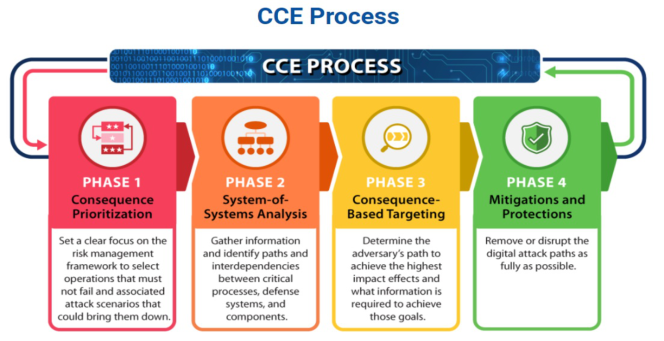
In pursuit of this goal, we developed an “OT risk workshop” specifi- cally for this purpose. For its development, we drew inspiration from the CCE concept. CCE is a methodology focused on securing critical infras- tructure systems at the national level. Originating from the Idaho National Laboratory, CCE operates under the assumption that if a skilled and deter- mined adversary targets a critical infrastructure system, that network will be penetrated. The “think like the adversary” approach provides critical infras- tructure owners and operators with a four-phase process to safeguard their essential operations. The following graphic illustrate each of the four phases of the CCE Methodology (Fig. 1). Our primary focus lies on “Phase 1: Con- sequence Prioritization” within these four phases. This phase is particularly accessible for factory personnel with limited cybersecurity awareness because it directly aligns with their business objectives, including production conti- nuity, safety, quality, environmental considerations, cost management, and timely delivery.
Figure 1: CCE process (INL, 2023).
To address the second challenge, which pertains to the lack of a governance organizational structure, we applied the COBIT5 governance framework for enterprise IT (ISACA, 2012) to the management system of factory systems. One of the notable features of COBIT5 is its clear separation between gov- ernance and management. We adapted this concept to the context of factory systems and established a reference architecture for organizing roles in both normal and emergency states.
OT RISK WORKSHOP We developed an OT risk workshop that provides factory personnel with the opportunity to recognize the connection between cybersecurity and opera- tional technology (OT) risks, as well as their business goals. Organizing this workshop is essential, and IT professionals should take the lead due to their cybersecurity expertise. Ideally, more than 10 factory employees from pro- duction management, production engineering, and the factory IT team should participate in managing the factory network. We conducted this workshop at several factory sites to refine our approach.
The workshop comprises three group activities, each lasting 30 minutes for group discussions. During these sessions, the group leader shares the results for 10 minutes. Here’s an overview of the workshop components:
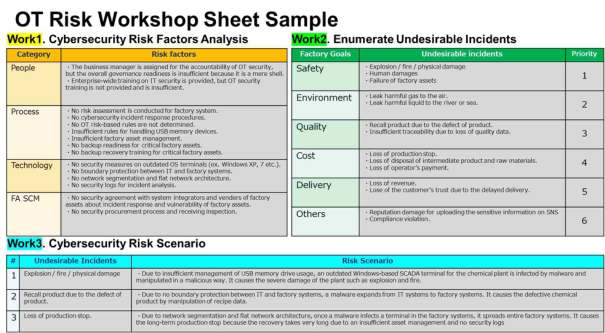
1. Cybersecurity Risk Factors Analysis: In the first activity, participants ana- lyze cybersecurity risk factors across four categories based on the Japanese guidelines’ checklists. Referring to the comprehensive checklist of 32 items is recommended. 2. Enumerating Undesirable Incidents: The second activity involves enu- merating undesirable incidents related to factory goals, such as safety, environment, quality, cost, and delivery. Importantly, participants should not consider cybersecurity during this step. Often, factory personnel tend to focus on cybersecurity incidents without fully understanding how they relate to undesirable outcomes. Therefore, they should purely consider the undesirable incidents. 3. Cybersecurity Risk Scenario: Finally, participants consider the top three cybersecurity risk scenarios, prioritizing incidents. They combine the results from the first and second activities to build these scenarios. IT professionals can assist in creating them, as specialized knowledge of cybersecurity may be necessary.
This workshop aims to enhance awareness and preparedness for cyberse- curity risks in factory systems. The sample result is shown for the reference (Fig. 2).
Figure 2: Sample result of OT risk workshop.
Development of Approach for Improving Cybersecurity Governance for Factory Systems 223
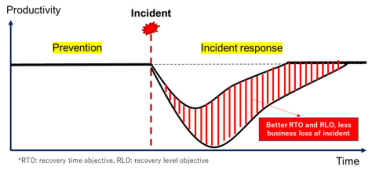
REFERENCE MODEL OF GOVERNANCE After the workshop, factory personnel need to maintain the momentum of mindset transformation. They should promptly establish a cybersecurity gov- ernance organization for factory systems. The typical approach involves IT professionals determining the roles of factory cybersecurity for the factory staff. However, this often results in governance becoming a mere shell because the factory personnel do not fully grasp the underlying purpose. To enhance the situation, we must keep the concept of productivity resilience in mind (Fig. 3).
Figure 3: Productivity resilience concept.
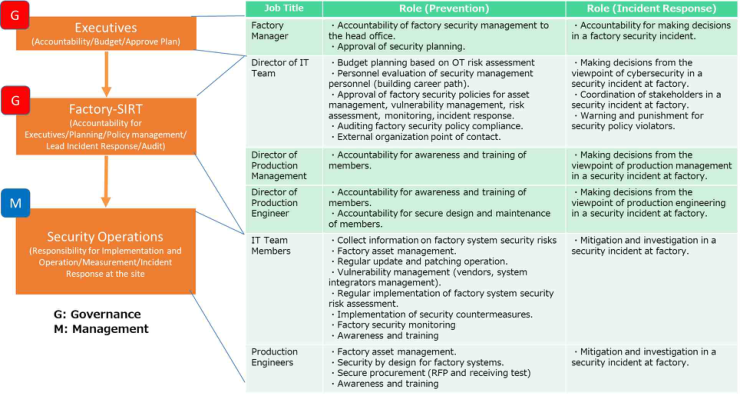
The purpose of cybersecurity measures is not merely their installation; it is business risk mitigation. In IT systems, this typically involves protecting information. However, in factory systems, the primary goal is production continuity. Therefore, quick incident response and recovery are as crucial as prevention because they mitigate business losses when incidents occur. We have developed a reference model for governance in factory systems, aligned with COBIT5, which delineates roles in both prevention and incident response (Fig. 4). This transition is seamless after the workshop, as factory personnel are already aware of the risks that need mitigation.
Figure 4: Governance reference model for factory systems.
At factory sites, executives who are usually factory managers handle accountability, budget approval, and plan endorsement. The Factory-SIRT, which serves as the core governance team for factory cybersecurity, is respon- sible for executives, planning, policy management, and leading incident response. When a cybersecurity incident occurs, the Director of the IT team coordinates stakeholders and oversees the incident response from a cyber- security perspective. The Director of Production Management determines whether production should be halted. The Director of Production Engi- neering assesses OT risks stemming from the incident. Finally, the Security Operations team is responsible for implementation, operation, measurement, and incident response at the site. Once factory personnel define the roles of factory cybersecurity based on the reference model, establishing cyberse- curity governance for factory systems becomes straightforward, enhancing readiness to mitigate the OT risks identified during the workshop.
CONCLUSION
In conclusion, we have developed an effective approach to enhance cyberse- curity governance for factory systems in SMEs. This approach is rooted in the understanding that the original purpose of cybersecurity is to mitigate business risks, rather than merely installing cybersecurity countermeasures according to guidelines. The OT risk workshop facilitates a better compre- hension of OT risks for all stakeholders. Following the workshop, factory personnel can easily establish factory cybersecurity governance using our developed reference organizational model. Our tools will soon be available on GitHub after the paper is published. Additionally, we plan to continue exploring how SMEs can enhance their cybersecurity readiness based on the 32 items outlined in the Japanese guidelines.
ACKNOWLEDGMENT
This research was supported by Fortinet Japan G.K. for collaborative work during the workshop. The authors extend their gratitude to the peer reviewers for their valuable feedback, which contributed to improving the quality of this manuscript.
REFERENCES
Bochman, A. A., & Freeman, S. (2021). Countering cyber sabotage: introducing consequence-driven, cyber-informed engineering (CCE). CRC Press. GitHub (2023), OT Security Simple Assessment https://github.com/OTSec-Hiroshi
-Sasaki/en-ot-security-simple-assessment. Last accessed 7 Jan 2024. INL (2023). Consequence-Driven Cyber-Informed Engineering https://inl.gov/cie/ ISACA, 2012. COBIT 5: A Business Framework for the Governance and Management of Enterprise IT, Isaca. METI., Study Group for Industrial Cybersecurity Working Group 1 (Systems,
Technologies and Standardization) Factory sub-working group. (2022). The Cyber/Physical Security Framework for Factory Systems (draft) Version 1.0: https://public-comment.e-gov.go.jp/servlet/PcmFileDownload?seqNo =0000236565 Sasaki, H., Watanabe, K., & Koshijima, I. (2023). Analysis of Cybersecurity Risk for Factory Systems. Human-Centered Design and User Experience, 114(114).
LISTED IN THE AHFE DIGITAL BOOKSTORE CATALOGUE
Explore the complete digital volume
Human Factors in Cybersecurity
Read this individual research paper free through the original publisher, or explore the full digital proceedings book.
ISBN 978-1-964867-03-8
Explore this ISBN in the AHFE Bookstore ↗Listed in the July 2026 bookstore catalogue; search by ISBN to confirm current availability · Digital book purchase optional