Kenta Nakayama, Ichiro Koshijima, Kenji Watanabe (2024). Analyzing important factors in cybersecurity incidents using table-top exercise. In: Human Factors in Cybersecurity. AHFE Open Access, vol. 127, pp. 105–114. https://doi.org/10.54941/ahfe1004770
In recent years, the threat of cyber-attacks has been increasing yearly. Various organizations should take countermeasures for it. In the face of increasing threats, organizations need to take not only technical measures but also human countermeasures. However, cyber-attacks themselves are becoming more sophisticated, so it is important for organizations to prepare countermeasures and organizational structures based on the assumption that incidents due to cyber-attacks will occur. Moreover organizations are required to minimize the damage caused by cyber-attack incidents and continue their business operations.This study focused on human countermeasures especially organizational structures, designed an incident response exercise, and conducted it with approximately 60 members of a critical infrastructure company in Japan. Based on the records of the exercise and the results of the post-exercise questionnaire, these results examine organizational and human barriers that organizations may face in incident response and the organizational structure that minimizes the damage from incidents. The incident response exercise was based on a scenario in which a hypothetical local infrastructure company was infected with ransomware and could not fulfill its role as a local infrastructure. The roles of management, IT department, and upper-level managers and personnel in the field departments were defined, and how incident response would be conducted from each position was examined. The exercise was recorded chronologically using the chronology used in disaster recovery, and the instructions given by whom and to whom were organized in chronological order so that the participants could look back on the details of their responses after the exercise. A questionnaire survey was conducted after the exercise, and the exercise itself received a high evaluation, with an average score of 4 or higher out of 5. In addition, information on important items in incident response, including changes before and after the exercise, was collected through free-response statements. Context-based evaluation and analysis of the collected results revealed what members of the Japanese critical infrastructure community consider important in incident response. Furthermore, from the contents recorded in chronology during the exercise, the process of escalation and decision-making to management and upper management was analyzed to identify barriers such as delays in reporting and decision-making that may lead to the expansion of incident damage. In addition, based on the results of these analyses, we will deepen our thinking and make recommendations on the organizational structure and transfer of authority for rapid incident response.
In recent years, the increase in cyber-attacks has made it imperative to secure not only technical measures but also human resources. However, cyber secu- rity personnel are in short supply, and in a survey of Japanese companies, approximately 88% said they lack cyber security personnel (KPMG, 2023). Therefore, cyber security training and exercises are being conducted for per- sonnel involved in IT systems and control systems (NISC, 2023). In light of these current conditions, cyber security exercises are one of the impor- tant security measures, and it is also important to review the organizational structure and process improvement cycle based on the exercise results. Exist- ing studies have proposed card game exercises with specific actions for any
given incident scenario (Mizuno 2019, Nakayama 2023). These can simu- late many incidents repeatedly to strengthen incident response capabilities. However, because the actions are specified, it is difficult for participants to think of their actions and put them into practice during the exercise. In addition, there is no system in place for review after the exercise or for post-incident response. In this study, a method in which participants assume specific roles and conduct exercises based on their ideas was considered. In addition, chronology, which is also used at disaster sites, was adopted as a recording method so that participants could look back on the content of the incident response. In addition, a simple incident response manual was pre- pared to assist participants, and they were encouraged to review the manual as necessary during the exercise. After the exercise, participants were asked to review the recorded chronology and revise the incident response manual to include the post-incident response phase. In addition, the recorded chronol- ogy revised manual, and post-exercise questionnaire were analyzed using text mining techniques. Through these analyses, we attempted to extract important elements in incident response and barrier elements that hinder the incident response. The extracted items will also provide insight into the nature of the organization and the transfer of authority.
METHODS
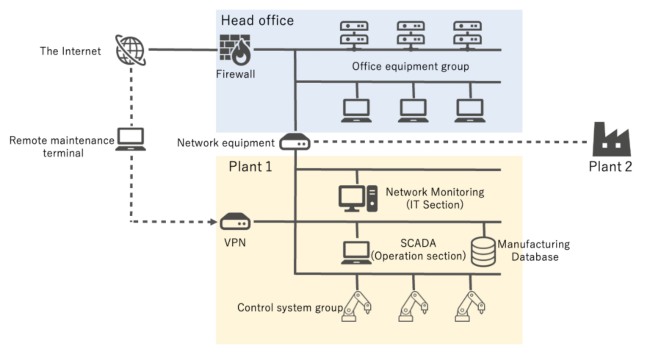
In conducting the exercise, a virtual company is set up so that participants can have a common understanding of the exercise. The virtual company is a company that has a control system and two plants from which it provides services. The services to be provided can be configured arbitrarily, but for this exercise, a service to supply heat sources to neighboring facilities was defined. As a prerequisite, a plant shutdown directly affects the business of the hypothetical company. In addition, if the control system in the plant becomes uncontrollable, human lives may be endangered. Figure 1 shows a network diagram of the virtual company. The participants in the exercise will work while looking at the network configuration diagram in Figure 1.
Figure 1: Network diagram of the virtual company.
Analyzing Important Factors in Cybersecurity Incidents Using Table-Top Exercise 107
In addition, participants are assigned roles in the virtual company shown in Table 1. Participants will engage in the exercise while considering their assigned role. Rather than having everyone participate in a discussion about incident response, participants are assigned specific roles, and by considering the priorities of each role, they cannot only resolve the incident, but also, if they are in management, consider the impact of the incident on the business, and if they are in the plant, to consider the impact of the incident on the plant operations and lifesaving. For plant personnel, the objective is to broaden their perspectives from multiple perspectives, including plant operations and lifesaving, and to gain an understanding and awareness of the different ele- ments and ways of thinking that are important in incident response as an organization.
Table 1. Characters and their roles in the virtual company.
Table available in the original PDF paper.
Loc. Role Role Details Head office Management Make management-related decisions Represent the organization, including accountability Sales Div. Performs operations for customers CSIRT Performs system security duties Has a role in planning, implementation, response, etc. Back Office Div. Perform tasks related to public relations, general affairs, accounting, and human resources IT Div. Performs construction, operation, and maintenance of internal information systems and infrastructure Manufacturing Div.
Performs duties related to the operation
Operate and maintain the plant to provide services Plant1 Plant Manager Oversee plant operations Operation Section (Boardman)
Monitors and operates SCADA screens Performs duties related to the operation
Operation Section (Fieldman)
Checks and operates on-site equipment
Instrumentation/ Equipment Section
Design accident prevention for process safety, occupational safety, etc.
Manage maintenance of plant instrumentation and equipment Safety Management Section IT Section Management and operation of the network in the plant Others Others *Set up as necessary in the exercise
Incident response exercises are conducted in the form of scenarios in which events occur over time, and each person in charge coordinates information and decides on a response policy. As shown in Table 2, the scenario of the incident response exercise is divided into three major phases: Predictive, Emergency, and Recovery. The total duration of the exercise is expected to be
70 minutes. The discussion during the exercise was conducted using chronol- ogy, which is also used in disaster response so that the discussion can be reviewed in chronological order. At a disaster site, information is organized in chronological order on a whiteboard, but for this exercise, chronology using Excel was adopted due to the need to tally the information. The chronol- ogy summarizes the content of discussions in chronological order and also records who contacted whom to clarify the information network at the time of incident response.
Table 2. Incident response exercise scenario.
Table available in the original PDF paper.
Phase Events Discussion Points Predictive (10 min) The customer informs sales that the service is not working.
What are the possible causes at this point?
What are the possible causes at this point?
Where is an internal inquiry considered appropriate?
Where is an internal inquiry considered appropriate? Fieldman told us the plant’s safety valve was open. *Meaning that some kind of abnormality has occurred in the actual equipment of the plant.
To what extent and how to report incidents that have occurred
Emergency (30 min) Threats are found on office terminals in Back Office Div. *Threatening letter Pay 50 BTC within 3 days or we will shut down the system
What are the possible business consequences?
To what extent and how to report incidents that have occurred
How do we decide whether or not to pay the ransom? Threats are found on SCADA terminals in Plant 1 *Threatening letter Pay 50 BTC within 3 days or we will shut down the system
What are the possible business consequences?
How do we decide whether or not to pay the ransom?
To what extent and how to report incidents that have occurred
What is considered to be the extent of ransomware infection? Recovery (30 min) SCADA terminal will no longer be able to control the plant *For the sake of the exercise scenario, let’s assume that no ransom was paid
How do you consider the impact on business continuity?
How do we decide to shut down the plant or operate it manually?
For this incident response exercise, a simplified manual was prepared by the JPCERT/CC incident response flow. During the exercise, participants
Analyzing Important Factors in Cybersecurity Incidents Using Table-Top Exercise 109
were asked to respond flexibly according to the situation while referring to this manual. After the exercise, participants practiced improving the manual and simulated post-incident response. The manual summarizes the general framework of incident response in a virtual company in the following five items.
Contents of the Incident Response Manual (JPCERT, 2021)
1. incident detection and reporting 2. initial response to the incident 3. notification of the incident 4. incident containment and recovery 5. post-incident response
Table 3. Content of post-exercise questionnaire.
Table available in the original PDF paper.
No. Question Answer Format Multiple choice 1 What was your most recent assignment? CSIRT, SOC, Information System Div., Manufacturing Div., Vendor/SIer, Others (Free text)
Free text
2 How many years of work experience do you have for Q1?
5-point rating
3 Please indicate any work experience other than Q1 Free text 4 Overall satisfaction with the incident response exercise (Small: 1 - Large: 5) 5-point rating 5 Please tell us the reason for the above Free text 6 Please rate your efforts during the exercise (Bad:1 - Good:5)
5-point rating
7 Will chronology be useful in the incident response? (1: Not useful at all - 5: Very useful) Free text 8 Please tell us about any difficulties you had in conducting the exercise.
Free text
9 What items in the incident response manual would speed up the incident response process?
Free text
10 Please tell us what you thought was important in incident response “before” this exercise.
Free text
11 Please tell us what, if any, changes you have made to your thoughts on Q10 “after” this exercise.
Free text
12 Please tell us what you learned and realized through this exercise.
Free text
13 Please tell us what could be improved for the exercise (e.g., what was difficult to understand) After the exercise, a questionnaire was administered to measure the effec- tiveness of the exercise. The content and format of the questionnaire are shown in Table 3. The background of the participants, their satisfaction with the exercise, their attitudes toward incident response before and after the exercise, and how they have changed since the exercise will be confirmed. In addition, the effectiveness of the chronology used in the exercise during inci- dent response will also be investigated. The text mining tool, User Local AI
Text Mining (https://textmining.userlocal.jp/), will be used for the free text responses.
RESULTS
The exercise lasted for three days and was attended by 63 participants (14 teams). The survey responses were collected for all teams, but the chronology of the exercise was corrupted for one team, so the results of 13 teams were used for the relevant analysis. Table 4 shows the number of participants and their level of satisfaction with the exercise for each day.
Table 4. Exercise participants and satisfaction with each schedule.
Table available in the original PDF paper.
No. Date Participants Teams Evaluation Point Avg.
Evaluation Point SD.
1 October 4, 2023 20 4 4.20 0.62 2 November 8, 2023 22 5 4.14 0.56 3 December 18, 2023 21 5 4.24 0.70
Satisfaction With the Exercise Each session scored an average of 4 or higher, proving that each session provided an exercise of equal quality with a high degree of satisfaction. This allows us to assume that the quality of the exercises will have a low impact on the results of the analysis in subsequent results, which will reflect the background and thinking of each participant. The backgrounds of the participants and the number of participants in each session are shown in Table 5.
Table 5. Background information on participants and number of participants per date.
Table available in the original PDF paper.
No. Role (Background) No. 1 No. 2 No. 3 Total A CSIRT 2 5 6 13 B SOC 1 3 2 6 C Information System Div. 9 4 4 17 D Manufacturing Div. 4 0 3 7 E Vendor/SIer 3 5 5 13 F Others 1 5 1 7
Evaluations of the Chronology in the Incident Response Exercise The validity of the chronology used in the exercise was also verified in questions 7 and 8 of the questionnaire. The results show that only No. 1’s evaluation of chronology during the exercise exceeded 4 points on average, while the average score for No. 2 and 3 was about 3.5 points. The stan- dard deviation also appears to be greater than 0.9 compared to No. 1. The backgrounds of the participants in each session were different, and they were
Analyzing Important Factors in Cybersecurity Incidents Using Table-Top Exercise 111
not evenly distributed as shown in Table 5. Therefore, the validity of the chronology was evaluated for each participant’s background, as shown in Table 6.
Table 6. Evaluation of the use of chronology during incident response for each background.
Table available in the original PDF paper.
No. Role (Background) Evaluation Point Avg. Evaluation Point SD.
A CSIRT 3.38 1.04 B SOC 3.50 1.05 C Information System Div. 3.82 0.95 D Manufacturing Div. 3.86 0.69 E Vendor/SIer 3.92 0.76 F Others 3.71 0.76
From these results, it can be seen that the CSIRT and SOC gave chronology a score of 3.5 or less, with a standard deviation of more than 1, indicating that the effectiveness of chronology is not well evaluated. The standard deviation for the Information System Division was 0.95, which is relatively close to the standard deviation for CSIRT and SOC. The common points among the three divisions are daily IT-related work, monitoring and operations, and actual cyber security incidents. The commonality among the three is that they are engaged in IT-related operations, monitoring, and operations daily, as well as in responding to actual cybersecurity incidents. Some of the comments in the questionnaire included, “I think it would be difficult to describe in the chronology when an actual incident occurs,” and it can be inferred that it would be difficult to describe in the chronology using Excel this time when an actual incident occurs. However, since the average evaluation out of 5 points was above the median, a certain effectiveness of the chronology was demonstrated in incident response exercises such as this one.
Important Factors in Incident Response The important items in incident response were identified in Q10 of the ques- tionnaire items, and changes in their thinking were checked in Q11 after the exercise. It was confirmed that 59% (37 respondents) of the total respon- dents changed their thinking or came up with additional ideas before and after the exercise and that more than half of the respondents brought about changes or new insights into their thinking about incident response before and after the exercise. The top five most frequently occurring nouns in the survey responses are shown in Table 7. The responses of those whose think- ing did not change before and after the exercise were retained in the table. In both questions, “information” appeared frequently after “response,” indicat- ing the importance of information in incident response. In addition, “speed” was ranked third before the exercise (Q3), but was ranked lower than fifth after the exercise (Q11). In Q10, “communication” and “manual” were also in the top five, but in Q11, “decision”was more frequent. This can be inferred as a result of the importance of decision-making in each role in the incident response exercises, as some roles require decision-making. The “response,”
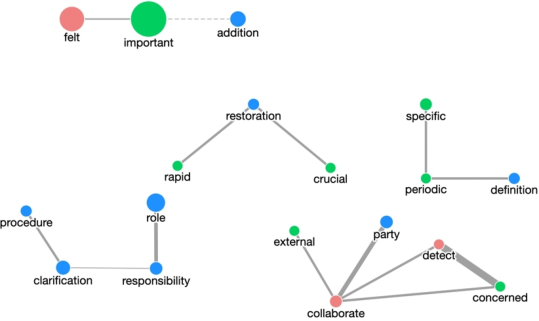
“manual,” and “incident,” which were also ranked in the same category, were incident response exercises that used some of the manuals. For further discus- sion, the results of Q11 were analyzed using a co-occurrence network shown in Figure 2. The co-occurrence network has been traditionally used in content analysis to statistically express the data (Osgood 1959, Danowski 1993).
Table 7. Ranking of frequently appearing words in survey questions 10 and 11.
Table available in the original PDF paper.
No. Before(Q10) After(Q11) 1 response 14 response 16 2 information 13 information 12 3 speed 9 incident 10 4 communication 8 manual, communication, decision 8 5 manual 7 - -
Figure 2: Co-occurrence network created from responses to survey Q11 (extract only items with 3 or more nodes).
Figure 2 shows that there is a network of roles and responsibilities and that these roles and responsibilities are linked to a network of clarification and procedures. In addition, the word “collaboration” is used as a starting point for considering and identifying external and other departments. Based on the results, it is considered important to clarify the roles and responsibilities of each person in incident response, and for the person in charge to make appropriate decisions based on these procedures. In addition, information is important to support these roles, and accurate information must be provided to the appropriate personnel during the incident response process. Therefore, it is important to show the roles, authorities, and procedures, including the organization structure, in advance of the incident response.
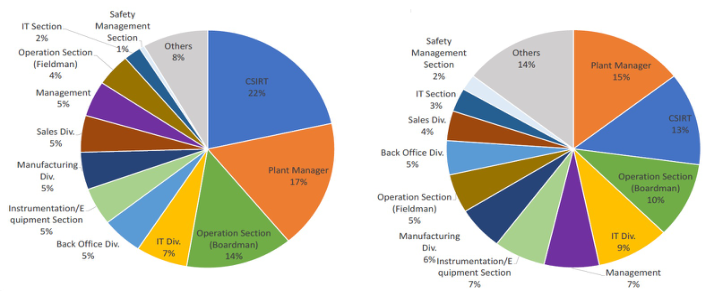
To examine the organizational structure, the contact source and contact person recorded in chronology during the exercise were analyzed, and the average percentage of appearances of these roles during the exercise was cal- culated and each is shown in Figure 3. CSIRT plays a central role in incident
Analyzing Important Factors in Cybersecurity Incidents Using Table-Top Exercise 113
response, followed by the plant manager, who is involved in the core of coor- dination during incident response. In the scenario of the incident exercise, the plant manager was entrusted with the final decision in many cases because the incident involved plant operations. In other words, the head of the site, who is involved in the core of the business when an incident occurs, is required to make appropriate judgments at the time of the incident. Therefore, it is necessary for the organization to define a central organization for incident response, such as a CSIRT, and a role for on-site management in the event of an impact on the company’s business, and to transfer the necessary authority to this organization.
Figure 3: Percentage of contact source (left) and person (right) listed on chronology.
CONCLUSION
In this study, an incident response exercise was conducted and the contents of the questionnaire and contact information recorded on the chronology were analyzed. The exercise was highly satisfactory overall, and more than half of the participants found it useful in changing their thinking about incident response and providing new insights after the exercise. In addition, analysis of the questionnaire and chronology confirmed the importance of clarifying information and the roles and authority of each person in charge of inci- dent response and establishing procedures in advance. In the future, we aim to create a mechanism for information coordination in incident response by analyzing the details of the roles that serve as a place for information collec- tion and the contents of the manual improvement exercise conducted after the exercise.
ACKNOWLEDGMENT
I would like to acknowledge the IPA Industrial Cyber Security Center Trainees who participated in this exercise, as well as Prof. Koshijima and Prof. Hashimoto for their support in conducting the exercise.
REFERENCES
Danowski, J. A. (1993). Network Analysis of Message Content. In W. D. Richards Jr. & G. A. Barnett (Eds.), Progress in Communication Sciences IV (pp. 197–221). Norwood, NJ: Ablex. JPCERT Coordination Center., (2021) Creation of Incident Response Man- ual. https://www.jpcert.or.jp/csirt_material/files/13_incident_response_manual _20211130.pdf KPMG. (2024). Cyber security Survey 2023. https://assets.kpmg.com/content/dam/
kpmg/jp/pdf/2024/jp-cyber-security-survey2023.pdf Mizuno, E., et al. (2021). Cyber Incident Response Tabletop Exercise to Raise Ownership. https://doi.org/10.11511/jacc.64.0_1152 Nakayama, K., Watanabe, K. (2023). Incident response exercises and method-
ologies to guide best practices for incident response in healthcare institutions. AHFE (2023) International Conference. AHFE Open Access, vol. 116. AHFE International, USA. http://doi.org/10.54941/ahfe1004378 NISC. (2023). Targeting 14 areas of critical infrastructure Cyber Exercise to Verify Disaster Response System-FY2023 “Cross-cutting Exercise” - https://www.nisc.g o.jp/pdf/policy/infra/NISC_enshu_20231208.pdf Osgood, C. E. (1959). The Representational Model and Relevant Research Meth-
ods. In I. d. S. Pool (Ed.), Trends in Content Analysis (pp. 33–88). Urbana, IL: University of Illinois Press.
LISTED IN THE AHFE DIGITAL BOOKSTORE CATALOGUE
Explore the complete digital volume
Human Factors in Cybersecurity
Read this individual research paper free through the original publisher, or explore the full digital proceedings book.
ISBN 978-1-964867-03-8
Explore this ISBN in the AHFE Bookstore ↗Listed in the July 2026 bookstore catalogue; search by ISBN to confirm current availability · Digital book purchase optional