Kenta Nakayama, Kenji Watanabe (2024). Recommendations for the use of resilience matrix in healthcare institutions. In: Human Interaction and Emerging Technologies (IHIET-AI 2024): Artificial Intelligence and Future Applications. AHFE Open Access, vol. 120, pp. 497–502. https://doi.org/10.54941/ahfe1004602
In recent years, the threat of cyberattacks has been increasing annually, necessitating organizations to prioritize security measures. This urgency is particularly critical in healthcare institutions, given their status as crucial infrastructures and the potential risks cyberattacks pose to human lives. However, limited IT investment in healthcare institutions has resulted in inadequate cybersecurity measures and underinvestment in IT infrastructure. Outdated and unsupported operating systems pose significant vulnerabilities, escalating the risk of security incidents. Despite the challenges imposed by limited IT investment, organizations must strive to develop resilience that enables swift recovery in the event of a security incident, even while accepting a certain level of risk. As it stands now, healthcare institutions that have gotten cyberattacks are hesitant to disclose some of the findings of security incidents involving vulnerabilities that have occurred at healthcare institutions because they reveal vulnerabilities within the industry and suggest the possibility of further cyber-attacks. However, NIST SP800-61, which is also a guideline for computer incident response, states that it is important to prepare for the next security incident by learning lessons from past security incidents. In the first half of this study, security incidents that have occurred in healthcare institutions in the past are discussed and issues are organized using the PPT (People, Process, and Technology) framework used to examine cybersecurity measures. In this study, issues were organized based on two hospital incident cases that occurred in Japan in 2021 and 2022 and for which investigation reports were issued.In terms of People (organizations), the lack of security personnel is positioned as the cause of incidents. However, healthcare institutions prioritize patient care, and for economic reasons, there is also the issue of difficulty in securing not only security personnel but also IT personnel.In terms of Process, the issues were that the information collection system for urgent vulnerabilities and the patch application process were not in place, and the password policy was not well maintained and was weak. In terms of Technology, the vulnerability of the equipment and systems had not been addressed, and the anti-virus system was not in operation. Due to the compatibility of the electronic healthcare record system, it was not possible to update the equipment or run the anti-virus.The second half of the paper will focus on People and Processes in particular, and organize their roles in the incident response phase using the Incident Command System (ICS). In a normal ICS, the five actors are Command, Operations, Planning, Logistics, Finance, and Administration, but since many of the roles played by the legal department could be read from the incident case studies, a resilience matrix was organized to identify the relevant actors. In the future, we will further discuss the practicality of the resilience matrix and the triggers and considerations for shifting to the OODA loop (Observe, Orient, Decide, Act) when responding to an incident by applying the results of previous studies, such as incident response exercises.
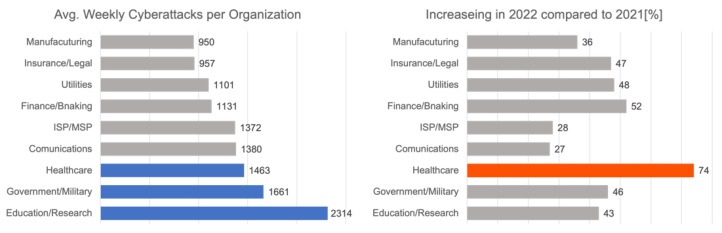
According to the annual report of U.S. security vendor Check Point, cyber- attacks worldwide increased by 38% in 2022 compared to 2021. In par- ticular, cyber-attacks targeting healthcare institutions have been on the rise recently, with an average of 1,410 cyber-attacks per organization per week occurring at healthcare institutions in the U.S. alone, an 86% increase from the previous year of 2021 (Figure 1) (Check Point, 2023). It is believed that the reason why cybercriminals attack healthcare institutions is that personal healthcare information is 20 to 50 times more valuable than personal finan- cial information (Kruse, 2017). They may be one factor that makes healthcare institutions targets of cyber-attacks.
Therefore, it is essential to promote security measures in healthcare insti- tutions, but they have been slow in taking organizational and technical countermeasures for cybersecurity due to their history of integration into net- works from previously independent systems and small budgets for security in IT capital investment (Kruse, 2017). Thus, organizations need to secure appropriate budgets for IT investments and at the same time take measures against cyber-attacks that can be implemented within a limited budget. In
addition, the report stated that they are hesitant to disclose some of the findings of security incidents involving vulnerabilities that have occurred at healthcare institutions because they reveal vulnerabilities within the industry and suggest the possibility of further cyber-attacks (Conn, 2016).
However, NIST SP800-61, which is also a guideline for computer incident response, states that it is important to prepare for the next security incident by learning lessons from past security incidents. In this paper, after organizing the issues of security incidents that have occurred in the past in healthcare institutions in terms of PPT (People, Process, and Technology), deepen the discussion in terms of Process, which is believed to be addressed with existing resources.
Figure 1: Avg. weekly cyber attacks per organization (left figure) and increasing rate in 2022 compared to 2021 per organization (right figure) (Check Point, 2023).
Method
The PPT (People, Process, Technology) framework, also known as the Golden Triangle, is used to examine security measures and represents three elements that inevitably interact (Caramancion, 2020). The reports of ransomware attacks on healthcare institutions in Japan in 2021 and 2022 will organize the responses to incidents in each role of healthcare institutions and recommend ways to improve them. The following two hospitals are examples of incidents to be referred to.
Case A: Handa Hospital (2021) (Morii, 2022)
In the early hours of October 31, 2021, the hospital system was infected with Lockbit2.0 ransomware
The vulnerability of VPN equipment was exploited to gain entry
BCP for earthquake disasters was activated and the incident was treated as a disaster from the beginning
During this time, the hospital stopped accepting new patients
On January 4, 2022, normal healthcare services were resumed after the system was restored.
Case B: Osaka General Medical Center (2022) (Inomata, 2023)
In the early morning of October 31, 2022, the hospital system was infected by Elbie ransomware
Recommendations for the Use of Resilience Matrix in Healthcare Institutions 499
The intrusion occurred through a VPN device of a food service vendor adjacent to the hospital
The BCP task force established to discuss restoration
Complete restoration, including surgical operations, was completed on January 16, 2023.
RESULTS
In both cases A and B, when an incident occurred, BCP (Business Continuity Plan) for a large-scale natural disaster was used to ensure business continuity and recovery. In each report, these causes are summarized in Table 1 from the perspective of PPT. After that, I would like to discuss each of the issues in cases A and B in more detail.
Table 1. Security incident issues with the PPT framework.
Table available in the original PDF paper.
PPT Security incident issues People
Insufficient security personnel and knowledge (A, B)
Lack of security awareness, knowledge, experience, and prepara- tion for incident response at IT system vendors (A, B) Process
Password policy is not in place (A, B)
Insufficient information collection system for vulnerability infor- mation, etc (A, B)
Policies and rules for external connections were not in place (A)
The boundary of responsibility at the time of contract was unclear (A, B) Technology
Weak passwords (A, B)
Vulnerabilities in equipment and systems were not addressed (A, B)
Anti-virus products have not been installed (A)
Standard port (3389) is allowed for RDP communication at all times (B)
ISSUES AND RECOMMENDATIONS IN PEOPLE It is emphasized that no matter how technology is considered human- independent, individuals will ultimately come into contact with technology at various points (Furnell, 2012). In both cases, a lack of security personnel was positioned as the cause of the incidents, but in healthcare institutions, the priority is to serve patients, and it is difficult to secure personnel for IT personnel as well as security, even for economic reasons (Kruse, 2017). In addition, while the security incidents were due to technical vulnerabilities, there are also security incidents based on human factors (phishing emails, social engineering) (Pollini, 2022). While it is important to secure human resources, it is also important for healthcare institutions to provide security education to personnel such as doctors and nurses, which is reported to be effective to a certain extent (Nifakos, 2021).
500 Nakayama and Watanabe
ISSUES AND RECOMMENDATIONS IN THE PROCESS The reasons for the vulnerability were the lack of an information collection system and patch application process for urgent vulnerabilities, as well as the lack of a password policy and its weaknesses. In particular, vulnerability responses are often not covered by the maintenance contracts with IT system vendors, which do not cover the provision of vulnerability information or version upgrades. Therefore, it is important to establish a policy for contracts with IT system vendors and the division of roles. In the latter part, Challenge & Discussion section will further discuss what kind of response process is required before and after an incident for each role of the person in charge by applying the existing framework.
ISSUES AND RECOMMENDATIONS IN THE TECHNOLOGY There were issues of equipment and system vulnerabilities that had not been addressed and anti-virus systems that had not yet been put into operation. In the case of general corporate IT systems, OS updates, and anti-virus installations would be performed, but in both cases, it was not possible to update equipment or run anti-virus due to the compatibility of the electronic healthcare record system.
Although the entire system would need to be modified to maintain system compatibility, budgetary and other issues may prevent such modifications from taking place. This response to the emphasis on system availability can be seen as similar in some respects to Operational Technology (OT) in the manufacturing industry (Uchenna, 2017). If the availability of legacy systems is to be emphasized as in factories, it would be useful as a countermea- sure to consider permission list-type endpoint security measures that only allow application operation for specific purposes, rather than those that stop operation such as anti-virus.
CHALLENGE & DISCUSSION In both cases, BCP for natural disasters was useful. It is also obvious that cybersecurity has caused as much damage as disasters in recent years, and BCP is considered to have had a certain level of effectiveness, especially in the healthcare field where human lives are at stake.
To consider the process of triggering BCP, the roles of actors in the inci- dent response phase are summarized using the Incident Command System (ICS) used in firefighting and other fields. In a normal ICS, the five actors are Command, Operations, Planning, Logistics, Finance, and Administration (Broder, 2012). By the way, the lack of a system for communication and main- tenance by the IT system vendor regarding vulnerability information that is commonly disclosed in both cases A and B is also mentioned as a cause of security incidents. There are many legal elements regarding contracts, and it is also important to confirm appropriate contracts at the time of IT system implementation through legal documents. As for case B, there was also an intrusion from the network from a food service vendor, and it is necessary to pay attention to the security of the supply chain again. For this reason,
Recommendations for the Use of Resilience Matrix in Healthcare Institutions 501
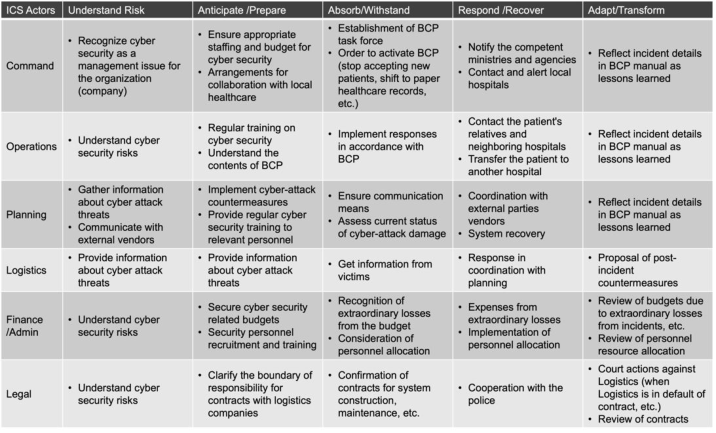
this study will focus on clarifying the boundary of responsibility in the event of a security incident involving the supply chain. Therefore, the role of legal affairs will be added to the ICS actors, and the resilience matrix proposed in Horizon 2020 (SmartResilience, 2019) will be used to organize the response of each ICS actor in normal times and emergencies. Although the original matrix is organized within a broad framework of systems, organizations, and information, it does not organize the response that is incorporated into each organization’s role. Then incorporating the actions of each response phase into the roles of each organization is believed to provide a more concrete indicator for incident response. Figure 2 shows an incident matrix that orga- nizes the processes that the 5 actors of ICS and the legal should respond to during each incident phase based on cases A and B. Also, logistics in this matrix for healthcare institutions can be replaced with IT system vendors for a better understanding.
Figure 2: Incident matrix with ICS actors and legal.
The response process for all parties involved was organized based on the ICS and Horizon 2020 resilience matrix. Of special note for healthcare insti- tutions is crisis communication, such as the transfer of patients to and from local healthcare institutions at the time of an incident. It is important to ensure that these communication systems and means are in place in advance of an incident during the preparation phase. In addition, these processes need to be reviewed through the PDCA cycle to ensure that there are no omissions in the response through incident response training. Moreover, it is important to utilize the OODA loop (Observe, Orient, Decide, Act) instead of the usual PDCA cycle during emergencies.
In the future, training and demonstration experiments will improve the incident matrix and deepen the consideration of triggers for following the OODA loop during incident response.
502 Nakayama and Watanabe
CONCLUSION
This paper reviewed incident cases of Japanese healthcare institutions from the perspective of PPT and provided recommendations for each issue. This paper tried to apply existing frameworks to the response to incidents, partic- ularly in process, and makes recommendations for enhancing organizational resilience, depending on the role of the person in charge of the field. As noted earlier, it is important to learn from the lessons of security incidents that do occur. This research expects that the lessons learned from the incidents that occurred and the resilience matrix discussed will serve as an indicator for improving the resilience of each organization. In addition, the resilience matrix should be improved by creating training based on it and then imple- menting the training. The creation of applicable training and improvement of the resilience matrix will be a future issue.
REFERENCES
Broder, J. F., & Tucker, E. (2012). “Emergency Management – A Brief Introduction.”
In J. F. Broder & E. Tucker (Eds.), Risk Analysis and the Security Survey (Fourth Edition). pp. 101–112. Butterworth-Heinemann. ISBN 9780123822338. https: //doi.org/10.1016/B978-0-12-382233-8.00012-1. Caramancion, K. M. (2020). An Exploration of Disinformation as a Cybersecurity Threat. 440–444. 10.1109/ICICT50521.2020.00076. Check Point Research Team. (January 5, 2023). Check Point Research Reports a
38% Increase in 2022 Global Cyberattacks. Check Point Website: https://blog.c heckpoint.com/2023/01/05/38-increase-in-2022-global-cyberattacks/ Conn, Joseph. (April 16, 2016). Federal task force takes on healthcare cybersecurity. Modern Healthcare Website: https://www.modernhealthcare.com/article /20160416/MAGAZINE/304169890/federal-task-force-takes-on-healthcare-cyb ersecurity Furnell, S., Clarke, N. (2012). Power to the people? The evolving recognition
of human aspects of security. Computers & Security. Volume 31, Issue 8, pp. 983–988. https://doi.org/10.1016/j.cose.2012.08.004. Inomata, Atsuo. (May 23, 2023). Information Security Incident Investigation Committee Report. Osaka General Medical Center Website: https://www.gh.opho.jp/p df/report_v01.pdf Kruse, C. S., Frederick, B., Jacobson, T., & Monticone, D. K. (2017). Cybersecurity
in healthcare: A systematic review of modern threats and trends. Technological Health Care, 25(1), pp. 1–10. doi: 10.3233/THC-161263. Morii, Masakatsu. (Jun 7, 2022). Computer Incident Report. Handa Hospital Website: https://www.handa-hospital.jp/topics/2022/0616/report_01.pdf Nifakos, S., Chandramouli, K., Nikolaou, C. K., Papachristou, P., Koch, S.,
Panaousis, E., & Bonacina, S. (2021). “Influence of Human Factors on Cyber Security within Healthcare Organisations: A Systematic Review.” Sensors, 21(15), 5119. https://doi.org/10.3390/s21155119. Pollini, A., Callari, T. C., Tedeschi, A., et al. (2022). “Leveraging human factors in cybersecurity: an integrated methodological approach.” Cognitive Technology Work, 24, 371–390. https://doi.org/10.1007/s10111-021-00683-y. SmartResilience. (2019). Smart Resilience Indicators for Smart Critical Infrastruc-
tures. CORDIS Website: https://cordis.europa.eu/project/id/700621 Uchenna, P., Ani, D., He, H. (Mary), & Tiwari, A. (2017). “Review of cybersecurity issues in industrial critical infrastructure: manufacturing in perspective.” Journal of Cyber Security Technology, 1(1), 32–74. DOI: 10.1080/23742917.2016.1252211.
LISTED IN THE AHFE DIGITAL BOOKSTORE CATALOGUE
Explore the complete digital volume
Human Interaction and Emerging Technologies (IHIET-AI 2024): Artificial Intelligence and Future Applications
Read this individual research paper free through the original publisher, or explore the full digital proceedings book.
ISBN 978-1-958651-96-4
Explore this ISBN in the AHFE Bookstore ↗Listed in the July 2026 bookstore catalogue; search by ISBN to confirm current availability · Digital book purchase optional