Theofanis Fotis, Kitty Kioskli, Haralambos Mouratidis (2024). Human Factors and Cybersecurity in NHS Virtual Wards. In: Human Factors in Cybersecurity. AHFE Open Access, vol. 127, pp. 225–235. https://doi.org/10.54941/ahfe1004782
University of Essex, School of Computer Science and Electronic Engineering, Institute of Analytics and Data Science (IADS), Parkside Office Village, Wivenhoe Park, Colchester CO4 3SQ, United Kingdom ↗
The rapid evolution of healthcare technology, particularly in the wake of the COVID-19 pandemic, has seen a significant rise in the set-up and expansion of Virtual Wards by the National Health Service (NHS) in the United Kingdom. Virtual wards (also known as hospital@home) allow patients to get hospital-level care at home safely and in familiar surroundings, helping speed up their recovery while freeing up hospital beds for patients who need them most. Patients are reviewed daily by the clinical team and the ‘ward round’ may involve a home visit or take place through video technology. Many virtual wards use technology like apps, wearables and other medical devices enabling clinical staff to easily check in and monitor the person’s recovery. This paradigm shift, while revolutionary in extending healthcare services to patients remotely and out of the hospital, brings with it cybersecurity challenges sourced by the new infrastructure and directly relevant to the involved stakeholder’s human factors.The presentation will describe the context of NHS virtual wards explore the user interface design, usability, and accessibility of virtual ward technologies, and discuss how these factors impact both patients and healthcare professionals. Particular attention will be paid to the challenges faced by diverse patient groups, including the elderly and those with disabilities, in navigating virtual healthcare environments and how these characteristics affect the vulnerabilities of virtual ward technologies, from a human factors point of view. An examination of regulatory frameworks and standards, the role of patients and staff training in cybersecurity awareness, and the integration of advanced security measures within these new healthcare infrastructures. The presentation will discuss the importance of conceptualising the human-centric approach in maintaining and promoting cyber hygiene in Virtual Wards and propose a multi-disciplinary approach to address these challenges through privacy-by-design modelling of Virtual Wards, advocating for collaboration between patients, healthcare professionals, IT experts, cybersecurity specialists, and policymakers.
Over the past decade, the National Health Service (NHS) in the UK has undergone a significant digital transformation journey, driven by the Long- Term Plan initiated in 2019. This plan outlines the NHS’s commitment to
leveraging technology to enhance healthcare delivery over the next decade, highlighting its pivotal role in improving citizen care. As part of this trans- formation, and in response to the challenges posed by the pandemic, virtual wards have been introduced, also known as “hospital at home” programs, building upon the pioneering “virtual ward” model first utilized in Croydon, south London, in 2004.
These virtual wards employ a multidisciplinary team approach, incor- porating remote monitoring technology, regular virtual consultations, and occasional in-person visits from healthcare professionals (Norman et al., 2023). This innovative model offers several benefits, including alleviating strain on hospital resources, empowering patients with greater control over their recovery in familiar surroundings, and potentially expediting healing by reducing exposure to hospital-acquired infections (Taylor & O’Mahony, 2021). However, the transition to virtual wards presents challenges, particularly in the domains of human factors and cybersecurity, stemming from the new out-of-hospital environment, infrastructural adjustments, supply chain con- siderations, and the involvement of human stakeholders. On the human factors front, disparities in digital literacy, social isolation, and potential tech- nology dependence among patients necessitate tailored solutions to ensure equitable access and prevent exacerbating existing vulnerabilities. Healthcare professionals must adapt their communication and assessment skills to the virtual environment, effectively fostering relationships and managing patient expectations in situations where physical presence is limited. Moreover, the reliance on technology introduces a new dimension of risk, underscoring the need for robust cybersecurity measures to safeguard sensitive patient data and ensure the integrity of remote care delivery. This includes implementing rigorous network security protocols, providing comprehensive staff training in data protection, and proactively identifying and mitigating potential cyber threats to maintain patient trust and uphold the integrity of the healthcare system.
The aim of this paper is to delve into the realm of NHS virtual wards, with a specific focus on the design, usability, and accessibility of their user interfaces, and to explore their impact on both patients and health- care professionals. It will particularly address the challenges faced by diverse patient groups, including the elderly and individuals with disabili- ties, when navigating virtual healthcare environments, and analyze how these challenges influence the vulnerability of virtual ward technologies from a human factors standpoint. Additionally, the paper will examine regulatory frameworks and standards, the importance of patient and staff training in enhancing cybersecurity awareness, and the integration of advanced secu- rity measures within these evolving healthcare infrastructures. Emphasizing a human-centric approach, this paper will propose a multi-disciplinary strategy to tackle these issues, advocating for the implementation of privacy- by-design principles in Virtual Wards and fostering collaboration among patients, healthcare professionals, IT experts, cybersecurity specialists, and policymakers.
Human Factors and Cybersecurity in NHS Virtual Wards 227
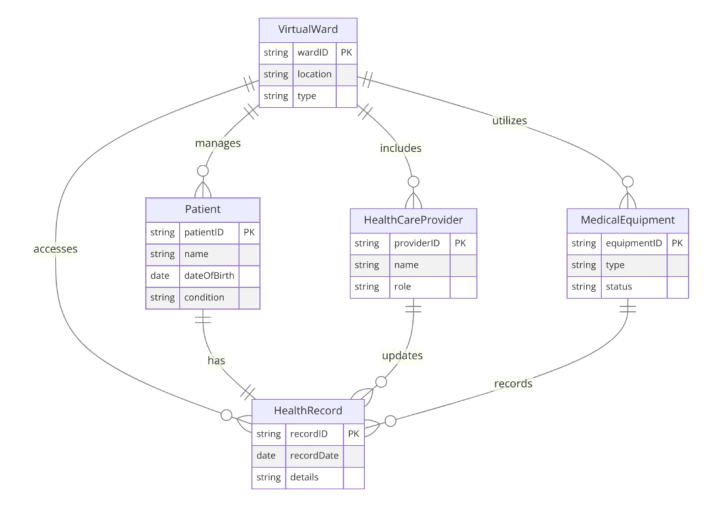
NHS Virtual Wards Infrastructure At its core, a virtual ward functions as a hospital-level care unit operating remotely. Patients receive the necessary medical attention while residing in their own homes, or potentially in care homes, fostering a sense of famil- iarity and comfort during recovery (Carrier & Newbury, 2016). This model typically involves a multi-pronged approach. Remote monitoring technology, employing wearable devices and sensors, captures vital signs and health data in real-time (see Figure 1). Regular virtual consultations, facilitated by secure video conferencing platforms, enable healthcare professionals to monitor progress, adjust treatment plans, and address patient concerns. Addition- ally, in-person visits provide essential hands-on care and physical assessments, bridging the gap between virtual and traditional modalities.
Figure 1: A simple schematic representation of a potential virtual ward.
The genesis of NHS virtual wards can be traced back to the early 2000s, with the Croydon Primary Care Trust pioneering the concept. Initially focused on managing chronic conditions such as chronic obstructive pul- monary disease (COPD),the model gradually expanded to encompass a wider range of medical needs (Guardian, 2007). The COVID-19 pandemic served as a potent catalyst, accelerating the adoption of virtual wards due to their ability to manage patients outside of potentially saturated hospital settings. Today, numerous NHS trusts across the UK implement a diverse array of vir- tual ward programs, catering to various patient populations and conditions, from post-operative care to managing respiratory infections and supporting individuals with frailty (Elias et al., 2023).
While NHS virtual wards hold the promise of accessible, convenient, and efficient healthcare by shifting the center of care to the patient’s home, effec- tively facilitating this human-computer interaction becomes crucial. In this remote monitoring environment where patients remain in familiar surround- ings, user-friendly interface design is the cornerstone of equitable access, optimal care delivery, and ultimately, patient and healthcare professional satisfaction (Henni et al., 2022).
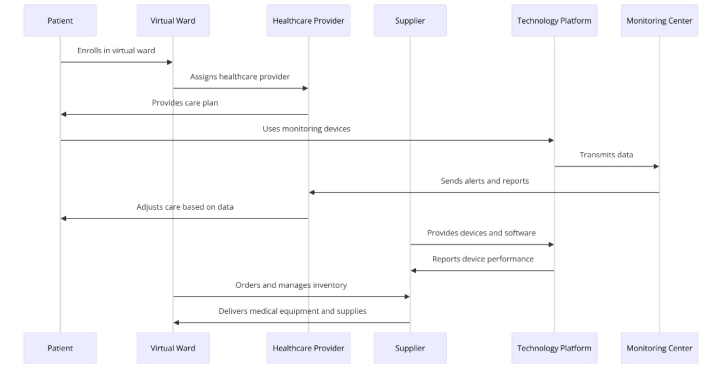
Visual representation of the supply chain of virtual wards can take vari- ous approaches. Some platforms may prioritize straightforward functionality, mimicking familiar web interfaces with clearly categorized options and intu- itive navigation, while others may adopt a more immersive approach, utiliz- ing gamification elements or personalized dashboards to enhance engagement and self-management. Regardless of the approach, challenges regarding usability remain a persistent concern (see Figure 2).
Figure 2: A potential supply chain of a virtual ward.
One major usability hurdle pertains to the inherent complexity of manag- ing health information. Patients, often grappling with anxiety and unfamiliar medical terminology, require interfaces that present data in a clear, concise, and readily understandable manner. Complicated dashboards, excessive jar- gon, and complex navigation pathways can exacerbate existing anxieties and impede efficient care management. Similarly, healthcare professionals navigating virtual care platforms require efficient data visualization tools, streamlined communication functions, and intuitive workflows to optimize their time and deliver effective care (Brewer et al., 2020; WHO, 2018).
The impact of usability shortcomings can be significant for patients, where frustration and confusion can lead to reduced engagement, missed medica- tion doses, and ultimately compromised health outcomes. These challenges can be exacerbated for elderly patients, individuals with disabilities, and those with limited digital literacy, for whom specific design considerations
Human Factors and Cybersecurity in NHS Virtual Wards 229
are required to ensure equitable access and prevent the widening of existing health disparities (Wadhwa et al., 2019).
Addressing these challenges requires a multifaceted approach through robust usability testing involving diverse patient and healthcare professional demographics to identify and eliminate design flaws. Incorporating user- centered design principles from the outset and involving real end-users in the development process are crucial steps. Ensuring user needs are met at every stage and adopting established accessibility guidelines and best practices in virtual wards are essential for enhancing usability and accessibility (NHS, 2023; Van Kessel et al., 2022).
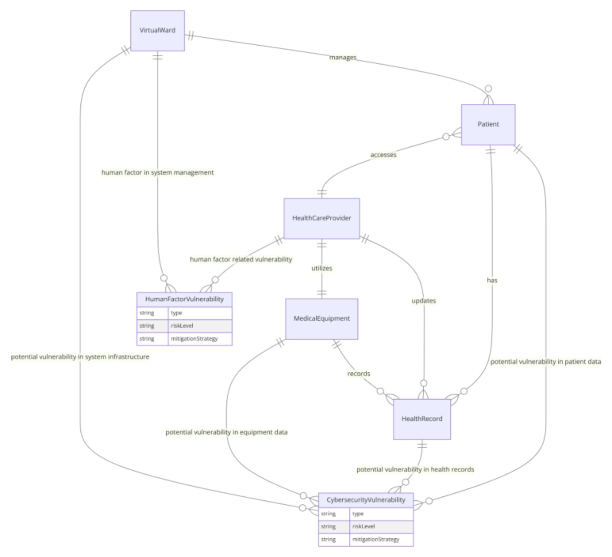
Virtual Wards, Human Factors and Cybersecurity Vulnerabilities As virtual wards transform healthcare landscapes, their unique and new sup- ply chain with digital interconnectedness, where medical data, diagnoses, and medication plans are shared through a complex network of devices, plat- forms, and healthcare professionals, combined with the patient at home, introduces new vulnerabilities and cybersecurity threats (Kioskli et al., 2023; Ntantogian et al., 2021) see Figure 3.
Figure 3: Cybersecurity vulnerabilities in a virtual ward.
Human Factors: The Weakest Link?
While sophisticated technology safeguards are typically present in hospital infrastructures, in a ‘hospital at home’ setting, the human factor becomes a critical aspect of cybersecurity and may act as the weakest link in the cyber- security chain. Considering the diverse range of patients at home, several key factors contribute to this vulnerability (Nifakos et al., 2021; Yeo et al., 2022):
1. Lack of Cybersecurity Awareness: Many patients and healthcare profes- sionals may have limited understanding of online threats and safe prac- tices, making them susceptible to phishing attacks and social engineering manipulation. 2. Weak Passwords and Data Sharing: Practices such as password reuse or sharing passwords with relatives and caregivers can provide easy access for attackers. Additionally, casual data sharing through personal email or unencrypted platforms compromises patient privacy and exposes sensitive information. 3. Negligence and Human Error: Simple oversights, such as leaving devices unattended or failing to update software patches, can create exploitable vulnerabilities for malicious actors to exploit.
Addressing these human factors and promoting cybersecurity awareness among patients and healthcare professionals is crucial to mitigating these risks and ensuring the security of ‘hospital at home’ environments. Measures such as comprehensive cybersecurity training, robust password management policies, and regular security audits can help strengthen the cybersecurity posture of virtual healthcare settings.
Furthermore, relevant studies on human factors influencing cybersecu- rity compliance among healthcare staff indicate a correlation between work pressure, deficient information security knowledge, and negative informa- tion security attitudes with increased Information Security Conscious Care Behaviour (ISCCB) risks. Conversely, healthcare professionals exhibiting greater agreeableness, openness, and those operating within a robust secu- rity culture demonstrate reduced likelihood of engaging in risky cybersecurity behaviours. Intriguingly, conscientiousness was unexpectedly associated with higher ISCCB risks and perceived severity of punishment. This finding emphasizes the importance of designing intuitive, workflow-integrated secu- rity protocols and providing continuous security education within healthcare environments (Yeng et al., 2022).
Mitigating the Human Factor: Building Cyber Resilient Virtual Wards Through Privacy by Design Within the healthcare sector, several existing cybersecurity solutions have been deployed. Notable examples include the use of endpoint device manage- ment tools, remote work environment security measures, security awareness training, technical controls, and mechanisms for incident reporting and cyber threat intelligence (He et al., 2021). However, these established solutions are primarily implemented within hospital settings and lack rigorous eval- uation in out-of-hospital, community-based healthcare contexts, particularly
Human Factors and Cybersecurity in NHS Virtual Wards 231
for novel infrastructures such as the virtual ward models. Given the evolving nature of virtual wards and the absence of established best practices, their cybersecurity status remains under-researched.
Given the diverse stakeholder interactions and inherent complexities within virtual wards, as discussed above, security demands a multi- faceted, customized approach. Privacy by Design offers a promising frame- work, having demonstrated effectiveness in similarly complex infrastructures (Alkubaisy et al., 2022, Al-Obeidallah et al., 2023). To address the spe- cific security vulnerabilities of virtual wards, we propose the adaptation of a Privacy by Design approach combined with co-designing principles, that encompasses several strategies, including:
Regular Training: Providing ongoing training for both patients and health- care professionals to recognize threats, adopt safe online habits, and safeguard sensitive information (Burton et al., 2023).
Strong Security Measures: Enforcing strong password policies, implement- ing multi-factor authentication, and utilizing data encryption across all virtual ward platforms and devices.
Insider Threat Mitigation: Identifying and addressing potential insider threats through background checks, access controls, and ethical training.
User-friendly Security Integration: Integrating security measures into plat- forms in a user-friendly manner that doesn’t hinder usability.
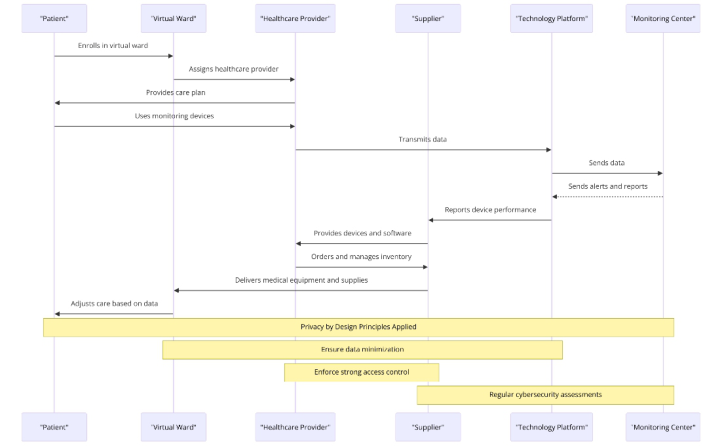
This multi-pronged approach relies on open communication, shared responsibility, and a collective commitment to privacy by design (Clarke, 2014; Debatin et al., 2020). Patients should be empowered to access, under- stand, and control their data through intuitive interfaces and transparent policies. Healthcare professionals require training and support to navigate data regulations and implement secure practices. IT experts must prioritize encryption, user authentication, and robust system monitoring. Collabora- tion between cybersecurity specialists and healthcare professionals is essential for conducting regular risk assessments and vulnerability testing. This collab- oration can be shaped further by applying co-design methodologies, where stakeholders collaboratively design and implement solutions (Darley, 2022). By bringing together the patients, the expertise of cybersecurity profession- als, IT staff and healthcare professionals and providers, co-design fosters a deeper understanding of security vulnerabilities and user needs. This col- laborative approach can lead to the development of more user-friendly and effective security solutions that consider the specific workflows and chal- lenges faced by healthcare personnel. Additionally, co-design empowers all stakeholders to take ownership of cybersecurity practices, fostering a culture of shared responsibility and leading to more sustainable and effective secu- rity outcomes. Policymakers, guided by ethical principles and public trust, should establish clear data governance frameworks and hold all stakeholders accountable for data security (Diamantopoulou et al., 2017). See Figure 4 for an illustration of these principles in action.
Figure 4: A hypothetical privacy by design approach for a virtual ward.
CONCLUSION
NHS virtual wards represent a remarkable advancement in healthcare deliv- ery, promising to reshape the landscape of patient care. However, the integration of these virtual care settings brings with it a set of cybersecurity vulnerabilities that demand careful consideration and proactive measures. As we move forward, it is essential to recognize and address these vulnerabilities to ensure the safety, security, and effectiveness of virtual ward environments.
Clinical implications abound in the context of cybersecurity vulnerabilities within virtual wards. Patient data security is paramount, and any breach or compromise could have serious consequences for patient confidentiality and trust in the healthcare system. Therefore, clinical practitioners must remain vigilant in implementing robust cybersecurity protocols to safeguard patient information and uphold professional standards of care. Additionally, the potential for cyberattacks to disrupt vital healthcare services underscores the critical importance of maintaining uninterrupted access to patient care, even in the face of digital threats.
Practical implications of addressing cybersecurity vulnerabilities in vir- tual wards extend beyond the clinical realm. From a practical standpoint, healthcare organizations must invest in comprehensive cybersecurity train- ing for both staff and patients to foster awareness and preparedness for potential threats. Furthermore, the development and implementation of advanced encryption techniques, decentralized data storage models, and arti- ficial intelligence-powered threat detection systems can enhance the security posture of virtual ward environments, bolstering patient trust and confidence in remote healthcare delivery.
Moreover, addressing cybersecurity vulnerabilities in virtual wards holds broader implications for the healthcare system as a whole. By prioritizing the
Human Factors and Cybersecurity in NHS Virtual Wards 233
integration of secure and accessible care practices, healthcare organizations can promote equitable access to healthcare services while mitigating the risk of cyber threats. This, in turn, fosters a healthcare ecosystem that prioritizes patient safety, privacy, and satisfaction, ultimately leading to improved health outcomes and enhanced overall quality of care.
By recognizing the challenges, incorporating diverse perspectives, and pri- oritizing secure and accessible care, healthcare organizations can navigate the complexities of virtual care delivery while ensuring the safety and well- being of patients. This proactive approach not only safeguards patient data and healthcare services but also fosters trust, confidence, and resilience in the face of evolving cybersecurity threats.
ACKNOWLEDGMENT
The authors would like to acknowledge the financial support provided for the following projects: ‘Collaborative, Multi-modal and Agile Professional Cybersecurity Training Program for a Skilled Workforce In the European Dig- ital Single Market and Industries’ (CyberSecPro) project, which has received funding from the European Union’s Digital Europe Programme (DEP) under grant agreement No. 101083594. The ‘Human-centered Trustworthiness Optimization in Hybrid Decision Support’ (THEMIS 5.0) project, which has received funding from the European Union’s Horizon Programme under grant agreement No. 101121042. The ‘advaNced cybErsecurity awaReness ecOsystem for SMEs’ (NERO) project, which has received funding from the European Union’s DEP programme under grant agreement No. 101127411. And ‘Fostering Artificial Intelligence Trust for Humans towards the optimiza- tion of trustworthiness through large-scale pilots in critical domains’ (FAITH) project, which has received funding from the European Union’s Horizon Pro- gramme under grant agreement No. 101135932. The views expressed in this paper represent only the views of the authors and not of the European Commission or the partners in the above-mentioned projects.
REFERENCES
Alkubaisy, D., Piras, L., Al-Obeidallah, M. G., Cox, K., Mouratidis, H. (2022). A Framework for Privacy and Security Requirements Analysis and Conflict Reso- lution for Supporting GDPR Compliance Through Privacy-by-Design. In: Ali, R., Kaindl, H., Maciaszek, L. A. (eds) Evaluation of Novel Approaches to Software Engineering. ENASE 2021. Communications in Computer and Information Sci- ence, vol 1556. Springer, Cham. https://doi.org/10.1007/978-3-030-96648-5_4 Al-Obeidallah, M., Piras, L., Iloanugo, O., Mouratidis, H., Alkubaisy, D and
Dellagiacoma, D. (2023). Goal-modeling privacy-by-design patterns for sup- porting GDPR compliance. International Conference on Software Technologies (ICSOFT). Rome (Italy) 10–12 Jul 2023 Rome (IT) SciTePress. https://doi.org/10. 5220/0012080700003538 Brewer, L. C., Fortuna, K. L., Jones, C., Walker, R., Hayes, S. N., Patten, C. A., & Cooper, L. A. (2020). Back to the future: Achieving health equity through health informatics and digital health. JMIR mHealth and uHealth, 8(1), e14512.
Burton, S. L. (2023). Change management and cybersecurity in healthcare. In Transformational Interventions for Business, Technology, and Healthcare (pp. 426–443). Carrier, J., & Newbury, G. (2016). Managing long-term conditions in primary and community care. British Journal of Community Nursing, 21(10), 504–508. Clarke, R. (2014). Big data and the right to privacy: A digital book from the Oxford
Internet Institute. Oxford University Press. Darley, A. and Carroll, Á. (2022) ‘Conducting Co-Design with Older People in a Digital Setting: Methodological Reflections and Recommendations’, International Journal of Integrated Care, 22(4), p. 18. Available at: https://doi.org/10.5334/ijic .6546. Debatin, B., Zar, M., & Miller, S. (Eds.). (2020). Privacy in information technology:
New directions in research and practice. Springer. Diamantopoulou, V., Kalloniatis, C., Gritzalis, S., & Mouratidis, H. (2017). Supporting privacy by design using privacy process patterns. In S. De Capitani di Vimercati & F. Martinelli (Eds.), ICT systems security and privacy protection (SEC 2017) (Vol. 502, pp. 33–42). Springer. Elias, E., Winn, T., Paz, E., et al. (2023). Experience and outcome from a London
NHS trust heart failure virtual ward. Heart, 109, A85. Gill, N., Bennett, P., & Vardy, E. R. L. C. (2023). Virtual wards: A rapid evidence synthesis and implications for the care of older people. Age and Ageing, 52(1), afac319. He, Y., Aliyu, A., Evans, M., & Luo, C. (2021). Health Care Cybersecurity Chal-
lenges and Solutions Under the Climate of COVID-19: Scoping Review. Journal of medical Internet research, 23(4), e21747. https://doi.org/10.2196/21747 Henni, S. H., Maurud, S., Fuglerud, K. S., et al. (2022). The experiences, needs and barriers of people with impairments related to usability and accessibility of digital health solutions, levels of involvement in the design process and strategies for participatory and universal design: A scoping review. BMC Public Health, 22, 35. https://doi.org/10.1186/s12889-021-12393-1 Kioskli, K., Fotis, T., & Mouratidis, H. (2021). The landscape of cybersecurity vul-
nerabilities and challenges in healthcare: Security standards and paradigm shift recommendations. In Proc. of the 16th International Conference on Availability, Reliability and Security on SecHealth Workshop (ARES’21) (pp. 1–19). Nifakos, S., Chandramouli, K., Nikolaou, C. K., Papachristou, P., Koch, S., Panaousis, E., & Bonacina, S. (2021). Influence of human factors on cybersecu- rity within healthcare organizations: A systematic review. Sensors, 21(15), 5119. https://doi.org/10.3390/s21155119 NHS. Digital technology. Retrieved from https://www.england.nhs.uk/digitaltechno
logy/. Norman, G., Bennett, P., & Vardy, E. R. L. C. (2023). Virtual wards: A rapid evidence synthesis and implications for the care of older people. Age and Ageing, 52(1), afac319. https://doi.org/10.1093/ageing/afac319 Tech-enabled virtual wards: Relieving pressure on the NHS while caring for patients
at home. Retrieved from https://transform.england.nhs.uk/key-tools-and-info/da ta-saves-lives/improving-individual-care-and-patient-safety/virtual-wards-reliev ing-pressure-on-the-nhs-while-caring-for-patients-at-home/#:~:text=It%20was %20first%20pioneered%20for,at%2092%20sites%20across%20England. Taylor, D., & O’Mahony, D. (2021). Virtual wards in healthcare: A review of the literature. Journal of Advanced Nursing, 77(10), 3039–3050.
Human Factors and Cybersecurity in NHS Virtual Wards 235
Van Kessel, R., Hrzic, R., O’Nuallain, E., Weir, E., Wong, B. L. H., Anderson, M., & Baron-Cohen, S. (2022). Digital health paradox: International policy perspectives to address increased health inequalities for people living with disabilities. Journal of Medical Internet Research, 24(2), e33819. Wadhwa, A., & Reddy, S. (2019). User experience and interaction design for e-health
systems. Springer Nature. World Health Organization. (2018). Inclusive digital healthcare: A framework for NHS action on digital inclusion. Retrieved from https://www.who.int/publicatio ns/i/item/9789241516570 Yeng, P. K.; Fauzi, M. A.; Yang, B. (2022) A Comprehensive Assessment of Human
Factors in Cyber Security Compliance toward Enhancing the Security Practice of Healthcare Staff in Paperless Hospitals. Information13, 335. https://doi.org/10. 3390/info13070335 Yeo, L. H., & Banfield, J. (2022). Human Factors in Electronic Health Records Cybersecurity Breach: An Exploratory Analysis. Perspectives in health informa- tion management, 19 (Spring), 1i.
LISTED IN THE AHFE DIGITAL BOOKSTORE CATALOGUE
Explore the complete digital volume
Human Factors in Cybersecurity
Read this individual research paper free through the original publisher, or explore the full digital proceedings book.
ISBN 978-1-964867-03-8
Explore this ISBN in the AHFE Bookstore ↗Listed in the July 2026 bookstore catalogue; search by ISBN to confirm current availability · Digital book purchase optional