Felix Dreger, Melanie Karthaus, Yannick Metzler, Felice Tauro, Vincenzo Carrelli, Georgios Athanassiou, Gerhard Rinkenauer (2024). Requirements for Successful Human Robot Collaboration: Design Perspectives of Developers and Users in the Scope of the EU Horizon Project FELICE. In: Human Factors in Robots, Drones and Unmanned Systems. AHFE Open Access, vol. 138, pp. 57–65. https://doi.org/10.54941/ahfe1005008
To be successful, the development, implementation, and establishment of human-robot collaboration (HRC) should be based on an objective, human-centered requirements analysis. However, developers often neglect the fact that users may possess significantly different but highly relevant perspectives due to task-related experiences.In the EU Horizon FELICE project, which is developing a team cobot as a support system for assembly workers, two focus groups (technical developers vs. users) were conducted. The participants discussed the requirements and possible challenges for successful HRC using the example of a handover task. Both focus groups emphasize usefulness, reliability, and safety as (the most) important criteria for successful HRC, user trust, and user acceptance. Technical developers stress the importance of precise timing, avoidance of task-interruptions and the provision of relevant information during collaboration, while the users highlight that HRC can create unsafe and stressful situations due to poor or no communication, low system reliability, and lack of safety. This underscores the need for a general understanding of the collaborative task design and specific information about the individual actions and events throughout the collaborative task. This may be implemented via training, which is considered to be important by both groups.This example shows that potential human-centered requirements, which affect direct technical requirements, are at the forefront of the developers view. Contrastingly, users focus on the outcome and the impact on the worker as driving the requirements. Despite this gulf, the implications to adapt the design process are minor in this particular case.
The progressing digitization of the industry is accompanied by the intro- duction of collaborative robots in many assembly processes. The close collaboration between robots and humans raises a major concern for the human factors discipline, namely the design process of the technical sys- tem for safe (DIN ISO/TS 15066, 2016; Kumar et al., 2021) and efficient human-robot/automation teaming, similar to high-risk areas such as pilot- ing or driving. However, the dynamics of the task and the proximity of the fully automated system to the human are very different (Natarajan et al., 2023). The focus is therefore on robot movements, multimodal interfac- ing, task assignment, task interruption, system reliability, and timely task orchestration to balance mental load and calibrate trust. This all serves the overall goal of high user acceptance and usability. At present, robots are often used to support assembly tasks such as blue-collar workers perform- ing simple-pick-and-place or transfer tasks. The backgrounds of the users and the builders of the human robot systems (designers, engineers, and com- puter scientists) differ, resulting in varying system perspectives. Nevertheless, human intuition can often lead to functional but not well-designed products. Different backgrounds and discrepancies in task perception can lead to diver- gent views and assumptions about how the system should support workers. The current study was conducted within the EU project FELICE and aimed to explore the gulf between system users, such as line managers and assem- bly workers, and the designers of a mobile robot that autonomously teams up with assembly workers at different workstations in a car manufacturing environment.
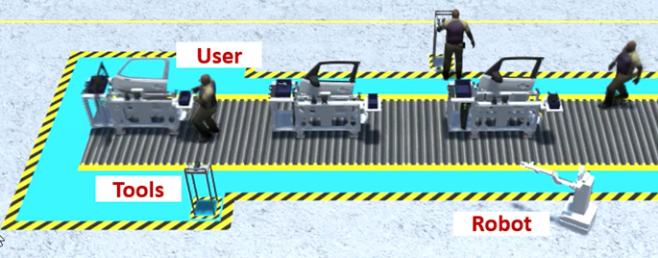
The addressed use cases comprise three workstations with different car door assembly processes which are completed by a human worker (see Figure 1). The collaborative robot is navigating the shop floor to flexi- bly assist the worker by handing over tools and assembly parts. Sequence, required tools, and assembly parts vary between workstations. The robot picks up and brings tools and parts from the tool stands to the worker and is either demanded by the worker or sent according to the workflow and work progress to the respective workstation.
To explore the use case based different design perspectives between devel- opers and users of the collaboration, two focus groups were conducted. Main goal was to derive relevant recommendations based on perspectives from the system designers, in contrast to the users, for improving future technical development and avoiding pitfalls. The implications for the applied design process of human-robot collaboration in assembly work are discussed.
METHODS
The first of the two focus groups (FG1) consisted of seven developers (29–57 years) from technical and industrial partners of the FELICE consortium. The developers came from varying fields (e.g. electrical engineering, mechanical engineering, systems engineering, cognitive robotics, computer science) and had between 1.5 to 30 years of professional experience, e.g. in human-robot collaboration, robot-interface programming, and production processes.
Requirements for Successful Human Robot Collaboration 59
Figure 1: Top view of the assembly line with three different workstations on the conveyer belt. The collaborating robot is moving freely between workstations and toolholders of different workers (top). Simulated assembly line with three doors at three different work stations. The robot is navigating for tool delivery (bottom).
The second focus group (FG2) consisted of eight users (30-39 years) of the FELICE system responsible for the assembly line at a large car manufac- turer of whom had three participants already experience of deploying robots (e.g. the use of collaborative robots, industrial anthropomorphic robots and research activities in the field of HRC). All participants agreed to participate voluntarily.
The discussions took place in a dedicated room at the CRF campus. Infor- mation on the deployment environment was only given in FG2. Here, the workflow was provided via process charts alongside an MS PowerPoint pre- sentation that presented both groups the questions to guide the discussions. The discussions focused on the criteria that the collaboration must meet a) to be successful i.e. the collaboration must add value, e.g. reduce errors, increase productivity, and reduce the workload of the worker, and b) to gain the trust and acceptance of the users. Therefore, the participants were asked i.a., which conditions must be met for successful/effective HRC overall, and for the workers to accept the HRC in principle. In addition, the participants were asked about the requirements for the successful implementation of the individual collaborative interactions (actions/steps) in the FELICEs Project use cases (e.g. “What information would you need before the robot reaches
the workstation for collaboration?”). Moreover, which and how more spe- cific HRC challenges must be overcome (e.g. “Which considerations do you have for your safety during HRC and how would these be addressed/resolved sufficiently?”).
All contributions to the discussion were recorded, transcribed and trans- lated from Italian. The subsequent analysis followed an abductive approach. Firstly, based on the grounded theory approach selective coding was applied (qualitative clustering) using the following eleven keywords to cluster the themes of the focus group discussion. These clusters were based on relevant aspects of (successful) HRC: timing, interruption, information, understand- ing, communication, control, customization, reliability, safety, training, usefulness (Heo et al., 2024). Secondly, the keywords were used to create higher-level content categories, for which some keywords were combined into one category (see table 1). Thirdly, a summarizing key statement for each category was formulated, which describes the essence of the discussion of the categories for both focus groups.
Table 1. Relevant keywords and categories.
Table available in the original PDF paper.
Keyword Category Timing Workflow Interruption Workflow Information Cognition Understanding Cognition Communication Action Controlling Action Customization Customization Reliability Reliability Safety Safety Training Training Usefulness Usefulness
RESULTS
Below, the key statements from both focus groups (FG1: developers; FG2: users) on the individual categories are outlined, summarized, and juxtaposed. Table 2 shows examples of original quotes (translated from Italian) from the focus group participants. Further quotes can be found in the individual sections on the different categories.
Table 2. Example quotes for each keyword/category.
Table available in the original PDF paper.
Keyword (Category) Quotes (Example), Translated From Italian Timing (Workflow) Humans don’t have to wait for the robot. Interruption (Workflow) User does not want to interrupt his ongoing task cycle. Information (Cognition) User needs to know when the robot is ready for hand over.
(Continued)
Requirements for Successful Human Robot Collaboration 61
Table 2. Continued Keyword (Category) Quotes (Example), Translated From Italian
Table available in the original PDF paper.
Understanding (Cognition) [There needs to be a] Basic understanding of the human user how the robot functions. Communication (Action) [There should be] Natural communication with the robot (speech). Controlling (Action) Provide the human user with multi-modal communication options for controlling the robot behavior Customization [There should be the] Ability to adapt preferences (task-related and user-related) of different workers. Reliability Robot reliability threshold of successfully performed functions [should be] at least 0.9. Safety Safety rules should be followed. Training Training is needed by all those who work with collaborative robots. Usefulness The collaborative robot must not be an obstacle, for example by wasting time or efficiency to human work.
Workflow For both focus groups, the timing of the HRC in completing the task is piv- otal. Therefore, an uninterrupted workflow is not only a prerequisite for the efficiency of the task execution, but also contributes to the users’ acceptance and trust in the HRC. Interruptions (e.g., “The robot arrives when the oper- ator is not ready” in the FELICE use case scenario) and obstacles to ongoing task execution can be stressors and should therefore be avoided.
Cognition Both focus groups agreed that detailed information about the work, all col- laborative actions, and a basic understanding of the entire collaboration process is essential for a successful HRC.
For example, in the FELICE use case it is important that “[the] user is informed about the robot’s arrival and standby status and the planned joint task” (FG1). Additionally, details of the collaboration, such as knowing the current location of the robot before approaching the workstation and where it stops, or specific “time constraints for the user to respond” were consid- ered crucial. To understand the robot’s behavior during the collaboration, FG2 recommended a checklist procedure that informs the user visually (dis- play) or acoustically (speaker) about the next steps and tasks. Moreover, FG2 noted that it is particularly important to have information about whether the collaboration is going according to plan or whether there is a problem.
Action According to FG1, communication is crucial in every stage of the collabora- tive task and control of the robot by the human user must be possible in each of these stages (e.g., “the user activates”the robot; “turns to the robot or gives speech commands”). In addition, communication with/control of the robot through simple commands is an important criterion for effective HRC and
user trust. Therefore, “provid[ing] a sufficient number of speech commands to control robot behavior” is useful as well as “multimodal communication options”, such as voice commands or physical actions like button presses.
In addition to FG1, participants in FG2 emphasized first and foremost the use of voice commands as interaction modality, but also remote control of the robot (by means of buttons or joysticks). However, it was mentioned that during collaboration, very loud acoustic signals could cause additional stress. Therefore, attention must be paid to appropriate (i.e. “adapted to the profile of the operator”), volume levels (“Identify a balanced sound that is not too alarming but not too quiet”).
Customization Within customization FG1 and FG2 came to similar results. The FG1 partici- pants suggested that “the way information is transmitted could be customized by the user,” for example using signs on the floor indicating the robot’s area within the shared space, or using graphical displays visualized on a tablet, or via specifically designed acoustic signals such as voice messages. This allows general flexibility of system use. FG2 participants remarked that some users “would prefer a light signal [and] another person would prefer something else” (FG2), This highlights that there should be the “ability to adapt to the preferences (task and user related) of different workers” (FG1).
Reliability Both focus groups agreed that reliability is a fundamental requirement for successful HRC as well as for user acceptance and trust. FG1 participants state, the “robot should be able to perform its tasks appropriately” or “in a satisfactory way”, with a reliability of at least 90% (error rate < 10%).
For FG2 participants the reliability of the robot is important, as robot mal- functions, such as faulty sensors or problems with tool handover, cause stress to the worker. Especially the frequency of malfunctions impacts the over- all workflow and interrupts the worker, which can cause additional stress. Therefore, FG2 stressed that the robot should “work really well” and that error handling by the users must be ensured as the user should always “be able to handle the malfunction” appropriately (FG2).
Safety For FG1 safety is important for user trust, especially at the beginning of the interaction. This starts with “avoiding unfavorable proximity” and “keeping a safe distance to the robot during transition”.
The FG2 participants not only remark safety as important at the beginning but also mention several aspects of safety and potentially risky situations dur- ing the collaboration. Additionally, possible countermeasures were discussed. Risks mentioned by the participants included the robot dropping a tool, tip- ping over, and injuring the user’s hand when closing the robot gripper. For instance, the first situation was proposed to be mitigated by “a safety net that can prevent objects from falling before they are handed to the opera- tor”. Participants also recommended to “equip the robot with an emergency
Requirements for Successful Human Robot Collaboration 63
button or even an emergency button on the line [workstation]”. Additionally, the robot should be equipped with a “self-diagnosis system, that warns of a malfunction and indicates a danger to the operator in real-time”.
Training In general, there was broad agreement among the focus group participants about the training needs for successful HRC. While FG1 participants gen- erally considered training to be important for the “developing of the user’s mental model”, FG2 participants gave specific advice on what the training should include. For example, they suggested a “general introduction to inter- acting with the robot” and “training on the hardware with which the robot is equipped with, especially the robot parts relevant to safety. Also training addressing “understanding audio signals” and “how to behave in emergency situations” was mentioned.
Usefulness Usefulness was mentioned by both focus groups as an important factor for user trust and acceptance. This applies to both the “perception of (the- oretical” usefulness of the innovation (short-term/initial acceptance)” and the “demonstration of usefulness and task suitability in practice (long-term acceptance” (FG1).
FG2 participants also emphasized that the robot must not disrupt or hin- der the workflow and HRC should be a “real relief” for the user (“the task the robot will do is particularly helpful”). That is, the collaboration should support the user’s work, improve work ergonomics (“a minimal increase in cognitive load is rewarded by an increase in workstation ergonomics”) work speed, reduce errors, and reduce “physical and cognitive loads” - especially “in complex and/or dangerous environments”.
In summary, according to technical developers, user trust and acceptance should be demonstrated for HRC to be effective, and the benefits of HRC perceived by the workers. During HRC appropriate timing and interrup- tion avoidance must be ensured. This applies especially to robot dispatch, navigation, approach, interaction initiation, and tool handover. Therefore, information about the collaboration must be provided in all steps of the HRC. The worker should have the capability to effectively communicate with and learn to control the robot (preferably through simple commands). This is particularly important during robot dispatch, robot standby, HRC start, and handover. Therefore, training is essential for the worker to develop a “men- tal model” of robot’s behavior and the resulting collaborative interactions. In addition, reliability and safety are prerequisites for effective HRC and user acceptance and trust.
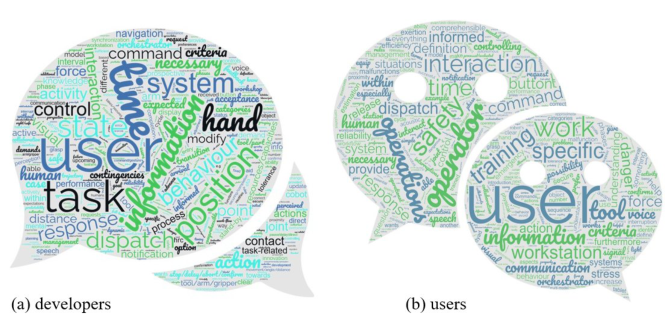
In contrast, users point out that several stressful situations can occur in HRC, which would increase the workers load, especially due to interrup- tions, lack of or poor communication, low reliability, and a lack of safety (see also Figure 2). To avoid stress and to increase the user acceptance and trust, the worker generally needs comprehensible and efficiently provided informa- tion to understand the robot’s behavior in different phases of the HRC, e.g.,
before the robot reaches a workstation. Users preferred voice commands for robot control and highlight that specific information (e.g. about audio sig- nals) should be taught and practiced, to enable the workers to anticipate the robot’s behavior and deal with safety issues.
Both FGs emphasize that relevant information should be customizable and adapted to the users need. In addition, training is seen as crucial for the general understanding of collaboration.
Figure 2: Word clouds of the minutes of the focus groups of the developers (a) and the users (b). Both emphasize the user, however (a) focus on timing, position, and information presentation, whereas (b) are concerned with training, operational safety, and interaction types.
CONCLUSION
Both focus groups, developers, and users cite usefulness, reliability, and safety as the most important criteria for successful HRC, user trust, and accep- tance. The focus groups showed that technical developers focus on technical requirements that drive the actual technical implementation. This leads to an emphasis on the importance of correct timing, the avoidance of interruptions, and striving to provide the ‘correct’ information during HRC.
In contrast, users prioritize the impact on themselves, indicating that HRC creates unsafe and stressful situations that may be caused by a lack of com- munication and misunderstandable or missing feedback while collaborating. A flawless system with higher reliability than expected from experts along- side practice and training is most important to users. Users already have clear ideas on what is to be trained, and therewith support future training design. Notably the different perspectives on the requirements may not have differ- ent implications for the final implementation and design process. Developers want to build safe and useful systems and therefore provide many system modes and solutions with flexible system settings. This allows adapting to the users. Users are, therefore, helpful in focusing the development activi- ties and reducing the proliferation of over-engineered systems that optimally support the users’ needs during work.
Requirements for Successful Human Robot Collaboration 65
ACKNOWLEDGMENT
The authors would like to thank Mirella Soldati (CRF) for conducting the sec- ond focus group and the participants of both focus groups for their valuable contributions. This work has received funding from the European Union’s Horizon 2020 Research and Innovation program under GA No. 101017151 FELICE.
REFERENCES
DIN ISO/TS 15066:2017-04, Roboter und Robotikgeräte - Kollaborierende Roboter (ISO/TS_15066:2016). (2016). Berlin: Beuth Verlag GmbH. Heo, I. S., Putri, A. K. H., Kim, B. S., Kwon, M. S., & Kim, S. H. (2024). Analysis
of quality standards for industrial collaborative robots based on user-centered design framework. Human Factors and Ergonomics in Manufacturing & Service Industries, 34(2), 100–117. Kumar, S., Savur, C., & Sahin, F. (2021). Survey of Human–Robot Collaboration in Industrial Settings: Awareness, Intelligence, and Compliance. IEEE Transactions on Systems, Man, and Cybernetics: Systems, 51(1), 280–297. Natarajan, M., Seraj, E., Altundas, B., Paleja, R., Ye, S., Chen, L., Jensen, R., Chang,
K. C., & Gombolay, M. (2023). Human-Robot Teaming: Grand Challenges. Current Robotics Reports, 4(3), 81–100.
LISTED IN THE AHFE DIGITAL BOOKSTORE CATALOGUE
Explore the complete digital volume
Human Factors in Robots, Drones and Unmanned Systems
Read this individual research paper free through the original publisher, or explore the full digital proceedings book.
ISBN 978-1-964867-14-4
Explore this ISBN in the AHFE Bookstore ↗Listed in the July 2026 bookstore catalogue; search by ISBN to confirm current availability · Digital book purchase optional