Jai Prakash Kushvah, Gerhard Rinkenauer (2022). Does Acoustic Feedback Increase the Accuracy of Weight and Force Perception during Fine Motor Activities?. In: Industrial Cognitive Ergonomics and Engineering Psychology. AHFE Open Access, vol. 35, pp. 10–17. https://doi.org/10.54941/ahfe1001596
It is known from basic research that fine motor activities linked to object handling such as grasping and lifting are almost automatised and highly adapted to the properties of manipulated objects. Object surface properties influence the grip-lift force coupling at object-digit-surface and the object weight perception. Such force-coupling relies on visual and somatosensory processes along with the internal models. Limited or affected somatosensory mechanism could lead to disturbed force efforts and deterioration in object weight perception. Present study was aimed to evaluate the strategy to strengthen the somatosensory mechanism by implementing additional sensory channel (grip force related online acoustic feedback) during a standard weight discrimination task. Participants from both young and old age judged the heaviness of objects with different shapes, compared to a reference object using the precision grip. Results showed that object shape manipulation influenced grip force and weight perception. Integration of additional sense supported the forward model by reducing sensorimotor processing time in both age groups. This indicates the facilitatory impact of multisensory integration on motor control. Moreover, it lowered the discrimination threshold of weight perception and improved the accuracy level. Contrarily, the effect of assistive acoustic feedback on grip force application and weight perception was not significant. We clearly observed the overall aging effects for weight perception and grip force application.
Motoric execution of everyday object-hand interactions involving grasping, holding, and lifting seems highly automatized. With precise accommodation of grip and load forces, chances of object slip are very less for a normal functioning hand. Such grip-load force coupling between hand and object mainly relies on visual and somatosensory cues (Jenmalm and Johansson, 1997). Brain utilizes the visual cues to identify the object properties (shape, size, volume, frictional conditions) for object weight estimation, retrieves the concerned internal model of force parametrization from somatosensory memory and anticipates the motor command in almost automatized manner.
Does Acoustic Feedback Increase the Accuracy of Weight and Force Perception 11
Newly experienced object manipulation sensed by the somatosensory system produces the mismatch between predicted and the actual sensory state. It causes the updating of internal models. This phase before lifting the object is crucial for force adaptation, both to prevent the object from slipping and to prevent muscle fatigue due to excessive force application (Johansson, 1998). In general, the somatosensory control loop (acting as feedback for actual sen- sory state of the motor command) is slow (~100ms) which delays specifying the corrective parameter specification for the motor command while dea- ling with the object variabilities (Johansson and Westling, 1984, 1988). Such limited and often affected (by physiological and environmental factors) soma- tosensory mechanism could lead to disturbed grip force application when handling object manipulations. In our routine life it is reflected by incidences of the object displacement between fingers, i.e., object drop or object crush. For instance, while lifting the object with surface variabilities using the pre- cision grip leads to greater force application for slippery object compared to the rough one (i.e., Rinkenauer et al. 1999) and due to sudden variation in the object surface it causes object slip also for the slippery one.
Thus, the current study is aimed at improving the grip-load force cou- pling at the object-digit surface by supporting the somatosensory feedback to maintain grasp stability during object manipulation. To address this issue, we are adding a sensory channel to the somatosensory feedback to strengthen the mismatch resolution process by providing an online grip force feedback through auditory sense. We hypothesized that such feedback will improve the object weight perception and grip force application through multisensory integration (Ernst and Banks, 2002). It has been well studied now that events implementing multimodalities followed by spatiotemporal correspondence allow for multisensory integration and improve the sensorimotor correlati- ons (Johansson and Flanagan, 2009). Thus, we expect that online acoustic feedback could lower the excessive grip force application and improve the object weight estimation while dealing with the object variabilities. We are implementing object shape manipulations during a standard weight discri- mination task (cf. also Flanagan and Bandomir, 2000). Precision grip related grip force-movement measures and psychophysical measures of object wei- ght perception were analyzed to conclude the effects of object shape acoustic feedback and aging.
METHOD
Participants Data of 11 young (Mage = 24.27 years, SD = 3.32 years) and 10 elder (Mage = 69 years, SD = 8.08 years) healthy, right-handed participants was collected. None of the participants was reported with colored blindness, any neurological disorder, hand function limitation from their background que- stionnaire. All participants followed the inclusion criteria of normal hearing and normal or corrected-to-normal vision. Participants received either course credits or monetary compensation (€10/hour) for the participation. Written informed consent was obtained prior to the study.
12 Kushvah and Rinkenauer
Apparatus and Experimental Set Up Grip force applied to the surface objects during lift trials was measured conti- nuously using strain gauges, each for reference and test object. Force voltages were amplified and then filtered (20Hz low pass with 24 dB/octave slope) before analog-digital conversion. Weight for the manipulanda was genera- ted using a linear motor. The measured grip force values were converted into a sound whose frequency increased linearly with the grip force. This sound was presented on external speakers to provide grip force linked auditory feed- back. To successfully implement the lift trials, participants were guided on a 19" computer monitor.
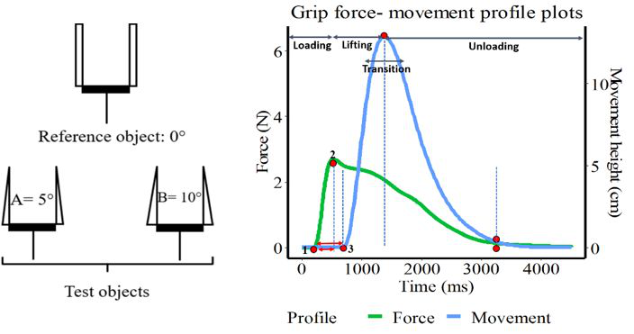
Weight Discrimination Task and Procedure Two test objects (A and B, cf. Figure 1, left side) in two feedback conditions (with auditory feedback and without auditory feedback) were implemen- ted in total 6 blocks of weight discrimination task. To avoid any the object carryover effects on task performance, the sequence of object and feedback conditions was pseudo-randomized. During the task, experimental weight for the reference object was maintained constant at 220g, whereas the test obje- cts weights varied on a trial-by-trial basis through an electric linear motor. Weights for the test objects were controlled using a staircase algorithm by implementing 2 interleaved staircases in a random sequence (Cornsweet, 1962). The algorithm approximated two points of the psychometric function (75th and 25th percentile response probabilities for the object heaviness) using the weighted up/down 3-step rule (Kaernbach. 1991). Participants were simply instructed to lift the reference object first and then the test object. Afte- rwards, they were asked to judge whether the test object was heavier than the reference object. The lifting procedures and judgment were instructed via a screen.
Task Measures
′
Data obtained during the staircase procedure was further processed using customized MATLAB scripts (MathWorks Inc., USA) to calculate the psych- ophysical measures. A maximum likelihood procedure was used to estimate the point of subjective equality (PSE) for each combination of object shape and weight. A logistic psychometric function (Bush, 1963) was used for this: Prob (“heavier”|Wi) = 1
1+ e(PSE−Wi) 0.91.DL
It shows the probability of whether the test object is judged heavier than the comparison object in the ith trail. Difference limen (DL) denotes the steepness of the psychometric function (weight difference between the 75th and 25th percentile). The lower DL is, the more sensitive the subjects are to weight differences. To provide more clear interpretation, a transforma- tion from PSE to perceived heaviness (PH) for the objects was calculated as PH = refw + (refw −PSE) (Rinkenauer at al. 1999). Here, refw denotes the reference object weight. Movement profile points were derived from the displacement recorded in the electric linear motor. Similarly, the force profile was derived by measuring the force values using the strain gauges. Movement
Does Acoustic Feedback Increase the Accuracy of Weight and Force Perception 13
Figure 1: Schematic presentation of the reference object and test objects with their respective surface angles (left side). Schematic depiction of averaged experimental grip and movement profiles (right side). For details, see the main text.
and force profiles were marked for force onset time (1), force peak amplitude (2) and movement onset time (3) (as shown in figure 1, right side) to calcu- late the precision grip parameters of force peak amplitude, time to peak force (TTPF) and latency (movement onset force time – force onset time).
RESULTS
2 X 2 X 2 mixed factorial ANOVAs were calculated to see the effects of 2 within-subjects factors: Object shape (A vs. B) and Feedback (without acou- stic feedback vs. with acoustic feedback) and a between-subjects factor of Age (young vs. old) on psycho-physical and test object associated precision grip parameters. Statistical analysis was performed using R and the open-source statistical software JASP.
Psychophysical Measures Perceived Heaviness ANOVA results showed the significant main effect of Object shape on percei- ved heaviness [F (1, 19) = 10.41, p = .004, ω2 = .14]. Participants perceived the object B much heavier (M = 255.89g, SD = 38.33g) compared to object A (M = 236.01g, SD = 20.03g). Perceived heaviness got influenced by Age [F (1, 19) = 9.77, p = .01, ω2 = .18]. Elderly participants perceived the object heaviness higher (M = 260.37g, SD = 36.8g) than the young ones (M = 232.85g, SD = 19.48g). Two-way interaction effect of Object and Age was significant on perceived heaviness [F (1, 19) = 4.36, p = .05, ω2 = .05]. Bonferroni-corrected post-hoc pairwise comparisons showed that perceived heaviness for elderly participants was higher for higher surface angle object (MB = 277.26g, SD = 40.29g; MA = 243.47g, SD = 23.57g; t = 3.67, p = .01). Moreover, the elderly group perceived object B much heavier com- pared to young groups’ perceived heaviness for object A (M = 229.23g, SD = 13.4 g; t = 4.42, p < .001) and object B (M = 236.46g, SD = 23.87 g;
14 Kushvah and Rinkenauer
t = 3.76, p = .004). Thus, object perceived heaviness increased with increa- sing the surface angle and age. Utilization of additional sensory feedback did not help in improving weight perception.
Difference Limen DL Experimental effects of Object shape [F (1,19) = 8.44, p = .01, ω2 = .06] and Feedback [F (1,19) = 10.24, p = .005, ω2 = .07] on DL were significant. DL increased with object surface angle (MB = 13.6g, SD = 5.4g; MA = 11.25g, SD = 6.83g). Grip force guided acoustic feedback significantly reduced the DL (MWith = 11.1g, SD = 5.39g; MWithout = 13.75g, SD = 6.78g). Thus, increase in object surface angle caused increase amount of change in object weights to be judged and additional sensory feedback narrowed the DL.
Precision Grip Measures Grip Force Peak Amplitude Peak grip-force amplitudes associated with the test objects were affected by the Object shape [F (1, 19) = 16.64, p < .001, ω2 = .08]. Grip-force peak amplitudes were higher for higher surface angle object (MB = 9.48 N, SD = 3.48 N; MA = 7.76 N, SD = 3.12 N). Age-related differences were significant for grip-force peak [F (1, 19) = 5.89, p = .02, ω2 = .11]. Peak grip force application was higher for elderly participants (Mold = 10.16 N, SD = 2.66 N; MYoung = 7.21 N, SD = 3.35 N) during the test object lifts. Further, grip force related acoustic feedback showed no effect on peak grip force application.
Time to Peak Force ttpf Results showed the main effect of Object shape [F (1, 19) = 20.04, p < .001, ω2 = .08] and Feedback [F (1, 19) = 7.08, p = .01, ω2= .03] on TTPF during test object lifts. TTPF increased with object surface angle (MB = 440.21 ms, SD = 102.74 ms; MA = 392.42 ms, SD = 86.83 ms). Grip-force related auditory feedback significantly reduced the TTPF (MWithout = 432.28 ms, SD = 96.32 ms; MWith = 400.36 ms, SD = 97.29 ms). Two- way interaction effects of Object shape and Age [F (1, 19) = 18.59, p < .001, ω2 = .07] and three-way interaction effects of Object Feedback and Age [F (1, 19) = 4.29, p = .05, ω2 = .01] had significant impact on TTPF. Bonferroni-corrected post-hoc pairwise comparisons revealed that both the interaction effects were mainly contributed by the elderly group. Thus, acoustic feedback mainly hel- ped elderly participants in shortening the loading phase during affected test object lifts due to object shape.
Latency Test object latency measure was influenced by Object shape [F (1,19) = 15.97, p < .001, ω2 = .06]. Latency increased with object surface angle (MB = 359.86 ms, SD = 103.52 ms; MA = 315.31 ms, SD = 87.05 ms). Further, grip force guided acoustic Feedback significantly reduced the late- ncy measure [F (1, 19) = 46.51, p < .001, ω2 = .12] (MWith = 305.68 ms,
Does Acoustic Feedback Increase the Accuracy of Weight and Force Perception 15
SD = 88.48 ms; MWithout = 369.49 ms, SD = 96.94 ms). Two-way intera- ction effect of Object X Age emerged significant [F (1, 19) = 10.09, p = .005, ω2 = .04]. Bonferroni-corrected post-hoc pairwise comparisons revealed that the effect was mainly contributed in elderly group. Thus, grip force guided feedback supported while updating the action program for correction in the loading phase.
DISCUSSION AND CONCLUSION Present experiment was conducted to see the potential impact of acoustic feedback as an additional sensory channel on corrective force parametri- zation process during a weight discrimination task. The task was featured with the unpredictable weight change within the conditions of object shape manipulation. Results revealed the overall impact of object shape on task measures. Participants perceived heaviness for the objects was greater for the object with higher surface angle. Object weight discrimination was better for the lesser surface angle object. Participants applied much higher peak grip forces to lift the object with higher surface angle. Also, they took longer time to reach peak force and also to start lifting the greater surface angle object. These findings are in line with the previous studies exploring the object size and friction coefficient manipulation (Adams et al. 2013). Moreover, the results showed tight coupling between action and perception (van Polanen and Davare, 2015). The 10° object requires the highest grip force for physical reasons (Flanagan and Bandomir, 2000). Participants applied the higher gra- sping force, probably because of the higher object weight perception. Object shape manipulation affected both the loading and lifting phases. Greater late- ncy and TTPF with increasing surface angle suggest elevated force efforts at the digit-surface to achieve a stabilized grip.
Effect of grip force related online auditory feedback on task measures was limited but significant. Such additional sensory channel was supposed to ove- rcome the delayed feedback process with in the somatosensory loop and to improve the force adjustments while dealing with the unpredicted weight changes. DL results showed that acoustic feedback helped in reducing the variability in object discrimination but from perceived heaviness results we found that it was not impactful in lowering the perceptual weight estimates. Similarly likely, the excessive peak grip force remained unaffected by acou- stic feedback. Interestingly, acoustic feedback reduced the latency and TTPF. It is vital to optimize the delayed processing of the somatosensory loop at the circumstances of object manipulation so that the corrective parameter speci- fications of force adjustments could be generated almost online. Results are promising in this direction. Reduced amount of latency and TTPF showed the shortening of the loading phase and thus could be considered as facili- tated by the acoustic feedback during force error correction. These effects are signifying the improved processing time for the forward loop and upda- ting the internal model. Such primary force adjustments during the loading phase have significance in stabilizing the grip and preventing the object slip (Johansson and Westling, 1984).
16 Kushvah and Rinkenauer
Present study revealed some imperative findings in the context of aging. Somatosensory feedback process can be affected due to age related deteriora- tion (Carmeli et al. 2003). Results showed that elderly participants perceived the object much heavier and thus applied higher peak grip force compared to the younger ones. Interestingly, no aging effect was observed for the DL measure. Further, longer TTPF and latency periods are suggesting the higher processing time taken by the elderly participants for the force adjustments during the loading phase.
In brief, our study showed implication of auditory feedback in naturally occurring as well as in aging affected force adjustments at object digit inter- face and object weight perception. Acoustic feedback as an additional sensory channel did not prevent the excessive grip force application and had no impact on object weight perception, but it improvised the processing time during the correction of motor command (forward model and internal model update). Object shape manipulations and aging affected the object weight perception and grip force application. Such acoustic feedback strategy might be useful in advancement of the grip-assistive tools used for the rehabilitation purpose and especially for the elderly population. Therefore, we are propo- sing a detailed investigation of grip-force related online auditory feedback in the aging context for the future research.
ACKNOWLEDGMENT
This work was supported by the “Research Training Group 1855” founded by the German Research Foundation (DFG). The authors would like to thank Mr. Hanno Mussmann for his technical support and Mrs. Carola Reiffen for her support of the data collection.
REFERENCES
Adams, M. J., Johnson, S. A., Lefèvre, P., Lévesque, V., Hayward, V., André, T., & Thonnard, J. L. (2013). Finger pad friction and its role in grip and touch. Journal of The Royal Society Interface, 10(80), 20120467. Bush, R. R. (1963). Estimation and evaluation. Handbook of mathematical psycho-
logy, 1, 429–469. Carmeli, E., Patish, H., & Coleman, R. (2003). The aging hand. The Journals of Gerontology Series A: Biological Sciences and Medical Sciences, 58(2), M146-M152. Cornsweet, T. N. (1962). The staircase-method in psychophysics. The American
journal of psychology, 75(3), 485-491. Ernst, M. O., & Banks, M. S. (2002). Humans integrate visual and haptic information in a statistically optimal fashion. Nature, 415(6870), 429–433. Flanagan, J. R., & Bandomir, C. A. (2000). Coming to grips with weight perception:
effects of grasp configuration on perceived heaviness. Perception & Psychophy- sics, 62(6), 1204–1219. Jenmalm, P., & Johansson, R. S. (1997). Visual and somatosensory information about object shape control manipulative fingertip forces. Journal of Neuroscie- nce, 17(11), 4486–4499. Johansson, R. S. (1998). Sensory input and control of grip. Sensory guidance of
movement, 218, 45–63.
Does Acoustic Feedback Increase the Accuracy of Weight and Force Perception 17
Johansson, R. S., & Flanagan, J. R. (2009). Coding and use of tactile signals from the fingertips in object manipulation tasks. Nature Reviews Neuroscience, 10(5), 345–359. Johansson, R. S., and Westling, G. (1988). Coordinated isometric muscle commands
adequately and erroneously programmed for the weight during lifting task with precision grip. Exp. Brain Res. 71, 59–71. doi: 10.1007/bf00247522 Johansson, R. S., and Westling, G. (1984). Roles of glabrous skin receptors and sensorimotor memory in automatic control of precision grip when lifting rougher or more slippery objects. Exp. Brain Res. 56, 550–564. doi: 10.1007/bf00237997 Kaernbach, C. (1991). Simple adaptive testing with the weighted up-down method. Perception & psychophysics, 49(3), 227–229. Rinkenauer, G., Mattes, S., & Ulrich, R. (1999). The surface-weight illusion: On
the contribution of grip force to perceived heaviness. Perception & psychophy- sics, 61(1), 23–30. Van Polanen, V., & Davare, M. (2015). Sensorimotor memory biases weight perception during object lifting. Frontiers in human neuroscience, 9, 700.
LISTED IN THE AHFE DIGITAL BOOKSTORE CATALOGUE
Explore the complete digital volume
Industrial Cognitive Ergonomics and Engineering Psychology
Read this individual research paper free through the original publisher, or explore the full digital proceedings book.
ISBN 978-1-958651-11-7
Explore this ISBN in the AHFE Bookstore ↗Listed in the July 2026 bookstore catalogue; search by ISBN to confirm current availability · Digital book purchase optional