Duan Wu, Peng Gao, Dongying Hu, Ran Xu, Yue Qi, Yumeng Zhang (2022). The Relationship Between Simplified Chinese Character Height and Cognition Research in Signage Design. In: Industrial Cognitive Ergonomics and Engineering Psychology. AHFE Open Access, vol. 35, pp. 101–107. https://doi.org/10.54941/ahfe1001608
75% of our external information comes from vision, in signage and wayfinding system, characters and graphics have become the most important factor of information cognition. As the main characters in China's signage and wayfinding system, simplified Chinese characters affect the rapid and accurate cognition of information. At present, most of the cognitive research on simplified Chinese characters are learned from the data of Japan and Taiwan. Compared with Latin alphabets, Japanese and Chinese characters are much similar, but there are still significant differences between them. Japanese is a combination of Chinese characters and Kanas, the fonts and the layout of characters are very different. The traditional Chinese characters used in Taiwan are much more complicated than the simplified ones used in mainland China. In order to obtain the data that can really guide the standards of signage design in China, this research carried out a series of experimental studies on simplified Chinese characters’ recognition. Under the condition of fixed font, font weight, color, similar stroke number and character frequency range, the experiment obtained the data of characters’ height and recognition distance by changing characters’ height and recording the corresponding visual recognition reaction time. Then, based on the method of regression analysis, the relationship between the two variables of character height and recognition distance is calculated and visualized. Through indoor simulation and supplementary experiments, the data and conclusions could guide or verify the existing ergonomics data and signage design standard. The research outcome shows the relationship between simplified Chinese character height and cognition distance of on public signage system, which provides a theoretical basis for the related research and design. The results also revealed that with the use of Sans Serif typeface,the minimum of character height in the current design standard can be further increased. This research is still in early stage, in addition to the character height, the influence of stroke number, thickness and background colour contrast of characters still need to be further studied.
“Signage” refers to the design or use of signs and symbols to communi- cate a message to users through vision, hearing, touch or other media in a built environment. Since 75% of human’s perception of external informa- tion comes from vision, the text and graphics in signage system have become the very important factor of information exchange. As the main text used
in China’s signage system, Simple Chinese characters affect the rapid and accurate transmission of information.
Many countries have researches on character recognition, and the national standard for characters has been formulated accordingly. While most of the cognitive research on simplified Chinese characters are learned from the data of Japan and Taiwan. Compared with Latin alphabets, Japanese and Chinese characters are much similar, but there are still significant differences between them. Japanese is a combination of Chinese characters and Kanas, the fonts and the layout of characters are very different. The traditional Chinese cha- racters used in Taiwan are much more complicated than the simplified ones used in mainland China.
The Highway Science Research Institute of China Ministry of Transpor- tation has published a series of research results on the character height, character spacing, height width ratio and stroke thickness of Simple Chi- nese characters used in traffic signs (GB5768-1999). However, the standard is only applicable to traffic system, which is aimed at drivers in the process of high-speed driving, and is not applicable to pedestrian signs in public space.
Therefore, when participating in the authoring group of the national stan- dard of the people’s Republic of China “Technical code for signage system of public buildings”, the author carried out a series of experimental research in order to verify or calculate the relationship between the character height and the cognition distance in signage system.
The experiments recorded in this paper attempts to use scientific, reaso- nable and effective research methods to carry out the research on simplified Chinese character recognition. The objective is to obtain the relationship data between character height and recognition distance of public signage system for Chinese pedestrian users, so as to guide or verify the future design.
METHODS
In the experiment, under several fixed reading distances, the volunteers were given different text height with random content on the page. The decline and minimum value of text height were obtained by recording and analysis the time and accuracy of their recognition, and with these data, the critical and recommended values could be calculated.
Influencing Factors of Character Recognition In addition to the height of a characters, there are many other factors that affect the text recognition in signage system, such as typeface, aspect ratio, stroke thickness, contrast with the background etc (Table 1). This experi- ment only tests the relationship of Simplified Chinese character height with recognition distance; therefore, a single factor multi-level experimental test is adopted to keep other factors as a fixed amount.
According to the literature review, the recognition distance of boldface texts (without decorative line) is the best in the same distance. At the same time, in China’s current national standard GB5768-1999, signage system is required to use boldface for Simplified Chinese characters. Therefore, boldface is used as the fixed factor in this experiment.
The Relationship Between Simplified Chinese Character Height and Cognition Research 103
Table 1. Influencing factors in the experiment.
Table available in the original PDF paper.
Influencing Factors Ration/Variable Set Value Typeface Ration (Sans-serif) boldface Stroke number Ration 5–10 Color Ration Black text on white background Information in one page Ration 6 street names on one page Text Hight Variable Distance Variable
Table 2. Participants’ gender and age distribution.
Table available in the original PDF paper.
Age
Gender 18–33 34–49 Over 50 Total Male 11 8 6 25 Female 9 12 4 25 Total 20 20 10 50
Experimental Equipment and Participants
Tobii Glasses Head mounted eye tracker(Tobii Technology Inc), used to track the eye’s movement and its corresponding residence time
Tobii studio analysis software is used to record the scanning position and analysis the identification range
Projector (high precision)
Photography and camera equipment
Computers and peripherals Relevant studies show that there are differences in response time between men and women of the same age, and the same for age differences (Table 2). Therefore, this experiment selects 50 participants of different genders and across all ages, requiring all participants to have corrected vision of more than 4.8, non-color blindness and no visual diseases.
Experimental Scheme Research shows that the difference between the static recognition and the dynamic recognition distance is very small within the speed of 120km/h (Hou DZ., Huang K., Han WY., 2010). Therefore, our experimental premise is:
(1) When the speed is below 120km / h, dynamic vision = static vision. (research results from the Western Transportation Construction Scie- nce and technology project 200431822333-10 of the Transportation Ministry of China). (2) The visual recognition distance s of human eyes is related to the viewing angle and object height H, that is, the recognition distance S is directly proportional to the height H: H = 2 · S · tga 2 = 2tga 2 · S = k · S →S = 1 k · H
(3) Visual recognition reaction is regarded as effective within 2.5 seconds. (4) The selected typeface is boldface, and the stroke thickness is 1/14 of the character height.
The experimental viewing angle is 15 ° upward.
Experimenters measure the participants’ recognition time for finding the target information among six message bars. If the visual recognition reaction is within 2.5s, it is regarded as effective recognition. Repeat the experiments by changing the parameters of recognition distance and characters height separately to obtain the variable.
Taking the “Chinese character frequency table” from the Modern Chinese Frequency Dictionary published by Beijing Language and Culture Institute Press as the thesaurus, we selected the high-frequency Chinese characters in the word frequency serial number 1-400 as the benchmark for the recogni- tion experiment. After eliminating those ones that are not suitable for the road name and do not meet the stroke requirements, we finally selected 153 Chinese characters with different structural forms, different use frequencies with relatively balanced structural of 5-10 strokes. We randomly choose two characters combining into one road name, which is taken as one message bar, forming a total of 77 message bars. According to previous studies, when the information is no more than 6 messages on one surface, the cognitive time about 2.43s, rounded to 2.5s. Therefore, the amount of information in each page is fixed as 6 road names, and the line spacing is fixed at 0.6h (Note: H is the height of Chinese characters).
A special program is written for the experiment. After playing, the target message and the recognition page will be appeared on the screen in turn. The participants are required to identify whether the target message appears in the page within 2.5s, and click a button to confirm after finding the target information. After 2.5s, the program will automatically switch to the next page. Whether the participants click the button or not, the corresponding word height data will be recorded automatically in the program. If the subje- cts confirm that there is no target information in the 6 road names, they will say “no” and be recorded by the experimenter.
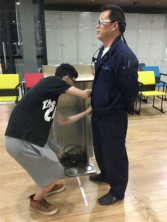
In the experiment, there will be a 2s blank between each page, and one landscape picture will be shown after every 5 pages to alleviate the fatigue of the participants. After the experiment, the record of eye tracker data was used to verify the recognition’s reliability. We also ensure that the ambient brightness conditions of the lab are consistent in the experiment (Figure 1).
Experimental Results Finally, 144 valid experiment data were collected and analyzed. After review the eye tracking data, the influence of confidence is removed. The average accuracy rate of each word in the experiments and the average time spent by the right respondent are analyzed. While the critical value of character height is generally lower than expectation, a serious of supplementary experiments are implemented to narrow the scope and obtain more accurate data. Final data are shown in Table 3.
The Relationship Between Simplified Chinese Character Height and Cognition Research 105
Figure 1: The experiment processes.Table 3. Sample human systems integration test parameters.
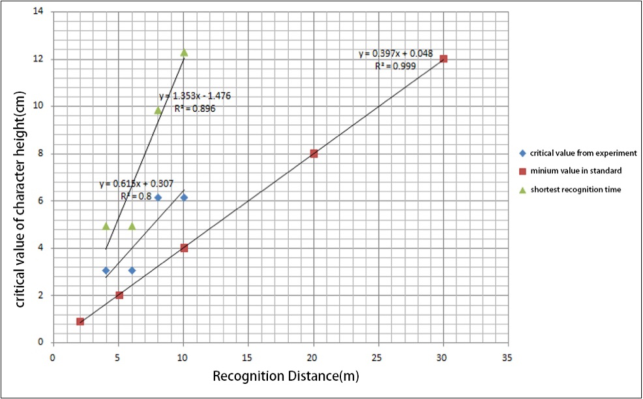
FINDINGS After regression analysis of the data in Table 3, it is found that if the critical value of H is judged by the value with the largest increase in time, it can be fitted into the linear equation y = 0.615x+0.307, where x is the recognition distance (meter), y is the minimum recognition character height (cm), and the judgment coefficient R 2= 0.8. This indicats that 80% of the relationship between the Simplified Chinese character height and the static observation distance can be explained by the linear relationship.
The fitting effect of the relationship between the height and distance of the regression model is acceptable, and it is relatively consistent with the linear trend of the values in the specification (Fig. 2). If the critical value of word
Figure 2: Relationship analysis of experimental data.Table 4. Minimum and limit character height relationship with distance.
Table available in the original PDF paper.
Observation distance (m) Limit value of minimum value of character height (cm) character height (cm) 1≤L≤2 1.6 1.6 4≤L≤5 3.4 5.3 L≤10 6.5 12.0 L≤20 12.6 25.6 L≤30 18.8 39.1
height is judged by the best value with the shortest time, it can be fitted to the linear equation y = 1.353x-1.476, R 2= 0.896.
Through the above analysis, it can be found that there is a good cor- relation between the height of Simplified Chinese characters and cognition distance. With the increase of cognition distance, the minimum value of cha- racter height should also be increased accordingly. Due to the limitation of experimental conditions, it can be concluded that the growth trend of the cri- tical value of Simplified Chinese character height is relatively uniform within 10 meters. At the same time, we believe that the minimum value of Chi- nese character height in the earlier draft specification (GB/T18574-2008) is mainly based on the data from Japan. Because Simplified Chinese characters are more complex, the critical value data from the experiment is larger. Based on that, we propose an optimization minimum value for the relationship (Table 4).
CONCLUSION
Through experiments, this research studies the relationship between Sim- plified Chinese character height and recognition distance of public signage
The Relationship Between Simplified Chinese Character Height and Cognition Research 107
system, which provides a theoretical basis for the related design and the nati- onal standard compile. The experimental results show that on the basis of using boldface typeface characters, the limit value of word height specified in the current Public Signage Design Standard in China need to be further improved.
While the research is still in early stage, in addition to the factor of chara- cter height, the influence and comprehensive effect of stroke number, stroke thickness, color contrast and other factors of Simplified Chinese characters also need to be further studied.
FUNDING This research was supported by the National Natural Science Foundation of China (project No.51708412).
ACKNOWLEDGMENT
The authors would like to acknowledge the support from Tongji University and Shanghai Municipal Engineering Design Institute (Group) Co., Ltd.
REFERENCES
Hou Dezao, Huang Kai, Han Wenyuan. (2010) Research on the Height Model of Chinese Signage Based on Driver’s Cognitive Characteristics. Highway Transpor- tation Technology, Volume 3. Jiang Haifeng, Han Wenyuan, Zhang Zhiyong. (2009) Study on the Relation-
ship Between Word Height and Visual Recognition of Traffic Signs, Highway Transportation Technology, Volume 26 No. 7. Shi Xiuhong. (2010) Study on the Relationship Between Font Selection and Visual Recognition of Traffic Signs. Kejifeng, Volume 3. The American Heritage Dictionary of the English Language (Fourth ed.). Houghton
Mifflin Company. 2000. Yu Lin, Xiaodong Pan, Shouen Fang. (2005) Study on the Relationship Between the Amount of Information and Cognition of Traffic Signs. Journal of Transportation Engineering and Information, Volume 03. Zhang Boming. (1993) Study on the Visual Recognition of Chinese Characters in
Industrial Cognitive Ergonomics and Engineering Psychology
Read this individual research paper free through the original publisher, or explore the full digital proceedings book.
ISBN 978-1-958651-11-7
Explore this ISBN in the AHFE Bookstore ↗Listed in the July 2026 bookstore catalogue; search by ISBN to confirm current availability · Digital book purchase optional