Duan Wu, Haoyue Lei, Mingjie Zhu, Yuhong Ma (2024). Empowering Sustainable Urban Futures: Exploring the Temporary Use of Community In-Between Spaces. In: Sustainable Construction in the Era of the Fourth Industrial Revolution. AHFE Open Access, vol. 149, pp. 83–91. https://doi.org/10.54941/ahfe1005277
In the pursuit of sustainable built environments, this paper delves into the innovative realm of Temporary Use (TU) strategies within communities in-between spaces. Urban spaces evolve entities and the efficient utilization of transitional spaces which holds immense potential for fostering community engagement, environmental stewardship, and economic resilience. This paper, using the case study method, aims to explore the multifaceted dimensions of TU practices, emphasizing their role in redefining the dynamics of urban living.Under the framework of TU, the research team conducted several on-field projects to explore and test the impact of TU in the KIC community in Shanghai from 2022 to 2023. From these cases, this discourse encompasses diverse perspectives, ranging from different types of TU and discusses their strategies and sustainable impact. By scrutinizing these case studies and ongoing projects, we aim to decipher the strategies that transform leftover or in-between spaces into vibrant community hubs. These spaces present opportunities for fostering social cohesion, promoting sustainable practices, and catalyzing economic development. This paper not only contributes to academic discourse but also provides practical guidance for policymakers and urban planners striving to create resilient, vibrant, and sustainable urban environments.
Contemporary cities witness a paradox of urban regeneration, marked by intense spatial competition amid a surplus of leftover spatial resources. With the attention emerging post-World War II in Europe, abandoned urban land resulted in leftover spatial resources, leading to terms like “leftover space,” “in-between space,” and “wasteland” (Kubler, 1965; Praglin, 1974; Lynch, 1995). Thus, this era prompted extensive research, focusing on the reuse of these resources for sustainable urban regeneration.
However, the global stock of leftover spatial resources remains substan- tial and continues to grow. Uncontrolled urban expansion prioritizes raw land over repurposing built-up spaces, contributing to a growing surplus.
For example, the vacancy rate in Chicago, 5.9% in 1990, is projected to rise to 8.3% by 2020 (Lee & Newman, 2017). Moreover, this unsustainable space usage not only wastes spatial resources but also poses security risks, requires significant urban management investments, and diminishes neigh- borhood vitality. Therefore, addressing these challenges demands innovative interventions.
TEMPORARY USE OF IN-BETWEEN SPACE The leftover spatial resources are the “by-product” of unsustainable urban planning from two dimensions, namely the spatio-temporal in-betweenness. In the spatial dimension, permanent urban planning lacks clear delineations but with rigid boundaries (Lynch, 1995), resulting gap spaces with uncer- tain tenure and spatial fragmentation. These gaps, resisting traditional urban development methods, lead to neglect and eventually being left over. In the temporal dimension, permanent-intended urban planning also produces gaps between long-term urban activities, due to interruptions or inherently non-contiguous scheduling (Urban Catalyst, 2003). During these gap peri- ods, the space is wasted and even continuously left over. Thus, addressing in-betweenness is crucial for effective design interventions to tackle this crisis.
Temporary Use (TU) is one intervention that targets these in-betweeness features. Although often fragmented with less exploitable value, in-between spaces provide an economically friendly and low-risk platform for grass- roots (Bishop & Williams, 2012). Leveraging these features, TU involves the temporary re-purposing of leftover spatial resources through quick, lightweight and cheaper activities. Thus, TU approach has short-term ben- efits in responding to city development needs and maximizing in-between space value. Meanwhile, in the long term, it becomes a supplemental strategy in community regeneration, reducing wasted spatial resources and offering a sustainable urban future.
Therefore, this paper presents a case study on the TU strategy of in- between space to empower a sustainable urban future. Subsequent sections draw upon the typology of TU strategies formulated by Urban Catalyst, uti- lizing a visualizing model to analyze four specific cases within the Shanghai Knowledge and Innovation Community (KIC). This paper aims to assess these sustainability potentials of cases and delve into the empowerment of TU strategies, particularly in the context of urban community regeneration.
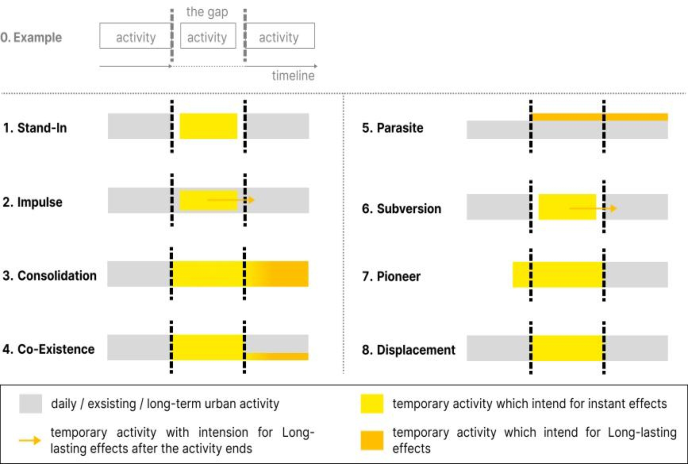
ANALYSIS MODEL OF TEMPORARY USE STRATEGY This paper discusses the TU strategy using the theoretical framework devel- oped in the Urban Catalyst project (Urban Catalyst, 2003; Oswalt et al., 2006). Initiated in the 2000s, this Berlin-based and European Union-funded project extensively investigated TU across 12 European cities. This project, focused on TU impacts on in-between spaces, proposed a typology compris- ing eight strategies: Stand-in, Impulse, Consolidation, Co-existence, Parasite, Subversion, Pioneer, and Displacement (see Figure 1).
Empowering Sustainable Urban Futures: Exploring the Temporary Use 85
Figure 1: Typology of eight strategies (adapted from Urban Catalyst, 2003).
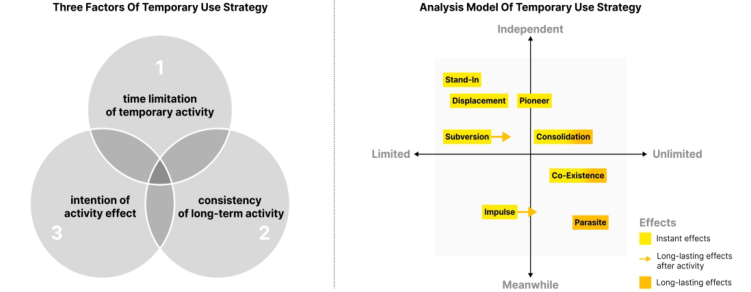
Based on this typology, three interrelated factors of the TU strategy are identified (see Figure 2). The initial two factors pertain to the dynamics of temporary and existing long-term activities on the site. Firstly, temporary activities have subjective duration, where one year can be temporary or per- manent from different perspectives (Bishop & Williams, 2012). However, the objective and sometimes stringent time limitation of temporary activ- ities is one key factor that influenced by the in-betweenness of the site. Secondly, the consistency of long-term activities is another key factor of the time pattern. Among the above TU strategies, some utilize vacancies of daily activities, some disrupt existing activities, while others concurrently share resources with ongoing daily activities. By various in the consistency strategies, TU reshapes the in-between space. Thirdly, the last factor is the intended effects of TU. The intention of temporary activities is crucial in the strategy-making process (Haydn & Temel, 2006). Therefore, among the above strategies, some solely temporarily utilize the leftover spatial resources, while others aspire to impart long-lasting effects on the site. Certain strategies even empower temporary activities to transition into permanent regenera- tion of the in-between space. In summary, while approaches may differ based on specific locations, these factors delineate how TU strategies are not only influenced but also reshape the in-between spaces.
Based on the above three factors, this paper employs an analysis model to systematize and analyze these eight TU strategies (see Figure 2). This model utilizes its horizontal axis, vertical axis, and colour coding to visually represent these three factors. With this model, the subsequent paragraphs delve into four specific TU practices of our team, exploring their sustainable potential in empowering the urban in-between spaces.
Figure 2: Three factors of TU strategy and its analysis model.
CASE BACKGROUND: KIC IN SHANGHAI, CHINA From 2022 to 2023, our research team conducted on-field projects in the Knowledge and Innovation Community of Shanghai, China (KIC) to explore and test the impact of TU. This 490,000 m2 community, situated between universities in the sub-city centre, is about 9 km from the uptown. Planned in the 2000s and completed in 2009, KIC is joint-funded by the government and Shui On Land real estate company, as a comprehensive neighbourhood focusing on knowledge-based urban activities. Notably, the real estate com- pany, as the largest owner of KIC public space, has deployed a specialized community management team to plan and operate the community since its completion until now.
KIC, as a hub for TU research and practices for our team, thrives on collaboration among multi-participants. This community especially attracts the creative industries, particularly in education, innovation and incuba- tion organizations. Therefore, in 2022, in collaboration with the community management team, our research team, affiliated with Tongji University and the College of Design & Innovation, established MeetU Lab, a public innovation laboratory. This lab aims to explore the collaborative dynam- ics in social public innovation and provide a platform for TU research and practices.
The practices of MeetU Lab, covering five types of strategy, activated different in-between spaces of the community, including green space, com- mercial space, office space, and creative space (see Figure 3). Among these practices, ChuanMer action and its three subsidiary events are selected and discussed in this paper, based on their significant contribu- tions to our understanding of TU strategies and their implications for urban sustainability. Thus, the subsequent analysis concentrates on them, examining the sustainable potential of TU from the designer initiator perspective.
Empowering Sustainable Urban Futures: Exploring the Temporary Use 87
Figure 3: Overview of MeetU Lab TU practices.
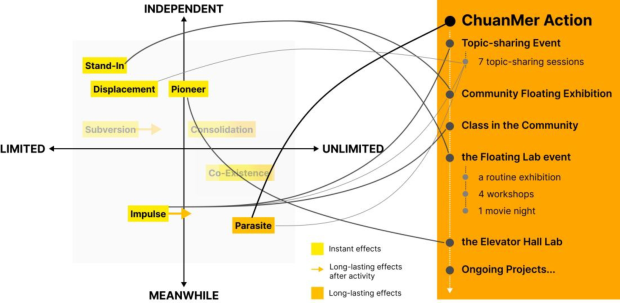
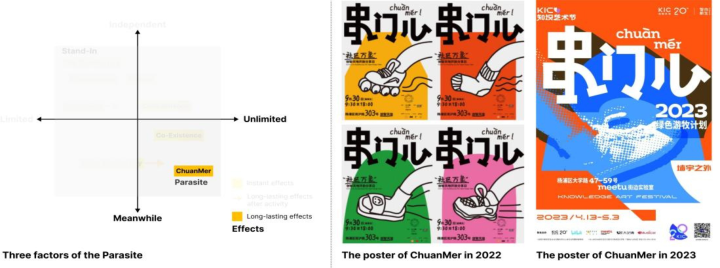
CASE ANALYSIS: CHUANMER ACTION AND ITS EVENTS ChuanMer, meaning “a casual visit” in Chinese, is the stem action for these two years and will continue to play a key role in the future (see Figure 4). Driven by MeetuLab, this action has activated 12 in-between sites through various TU events, including Topic-sharing Day, Floating Labs, Community Floating Exhibition, Elevator Hall Lab, and Class in the Community.
The overall ChuanMer action adopts the Parasite strategy. As named, this action developed in dependence on the existing daily activities of KIC and takes advantage of the availability of space through temporary activities which attract citizens to pay a casual visit. For example, Community Float- ing Exhibition cut up a year-long fixed exhibition into several temporary ones and moved from different in-between spaces. In the future, this action plans to extend its impacts to 32 more in-between spaces, with 12 TU events and 3 student startup projects.
Figure 4: The strategy and photos of ChuanMer action.
The commitment to sustainability is in all facets of the ChuanMer action. Firstly, ChuanMer, relying on a long-term collaboration, ensures systematic and frequent engagement in TU. With the multi-participation, especially that
of the community management team, this action integrates the TU frame- work into the overall community regeneration plan, advancing a systemic and consistent development. Secondly, unlike activating a completely abandoned community, ChuanMer refrains from disrupting the economic activities of KIC but serves as an acupuncture catalysts for in-between spaces through temporary activities. Thirdly, due to this light-touched method, the maxi- mum potential of the community is tested by temporally aligning creative activities with daily long-term ones, uncovering otherwise invisible surplus resources.
In summary, the Parasite strategy of ChuanMeras is a long-term empower- ment tool for the community, integrating with the community daily planning framework and optimizing the value of in-between spaces. However, the specific TU strategies differentiate in distinct events within the action.
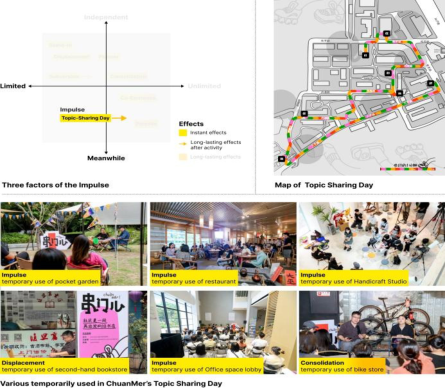
The Impulse Strategy: Topic-Sharing Day Event Topic-sharing Day, the first event of the ChuanMer action in 2022, themed Community Diversity and adopted the Impulse strategy (see Figure 5). This one-day TU event, different from its umbrella long-term action, gives an instant impulse for the community regeneration through seven one-hour sharing sessions in different in-between spaces. These seven sequence ses- sions aligned it topic with distinct locations and did not disrupt the daily activities on site. For instance, the second session utilized restaurant during off-peak hours for healthy eating topic-sharing, without disrupting regular restaurant operations. Between sessions, 15 minutes are allocated to guide the audience to walk to the next site. Consequently, these decentralized in- between spaces with the pathway in between were temperately connected and activated. In the end, this event received positive feedback, especially from owners and managers of the in-between spaces. In summary, this event employed a systematic strategy, providing the community with a network of impulses.
Figure 5: The strategy and photos of topic-sharing day event.
Empowering Sustainable Urban Futures: Exploring the Temporary Use 89
Besides the establishment of impulse network, sustainability is ingrained in the other two aspects. Firstly, the intensive occurrence of time-limited events in a single day multiplied the freshness and impacts into the com- munity. Moreover, this intensive occurrence allows for the reuse of materials between activities, minimizing resource waste relatively. Secondly, as daily and temporary activities happen simultaneously during this event, the influ- ence of topic-sharing were extended, empowering all potential participants in collaborations. In sum, Topic-sharing Day demonstrates sustainable poten- tial through systematic time-limited activities and an impulsive network of in-between spaces.
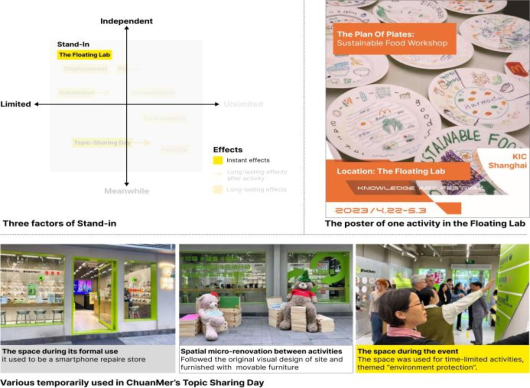
The Stand-in Strategy: The Floating Lab Event the Floating Lab is an event of ChuanMer action in 2023, employing the Stand-in strategy (see Figure 6). This TU event is conducted in one street-side store which is possessed and managed by the community management team. Unlike the cases above, this event does not aim for long-lasting impact but only use the vacant in-between space for the time available. This vacancy emerged in April 2023 when there was a 30-day gap between the departure of the previous tenant and the start of the next lease. During this gap, the Floating Lab launched a series of temporary activities in 21 days, themed “planet protection,” including a routine exhibition, one movie night, and four art workshops. This event, engaging over 50 volunteers and attracting 2,052 participants, successfully revitalized this urban space that would have otherwise faced vacancy. In the end, this event stopped before the time gap and restored the daily fabric of KIC.
Figure 6: The strategy and photos of the floating lab event.
Three strategic factors of the Floating Lab confer sustainable potential. Firstly, this event was challenged by the strictly limited time frame and phys- ical scale of the in-between space, requiring great adaptability and flexibility.
In response, it emphasized lightweight but attractive design language and movable furniture, reducing resource consumption and economic budget during space renovation and promoting sustainability. Secondly, this event utilized one common in-between space, the one between the gap of commer- cial leases, transforming it into a valuable asset for temporary events. This innovative use of specific in-between space introduces a duplicable solution to community managers and space owners. Thirdly, this event happens indepen- dently, granting greater freedom to users while requiring more commitment, especially in the site management and activity organizing. In conclusion, this event challenged the limits of this typical in-between space.
The Pioneer Strategy: The Elevator Hall Lab Event The Elevator Hall Lab, initiated in 2023, is an ongoing event employing the Pioneer strategy. It transforms an abandoned elevator hall into an offline lab- oratory. This event intends to have a long-lasting effect on the abandoned site, establishing an innovative usage of space to increase the vitality of site. Cur- rently, the space is renovated and serving as the headquarter of MeetU Lab where multi-background teams can co-design the next step of TU practices.
The strategic factors underscore the potential sustainability from two aspects. Firstly, as this site is abandoned by regular urban activities, tem- porary users can access the space with low risk, economic investment costs, and more freedom. Secondly, as a pioneer in the space, this action plays a crucial role in activating the vitality of the site through temporary activities. This ongoing event set a heat-up foundation for subsequent long-term activ- ities, emphasizing its functional orientation. From a broader perspective, this strategy can be integrated into community regeneration frameworks as a tar- geted tool for proactively re-utilizing spatial resources. However, the content and timing of the next official long-term activity is unclear now, creating uncertainty about the final effects of this pioneer action. In conclusion, the Elevator Hall Lab holds strategic value as a purpose-driven use of surplus spatial resources.
CONCLUSION AND DISCUSSION In summary, this paper underscores the importance of sustainable usage of spatial resources in the context of urban community regeneration. TU is considered an efficient intervention which essentially tackles the in-between space. Based on typology theory from Urban Catalyst, this paper empha- sizes three key factors of TU strategies, visualized through an analytical mapping model. Using this model, strategies from ChuanMer action and its subsidiary three events are discussed: ChuanMer action maximizes long-term urban spatial value through the Parasite strategy, Topic-sharing Day estab- lishes an impulse network connecting various in-between spaces, the Floating Lab challenges spatio-temporal limits by Stand-in strategy, and the Elevator Hall Lab serves as a pioneer in abandoned spaces. These case studies provide valuable insights for sustainable in-between space utilization and offer TU strategies for community regeneration.
Empowering Sustainable Urban Futures: Exploring the Temporary Use 91
However, one unsustainable criticism of TU needs consideration. Its time-limitedness implies a short lifespan for the materials. Thus, neglecting material recycling may result in a rebound effect in resource waste. The TU strategy needs to be examined more dialectically in future research to better empower urban sustainability.
ACKNOWLEDGMENT
This study was supported by the Ministry of Science and Technology (MOST) International cooperation project (2022YFE0197700) titled “Innovation during Urban Transformation. How to implement culture and creativity-led strategies to foster economic and social innovation in urban hubs during their transformative and re-development time”and Europe Horizon 2020 SC5-20- 2019 (868887-2) “Unleashing future-facing urban hubs through culture and creativity led strategies of transformative time”. The authors would like to acknowledge the faculty team, including Prof. Jarmo Suominen, Dr. Yan Wang, and Christian Kuhna. Special thanks to the dedicated student team - research assistants Xinlan Qian and Xinni Zhang, and M.S. students Siyuan Han, Jin Ning, Yuxi Li, Yating Ren, MingliSun, Lingyu Zhu, Ziqi Li, and Zixin Ren-for their significant contributions. We also appreciate the support from the KIC community and all participants over the two years whose collaboration has been pivotal to this study.
REFERENCES
Bishop, P., & Williams, L. (2012). The Temporary City (p. 19). London: Routledge. Haydn, F., & Temel, R. (2006). Temporary Urban Spaces: Concepts for the Use of City Spaces. Basel: Birkhäuser. Kubler, G. (1965). “The Unity of Cities in the Americas.” Cahiers d’Histoire
Mondiale. Journal of World History. Cuadernos de Historia Mundial, 9(1), 884. Lee, J., & Newman, G. (2017). “Forecasting Urban Vacancy Dynamics in a Shrinking City: A Land Transformation Model.” ISPRS International Journal of Geo-Information, 6(4), 124. Lynch, K. (1995). City Sense and City Design: Writings and Projects of Kevin Lynch.
MIT Press. Oswalt, P., Philipp, M., & Overmeyer, K. (2006). “Patterns of the Unplanned: Urban Catalyst.” In Loose Space (pp. 271–288). Routledge. Praglin, L. (1974). “The nature of the ‘in-between’ in DW Winnicott’s concept of
transitional space and in Martin Buber’s das Zwischenmenschliche.” Journal for the Study of Interpersonal Processes, 37(3), 240. Urban Catalyst. (2003). Strategies for Temporary Uses: Potential for Development of Urban Residual Areas in European Metropolises. Studio Urban Catalyst, Berlin.
LISTED IN THE AHFE DIGITAL BOOKSTORE CATALOGUE
Explore the complete digital volume
Sustainable Construction in the Era of the Fourth Industrial Revolution
Read this individual research paper free through the original publisher, or explore the full digital proceedings book.
ISBN 978-1-964867-25-0
Explore this ISBN in the AHFE Bookstore ↗Listed in the July 2026 bookstore catalogue; search by ISBN to confirm current availability · Digital book purchase optional