Fang Bin Guo, Bingyu Wu, Matthew Wah, Zaili Yang, Eddie Blanco-Davis, Abdul Khalique, Alan Bury (2022). Towards An Ergonomic Interface In Ship Bridges: Identification of The Design Criteria. In: Industrial Cognitive Ergonomics and Engineering Psychology. AHFE Open Access, vol. 35, pp. 108–117. https://doi.org/10.54941/ahfe1001609
Despite the current effort on ship design associated with hull structure, navigational and propulsion, equipment design inadequacy still causes approximately one-third of all maritime accidents [1]. Human-centred design (HCD) can minimise human errors through maritime service design [2]. The core of HCD is to enhance the usability of products/systems and maximise user’s satisfaction. The Human-centred maritime design (HCMD) applies the HCD method in ship bridge design, and enhances OOW performance in vessel operation. Service design is categorised as a sub-category of industrial design [3], a specification and construction process to deliver valuable capacities for actions of a particular user [4]. Contemporary industrial designers increasingly produce concepts/solutions for services rather than physical products [5], which is expected to work across disciplines and understand users, technologies, and business [3]. Taking account of the five vital parts of service design: actors (seafarers), locations (ship bridge), props (interfaces), associates (vessel manufacturers), and processes (operation workflows) [6] in the maritime service industry, a new HCMD will help designers to identify problems, iterate design concepts, and address all dimensions of user’s issues. VR and 3D Game Engine technologies provide an alternative approach for designers to present their design concepts. They enable prototyping and testing (data collection) works to be undertaken easily and with low cost; this was especially significant when the practice of NPD (new product development) took place during the Covid-19 pandemic. Human factors/ergonomics (HF/E) has been adopted in current ship design [2]. The application of physical ergonomics has benefitted the modernisation of ship design to improve seafarers’ workplace conditions. Cognitive ergonomics particularly helps in the user interface design (UI) to reduce seafarers’ cognitive workload. Organisational ergonomics, however, will affect the workflow structure of vessel operations to relieve the pressure on seafarers during the decision-making process [2]. A recently funded project has been undertaken by a multidisciplinary team, seeking a design solution to improve seafarers’ performance reliability at sea. The principles/criteria of maritime service design were developed based on the study of a) human/operator needs; b) the state-of-the-art technologies to improve the seafarer’s work environment; and c) the user experience (UX) in vessel operation. A combination of engineering and design research methods were employed: a systematic review to clarify/address the above research questions; and the field study to investigate current/future requirements of ship bridge design; to map the behavioural human-machine interaction (HMI) and further to develop the design criteria/drivers for the ideation of an ergonomic interface. The NASA-TLX (task load index) assessment method will be used in the validation phase (future work) to assess if the design solution reduced participants’ cognitive workload and enhanced their vessel operation performance. This paper explores the project conducted so far and offers initial findings.
Technological innovations have improved the safety of maritime-related industries, however in the recent decades, human errors still contribute to 80% of sea accidents (Wróbel, 2021). Norman (2019) believes one of the causes is because much of our technology is designed through a technology- centred approach. He disputes the practice of design with technology at the forefront and stresses the importance of user experience (UX).
Ship bridge design is criticised over technology-centred while lacking the consideration of vessel operations as part of the design process. People expect the advanced technology will increase the number of instruments on ship bridge, so that it enhances the performance of the Officers on Watch (OOW) through reducing workload and providing a ‘better situational awareness’ (Hareide, 2017), ultimately, making ship operations safer. Advanced techno- logy has reduced accidents resulting from technical failures; however, human factors associated with the use of technology continue to cause more than 1/3 of the accidents (Bieli´c, et al., 2017). Instead of blindly introducing new
Towards an Ergonomic Interface in Ship Bridges: Identification of the Design Criteria 109
technology into ship bridge design, it is more critical to examine the situa- tion awareness efficiency supported by technologies. Technology evolution results in the complex interfaces of products, systems, and workplaces; in particular, the multimodality interfaces which display various and numerous information, and ultimately challenge users to recognise and interact with (Guo, et al., 2021). The consequent distractions become potential negative factors affecting work efficiency and safety.
Norman (2018) introduced the human-centred design (HCD) method that aids to identify and fix the real and underlying problems in current ship bridge design, in terms of the equipment, layout, and working procedures aimed to eliminate most errors caused by humans. It is imperative to opti- mise the bridge design using human-centred participatory design approach, to upgrade human machine interaction (HMI) with the minimum cognitive load.
HCD takes account of people at the centre of design, to improve their experience when using or interacting with products, systems, and environ- ments (Giacomin, 2015). Human Factors/Ergonomics (HF/E) refers to the application of psychological and physiological principles to the design of pro- ducts, processes, and systems (Wickens, et al., 2003). This scientific discipline focuses on understanding people’s needs, abilities, and limitations with the purpose of designing adequate interaction systems (IEA, 2014).
Currently, most ship designers focus on the physical ergonomics, and in the research of seated wheelhouse cockpit designs that integrate equipment around anthropometrics, such as the line of sight, to assure information to be more accessible for the OOW. Grech et al. (2008) have upgraded this to list the lack of standardisation as one of the primary HMI issues on-board ships, and the lack of usability, information overload, and ergonomic inte- gration in design. These concepts, however, did not consider the ship bridge as an ‘all in one product’ with a multimodality interface. This paper aims to investigate the specifications for the design of ‘a product of future bridge’, where the concept integrates all the equipment in the ship bridge as the parts of a product, finally, to function as one system or product.
UPGRADING INTERFACE DESIGN THROUGH HUMAN-CENTRED DESIGN HCD is commonly applied in the design industry and is characterised as a multi-stage problem-solving process. Researchers argue that current meth- ods of reducing human error at sea require a different approach to existing models of accident mitigation. Apostol-Mates and Barbu (2019) describe the human element in a study regarding accidents involving fatigue as “the cen- tral pillar of the system”, signifying the importance of the human element in operating the vessel is beyond the mechanical and technological elements. Norman (2019) agrees that the reliance on technologies within the industry creates a hostile environment for humans. He disputes the practice of desi- gning with technology and suggests that the UX should come first. Likewise, Costa (2016) suggested that applying the HF into the design of vessels will potentially alleviate the number of human errors.
The Ergonomics.org.uk (2012) defines HF is about ‘fit’: the fit is between people, the objects, and the environments they use or work. The objective of HF is to design systems, jobs, and organisations that match human capa- bilities to reduce human errors, increase productivity, and enhance safety or comfort with a specific focus on the interaction between the human and the thing of interest (Wickens, et al., 2003). HF incorporates three domains: the physical, cognitive, and organisational ergonomics (IEA, 2014). These three criteria dictate the quality of design and assist how the design intera- cts with human elements. Basically, the physical ergonomics benefits modern specialised ship design to satisfy OOW’s requirements. Cognitive ergonomics emphasises the interface design process to reduce users’ cognitive workload. Organizational ergonomics takes account of the workflow structure of bridge operations, which can increase or decrease pressures during the process of decision making in the ship bridge. Therefore, HF participation in HCD expe- cts to promote overall system design results and increase life cycle cost savings (Hendrick, 2008) by better integrating users, machines, and work environ- ment to increase production efficiency, minimize errors, and improve user trust and system reputation (Maguire, 2001).
IMO GUIDELINES ON SHIP BRIDGE DESIGN Established in 1948, the International Maritime Organization (IMO) has issued a number of regulations to provide machinery for cooperation among governments worldwide; it encourages and facilitates the general adoption of the highest practicable standards in matters concerning maritime safety, effi- ciency of navigation, and the prevention and control of marine pollution from ships (O’Neil, 2011). IMO keeps adopting recommendations and revising existed regulations. Between 1997 and 2003, IMO introduced and revised human element vision, principles, and goals respectively, which begin to pro- actively identify the HF-related safety issues (Schröder-Hinrichs, et al., 2013). The Guidelines on Ergonomic Criteria for Bridge Equipment and Layout developed and announced in 2000, aimed to pursue a successful ergonomic design of the bridge and bridge equipment, containing ergonomic require- ments and pragmatic layouts to support OOWs in their tasks based on the theory of HCD. The guideline detailed ergonomic requirements for seven aspects (i.e. Bridge layout, Work environment, Workstation layouts, Alarms, Input devices, Information display, and Interactive controls), and incorpora- tes interface and interaction criteria physically and virtually, for designers, manufactures, and ship owners to follow and review.
In 2003, the Maritime Safety Committee (MSC) highlighted the issues that need to be considered when introducing new technology on board ships, to guarantee the effectiveness of seafarers operating the new technology safely (IMO, 2003). MSC discussed issues regarding the adoption of new techno- logies into vessels, concerning factors such as familiarity with equipment, the variety of user interfaces (UIs) between vessels, interface symbology, behavioural patterns of inexperienced seafarers under stress, a quantity of information, and lack of understanding regarding the limitations of automa- tion at the time. In 2006, MSC developed new performance standards for
Towards an Ergonomic Interface in Ship Bridges: Identification of the Design Criteria 111
Electronic Chart Display and Information System (ECDIS). The guidelines for the presentation of navigation-related symbols, terms, and abbreviations were amended in 2019. ECDIS became more mature in both its technology and implementation within ships, as new standards became the norm, which made ECDIS more user friendly, realising its potential, as discussed within the annex of MSC Circular.1503 in 2017. Thus, cementing the implementation of digitalised ship environments for the foreseeable future.
ADOPTING DIGITAL TECHNOLOGY The emerging technologies provide new ways to display information and interact with users, further, to help mitigate risk and enhance seafarers’ performance in vessel operation. This paper studied a variety of advanced interactive and display technologies that targeted to minimise the distracti- ons for OOWs within ship bridges, to reduce their cognitive workload, and to relieve pressure during decision-making processes.
Augmented Reality (AR) overlays computer-generated digital elements onto the real world via a tight integration of camera hardware and softw- are. This technology has been widely adopted in consumer product design such as smartphones, and other sectors. Recently, Furuno (a historical Japa- nese supplier in the maritime field) applied AR to the Envision Navigation system, aiming to enhance seafarers’ navigational performance. Likewise, the Ocean Industries Concept Lab (OICL) in Norway, released a video displaying a concept of AR ship navigation. Differing from Furuno, OICL used the head mounted display (HMD) to overlay information on the sight field of seafarers and provided seafarers with more flexible and moveable visions.
Virtual Reality (VR) technology especially the VR HMD can offer affor- dable and highly immersive experience to users. The technology has widely benefited education and the training domain. The “sense of being there” enables experiential learning in simulated virtual environments effectively (Stevens and Kincaid, 2015), where seafarers can acquire accurate spa- tial information with a meaningful, contextual, and scenario-based learning experience (Renganayagalu et al., 2021).
Mixed Reality (MR) provides better experience to AR as it incorporates VR, which allows for greater interaction. Microsoft (2021) has also deve- loped its second-generation headset ‘the HoloLens2’. The MR blurs the boundaries between real and virtual and supports both interactions with real and virtual context.
Cognixion One is defined as the world’s first brain computer interface with augmented reality wearable speech generating device (Cognixion, 2020). The technology combines AR and upgrades Electroencephalogram (EEG), in which the incoming data is interpreted by a machine learning model to acce- lerate teasing out signals and making predictions, to help those who struggle with communication, so as to provide users visual, voice, and brain UI to smoothly interact with (Coldewey, 2020). Like a heads-up display, the visual UI is reflected to a transparent surface as an overlay of information, while audio and speakers ensure the product’s ability to communicate with users by voice. However, the additional benefit is to read electrical activity within
the brain to determine what is displayed. Therefore, this technology can also be used to measure stress, cognitive load, and fatigue through the headset.
Surface Dial is a product of Microsoft released in 2016. Microsoft defines it as a product able to “Store, customise, access, navigate and reimagine phy- sical tools in the digital world – from concept to creation” (Microsoft, 2020). It is expected that Dial will create the most natural and immersive way for users to interact with, and further to build an intuitive connection between virtual interfaces and physical moves.
Given the above, these advanced display and interactive digital technolo- gies demonstrate great potential to exhibit information, promote HMI, and further upgrade current interface of the bridge ergonomically.
BEHAVIOURAL MAPPING OF THE OOWS Recently, an approximately 60 minutes’ simulation exercise was set up by the authors of this paper in a 360° ship bridge simulator. The task was desi- gned as a voyage planning of ‘arrive at a port’, which involved managing temporary/emergent events during the vessel operation, such as performing urgently when the harbour is suspended due to strong winds and handling a fire alarm emergency. Four experienced deck officers participated in this exercise, including a Master, two OOWs (a and b), and a Helmsman. The master leads the team and holds full awareness and knowledge of the task and working situation. The two OOWs executively operate the vessel with the assistance of numerous digital and manual equipment at the workplace. Helmsman, however, followed the OOWs commands to concentrate on the manual steering during the entire operation.
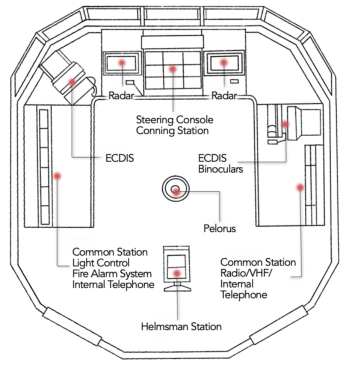
Figure 1 visualises the floor plan of the workplace that consists of a Con- ning Station, two Radars, two ECDISes, a Helmsman Station, a Pelorus, and two Common Stations equipped with Radio, VHF, telephone, and fire alarm systems. Behavioural mapping was performed based on the entire process of the task, to record individual’s working position and trajectories of their eye focal points and body movements respectively.
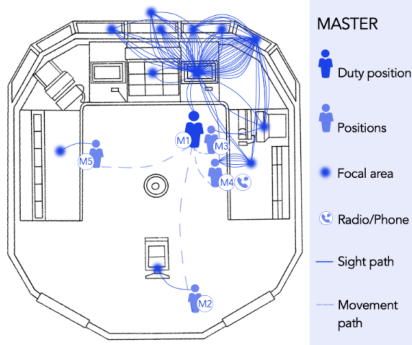
The Master’s map (see Figure 2) demonstrates that the major working posi- tion of the Master is next to the radar on the right, where he/she is frequently checking the radar and looking out through front windows. He/she often communicates with the OOWs; however, has very seldomly interacted with the Conning Display, the ECDIS, and the Common Station. Given these obse- rvations, it can be learnt that the radar is the primary equipment that the master interacts with, and looking out is his/her major activity.
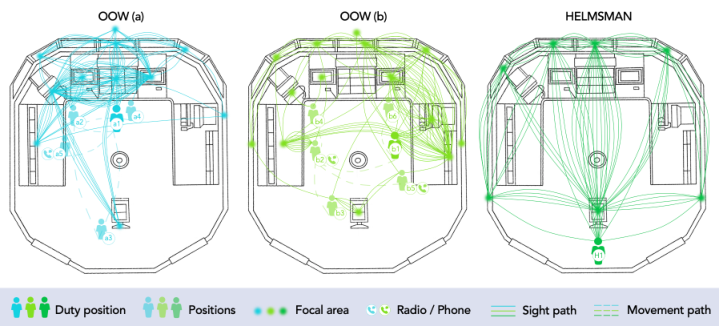
The two OOWs shared the same duty in this task; however, they have pla- yed different roles individually. The OOW(a)’s major working position is next to the Conning Station, where he/she often interacts with the Radar and the ECDIS on the left side. Whilst interacting with the Conning Display, OOW(a) has also frequently looked out and communicated with the Helmsman. Whe- reas OOW(b)’s major working position is close to the Master and is next to the Common Station on the right. He/she often interacts with the ECDIS, Radar, and performs looking out through all windows. OOW(b) often checks paper charts, keeps a stand-by for external and internal communication via
Towards an Ergonomic Interface in Ship Bridges: Identification of the Design Criteria 113
Figure 1: Floor plan.Figure 2: Behavioural mapping of master.
VHF/radio/telephone supplied on the Common Station, and works flexibly and exhibits the most complicated routes inevitably (see Figure 3).
The Helmsman displayed a simple behavioural map with a fixed working position at the Steering Station. He/she follows the OOWs commands to steer manually and keeps looking out from all windows almost simultaneously.
The preliminary results indicate that the Radar, ECDIS, Conning Display, and Steering Station appear to be the most significant equipment required during vessel operation. Meanwhile, paper charts seem quite important and necessary, and cannot be completely replaced by ECDIS, in case the digital equipment fails to work due to unexpected events and leading to accidents. In addition, more than one ECDIS and Radar may be needed in the bridge, if more OOWs work in a tight space at the same time. It indicates that a multi- modality interface may be an ideal solution to present multiple information within a limited space.
Figure 3: Behavioural mapping of OOW (a), OOW (b), and Helmsman.
DISCUSSION
The findings of primary and secondary research provide an essential foun- dation of HCD specifications for the next generation of bridge designs, including ergonomic requirements and practical layouts that target to pursue a successful ergonomic design of the bridge and bridge equipment to support OOWs in their tasks.
The three dimensions of HF supply comprehensive assistance in HCD. Physical Ergonomics offers anthropometric standards to exam and improve OOWs’ working postures, manual steering, repetitive movements, and work- place layout, thereby reducing distraction. Cognitive ergonomics, in parti- cular the study of symbolic qualities of man-made shape in the cognitive and social context of their use, can facilitate people’s cognitive ability, so as to assist HMIs, when people do not respond to the physical qualities of things but act on what they mean to them (Krippendorff, 1984). Finally, organisational ergonomics serves to optimise the workflow structures, poli- cies, and processes, to enhance communication and assist the teamwork, thereby, to increases or decrease the pressure of HMI’s effecting on decision making.
IMO keeps updating guidelines on ergonomic criteria for bridge equi- pment and layout, and revising existing regulations for workstations such as navigating, monitoring, Helmsman operations, docking, planning, safety, and communication. It also details ergonomic requirements including Bridge layout, Work environment, Workstation layouts, Alarms, Input devices, Information display, and Interactive controls. MSC often renews perfor- mance standards for ECDIS guidance of good practice, the presentation of navigation-related symbols, terms, and abbreviations.
The emerging display and interactive digital technologies provide the fea- sible and practical solutions to upgrade current UIs of ship bridge. The AR HMD overlays information on the sight field of seafarers to provide sea- farers with more flexible and moveable visions. The VR HMD, however, offers highly immersive experience to users. Cognixion One combines AR
Towards an Ergonomic Interface in Ship Bridges: Identification of the Design Criteria 115
and upgraded Electroencephalogram (EEG) to supply users with visual, voice, and brain UI interactions. Further, this technology can measure stress, cogni- tive load, and fatigue through the headset. Ultimately, Surface Dial plants “physical tools in the digital world” (Microsoft, 2021), creating an immer- sive way in building an intuitive connection between virtual interfaces and physical moves.
The data collected from the behavioural mapping indicates that Radar, ECDIS, Conning Display, and Steering Control are four vital pieces of equi- pment required in vessel operation, together with paper charts, which appear to be a necessary substitution of ECDIS. These findings have confirmed the hypothesis of creating a simple and multimodality interface with intuitive interaction as an ideal solution to reduce the amount of physical equipment, to minimise distractions, and to improve the OOWs’ working conditions.
CONCLUSION
Given the above discussion, the preliminary design criteria can be concluded to incorporate (a) following the IMO guidelines and the MSC regulations, (b) applying the three dimensions of HF in HCD, (c) satisfying the findings indicated in the behavioural mapping, and (d) adopting the state-of-the-art digital technologies. These four criterions will form an experimental concept, to address ergonomic issues through upgrading the interface design of cur- rent workplaces. Further, the concept will be evaluated via a usability test undertaking in a focus group discussion later, to finalise a validated design criterion, thereby to drive the formal prototype of ‘A Product of Future Ship Bridge’.
ACKNOWLEDGMENT
This research is funded by MarRI-UK. It is also partially supported by EU H2020 Marie Curie RISE ENHANCE project (MSCA-RISE 823904). The authors would like to thank all project participants for their valuable dedication to this research.
REFERENCES
Apostol-Mates, R. and Barbu, A. (2019). Fatigue Leading to Human Error: A Study Based on Marine Accidents. Scientific Bulletin “Mircea cel Batran” Naval Academy, 22(2), pp. 110–115,110A. Bieli´c, T., Hasanspahi´c, N. and ˇCulin, J. (2017). Preventing Marine Accidents Caused
by Technology-induced Human Error. Scientific Journal of Maritime Research, 31, pp. 33–37. Cognixion. (2020). Cognixion One - The World’s First Brain Computer Interface with Augmented Reality Wearable SpeechTM Generating Device. Available at: https://one.cognixion.com/ (Accessed: 9 January 2022). Coldewey, D. (2020). Cognixion’s Brain-monitoring Headset Enables Fluid Com-
munication for People with Severe Disabilities. Available at: https://techcrunch.com/2021/05/04/cognixions-brain-monitoring-headset- enables-fluid-communication-for-people-with-severe-disabilities/ (Accessed: 9 January 2022).
Costa, N. (2016). Human Centred Design for Maritime Safety. A User Perspective on the Benefits and Success Factors of User Participation in the Design of Ships and Ship Systems, pp. 53. Ergonomics.org.uk (2012). Ergonomics Ergo-what? Available at: https://www.
designingforpeople.org.uk/explore/definitions/ergonomics/ (Accessed: 9 January 2022). Giacomin, J. (2015). What Is Human Centred Design? The Design Journal, 17(4), pp. 606–623. Grech, M.R., Horberry, T.J., and Koester, T. (2008). Human Factors in the Maritime
Domain (1st ed.). Boca Raton: CRC Press. Guo, F.B., Yang, Z., Blanco-Davis, E., Khalique, A., and Bury, A. (2021). Does Being Human Cause Human Errors? Consideration of Human-Centred Design in Ship Bridge Design. Proceedings of the AHFE 2021 Virtual Conferences on Neuroergonomics and Cognitive Engineering, July 25-29, 2021, USA. Hareide, O. S. and Ostnes, R. (2017). Maritime Usability Study by Analysing Eye
Tracking Data. Journal of Navigation, 70 (5), pp. 927–943. Hendrick, H.W. (2008). Applying Ergonomics to Systems: Some Documented “Lessons Learned”. Applied Ergonomics, 39 (4), pp. 418–426. IEA. (2014) What is Ergonomics? Available at: https://iea.cc/what-is-ergonomics/
(Accessed: 9 January 2022). IMO. (2003). Issues to Be Considered When Introducing New Technology on Board Ship. London: International Maritime Organisation. IMO. (2019) Electronic Nautical Charts (ENC) and Electronic Chart Display and
Information Systems (ECDIS). Available at: https://www.imo.org/en/OurWork/Safety/Pages/ElectronicCharts.aspx (Accessed: 9 January 2022). Krippendorff, K and Butter, R. (1984). Special Issue Devoted to Product Semantics.
Innovations 3/2 Maguire, M. (2001). Methods to Support Human-Centred Design. International Journal of Human-Computer Studies, 55 (4), pp. 587–634. Microsoft. (2021) Microsoft HoloLens 2. Available at:
https://www.microsoft.com/en-us/hololens (Accessed: 9 January 2022). Microsoft. (2021) Surface Dial Overview. Available at: https://www.microsoft.com/ en-gb/d/surface-dial/ (Accessed: 9 January 2022). MSC. (2006). Adoption of the Revised Performance Standards for Electronic Chart
Display and Information Systems (ECDIS), s.l.: International Maritime Organisa- tion. MSC. (2017). ECDIS-Guidance for Good Practice, s.l.: International Maritime Organisation. Norman, D.A. (2018) Human Error? No, Bad Design. Available at: https://jnd.org/
stop_blaming_people_blame_inept_design/ (Accessed: 9 January 2022). Norman, D.A. (2019) People-Centred (Not Tech-Driven) Design. Available at: https://jnd.org/people-centered-not-tech-driven-design/ (Accessed: 9 Jun 2021) O’Neil, W. A. (2011). Raising World Maritime Standards. Maritime Policy &
Management, 31 (1), pp. 83–86. Renganayagalu, S.K., Mallam, S.C. and Nazir, S. (2021). Effectiveness of VR Head Mounted Displays in Professional Training: A Systematic Review. Tech Know Learn, 26, pp. 999–1041. Schröder-Hinrichs, J. U., Hollnagel, E., Baldauf, M., Hofmann, S. and Kataria, A. (2013). Maritime Human Factors and IMO Policy. Maritime Policy & Management, 40 (3), pp. 243–260.
Towards an Ergonomic Interface in Ship Bridges: Identification of the Design Criteria 117
Stevens, J. A. and Kincaid, J. P. (2015). The Relationship Between Presence and Performance in Virtual Simulation Training. Open Journal of Modelling and Simulation, 3(2), pp. 41–48. Wickens, C. D., John Lee, Y. D. L. and Gordon-Becker, S. (2003) An Introduction to
Human Factors Engineering (2nd ed). Harlow: Pearson. Wróbel, K. (2021) Searching for the Origins of the Myth: 80% Human Error Impact on Maritime Safety. Reliability Engineering & System Safety, 216, 107942.
LISTED IN THE AHFE DIGITAL BOOKSTORE CATALOGUE
Explore the complete digital volume
Industrial Cognitive Ergonomics and Engineering Psychology
Read this individual research paper free through the original publisher, or explore the full digital proceedings book.
ISBN 978-1-958651-11-7
Explore this ISBN in the AHFE Bookstore ↗Listed in the July 2026 bookstore catalogue; search by ISBN to confirm current availability · Digital book purchase optional