Adel Jebali (2024). French as a second language (L2) and AI: Deep Learning Models to the Rescue of Object Clitics. In: Training, Education, and Learning Sciences. AHFE Open Access, vol. 155, pp. 216–222. https://doi.org/10.54941/ahfe1005406
Just like many other Romance languages, French includes units known as object clitics, which exhibit characteristics of both affixes and noun phrases (NPs). They resemble affixes in that they need a prosodically strong host to attach to, and they are similar to NPs in that they fulfill a syntactic role in the utterance. These properties, coupled with their unique positioning compared to the phrases they replace, categorize them as special clitics (Zwicky, 1983). All these factors place them at the intersection of phonology, morphology, and syntax. Consequently, it’s not surprising that they pose a challenge for learners whose first language isn’t French.Learners of French as a second language (L2) often find it difficult to master the use of these units, leading to mistakes and various avoidance strategies. Errors can include incorrect agreements (with the antecedent, as well as with the past participle and adjectives), non-standard placement (such as placing the clitic between the auxiliary and the past participle), resorting to strong pronouns (likely influenced by languages that allow it, such as English), and an incomplete understanding of certain morphosyntactic or semantic properties (such as the distinction between animate and inanimate or verb subcategorization). On the other hand, avoidance strategies include NP repetition and omission (Wust, 2009; Emirkanian et al., 2021).Could deep learning be the solution to assist these learners? We believe so.To train a model capable of identifying sentences containing errors in the use of clitic object pronouns, a substantial amount of training data is required. This data should include a significant number of correctly written sentences in French L2, along with sentences containing errors in the use of clitic object pronouns. Once collected, this data needs to be prepared for use in a deep learning model. The data must be cleaned, normalized, and encoded into a format that the model can interpret. The data can also be augmented with variations of similar sentences, allowing the deep learning model to learn to generalize and recognize errors in a wider context.Our project involves adapting a pre-trained FlauBERT model (Le et al., 2020), based on BERT (Devlin et al., 2019), for a grammaticality judgment task. We fine-tuned this monolingual model on a dataset of 5272 sequences annotated as correct or containing errors. This dataset includes authentic productions from learners of French L2 (Jebali, 2018), along with data collected from the web containing both real productions and modifications introducing non-authentic but plausible errors.After fine-tuning FlauBERT, we used it to provide grammaticality judgments on a second evaluation corpus containing data the model had never seen before. On this dataset, it achieved an overall F-score of 0.93, which is higher than the scores obtained by GPT 3.5 (ChatGPT) and Antidote 11.After fine-tuning this initial model, we further fine-tuned it on a corpus of 6936 examples of errors related to the use of these clitics. The task was to discriminate between four types of errors regarding these units: agreement, position, resort to strong pronouns, and syntactic or semantic order errors. This second model achieved an evaluation F-score of 0.95, demonstrating excellent classification capabilities.Both deep learning models can be seamlessly integrated into an automatic correction system to help French L2 learners avoid errors related to the use of clitic object pronouns.The system pipeline we’ve established using these two models takes a sequence of words (ranging from a sentence to an average-length paragraph), checks for errors in the use of the object clitic, and provides feedback based on the error type. We later added an additional generative module, a model fine-tuned on another corpus and based on mBARThez (Kamal Eddine et al., 2021), which is built on BART (Lewis et al., 2019). This module can suggest a correction for the sequence containing an error in the use of the object clitic.
Object clitics (OCs) in French are personal or oblique pronouns that are commonly used in sentences such as example (1b): (1) a. Sarah a écrit ce roman policier. b. Sarah l’a écrit. In sentence (1b), the OC pronoun “le” (which is elided to l’) is a syntactic object of the verb and attaches preverbally to it, despite being a prosodically weak element. This is different from the behavior of equivalent pronouns in English, such as in example (2b), where the pronoun “it” is placed to the right of the verb in the same position as the nominal phrase (NP) it replaces, “this detective novel”.
(2) a. Sarah wrote this detective novel. b. Sarah wrote it. The peculiar behavior of OCs in French, as well as other unique features of these elements, often causes confusion among French second language (L2)
French as a Second Language (L2) and AI: Deep Learning Models 217
learners. As a result, these learners use various strategies to compensate for their lack of mastery of these forms. Some authors, including (Wust, 2009), have noted the issue of omission and avoidance, while others, such as (Jebali, 2018), have highlighted strategies like NP repetition. Learners also commonly make errors in the placement of OCs relative to the verb and auxiliary, and in false agreements in gender, number, or person with the antecedent. Addi- tionally, grammatical case errors, discussed in (Emirkanian, Redmond and Jebali, 2021), are also prevalent, such as using the accusative instead of the dative and vice versa.
All these strategies and errors are well-represented in the data used to fine-tune two deep learning models aimed at classifying French L2 learn- ers’ productions into two categories, and at classifying their errors relative to OCs’ use, as explained in the following sections.
DATA While we were conducting this research and up to the present day, there is no existing corpus or dataset that allows us to fine-tune deep learning mod- els according to our objectives. Therefore, we initially had to create two datasets:
The first one is primarily composed of authentic mistakes made by learn- ers during a previous experiment conducted by the researcher (Jebali, 2018). This dataset also includes some fabricated sentences that demon- strate common mistakes missing in our initial corpus. In total, the corpus consists of 2636 examples of various mistakes in the use of OCs. This dataset also includes perfectly correct sentences regarding OC use in French, sourced from various websites. To maintain balance, the number of these correct examples was also 2636, bringing the total to 5272 examples.
The second dataset consists solely of sentences containing mistakes in the use of OCs. We identified four types of mistakes and used examples from the first dataset, supplemented with additional examples to create four balanced categories, each containing 1734 examples, for a total of 6936. More details about these categories will follow.
The First Dataset This first dataset is geared towards a binary text classification task. So, in this dataset we gathered text sequences that fall into two classes:
1. Correct 2. Erroneous This classification is done according to the French language rules regarding the use and placement of OCs. Thus, while example (1b) falls into the first class, example (3) below falls into the second one, where the OC le is placed to the right of the past participle écrit instead of the pre-auxiliary position.
(3) Sarah a écrit le.
218 Jebali
The Second Dataset This dataset is geared towards a 4 categories classification task. So, we used examples from corpus 1, but we added much more examples to have enough data that fall into 4 categories of errors:
1. Cat. 1: Agreement errors (in gender, number or person) regarding the antecedent. In example (4), below, the learner used the OC les (plural) instead of the OC le (l’), which is singular (like the antecedent papa). 2. Cat. 2: Placement errors. The OC is otherwise OK, but it is placed in a non-canonical position, such as in example (3). 3. Cat. 3: Strong pronouns instead of OCs or vice versa. In example (5), for instance, the learner used the strong pronoun eux instead of the OC les. 4. Cat. 4: Semantic and morphosyntactic errors. This is a mix of 4 types of errors: Case (Accusative instead of Dative, for example), Missing and nul object, doubling errors and confusion between y, en, le and ça. The reason we put these errors together is that they all imply a missanalysis of the argument structure. (6) illustrates an example of a nul object: (4) Papa a contracté une maladie qui les a rendu très faible. (5) Mon chien adore les enfants. Pourtant il aboit quand il voit eux. (6) Est-ce que tu vas à l’école? Oui, je vais.
MODELS FINE-TUNING & EVALUATION FlauBERT
FlauBERT (Le et al., 2020) is a language model developed by the French National Centre for Scientific Research (CNRS). Serving as the Francophone counterpart to CamemBERT (Martin et al., 2020), both models trace their roots back to BERT (Devlin et al., 2019).
With a robust architecture comprising 373 million parameters, FlauBERT is specifically tailored for the task of grammaticality judgment and text classi- fication. The model’s effectiveness is achieved through a fine-tuning technique using the Hugging Face Transformers library. The process involves a two-step approach: firstly, the transfer learning of a pre-trained model into a binary classifier to discern between correct and incorrect sentences regarding OCs’ use. The second fine-tuning step focuses on distinguishing among the four types of errors, demonstrating FlauBERT’s understanding of grammatical nuances.
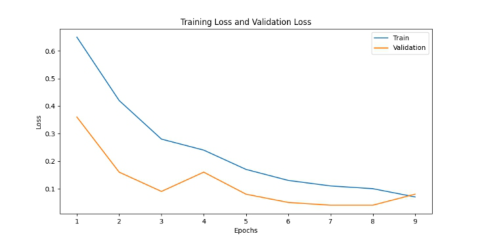
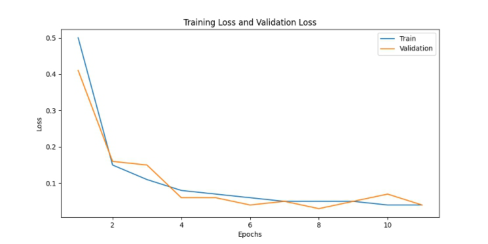
Fine-Tuning The two fine-tuning steps were done on a single consumer GPU with a batch size of 32 and 20 epochs with an early stopping at epoch 9 for the first model and at epoch 11 for the second. The first model achieved a validation accu- racy of 0.97 and the second 0.99. Figures 1 and 2 show training loss and validation loss values for the two fine-tuned models:
French as a Second Language (L2) and AI: Deep Learning Models 219
Figure 1: Training and validation loss (model 1).Figure 2: Training and validation loss (model 2).
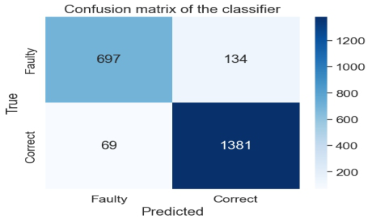
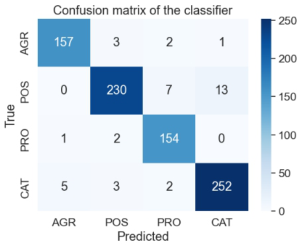
Evaluation During the fine-tuning process, the two datasets were divided into two subsets each, with 90% allocated for training and 10% for evaluation. Following the fine-tuning phase, the models undergo testing using two additional datasets. Models 1 was evaluated on 2282 examples, while Model 2 was tested on 833 examples, all of which have never been encountered by the models before. This approach ensures a robust assessment of the models’ generalization capabilities.
These evaluations led to the following results: F-score for model 1 is 0.93 and 0.95 for the second. Confusion matrices are shown in Figures 3 and 4:
Figure 3: Model 1 eval.
220 Jebali
Figure 4: Model 2 eval.
To gauge its performance, comparisons are drawn between model 1 and two benchmark models: Antidote 11 and GPT-3.5 (ChatGPT). These com- parisons provide insights into how well the FlauBERT-based model performs in relation to established language tools and advanced large language models. Model 2 cannot be compared to any other tool as this error classification is novel. Table 1 presents this comparison:
Table 1. Comparison results between Model 1, Antidote 11 and GPT 3.5.
Model 1 stands out as notably more robust than both Antidote 11 and GPT 3.5 when it comes to distinguishing between correct and erroneous sentences concerning object clitics (OCs). Conversely, Model 2 exhibits considerable strength in effectively identifying errors made by learners in relation to these OCs with an F1-score of .95, a precision of .95, and a recall of .96 with better results in identifying error types 1 and 3.
Our Models’ Potential in Education These models are fine-tuned in the express purpose of making them useful to French L2 learners. This is achieved by doing the following:
The integration of these models into a complete system that enables learners to distinguish between correct texts and those containing errors in the use of OCs. It also allows for the identification of the exact type of error, and if the learner wishes, the system can also rephrase the text to eliminate the specific error.
The feedback provided is tailored to the specific type of error made, ensuring a targeted and effective learning experience.
The system also highlights and suggests corrections for repetitions in noun phrases (NP) or adjectival phrases (AdjP).
French as a Second Language (L2) and AI: Deep Learning Models 221
The system includes a lexical spell-checking module as an initial phase, as spelling corrections enhance the predictions made by our models.
This system encourages autonomy, empowering learners to take control of their language acquisition journey.
The rephrase module is based on mBARThez (Eddine et al., 2021) is not chat-like. One of the advantages of this generative module is that it doesn’t take the learner’s place in telling them what to think. Instead, it operates based on the learner’s expressions and ideas, offering linguistic improvements and sometimes even stylistic enhancements.
CONCLUSION
In this paper, we presented a cost-effective system developed by a single indi- vidual that will be available for free and will be a valuable tool for French second-language learners. While the system currently has limitations, as it does not address various errors (other than those concerning OCs), some aspects are already covered, including simple agreements, the placement of complements before verbs, negation, punctuation, and more. Looking ahead, the project aims to expand its scope by modeling the interlanguage of French second-language learners, extending beyond just cliticization. This initia- tive reflects a commitment to enhancing language learning experiences and holds promise for further advancements in supporting learners of French as a second language.
ACKNOWLEDGMENT
This work is made possible through a grant from the Social Sciences and Humanities Research Council (SSHRC) of Canada under the Knowledge Development program. The fine-tuning calculations were performed on the servers of Canada’s Digital Alliance, primarily utilizing Niagara and Mist.
REFERENCES
Affes A., I. Biskri and A. Jebali. (2022). French Object Clitics in the Interlanguage: A Linguistic Description and a Formal Analysis in the ACCG Framework, in N. T. Nguyen et al. (Eds.): ICCCI 2022, LNAI 13501, pp. 220–231. Cheng Y. and M. Duan. (2020). Chinese Grammatical Error Detection Based on
BERT Model, Proceedings of the 6th Workshop on Natural Language Processing Techniques for Educational Applications, pp. 108–113. Devlin J., M.-W. Chang, K. Lee and K. Toutanova. (2019). BERT: Pre-training of Deep Bidirectional Transformers for Language Understanding, Proceedings of the 2019 Conference of the North American Chapter of the Association for Compu- tational Linguistics: Human Language Technologies, Volume 1 (Long and Short Papers). Emirkanian E., L. Redmond and A. Jebali. (2021). Maîtrise des clitiques datifs dans
les structures bitransitives en français L2 par des apprenants anglophones : Influ- ence de la structure argumentale de la L1, Canadian Journal of Applied Linguistics, Volume 24, Number 2. Guerdoux G., T. Tiffet and C. Bousquet. (2022). Inference Time of a CamemBERT Deep Learning Model for Sentiment Analysis of COVID Vaccines on Twitter, in J. Mantas et al. (Eds.): Advances in Informatics, Management and Technology in Healthcare.
222 Jebali
Jebali A. (2018). Anxiété langagière, communication médiée par les technologies et élicitation des clitiques objets du français L2, Alsic 21. Kamal Eddine M., A. J.-P. Tixier, and M. Vazirgiannis. (2021). BARThez: A Skilled
Pretrained French Sequence-to-Sequence Model, arXiv:2010.12321 [cs. CL]. Liu Y. et al. (2019) RoBERTa: A Robustly Optimized BERT Pretraining Approach, ArXiv, abs/1907.11692. Martin L. et al. (2020). CamemBERT: A Tasty French Language Model, Proceedings
of the 58th Annual Meeting of the Association for Computational Linguistics, pp. 7203–7219. Noreskal L., I. Eshkol-Taravella and M. Desmets. (2021). Erroneous Coordinated Sentences Detection in French Students’ Writings, in K. Wojtkiewicz et al. (Eds.): ICCCI 2021, CCIS 1463, pp. 586–596. Vaswani A. et al. (2017). Attention Is All You Need, NIPS’17: Proceedings of the 31st
International Conference on Neural Information Processing Systems, December. Wust V. (2009). A la recherche des clitiques perdus: The dictogloss as a measure of the comprehension of y and en by L2 learners of French, The Canadian Modern Language Review, Volume 65, Number 3.
LISTED IN THE AHFE DIGITAL BOOKSTORE CATALOGUE
Explore the complete digital volume
Training, Education, and Learning Sciences
Read this individual research paper free through the original publisher, or explore the full digital proceedings book.
ISBN 978-1-964867-31-1
Explore this ISBN in the AHFE Bookstore ↗Listed in the July 2026 bookstore catalogue; search by ISBN to confirm current availability · Digital book purchase optional