Anuoluwapo Kolade, Ismael Aina, Bamidele Dahunsi, Bolanle Ikotun, Damilola Oyejobi (2024). Feasibility and properties of cement boards with waste tyre textile fibre for non-structural applications. In: Human Factors in Design, Engineering, and Computing. AHFE Open Access, vol. 159, pp. 1706–1716. https://doi.org/10.54941/ahfe1005738
This research underscores the potential of waste tyre textile fibre (WTTF) to contribute to sustainable building practices by reducing environmental impact through waste recycling and improving material performance in specific construction applications. It assessed the feasibility of manufacturing cement boards by incorporating WTTF for non-structural purposes like partition walls, wall sidings, and ceiling panels and eaves. The physical and mechanical characteristics of the cement boards were investigated to identify the most effective WTTF content for optimal performance and to compare the findings with commercial cement boards (control specimens). The cement boards were manufactured by partially replacing cement with 5%, 7.5%, and 10% WTTF by weight. Testing involved three specimens per mix for density, water absorption, and thickness swelling and twelve specimens per mix for flexural strength for 7, 14, 21, and 28 days of natural curing. The results indicated that average densities decreased with increasing WTTF content, and water absorption in-creased with higher WTTF content, reaching minimum density and maximum water absorption at 10% WTTF substitution, which are higher than the average density and water absorption of the control specimens. Thick-ness swelling was 0% for the control specimens but rose with increased WTTF content in the mixes. Flexural strength improved with higher WTTF content and longer curing time, demonstrating significant strength improvements. The optimum cement board mix had 5% WTTF, which showed the highest density (1952 kg/m³), lowest water absorption (28.26%), and minimal thickness swelling (3.35%). As a result, WTTF is compatible with cement paste and holds potential for non-structural construction applications when used to substitute a portion of the cement in cement boards at a 5% ratio. However, these boards are unsuitable for areas with continuous water exposure because of their high water absorption and thickness swelling.
Fibre cement is a vital construction material used in several applications, including building facade cladding systems and advertising, promotional, and decorative uses. For instance, natural fibre-based cement sheets have been employed for interior and exterior coverings and flat and corrugated forms for roofing (Khorami et al., 2016). Fibre cement materials offer numerous benefits, such as abundant resource availability, sustainability, high
Feasibility and Properties of Cement Boards With Waste Tyre Textile Fibre 1707
fibre strength, biodegradability, and relatively low cost (Mohr et al., 2004; Hamada et al., 2023).
In the last twenty years, many developing countries in Africa have prohibited using asbestos fibres in cement boards, despite blue asbestos being initially discovered in South Africa in 1805 (Abratt et al., 2004). However, only a few countries possess the technology to manufacture non-asbestos cement composites, leading to the continual mining and usage of carcinogenic fibres in some developing countries today for affordable, mass-produced building materials. Nevertheless, the affordability of asbestos comes at a significant human cost, and a global effort has been launched to replace asbestos fibres in construction materials following the acknowledgement of the health hazards of asbestos in the early 1970s. Consequently, the development of non-asbestos cement boards using less sophisticated technology and accessible materials is essential for Africa’s developing countries.
Different types of natural and synthetic fibres, including abaca, bagasse, wheat, kraft pulp, sisal, jute, kenaf, bamboo, steel, wood, glass, acrylic, and polyvinyl alcohol fibres, have been used as alternatives to asbestos in the production of cement boards based on their properties, effectiveness, non-hazardous nature, and cost (Khorami and Ganjian, 2011; Hamada et al., 2023). However, this study focused on using waste tyre textile fibres (WTTFs) in cement boards. WTTF is typically obtained from the recycling of end-of-life tyres (ELTs) and is currently considered waste as it has minimal or no current secondary usage (Ružickij et al., 2024). The significant accumulation of waste rubber tyres in Africa annually is a matter of concern, particularly with Nigeria generating around 2.5 million tons of tyre waste (Abuja Chamber of Commerce and Industry, 2019) and South Africa producing over 177,000 tons (Mavukwana et al., 2020). Therefore, there is a need to recycle and repurpose waste rubber tyres as WTTFs for construction purposes.
Fazli and Rodrigue (2022) noted that numerous research studies have explored the secondary application of WTTFs. These studies have examined their potential use as reinforcements in geotechnical engineering practices, polymer blends, and building materials. Similarly, Ferdous et al. (2021) documented recent advancements in using waste tyre rubber residues to replace aggregates, binders, and fibres in concrete formulations. However, this study determined the influence of different WTTF content (5%, 7.5% and 10%) on the physical and mechanical properties of cement boards, such as density, thickness swelling, water absorption, and flexural strength. The study’s findings indicated the suitability of WTTFs for use in cement boards for non-structural purposes.
MATERIALS AND METHODS
Materials
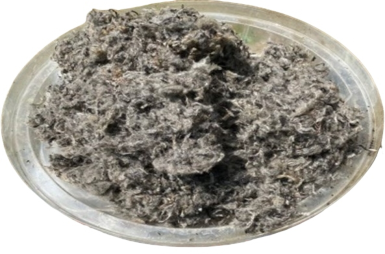
Portland limestone cement (PLC), waste tyre textile fibres (WTTF) and water were used for this study. The WTTF was sourced from Freetown Waste Management Recycle Limited, Apata, Ibadan, Nigeria. It is shown in Figure 1 and its properties and chemical composition are detailed in
Tables 1–2. Dangote Cement Plc produced the cement (grade 42.5R) used as the binder, procured from a local cement supplier in Ibadan, Nigeria. The cement’s physical characteristics and chemical composition are found in Table 3. Lastly, the water used was obtained from the Petroleum Engineering Building at the University of Ibadan.
In addition, Figures 2a-b presents the Scanning Electron Microscopy (SEM) images of typical WTTFs. These images depict a rough and fibrous surface texture on WTTFs, featuring irregularities, protrusions, and longitudinal striations, which can contribute to the flexibility and flexural strength of WTTFs and improve their mechanical interlocking with matrix materials in composite applications. However, using a high quantity of WTTFs results in uneven distribution within the matrix, leading to a decline in mechanical properties (Grammelis et al., 2021). It is also important to note that the surface of WTTFs may still contain residual rubber from the tyre, forming a coating that can affect adhesion properties with other materials.
Figure 1: Waste tyre textile fibre (WTTF).Table 1. Properties of yarned WTTFs used.
Table available in the original PDF paper.
Properties Values Length 0 – 50 mm Diameter 0.020 – 1.50 mm Water absorption 7 – 16 % Linear density 850 – 1700 Denier
Feasibility and Properties of Cement Boards With Waste Tyre Textile Fibre 1709
Table 3. Physical characteristics and chemical composition of cement used.
Table available in the original PDF paper.
Properties Values Oxides % Fineness 7.22 % CaO 64.30 pH 13.35 SiO2 21.60 Specific surface area 3.17 m2/kg Al2O3 5.85 Specific gravity 1.15 g/cm3 Fe2O3 2.78 SO3 2.03 MgO 1.42 K2O 0.72 Na2O 0.14 LOI 1.38
Figure 2a and b: SEM of WTTFs (adapted from Grammelis et al., 2021 and Valdés-Vidal et al., 2022).
Research Design Preliminary physical and mechanical assessments, including length and diameter measurements, water absorption, and linear density, were carried out on the shredded WTTFs. Three specimen sets, identified as Mix 1, Mix 2, and Mix 3, with the same water-to-cement ratio (0.33) and different proportions of WTTF in the fibre/cement ratios of 5:95, 7.5:92.5 and 10:90 by weight, were considered for the experimental work. The varying quantities of cement and shredded WTTF in each mix are detailed in Table 4. Four specimen types were tested: the control specimens and those containing 5%, 7.5% and 10% WTTF, labelled as CB, CB (5%), CB (7.5%), and CB (10%), respectively.
Square wooden moulds measuring 250 mm × 250 mm x 6 mm were specially made for producing the test cement board with WTTF specimens. The mould cavities were carefully cleaned to prevent particle interaction with the test specimens, and the inner part of the cavities was oiled to facilitate easy removal of the specimens after hardening. Before casting the test specimens with WTTF content, the WTTFs were washed in water to eliminate impurities and then sun-dried. When casting, the weight of cement, WTTF, and water were accurately measured in the right proportion before combining to form a paste. Subsequently, the freshly mixed paste was poured into the moulds,
vibrated, and allowed to set and harden for 24 hrs before the specimens were naturally cured in the air.
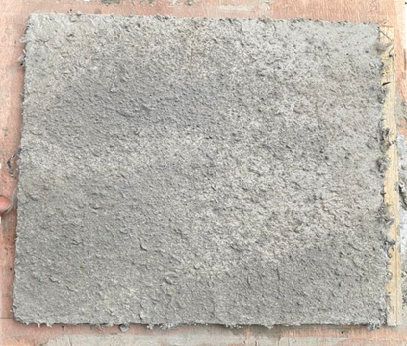
The hardened cement board specimens with WTTF content, as shown in Figure 3, were subjected to flexural testing after 7, 14, 21 and 28 days. In contrast, the control specimens were only tested once for flexure as they were commercial cement boards. Density, water absorption, and thickness swelling tests were performed on all specimens at 28 days.
Density Test In general, the mechanical properties of cementitious materials are impacted by density. A more densely packed cementitious composite is likely to exhibit increased strength, durability, and resistance to permeability, wear, impact, and mechanical damage compared to a less densely packed composite material. This study focused on determining the hardened density of cement boards to gain insights into their strength, quality, and ease of handling. Initially, the mass of each specimen was measured using a weighing balance, and each specimen’s length, width, and thickness were measured to calculate its volume. Subsequently, the hardened density of each specimen in kg/m3
after the 28th day of curing was calculated by dividing the specimen’s mass by its volume.
Feasibility and Properties of Cement Boards With Waste Tyre Textile Fibre 1711
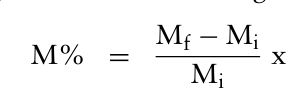
Water Absorption and Thickness Swelling Test Composite specimens with dimensions of 250 mm x 125 mm and a thickness of 6 mm were used for conducting water absorption and thickness swelling tests according to ASTM D570-98 (2018). Each cement board type was represented by three of the nine specimens used. To eliminate any initial moisture, all specimens were dried at 110oC in an oven for approximately 1 hr, then cooled to room temperature for 4 hrs. Subsequently, the initial weights and corresponding thicknesses of the specimens were measured, accurate to 0.001 g and 0.001 mm, respectively. Afterwards, the specimens were submerged in water for 24 hrs at room temperature (23 ± 1oC). The specimens were measured using a digital weighing balance and vernier caliper, and the results were subjected to analysis. Finally, water absorption (M) and thickness swelling (TS) were calculated using Equations 1-2:
x 100 (1)
Equation reproduced from the original PDF.
x 100 (2) Ti where Mi = oven-dried mass of the specimen before immersion in distilled water; Mf = final mass of the specimen after immersion; Ti = initial thickness of the composite specimen after oven-drying; and Tf = final thickness of the specimen after immersion in distilled water.
Flexural Test The specimens underwent flexural testing according to ASTM D790 (2017) using an INSTRON mechanical testing machine with a 10 KN load. Failure and fracture of the specimens occurred during 3-point bending, and the test was conducted at a crosshead speed of 2 mm/min, as specified in previous studies. Each mix was tested with three (3) specimens, and the average flexural strengths in MPa were recorded.
RESULTS AND DISCUSSION
Hardened Density
Table 5 indicates that as the WTTF content increases, the average density of the WTTF cement boards decreases. When compared to the control CB, the average density increased by 48.8%, 25.6%, and 1.7% for CB (5%), CB (7.5%), and CB (10%), respectively. The density of the WTTF cement boards is generally affected by the mass of their components. Thus, the decrease in density observed with higher WTTF content can be attributed to the lower mass of WTTFs than cement.
The initial increase in density for CB (5%) compared to the control specimen can be explained by the improved particle packing and bonding achieved with a moderate addition of WTTF, enhancing the compactness of the resulting material. However, as the WTTF content increases, the lighter weight of the WTTF and potential increase in voids within the cement matrix leads to a reduction in density.
Table 5. Average densities of specimens at 28 days.
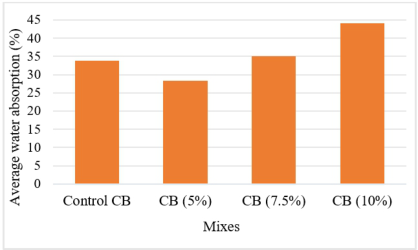
Water Absorption and Thickness Swelling From the information illustrated in Figure 4, the average water absorption of the specimens increased as WTTF content increased. The average water absorption for CB (5%) is 28.26%, with increases of 24.03% and 56.16% for CB (7.5%) and CB (10%), respectively, compared to CB (5%). The control specimen had an average water absorption of 33.78%. Compared to the control CB, there is a 16.34% decrease in water absorption for CB (5%) and increases of 3.76% and 30.64% for CB (7.5%) and CB (10%), respectively.
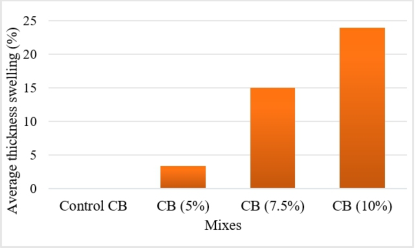
It is also indicated in Figure 5 that the average thickness swelling of the WTTF specimens increased with higher WTTF content. The average thickness swelling for CB (5%) is 3.35%, with significant increases of 347.76% and 614.93% for CB (7.5%) and CB (10%), respectively, compared to CB (5%). The control CB exhibited no thickness swelling (0%). Compared to the control CB, the average thickness swelling is 3.35%, 15%, and 23.95% for CB (5%), CB (7.5%), and CB (10%), respectively.
The increase in water absorption and thickness swelling in WTTF cement boards compared to control specimens can be attributed to the hydrophilic nature of the WTTFs. These fibres absorb more water and create small voids in the cement matrix, resulting in higher water uptake and subsequent swelling. On the other hand, the control specimen without these fibres exhibited lower water absorption and no swelling, indicating a more condensed and impermeable matrix. The optimal 5% WTTF content strikes a balance by minimizing adverse effects such as excessive water absorption and swelling.
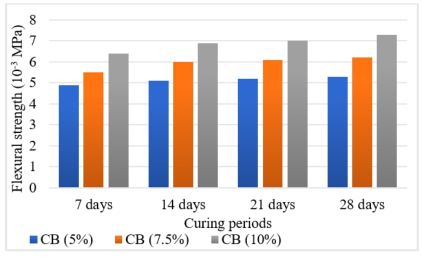
Flexural Strength It is evident in Figure 6 that the WTTF cement boards exhibited higher flexural strength with increased waste tyre fibre content and curing periods. The flexural strength of CB (5%) at 7 days increased by 4.1%, 2.0%, and 1.9% at 14, 21, and 28 days, respectively. The increases for CB (7.5%) were 9.1%, 1.7%, and 1.6% over the same curing periods. Similarly, for (CB 10%), the increases were 7.8%, 1.4%, and 4.3%, respectively. In comparison with the control CB, the average flexural strength decreased by 58.8%, 53.8%, and 46.2% at 7 days; 57.1%, 49.6%, and 42.0% at 14 days; 56.3%, 48.7%, and 41.2% at 21 days; and 55.5%, 47.9%, and 38.7% at 28 days for CB (5%), CB (7.5%), and CB (10%) respectively.
The increase in flexural strength of the WTTF cement boards with increasing WTTF content can be attributed to the reinforcing effect of
Feasibility and Properties of Cement Boards With Waste Tyre Textile Fibre 1713
the WTTFs. These fibres perform as a bridge within the cement matrix to improve its ability to resist bending and cracking under stress. They also enhance the stress distribution across the board, preventing localized failures and contributing to strength. Furthermore, the interlocking effect between the fibres and the cement matrix enhances the bonding and load- bearing capacity, resulting in increased flexural strength with higher WTTF content and extended curing periods. However, the WTTF cement boards underperformed compared to the control specimens, which had an average flexural strength of 11.9 × 10⁻³ MPa at 28 curing days.
Figure 4: Average water absorption of cement boards.Figure 5: Average water absorption of cement boards.Figure 6: Average water absorption of cement boards.
Optimal WTTF Content for Cement Boards Based on experimental results and analysis, it can be deduced that the most suitable WTTF content in cement boards is 5%, as the mix showed a water absorption rate of 28.26%, a thickness swelling of 3.35%, a density of 1952 kg/m3, and an average flexural strength of 5.3 × 10⁻³ MPa after 28 days of curing. Therefore, using cement boards containing WTTFs at a 5% replacement of cement by weight for non-structural purposes helps to achieve the most optimal combination of physical and mechanical properties.
Feasibility of Manufacturing Cement Boards With WTTFs The experimental results show that it is possible to incorporate WTTFs into cement boards, as these boards can have suitable properties for non- structural uses, as long as the right amount of WTTF is used. For instance, the lower water absorption and minimal thickness swelling properties of cement boards with 5% WTTF content are critical for partition walls, wall sidings, ceiling panels and eaves, where durability, dimensional stability and resistance to warping are essential. These boards can also withstand bending and handling stresses during installation and use. Furthermore, adding WTTFs to cement boards promotes sustainable construction practices by helping to recycle rubber waste, reduce environmental pollution, and support the circular economy. Therefore, the successful use of WTTFs in cement boards can demonstrate the potential for innovative material reuse in construction, offering both environmental and economic benefits.
CONCLUSION AND RECOMMENDATIONS This study focused on producing cement boards with waste tyre textile fibre (WTTF) for non-structural purposes like partition walls, wall sidings, ceiling panels, and eaves by evaluating the physical and mechanical properties of the cement boards with varying WTTF content and comparing them with commercial cement boards. The following were deduced from the experimental results:
1. WTTF influences the properties of the cement boards, as the optimal mix with 5% WTTF replacement displayed superior performance with a water absorption rate of 28.26% (lower than control specimens), thickness swelling of 3.35%, density of 1952 kg/m3, and a flexural strength of 5.3 × 10⁻³ MPa after 28 days of curing. Therefore, they are a viable alternative to the control specimens for non-structural applications in construction. 2. Higher WTTF contents beyond 5% further increased water absorption and thickness swelling, which could restrict the use of such cement boards in environments with constant moisture exposure. 3. Incorporating WTTF into cement boards promotes the innovative reuse of waste materials in construction, contributing to environmental sustainability by recycling rubber waste, reducing landfills, and supporting the circular economy.
Feasibility and Properties of Cement Boards With Waste Tyre Textile Fibre 1715
In addition, the following recommendation is suggested:
1. Future research on validating the use of WTTF in cement boards could explore long-term durability and performance under various environmental conditions, as well as the use of waterproofing materials (such as plastic barriers, glass mat fibres, or liquid membranes) to enhance water resistance properties and additives like mica, aluminium stearate, and cenospheres to achieve specific board qualities
REFERENCES
Abratt, R. P., Vorobiof, D. A. & White, N. (2004). Asbestos mesothelioma in South Africa. Lung Cancer 45: S3–S5. Abuja Chamber of Commerce and Industry. (2019). Nigeria’s 10m used tyres
annually pose danger to environment. The Daily Trust Newspaper. Retrieved from: https://www.dailytrust.com.ng/nigerias-10m-used-tyres-annually-pose-da nger-to-environment-acci.html. ASTM D570-98 (2018). Standard test method for water ab-sorption of plastics.
ASTM International, West Conshohocken, PA. ASTM D790 (2017). Standard test methods for flexural properties of unreinforced and reinforced plastics and electrical insulating materials. ASTM International, West Conshohocken, PA. Fazli, A. & Rodrigue, D. (2022). Sustainable reuse of waste tire textile fibers (WTTF)
as reinforcements. Polymers 14(19): 3933. Ferdous, W., Manalo, A., Siddique, R., Mendis, P., Zhuge, Y. Wong, H. S. Lokuge, W., Aravinthan, T. & Schubel, P. (2021). Recycling of landfill wastes (tyres, plastics and glass) in construction–A review on global waste generation, performance, application and future opportunities. Resources, Conservation and Recycling 173: 105745. Grammelis, P., Margaritis, N., Dallas, P., Rakopoulos, D. & Mavrias, G. A. (2021).
A review on management of end-of-life tires (ELTs) and alternative uses of textile fibers. Energies 14(3): 571. Hamada, H. M., Shi., J., Al Jawahery, M. S., Majdi, A., Yousif, S. T. & Kaplan, G. (2023). Application of natural fibres in cement concrete: A critical review. Materials Today Communication 35: 105833. Khorami, M. & Ganjian, E. (2011). Comparing flexural behaviour of fibre–cement
composites reinforced bagasse: Wheat and eucalyptus. Construction and Building Materials 25: 3661–3667. Khorami, M., Ganjian, E. & Srivastav, A. (2016). Feasibility study on production of fibre cement board using waste kraft pulp in corporation with polypropylene and acrylic fibres. Materials Today: Proceedings 3(2): 376–380. Mavukwana, A., Fox, J. A. & Sempuga, B. C. (2020). Waste tyre to electricity:
Thermodynamics analysis. Journal of Environmental Chemical Engineering 8(4): 103831. Mohr, B. J., El-Ashkar, N. H. & Kurtis, K. E. (2004). Fibre–cement composites for housing construction: State-of-the-art review. In Syal, M., Hastak, M. & Mullens, M. (eds.), Vol. 2, Focus group 2, 112–118, Proceedings of the NSF Housing Research Agenda Workshop, Orlando, FL, USA, 12–14 February 2004.
Ružickij, R., Romagnoli, F. & Grubliauskas, R. (2024). Waste tyre textile fibre composite material: Acoustic performance and life cycle assessment. Sustainability 16(15): 6281. Valdés-Vidal G., Calabi-Floody A., Duarte-Nass, C., Mignolet C. & Díaz, C. (2022).
Development of a new additive based on textile fibers of end-of-life tires (ELT) for sustainable asphalt mixtures with improved mechanical properties. Polymers 14(16): 3250.
LISTED IN THE AHFE DIGITAL BOOKSTORE CATALOGUE
Explore the complete digital volume
Human Factors in Design, Engineering, and Computing
Read this individual research paper free through the original publisher, or explore the full digital proceedings book.
ISBN 978-1-964867-35-9
Explore this ISBN in the AHFE Bookstore ↗Listed in the July 2026 bookstore catalogue; search by ISBN to confirm current availability · Digital book purchase optional