Ye Junnan, Saiya Wang, Yue Wu, Haoyue Liang (2024). Unconscious Design Method of Haipai Cultural Tourism Souvenirs Based on Extensional Narrative Theory. In: Human Factors in Design, Engineering, and Computing. AHFE Open Access, vol. 159, pp. 591–601. https://doi.org/10.54941/ahfe1005625
Haipai culture is unique to Shanghai and holds significant cultural value. Tourism souvenirs,as a key value-added industry in tourism, naturally serve as carriers for conveying local cultural essence and play a crucial role in promoting and disseminating Haipai culture. To address the current issues of severe homogenization, lack of depth, and insufficient emotional resonance in Shanghai tourism souvenirs, this paper explores an unconscious design approach for these souvenirs based on Extenics and narrative theory. Firstly, the KANO model is utilized to filter and categorize target user needs, obtaining their priority. Secondly, a cultural and creative product narrative design model constructed using Extenics innovation methods is employed to diagram the narrative framework of Haipai culture.Finally, through three unconscious design pathways, the narrative elements of Haipai culture and the user needs for tourism souvenirs are linked, resulting in the formulation of design strategies for Shanghai tourism souvenirs.The site of the First National Congress of the CPC, a landmark in Haipai culture, is used to validate the feasibility and rationality of these design strategies through the reproduction of its related elements in tourism souvenir design practice. This method provides a feasible path for both the internal excavation and external manifestation of Haipai cultural connotations and offers new ideas for showcasing Chinese cultural characteristics in the field of tourism souvenir design in the future.
Souvenirs, as cultural carriers, play a key role in disseminating local culture and preserving travel memories, driven by emotional and psychological factors (Shtudiner et al., 2019). As the tourism souvenir market grows, homogenization is diminishing the shopping experience (Wu et al., 2022). Many designs focus on superficial symbols, neglecting deeper cultural essence. Thus, innovative approaches for souvenirs are crucial.
Narrative theory can effectively convey users’ emotional needs and the cultural connotations of a region through a storytelling approach in tourism souvenir design, making the cultural content more vivid and easier to understand. The Extenics-based elementary model provides a pathway for transforming abstract cultural elements into tangible products. Unconscious
design, by analyzing users’ latent needs and psychological responses, can better meet their implicit demands. This paper integrates these three approaches to connect Haipai cultural elements with consumer needs, proposing a design method better suited for Shanghai tourism souvenirs (STSs).
NARRATIVE THEORY AND TOURISM SOUVENIR DESIGN Narrative theory was initially applied in architectural, interior, and landscape design (Chen et al., 2022). Recently, narrative design research has expanded from spatial design to visual design (Wang et al., 2019), gaming (Naul and Liu, 2020), and product design (Li and Wen, 2022).
Based on the aforementioned literature, it can be concluded that domestic and international scholars use a common approach in applying narrative theory: designers act as narrators, organizing and integrating narrative elements across disciplines to convey information and immerse users in the work’s context. In tourism souvenir design, the key challenge is achieving emotional resonance while accurately integrating historical and cultural elements. Compared to other approaches, narrative design emphasizes the intrinsic meaning of artistic creation, making it well-suited for organizing cultural elements and fostering divergent thinking. Narrative design also enhances creativity and evokes emotional responses, deepening the connection between users and products (Zhang and Lu, 2016).
OVERVIEW OF EXTENICS Extenics is a new discipline dedicated to studying the possibilities of extending things and the principles of innovation. Scholars have conducted research on the application of Extenics in tourism souvenir design, which can be broadly categorized into two approaches: direct extraction of specific forms by combining design semiotics and the extraction of cultural feature words based on Extenics semantics. The Extenics semiotics method used in the former, which extracts Haipai cultural elements, is particularly relevant to this study. Currently, some scholars have applied Extenics semiotics to garden leaking windows (Cao, 2022) and intangible cultural heritage (Duan and Zhao, 2020), utilizing a combination of semiotics and Extenics to extract cultural genes.
This study uses the diamond thinking model of Extenics to conduct divergent and convergent analysis on Haipai cultural symbols. Based on the element theory, a mathematical model is established to achieve the transformation of Extenics design symbols, which is then applied to the design of STSs.
OVERVIEW OF UNCONSCIOUS DESIGN “Unconscious Design,” also known as “Intuitive Design,” is a design concept first proposed by Naoto Fukasawa. Unconscious design integrates elements that the body has already perceived but the mind has not yet noticed, bringing
Unconscious Design Method Research of Haipai Cultural Tourism Souvenirs 593
users a sense of “familiarity.” This approach makes products more human- centered. Given the strong latent demand among consumers for emotional resonance and cultural depth in STS, it is necessary to apply unconscious design in the creation of these souvenirs.
In “Design Ecology,” Naoto Fukasawa proposed two design methods for unconscious design: “objective sketching” and “found object.” However, in product design, it is necessary to connect the objective sketching that relies on intuitive perception with the found object approach that depends on indirect perception, thereby forming a third design method: the “crossover of the two.” These three methods constitute the three pathways of unconscious design (Wang et al., 2022).
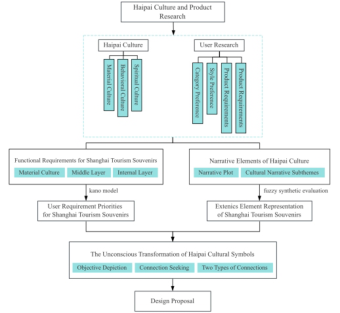
Figure 1: Unconscious design process for tourism souvenirs based on extenics narrative theory (Source: Author’s own).
CONSTRUCTION OF AN UNCONSCIOUS DESIGN PROCESS FOR HAIPAI TOURISM SOUVENIRS BASED ON EXTENICS AND NARRATIVE THEORY The Haipai tourism souvenir design process proposed in this paper consists of three main steps. First, the KANO model is used to determine the priority of user needs. Next, a narrative model is employed to refine the narrative sub-themes identified in the preliminary research, extracting the relevant design elements. The fuzzy comprehensive evaluation method is then applied to obtain cultural narrative sub-themes, based on which Extenics element representation model is established. Following this, the three pathways of unconscious design are used to link user needs with the narrative elements in the cultural sub-themes, resulting in design objectives related to craftsmanship quality, form and appearance, and cultural connotation. AIGC (Artificial Intelligence Generated Content) is used to generate initial concept sketches to provide compositional references. Finally, the design practice is conducted using images derived from Extenics transformations, culminating in the creation of a Shanghai tourism souvenir design proposal (see Figure 1).
DESIGN PRACTICE OF SHANGHAI TOURISM SOUVENIRS Priority Analysis of User Needs for Shanghai Tourism Souvenirs Based on the KANO Model
Based on the literature related to STSs and Haipai culture, consumer needs for STSs were collected and translated into functional descriptions. The KANO model was introduced to examine the priority of user needs for these souvenirs. Through user interviews with potential consumers and expert selection, three primary indicators were identified: the external, intermediate, and internal layers of product attributes. The external layer includes product form, color, material, patterns, and branding; the intermediate layer covers product functionality, technology, and interaction; and the internal layer represents cultural attributes. Additionally, 20 specific demand items were identified, forming the basis for a questionnaire (see Table 1). After eliminating clearly illogical data, a total of 115 valid questionnaires were collected. The results, combined with user behavior observations and KANO questionnaire findings, indicate that:
Table 1. User demand attribute analysis for Shanghai tourism souvenirs (Source: Author’s own).
2 Good artistic effect 29 29 49 8 0 A 67.83% -50.43% 3 Use of Haipai cultural colors
31 8 5 71 0 I 11.30% -33.91%
4 Use of traditional colors 9 11 53 42 0 A 55.65% -17.39% 5 Exquisite craftsmanship 77 5 19 14 0 M 20.87% -71.30% 6 Use of region-specific materials and techniques 62 19 9 25 0 M 24.35% -70.43%
7 Patterns with Haipai cultural elements
21 18 15 41 20 I 34.74% -41.05%
8 Use of traditional patterns 21 27 11 56 0 I 33.04% -41.74% 9 Brand personality matching Haipai culture Practical and effective 50 38 17 10 0 M 47.83% -76.52% 10 Good brand reputation 62 17 18 15 3 M 31.25% -70.54% 11 Middle Layer
51 37 3 24 0 M 34.78% -76.52%
12 Easy to operate and use 7 42 18 43 5 I 54.55% -44.55% 13 Use of new technology 16 50 46 2 1 O 84.21% -57.89% 14 Innovative form 90 13 5 7 0 M 15.65% -89.57% 15 Story association 17 29 51 16 2 A 70.80% -40.71% 16 Evokes travel memories 7 12 67 29 0 A 68.70% -16.52% 17 Emotional resonance 32 9 42 32 0 A 44.35% -35.65% 18 Internal Layer
Reflecting the Style of Historical Eras
59 24 28 4 0 M 45.22% -72.17%
19 Cultural characteristics have symbolic significance
60 44 10 1 0 M 46.96% -90.43%
20 Cultural attributes integrate well with souvenirs
In the external layer, consumers generally believe that STSs must possess design characteristics of Haipai culture and should incorporate patterns that include Haipai cultural elements. Additionally, most consumers place a high value on exquisite craftsmanship and innovative presentation, considering
Unconscious Design Method Research of Haipai Cultural Tourism Souvenirs 595
these aspects essential in souvenir design. However, consumers generally feel that the brand identity of the souvenirs does not need to strictly adhere to Haipai culture, and there is relatively weaker demand for the use of traditional patterns.
In the middle layer,on the technical level, the innovative forms of souvenirs are highly attractive to consumers, with most respondents indicating a preference for products that utilize novel presentation methods. In terms of interaction, consumers categorize the emotional value of souvenirs as an attractive attribute. If a souvenir can evoke travel memories and trigger emotional resonance, it will provide consumers with a high level of surprise and satisfaction.
In the internal layer, consumers consider the cultural attributes of the souvenirs to be essential. Souvenirs that reflect the historical era’s style can help consumers better appreciate Shanghai’s unique historical background and culture, thereby increasing their sense of identification with and desire to purchase the souvenirs.
Selection of Haipai Cultural Narrative Sub-Themes The design focused on the First National Congress of the CPC, a Haipai cultural landmark. Through research and site visits, four key narrative sub- themes were identified: the site of the First National Congress, New Youth magazine, the Story of Truth, and radio repair tools. In-depth research and analysis were conducted on these four narrative sub-themes, starting from the cultural elements themselves and using temporal relationships or the relationship between the whole and the parts to associate related elements. The morphological and color characteristics at the extensional level were extracted, resulting in a collection of symbolic elements for the four narrative sub-themes of the First National Congress. Due to space limitations, only the element collection related to the site of the First National Congress is presented (see Table 2). These four narrative sub-themes were combined with the design medium to form cultural narrative sub-themes, and a narrative design model for tourism souvenirs of the First National Congress was established. The narrative plots of the four sub-themes were constructed, from which specific design elements were extracted.
Table 2. Extraction of cultural symbols from the site of first national congress. (Source: Author’s own).
Table available in the original PDF paper.
Narrative Subtheme Legend Morphology Extraction Color Extraction
The site of the first national congress
Associated Symbols
Taking the narrative sub-theme of the site of the First National Congress of the CPC as an example, the design medium selected is a paper sculpture lamp. On the instinctual level, symbolic narrative is used to directly extract the exterior outline of the site, the decorative motifs on the lintel, and the brick-red main color of the fair-faced wall, presenting these elements from an objective historical perspective. On the behavioral level, hierarchical narrative is employed to analyze the user’s interaction with the paper sculpture lamp, the changes in lighting color and the act of turning the lamp on and off reflect the historical evolution of Shanghai. On the reflective level, the First National Congress of the CPC, as an important cultural landmark in Shanghai, carrying the sense of belonging and pride that citizens have for this culture. The continuous illumination of the lamp represents the permanence of cultural memory, symbolizing the site’s enduring importance as a cultural heritage in the development of the city.
Through expert interviews and discussions, the four narrative sub-themes were ultimately developed into 15 cultural narrative sub-themes. S1-S7 correspond to the site of the First National Congress, S8-S11 to New Youth magazine, S12 and S13 to the Story of Truth, and S14 and S15 to radio elements. The 15 cultural narrative sub-themes were evaluated and selected based on 14 subdivided product demand items across the three levels identified in the previous chapter. To determine the weight of factors across the three levels, exploratory factor analysis was conducted using SPSS 25. After rotation, the cumulative variance contribution rate was 60.287%, with information loss below 40%, meeting the standard (see Table 3). By normalizing the rotated variance contribution rates, the weights for each dimension were obtained, resulting in a factor weight coefficient set for the three common factors: W = {0.382, 0.370, 0.248}.
Table 3. Factor analysis of 14 indicators. (Source: Author’s own).
Table available in the original PDF paper.
Common Factor
Evaluation Factor Factor Loading
Percentage of Variance
Cumulative Variance Contribution Rate
Middle Layer
Use of new technology 0.721 Innovative form 0.755 Story association 0.78 23.029 23.029% Evokes travel memories 0.757 Emotional resonance 0.776 External Layer
Shape with Haipai cultural characteristics 0.75 Good artistic effect 0.758 Use of Haipai cultural colors 0.683 22.286 45.315% Use of traditional colors 0.614 22.286 45.315% Exquisite craftsmanship 0.709 Internal Layer
0.778 14.972 60.29%
Use of region-specific materials and techniques 0.558 Reflecting the Style of Historical Eras 0.766 Cultural characteristics have symbolic significance Cultural attributes integrate well with souvenirs 0.775
Unconscious Design Method Research of Haipai Cultural Tourism Souvenirs 597
The evaluation of 15 cultural narrative subtopics was conducted using the fuzzy comprehensive evaluation method.The comprehensive evaluation values G for the 15 cultural narrative subtopics S were obtained (see Table 4).
S G S G S G S1 2.781 S2 3.276 S3 2.954 S4 2.763 S5 2.692 S6 3.042 S7 2.798 S8 3.173 S8 3.062 S10 2.679 S11 2.805 S12 2.654 S13 3.032 S14 3.237 S15 3.043
Ultimately, the subtopic with the highest overall score, S2, which is the mirror paper sculpture lamp modeled after Shikumen and decorative elements, was selected for design practice (see Table 5).
Table 5. S2 Cultural Narrative Subtheme. (Source: Author’s own).
Table available in the original PDF paper.
Appearance Function Connotation Conceptual Legend
Cultural Narrative Subtheme
Symbolizing the timelessness of Haipai culture
Light on: paper sculpture lamp Light off: mirror
S2 Reconstruction of Shikumen and Decorative Elements
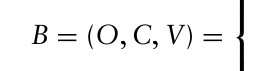
Construction of Extenics-Based Element Representation for Shanghai Tourism Souvenirs By combining the Extenics-based element theory and Extenics transformation method, an Extenics-based element representation model is established. Let B represent the knowledge representation of the Shanghai First National Congress of the Communist Party of China (CPC) tourism souvenir, where O is the object, C is the characteristic, and V is the value, forming a triplet to describe the objects, events, and their relationships. Furthermore, O (Design of Tourism Souvenirs for the First National Congress of the CPC Based on Extenics Semiotics), C can be divided into C1 (design object), C2 (design source), and C3 (design purpose), with the corresponding values V1 (tourism souvenir paper sculpture lamp), V2 (symbolic elements of the First National Congress site), and V3 (inheritance of Haipai cultural connotations). Thus, the following can be obtained:
O C1 V1
O C1 V1
Equations and mathematical formulas are available in the original paper PDF.
Equation reproduced from the original PDF.
· · · · · · Cn Vn
C2 V2 C3 V3
[Equation or mathematical symbol available in the original paper PDF]
[Equation or mathematical symbol available in the original paper PDF]=
[Equation or mathematical symbol available in the original paper PDF]
[Equation or mathematical symbol available in the original paper PDF]
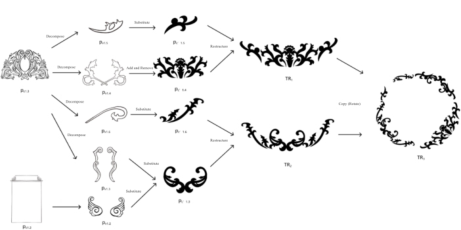
The characteristic elements of the site of the First National Congress of the Communist Party of China (CPC) have already been extracted. These extracted elements were encoded to establish an element library. Five key elements were identified from the site: Shikumen (stone-framed gate), exterior walls, the national flag, roof tiles, and the “Wan” character lattice. These elements were vectorized, and further details such as the Shikumen outline, Baroque carvings, exposed brick walls, and panda roof tiles were extracted.
Due to space limitations, the Baroque carving design is used as an example(see Figure 2). The Baroque carving element pc1.3 was deconstructed to generate four simplified graphics. pv1.5 was transformed into pc1.5 through a substitution reaction, and pv1.6 was similarly transformed into pc1.6. pv1.4 had its outer contour extracted using an addition and subtraction method, with floral elements added to the center to generate pc1.3. The rear wall of the Shikumen (pc1.2) was deconstructed to extract the wing-shaped element pv1.2, which was then recombined with the outer contour of pv1.3 to generate pc1.3. The four newly generated elements were paired and recombined to create TR1 and TR2, which were then arranged in a circular pattern as TR3 through rotation and duplication. This process was then applied sequentially to the second and third layers of the graphic for further deconstruction and transformation.
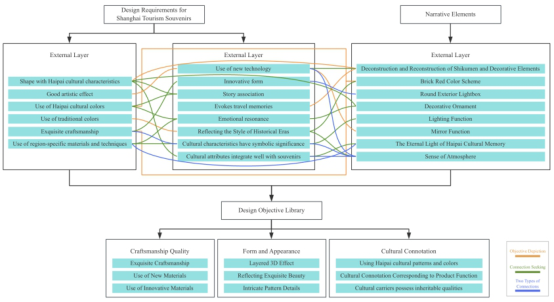
Unconscious Design Transformation of Shanghai-Style Cultural Narrative Elements Taking the paper sculpture lamp as an example, three unconscious pathways were utilized to link the consumer demands for STSs with the narrative elements from cultural narrative subtopics. This process resulted in the establishment of a design objective library for STSs, identifying design objectives in three key aspects: craftsmanship quality, form and appearance, and cultural connotation. These objectives were then used to guide the design practice (see Figure 3).
Unconscious Design Method Research of Haipai Cultural Tourism Souvenirs 599
In terms of craftsmanship quality, STSs emphasize a refined and unique visual experience, as well as the use of innovative materials, which are reflected in the excellent production techniques, quality, and collectible value of the products. Regarding form and appearance, a three-dimensional effect is achieved through the layered stacking of natural elements and the main design elements, showcasing intricate pattern details that imbue the paper sculpture lamp with rich visual information and an overall harmonious and refined aesthetic. As for cultural connotation, it is essential to seamlessly integrate the characteristics of Shanghai-style culture into the medium, ensuring that the cultural significance corresponds with the product’s function. This allows the product to convey the underlying stories and cultural context, while also preserving the tradition of paper sculpture craftsmanship.
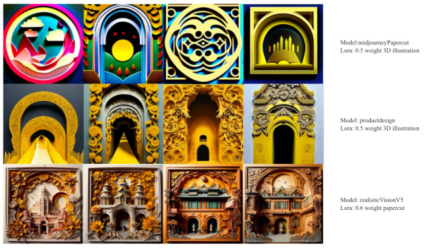
Unconscious Design Practice and Evaluation of Shanghai Tourism Souvenirs Empowered by AIGC After establishing the design positioning, the AIGC tool Stable Diffusion was utilized to generate initial concepts, providing inspiration for the design proposal. Using the text-to-image feature, the prompt included “paper- cutting craft” and “paper illustration” to describe the technique, “Shikumen architecture” and “Baroque floral art” to describe the main visual elements, “warm yellow” to describe the color palette, and “delicate, vintage, artistic, compact”to describe the overall style. The term “complex details”was added to enhance the intricacy, and “tunnel”was included to add depth to the image. (see Figure 5).
By integrating the graphics obtained from the Extenics transformation in the previous chapter, the final design output was achieved, (see Figure 6). Further discussions were conducted with typical respondents from the questionnaire survey. The respondents generally expressed that the design of the Shanghai tourism souvenir clearly conveyed the unique imagery of Shanghai-style culture. They particularly noted that the form and color met their expectations, with the cultural connotation well-aligned with the
product’s function, allowing them to associate the product with historical stories and providing a comfortable and smooth interactive experience during use.
Figure 4: Results of text generation mapping. (Source: Generated by Stable Diffusion).Figure 5: Shanghai Haipai culture paper sculpture lamp effect. (Source: Author’s own).
CONCLUSION
This paper is based on the study of Shanghai-style cultural narrative elements and the needs of Shanghai tourism souvenir consumers.Three pathways of unconscious design were employed to link the two, leading to the identification of four design objectives. Extenics was then used to transform cultural elements into graphic representations, with the aid of AIGC tools for design practice, culminating in a design proposal for a Shanghai tourism souvenir. The strategy proposed in this paper introduces new perspectives in the extraction, decoding, and expression of cultural elements, offering a solution to the issue of homogenization. It addresses the weakness of existing design methods in linking cultural elements with product functionality, thereby imbuing STSs with Shanghai-style cultural connotations and evoking emotional resonance among consumers. In the future, a more comprehensive database of Shanghai-style cultural elements could be established to further explore the integration of these elements with STSs.
REFERENCES
Cao, Q. (2022). Modern furniture design based on traditional leaking window elements. Packaging Engineering (Art Edition), 43(14), 264–271.
Unconscious Design Method Research of Haipai Cultural Tourism Souvenirs 601
Chen, J., Chen, Y., Zheng, L., & Tang, Q. (2022). Research on Spatial Memory of Architectural Narrative Based on Spatial Syntax Theory: Wushan Dormitory of SCAU University as an Example. Journal of Mechanical, Civil and Industrial Engineering, 3(1), 40–55. Duan, J., Li, F., & Zhao, Y. (2020). Research on the design method of intangible
cultural heritage derivatives based on Extenics semiotics. Packaging Engineering (Art Edition), 41(12), 93–98. Li, H., & Wen, K. (2022). Research on Design of Emergency Science Popularization Information Visualization for Public Health Events-Taking “COVID-19” as an Example. Sustainability, 14(7), 4022. Naul, E., & Liu, M. (2020). Why story matters: A review of narrative in serious
games. Journal of Educational Computing Research, 58(3), 687–707. Shtudiner, Z., Klein, G., Zwilling, M., & Kantor, J. (2019). The value of souvenirs: Endowment effect and religion. Annals of Tourism Research, 74, 17–32. Wang, C., Wang, J., Gan, L., & Gao, Z. (2019, July). Research on innovative design
of lamp mix-and-match based on “sense of dissonance”. In IOP Conference Series: Materials Science and Engineering (Vol. 573, No. 1, p. 012034). IOP Publishing. Wang, J., Wang, W., Yang, C., Wang, M., & Ye, J. (2022). Research on unconscious design of new Chinese-style tea furniture from a semiotic perspective. Furniture & Interior Design, 1, 30–35. Wu, J., Zhang, L., Lu, C., Zhang, L., Zhang, Y., & Cai, Q. (2022). Exploring tourists’
intentions to purchase homogenous souvenirs. Sustainability, 14(3), 1440. Zhang, Z., & Lu, J. (2016). Research on product narrative design based on regional cultural themes. Packaging Engineering (Art Edition), 37(24), 34–38.
LISTED IN THE AHFE DIGITAL BOOKSTORE CATALOGUE
Explore the complete digital volume
Human Factors in Design, Engineering, and Computing
Read this individual research paper free through the original publisher, or explore the full digital proceedings book.
ISBN 978-1-964867-35-9
Explore this ISBN in the AHFE Bookstore ↗Listed in the July 2026 bookstore catalogue; search by ISBN to confirm current availability · Digital book purchase optional