Huang Xinran (2025). Design model of museum IP special exhibition: Standardization of workflow. In: Human Factors in Communication of Design. AHFE Open Access, vol. 177, pp. 69–77. https://doi.org/10.54941/ahfe1006332
With the development of big data, the Internet and digital technology, the development of mass communication has been accelerated, and the audience needs of museums have also been different. The expansion of the culture and museum consumer market and the support of the policy environment have promoted the self-innovation of museums, and the intellectual property of many museums has participated in the development of cross-media, creating more forms of products and services. The museum's special exhibition on intellectual property is a branch of the museum's cultural creative derivative works. The special exhibition of intellectual property in the museum is to develop the typical cultural relics resources collected by the museum into products with cultural communication and exhibition. (Jiang Lu, 2017) Compared with museum thematic exhibitions, the development process of museum IP special exhibitions has the characteristics of easy identification, easy communication and easy link, and is held in the way of product development. When the museum's special exhibition of intellectual property is exported as a cultural product, it must be production-oriented in the development process.This is when the designer changes from an executive role to a system architect. The most important characteristics of the production of museum intellectual property exhibition are: production standardization, process specialization and intellectual property classification, only the establishment of exhibition production system standards and processes can be called production. Just like the industrialization of movies, it is necessary to establish a set of industrial assembly lines similar to Hollywood, so that the creation and production of movies into the process, the division of labor refinement stage, and the corresponding industry standards for regulation. Production standardization refers to the development of a museum intellectual property special exhibition, it is necessary to develop a set of development processes in line with the design and construction of the exhibition, and quantify and standardize things that are not easy to quantify. Process specialization refers to the specialization of workflow, each workflow is refined and divided, and different professionals work together to design the museum's thematic exhibition of intellectual property. (Item, 2017) Standardization of the process of museum IP exhibition is the key.
With the upgrading of industrialization, museum IP will also generate greater economic value in the development of commercialization. Iresearch Consulting Institute (2021) believes that the development mode of museum
IP in the realization of industrialization and commercialization can be broadly divided into three representative models: commodity development, cultural services and space operation. Commodity development can be divided into physical products such as cultural and creative products and virtual products such as film and television entertainment programs. Cultural services include museum education, publishing and museum interpretation. Among them, museum education mainly includes weekend classes, research and study Tours; The publishing business is mainly the content of cultural books and periodicals; Exhibition explanation services mainly include paid exhibition halls or exhibition explanations. The space operation is mainly based on pop-up exhibitions, online viewing, digital creative exhibitions, and supplemented by museum space rental. Kolter (1998) integrated marketing theory into museum operation and promoted the development and operation of museums towards marketization. He believes that the museum’s collections and exhibitions, as well as the museum’s educational programs and services, are products of the museum. Museums need to continuously innovate and give new value to products to enhance the competitiveness of museums.
Under the theoretical framework of marketing, the responsibilities undertaken by museum staff are not limited to service support, but also an indispensable part of the whole museum marketing system. In Introduction to New Museum Theory and Practice, Marstine (2008) believes that museum operation should be based on relevant marketing theories and combined with business models to obtain more funds for museum construction. In the face of increasingly competitive social environment, museums will inevitably face the situation that the financial support is not strong enough. Providing more comprehensive services has become a very important link in the management of contemporary museums. It is necessary for museums to stand in the position of consumers and explore the supply and demand of the consumer market, which has a position that cannot be ignored in the interaction between consumers and museums.
From the perspective of museum content operation and management, Duan and Lu (2017) believe that in the future network environment with the support of big data, IP content will gradually be capitalized, and people will become the link point of the entire social user content production model. With the development of the industrial chain, many new formats have been formed, such as cultural and creative product development formats, museum IP authorization industries, museum immersive experience formats, museum commercial special exhibition formats, and so on. When Li (2022) studied the industrial characteristics and development trend of the new forms of museum culture in China, he found that the spatial structure, communication structure, participation structure and economic structure of the industrial structure would be adjusted along with the birth of the new forms of business, so as to promote the upgrading and optimization of museum-related cultural forms. The integration of science and technology and traditional culture has promoted the innovation of museum content and form, and the promulgation of relevant policies has promoted the new generation to become a supportive
Design Model of Museum IP Special Exhibition: Standardization of Workflow 71
consumer group. Especially in the context of the strategy of cultural power, international exchanges and mutual learning of museums are on the rise.
MUSEUM IP SPECIAL EXHIBITION AS CULTURAL AND CREATIVE PRODUCTS The museum IP special exhibition, as a large creative product, is still in its infancy. There are many problems in the development of special exhibitions, such as insufficient depth of IP development, serious homogenization of museum IP special exhibitions and museum exhibitions, only simple display and text interpretation, lack of innovation and creativity. IP liquidity needs to be improved, lack of long-term economic benefit planning, special exhibition life cycle is short. Therefore, in the development of museum IP special exhibitions, it is necessary to further optimize and adjust the industrial structure, effectively connect the service, marketing, publicity, production, construction, design and creative links, and help the industrial development of museum exhibitions.
Space licensing will be an important trend in museum IP development in the future. Through space authorization, we can integrate cultural relics resources, architecture and other elements of the museum into the space design to create a space with a unique cultural atmosphere. This way of authorization not only allows the cultural elements of the museum to be more fully utilized and displayed, but also provides a more immersive cultural experience for the audience. The commercial special exhibition of the museum, like the cultural and art exhibitions, was first mainly held in the urban commercial complex. For shopping malls, thematic special exhibitions can enhance the cultural atmosphere and connotation of shopping malls, enhance consumption experience, and empower merchants and shopping malls. For museums, it can realize the market transformation of collection resources and promote the innovative development of museums. Nowadays, the model of “commercial special exhibition + cultural and creative shop” has been widely popular in the museum industry. In addition, museum special exhibitions have been extended to open Spaces such as airports, subways, bus stations, bookstores, commercial real estate, and cultural relic shops, forming a trend of “musealization” of public space. This is the active output of museum culture and creativity, which breaks through the conventional physical objects and fixed spatial forms of museums, turns the general public places of cities into urban cultural Spaces, produces and reproduces new urban culture, and realizes the spatial production of museums.
Museum IP special exhibition is an important part of the development of museum IP. The rich cultural relics resources of museums make them an important incubator of cultural IP. Similarly, museums need to provide diversified public cultural products and services, and the demand for high- quality IP is becoming more and more intense. With the cultural and creative industry being valued and advocated by the country, IP has been increasingly applied in the research and development of cultural and creative products in museums. Contemporary museums have gradually moved away from the single display exhibition visiting experience mode. Museums can build
72 Huang
cultural products and services around a core IP across a variety of media in different forms of presentation, such as novels, online videos, television, movies, radio plays, drama, concerts, live integrated performances, VR and AR experiences. Let the museum appear in the cultural vision of the audience in different forms of communication. According to the development characteristics of museum IP special exhibition, the concept of museum IP special exhibition can be summarized as “Museum IP special exhibition is to develop the typical cultural relics resources collected by the museum into products with cultural communication properties and exhibition properties.” Compared with the museum theme special exhibition, the development process of the museum IP special exhibition has the characteristics of easy identification, easy communication and easy link in the choice of IP, and the exhibition is organized in the way of developing products.
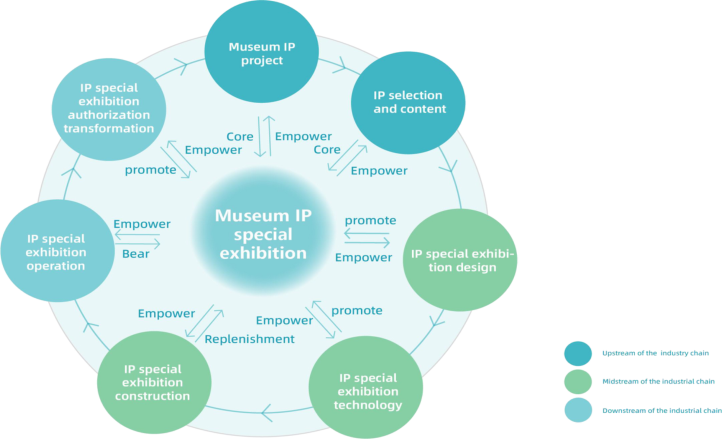
THE PROCESS OF THE MUSEUM IP SPECIAL EXHIBITION IS STANDARDIZED Industrial chain is a concept in industrial economics, which refers to the objective form of chain correlation between various industrial departments based on certain technical and economic relations, and according to specific logical relations and spatial and temporal layout relations. From the perspective of extending the industrial chain, the development path of cultural and creative products based on museum IP includes the following seven links. The standardization of the process of museum IP special exhibitions is the key to ensuring efficient and orderly exhibition development. Through standardized workflow, not only can improve the efficiency of team collaboration, but also ensure that every link can be carried out in accordance with a unified standard. The standardization of the process usually needs to be sorted out from the overall industrial chain of the museum IP special exhibition, which is divided into three parts: upstream, midstream and downstream of the industrial chain.
The upstream end of the industrial chain is the museum IP project and IP selection and content. Its main purpose is to ensure that the creative and content quality of the IP special exhibition is in line with the cultural values of the museum, has good market potential, and meets the needs of the target audience. IP selection and evaluation: Determine the appropriate IP. Conduct feasibility studies of IP to assess its cultural value, market impact and suitability. The social recognition, derivative potential and interactivity of IP are comprehensively evaluated. Exhibition planning and theme design: determine the theme and core content of the exhibition, plan the cultural background, story line and presentation mode of the exhibition. Determine the contents of exhibits, display methods, space layout, planning the function of the exhibition area. Choose appropriate cultural expression and exhibition means. Content development and creative presentation: Work with the design team on the creative and visual design of the exhibition to ensure that the design is consistent with the theme of the exhibition.
The middle reaches of the industrial chain are divided into three parts, IP special exhibition design, IP special exhibition technology, and
Design Model of Museum IP Special Exhibition: Standardization of Workflow 73
construction. Translate creative and planning schemes into practical and executable exhibition design and construction plans, and ensure the efficient promotion of projects in actual operation. Exhibition design and technical planning: According to the exhibition planning, design exhibition space, exhibits display, interactive areas, art installations, etc. Develop detailed exhibition design drawings, including space layout, lighting design, sound effects, interactive installation configuration, etc. Select the appropriate materials, display equipment and technical tools to determine the functional configuration of each exhibition area. Procurement of exhibits and equipment: procurement of exhibits (such as cultural relics, reproductions, art installations, etc.) and equipment (such as showcase, display table, lighting equipment, interactive equipment, etc.) according to the needs of the exhibition. When digitizing, restoring or reproducing exhibits, ensure compliance with museum standards and cultural conservation requirements. Construction and construction: On-site construction and construction shall be carried out according to standardized design drawings to ensure that the construction of exhibition space meets the design requirements. Install exhibition equipment and fixtures, perform commissioning and ensure the normal operation of all equipment.
The downstream of the industrial chain is the transformation of museum IP operation and museum IP special exhibition authorization. Exhibition operation management: Before the opening of the exhibition, organize the relevant preview, media conference and marketing promotion. Develop the operation and management plan after the opening of the exhibition, and carry out visitor flow control, personnel scheduling, site safety, etc. Implement the interactive experience in the exhibition and ensure the normal operation of technical tools such as interactive equipment and virtual experience. Audience experience and feedback collection: Interactive experience is designed to increase the interest and education of the exhibition and improve the audience’s sense of participation. Collect audience feedback, evaluate the exhibition effect, solve the problems and make optimization in time. Post- exhibition evaluation and summary: Summarize and evaluate the exhibition, including the flow of visitors, feedback, education effect, etc. According to the evaluation results, the planning, design and operation of future exhibitions will be adjusted. Authorization is to copy or extend the content or theme of the exhibition in other venues, and can also be applied to cultural and creative product development, digital resource authorization and copyright trading. Through authorization, cultural resources can be widely disseminated, the global influence of museum IP can be enhanced, sustainable economic sources can be provided for museums, and cooperation between museums and business, education and other fields can be promoted to realize the integration and utilization of social resources.
74 Huang
Figure 1: Design and development model of museum IP special exhibition.
THE DEVELOPMENT PATH OF MUSEUM IP SPECIAL EXHIBITION
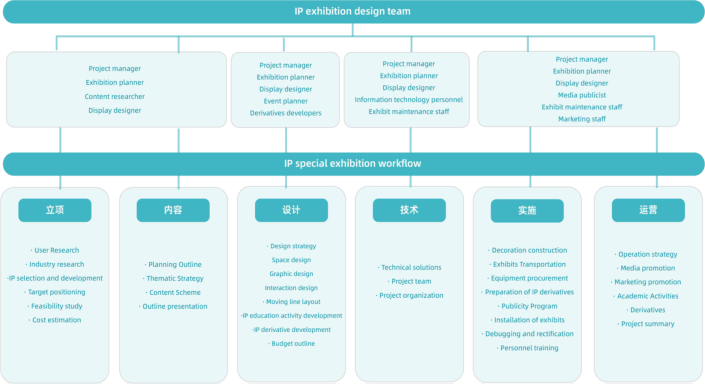
1. Build museum brand IP. Marketing guru Philip Kotler believes that a brand should be associated with certain product attributes, and at the same time, these product attributes must bring functional or emotional tangible benefits to consumers. If the museum breaks through the conventional thinking from the scope of simple cultural products and regards the museum as a brand, the relationship between the museum and the audience should also be regarded as the relationship between businesses and consumers, then the scope of the consumer should not be limited to the concept of the audience, and all people with consumption power, whether it is the audience or not, should be the object of the marketing of the museum’s cultural products. Through the development and marketing of cultural products, establishing the brand of museums in the business community and the wider audience, then the cultural products of museums are no longer simply defined as souvenirs, but truly become the brand of cultural products. 2. Build a professional project team. Professional project team is the key to ensure the effectiveness of the exhibition. Operate in the way of the project leader, set up a project team based on the professional team of the exhibition research and development department, and coordinate and promote all aspects of the curatorial work in the way of project management system. The professional background of curators is broader, and people engaged in exhibition planning, design, education or technical management can be appointed. According to the scale and characteristics of the project, professionals from other departments such as exhibition and education, operation, publicity and information center in the museum will be included to form a temporary project team. Giving
Design Model of Museum IP Special Exhibition: Standardization of Workflow 75
the project team sufficient decision-making power and voice in the field of professional technology is crucial to improving the responsibility and enthusiasm of the curatorial project team, ensuring professionalism and work efficiency. The project team has carried out full coverage of the whole process management and exhibition-related work of the exhibition life cycle, ensuring the controllability of the final effect of the exhibition. 3. Productization of special exhibition content and construction. The productization of the museum IP special exhibition is mainly reflected in the prefabrication of content and the modularization of construction. When the museum IP cultural and creative products are developed, the cultural and creative IP resource library will be established, which will include digital information and patterns of cultural relics. For example, the Digital Dunhuang Open Material Library is the world’s first blockchain-based digital cultural heritage open co-creation platform. The material library includes the information of the cave, the literature of the Sutra cave, and the elements of Dunhuang murals. The prefabrication of the content of the IP special exhibition requires the museum to establish a digital material library. The production process of museum IP special exhibition can be divided into three levels: base layer, configuration layer and expansion layer. Base layer: The area module divides the scale of the exhibition according to the size of the site, and provides a standardized plan to adapt to the needs of different areas. Hardware module, the standardized design of the exhibition hardware structure, for quick construction and adjustment. The hard installation part is mainly divided into exhibition wall, ceiling and floor. Configuration layer: Division and standardization of functional modules, exhibition functional units, including the design and equipment configuration of specific areas. Display module, the display form and components designed around the core content of the exhibition. It is divided into low-end line: graphic display, mid-end line: exhibits display, high-end line: interactive display. The space module divides the exhibition space. Development layer: Service module, maintenance and brand building. 4. Expand various channels to strengthen publicity. The downstream channel sales of the industrial chain sell cultural and creative products through various sales channels such as online e-commerce and offline physical stores to realize the value of their products to commodities. Sales data and user feedback can also provide concept innovation for the evaluation, screening and creative design of museum IP, promote the continuous iteration and update of cultural and creative products based on museum IP, and achieve a virtuous cycle of its development path, so as to create a development path of the whole industrial chain of cultural and creative products with museum IP as the core. 5. Authorized transformation of museum IP special exhibition. In the development path of the whole industrial chain of cultural and creative products with museum IP as the core, the museum should pay attention to its own positioning. As a cultural and educational
76 Huang
institution that stores cultural and natural heritage, museums cannot independently build all the commercial links in the development path of the industrial chain. Instead, they should fully integrate social resources and actively cooperate with various cultural and creative enterprises and institutions, manufacturers, operators and channel suppliers. Museums are responsible for providing cultural relic information and authorization. The resulting cultural and creative design scheme and physical products are reviewed and approved by the museum, and the promotion and sales can be jointly completed by the museum, cultural and creative companies, specialized promotion companies and sales companies.
Figure 2: Museum IP special exhibition design workflow.
CONCLUSION
The cultural and creative industry of museums has a huge development space in the cultural industry market. Doing a good job in the development of museum IP special exhibitions and creating high-quality exhibitions that meet market demand will not only generate huge economic value, but also build a new bridge between museums and the public through cultural and creative space products, and spread the history and culture behind museum IP to the public. Better play the cultural communication and education functions of museums, meet the growing spiritual and cultural needs of people, and provide a new design model for the development of museum exhibitions.
REFERENCES
2021 China Wenbo IP Commercialization Research Report 2021 [C]//. Iresearch Series Research Report (No. 8, 2021). [Publisher unknown], 202: 501–545. Duan Chunlin, Lu Xiao. “Big Data +” and IP Content Operation and Value Sharing [J]. Modern Communication (Journal of Communication University of China), 2017, 39(04): 114–118.
Design Model of Museum IP Special Exhibition: Standardization of Workflow 77
Jiang Lu. “IP”management: Exploration of new ideas for Museums to provide public cultural products and services [J]. Chinese Museum, 2017, (01): 79–88. Kotler N, Kotler P. Museum Marketing and Strategy: Designing Missions, BuildingAudiences, Generating Revenue and Resources [M]. Chichester: John Wiley; Sons, 1998. Lai Xiaopeng, Yang Meilin. Research on Legal Issues of Museum-related Intellectual
Property Rights, Chinese Museum, 2012 (4), pp. 63–66. Liu Yongwei. Art Authorization: A New Approach to the Development of cultural and creative Industry in Museums [J]. Museum Research, 2018(2): 38–44. Li Fengliang, Gu Zhenjing. The industrial characteristics and development trend of
new forms of museum culture in China [J/OL]. Journal of Shandong University (Philosophy and Social Sciences Edition), 2022(1): 96–106. Lu Rui. Value Innovation and Development Strategy Exploration of Museum IP Authorization Special Exhibition [J]. China Museum, 2020, (04): 90–94. State administration of cultural heritage issued “guidelines” to promote the museum
collection resources reasonable use [EB/OL (2019-5-9). http://xj.cnr.cn/2014xjfw/ 2014xjfwgj/20190509/t20190509_524606611.shtml
LISTED IN THE AHFE DIGITAL BOOKSTORE CATALOGUE
Explore the complete digital volume
Human Factors in Communication of Design
Read this individual research paper free through the original publisher, or explore the full digital proceedings book.
ISBN 978-1-964867-53-3
Explore this ISBN in the AHFE Bookstore ↗Listed in the July 2026 bookstore catalogue; search by ISBN to confirm current availability · Digital book purchase optional