Yixuan Shao (2025). Exploring the Influence of Pantone Color Trend Report on Design Communication in the Fashion Industry: a Long-term Comparative Study. In: Human Factors in Communication of Design. AHFE Open Access, vol. 177, pp. 1–12. https://doi.org/10.54941/ahfe1006326
As a significant factor influencing markets and consumer choices, color occupies an essential role in the fashion world. While Pantone’s seasonal color forecasts for New York Fashion Week claim growing industry influence, existing studies lack long-term analyses of their effectiveness across color categories. This study aimed to address this gap by adopting a long-term perspective and comparing the prevalence of Pantone colors in Vogue garments over time from 2015 to 2023. Employing big data techniques, the study was conducted in three phases: (1) extracting and filtering relevant images from Vogue’s official website using algorithms like YOLOv3; (2) isolating garment regions through clothing segregation and summarizing garment colors into five-color palettes using the k-means clustering algorithm; and (3) applying the CIEDE 2000 color-difference formula to measure the discrepancies between Pantone’s representative colors and garment color palettes from Vogue. Key findings reveal three insights: first, there are no consistent pattern of Pantone’s colors influencing the fashion colors of the same or subsequent years, with significant discrepancies observed in several instances. Second, the overall adoption rate of Pantone colors in Vogue declined over time, suggesting diminishing influence. Third, the percentages of color usage of Classic Colors is higher than these of Fashion Colors. These discrepancies suggest limitations in Pantone’s trendsetting role, potentially attributable to designers prioritizing uniqueness over standardization and audiences favoring stable Classic Colors. Methodological constraints—notably the exclusive focus on Vogue US—may further explain weak correlations. This study underscores the need for forecasters like Pantone to adapt strategies to evolving industry dynamics, balancing standardization with designers’ demands for differentiation. For practitioners, it highlights the growing divide between commercial color democratization and haute couture’s emphasis on exclusivity.
Color is one of the most essential elements in society. The human brain processes what is perceived within 90 seconds of initial interaction, and 62–90 percent of those judgments are decided solely on color psychology
(Singh, 2006). In the fashion industry, color holds multiple essential meanings. The choice of a certain color reflects not only the method of dyeing fabrics, products, packaging, etc. but also the choices and feedback from customers. Studies suggest that e-commerce sites with colors that fail to precisely match the actual colors of the products being offered are causing businesses to lose customers and revenue (Nitse, 2004). This follows that if a subject can influence the choice of color, the entire fashion chain will be altered to some extent.
Pantone is one of the more successful companies trying to define color in the marketplace and change the color choices brands and customers make. The company serves brand customization and promotion by naming specific color codes and creating bridge sets in their Pantone Matching System (PMS) as products. The standardization of colors help Pantone occupy an irreplaceable and important position in this field, and people trust their colors.This research focuses on another Pantone service: Fashion Color Trend Report. Since 2000, each year, Pantone Color Institute (PCI) will reveal three sets of colors - Spring/Summer color set and Autumn/Winter color set for New York and London’s Fashion Week, as well as Color of the Year. These three sets of colors predict the leading color in the following seasons and year. According to Tom Vanderbilt, a journalist invited to the Summer 2013 Pantone meeting to discuss the color trend, the organization colorize the cultural events and ultimately choose the season’s trendy colors by combining survey reports, discussion results, and customer opinions (Vanderbilt, 2012).
PCI states that the colors they select “increase in popularity, and once integrated into the cultural mindset, become even more influential the following year” (Pressman, 2023). Contrarily, from a study conducted by Han, etc., the predicted 2019 color sets do not align with the leading colors in Vogue magazine of 2019, showing little or no impact caused by Pantone (Han et al., 2021). Therefore, in the realm of Pantone color influence, there are questions worth exploring: 1) Han’s study concludes that the Pantone color predictions in 2018 have no influence on the 2019 magazines; however, do other years show influence on the following years? 2) Regardless of the strength or weakness of the influence of Pantone colors, can comparative observations over a long time period reveal a pattern of inter-annual influence on the colors of the fashion industry? 3) In the different series of predictive Pantone colors, which types have exerted a relatively stronger influence?
LITERATURE REVIEW
Currently, color trend research is divided into the following categories: studying how color trend forecasts help the fashion industry track consumer preferences (Singh, 2006; Nitse, 2004); using media big data to build forecasting models and make color forecasts (Detender etc., 2009; Lee, 2015); and judging how influential color forecasts are, such as whether or not they can have an impact on the fashion industry, which is a category that focuses the most on Pantone colors. Trend research, in general, still requires a set of rational, rigorous rather than subjective judgment logic and judgment systems. Therefore, more color trend research began to rely on big data to
Exploring the Influence of Pantone Color Trend Report on Design Communication 3
establish color prediction models to improve the objectivity and accuracy of the prediction. For example, in 2010 summer, Kim and Bae investigated the trend of the influence of conventional color emotions on modern clothing colors by examining images of street fashion in Dalian, China (Kim and Bae, 2011). Therefore, for the purpose of testing the accuracy of Pantone’s expected colors, this paper aims to conduct a quantitative research that is possibly free from subjective influences to discuss whether predicted Pantone colors has a significant influence to the fashion industry.
Maximizing the amount of data can improve the accuracy of quantitative research, so considerations of efficiency and accuracy necessitate machine learning methods. For color research, most machine learning algorithms used are in the form of supervised learning to classify and recognize (Li et al., 2019). Unsupervised learning are adopted mostly to develop forecasting systems (Nadeem, 2022). This research combines supervised and unsupervised learning: the former is used to exclude unnecessary raw images and precise the scope of the study, and the latter, specifically k-means algorithm, will be used to extract the color of Vogue images.
The impact of color trend reports on the fashion and business sectors can be measured by different perspectives, mainly semantics and marketing, individual case studies, sociology, and big data quantification. For instance, Lee uses Barthes’ semiological system to analyze Pantone’s communication and its market value (Lee, 2015). King introduces the “colour development timescale,” noting a two-year cycle from prediction to market impact (King, 2011). In terms of quantitative big data research, Han et al. (2021) used runway images from the 2019 Vogue magazine and compared the extracted color chips with the predicted Pantone colors for 2019. There is a significant difference between Han’s study and this research. Han etc. did a cross- sectional study that judges accuracy by taking data from one year of a magazine and determining whether or not Pantone’s predicted colors were used in the images for that year. Contrarily, this research considers the Pantone color predictions to be influential over time and therefore judges the degree of influence by taking data over a long period of time.
This research aims to find to what extent Pantone’s predictions have influenced the contemporary fashion industries. This paper will analyze Pantone’s colors, specifically in terms of color forecasting. Vogue US Magazine will be used as the comparison subject because, with its 5672 onboard designers from different countries and well-known brands such as Louis Vuitton, Burberry, and Miu Miu (Vogue, 2024), Vogue is one of the most representative and leading sources of fashion trends. Therefore, comparing the colors in Vogue magazine shows how much influence Pantone has on fashion trends. Though scraping web-images, this study identifies, classifies and compares colors based on machine learning to determine the influence of Pantone’s predicted colors on the application of colors in the fashion industry in terms of years and types.
4 Shao
METHOD
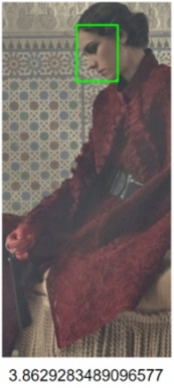
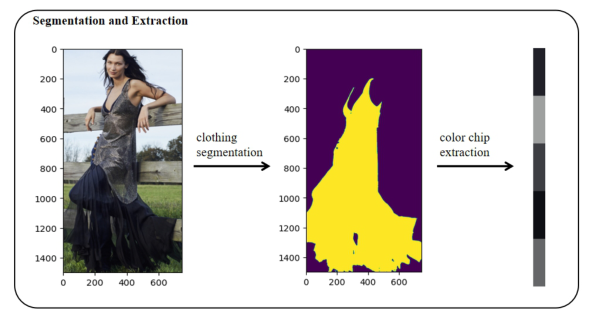
For the purpose of reflecting on whether people’s preferences and use of color are easily influenced, this research conducted the following steps: a) Magazine images of Vogue US from the year 2015 to the year 2023 were collected using Python from the official Vogue magazine website as a representation of leading trends in the fashion industry (Vogue, 2024). About more than 80,000 images were scraped. b) Garment images were filtered using YOLOv4 (You Only Look Once, version 4) by detecting the presence of humans, YOLOv3 by identifying whether it is a facial close-up or not (see Figure 1), and the gray threshold by exclude black and white pictures. In the end, 15,249 images were selected. A specialized Python package, “cloths_segmentation.pre_trained_models,” was utilized to identify and isolate the clothing portions within an image (see Figure 2).
Figure 1: YOLOv3 result with face boundary and calculated percentage.
c) The K-means clustering algorithm was employed to extract the color chips with 5 as the optimal number of color clusters. This research also utilizes the CIELAB color space for analysis for it mirrors human color perception more closely than the RGB color space, allowing a more nuanced identification of colors. The result of this process is the creation of a color card for each photo, showcasing the five primary colors extracted from the clothing (see Figure 2). These color cards provide a concise visual summary of the garment’s color palette, enabling a straightforward interpretation of fashion color trends as presented in Vogue magazine.
Exploring the Influence of Pantone Color Trend Report on Design Communication 5
Figure 2: Process diagram of extracting color chips.
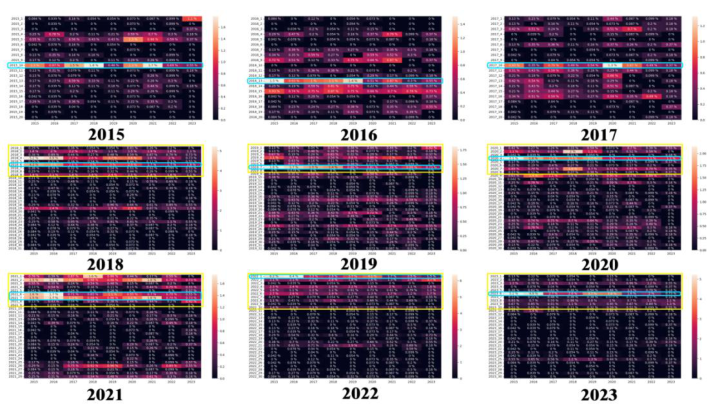
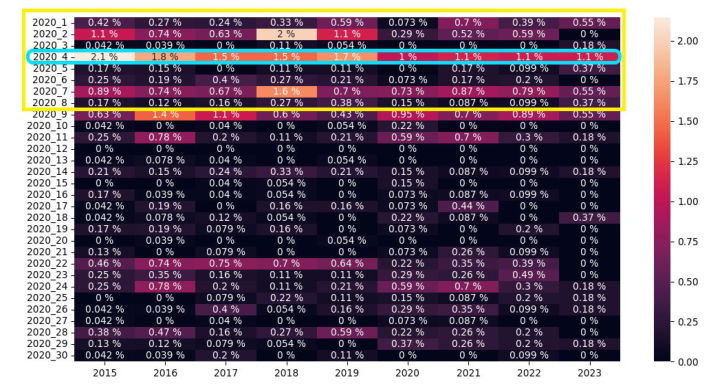
d) The CIEDE 2000 color-difference formula was applied to compare the differences between Pantone’s representative colors and garment color chips from Vogue magazine, using the Delta-E Value to determine if there is a significant difference from the representative color. As for Pantone’s representative colors, the New York Fashion Week Spring/Summer and Fall/Winter Color Palette from 2015 to 2023 are collected from Pantone’s official website (Pantone, 2023), with, on average, 24 colors in each year and 242 colors in total. These seasonal colors other than the Color of the Year were chosen due to their large amount of samples and a more detailed distribution. They all include both classic and fashion color predictions, respectively, so those two color sets were noted. All data with Delta-E less than 2 were counted as successful (see Table 1). From these data, the percentage of the number of images that match a certain color is calculated. Nine tables of these proportions were generated to represent nine years of Pantone color comparison data (see Figure 3). Using the year 2020 data as an example (see Figure 4), the vertical axis represents 30 Pantone colors from 2020; there are only 20 types of Fashion Colors until 2018, and only from 2018 onwards do the additional Classic Colors begin to appear. The horizontal axis represents the annual change in the share percentage of those 30 Pantone colors in the color chips extracted from Vogue magazines, including a total of 9 years from 2015 to 2023. By comparing the data horizontally, it is possible to see if a year of prediction has led to an increase in the percentage of the total number of images of garments that have used the altered color, leading to a conclusion for the impact of Pantone’s predictions.
Table 1: Color similarity standard table (Lee, 2005).
Table available in the original PDF paper.
Delta E(1E) Perception 0 < 1E < 1 Observer does not notice the difference 1 < 1E < 2 Only an experienced observer can notice the difference 2 < 1E < 3.5 Unexperienced observer also notices the difference
Continued
6 Shao
Table 1: Continued Delta E(1E) Perception
Table available in the original PDF paper.
3.5 < 1E < 5 Clear difference in color is noticed 5 < 1E Observer notices two different colors
Figure 3: Total result list of the average color values.Figure 4: Comparison table example of year 2020.
RESULT
After processing the raw data with machine learning, 15,249 valid images were retained. The extracted color chips were compared with Pantone
Exploring the Influence of Pantone Color Trend Report on Design Communication 7
seasonal Color Trend Palette from 2015 to 2023. Shown in Figure 3 and 4, the percentages refer to the number of images with a Delta E value less than 2 for a certain color as a proportion of the total number of images in the magazine for a given year. A higher percentage value means the color is used more often in that year, shown with a lighter background. Percentage value 0 means the color is not used at all in that specific year. Classical Colors were differentiated with the Fashion Colors. The color numbers circled in the yellow box are all Classic Colors that were introduced that year. The findings are as follows:
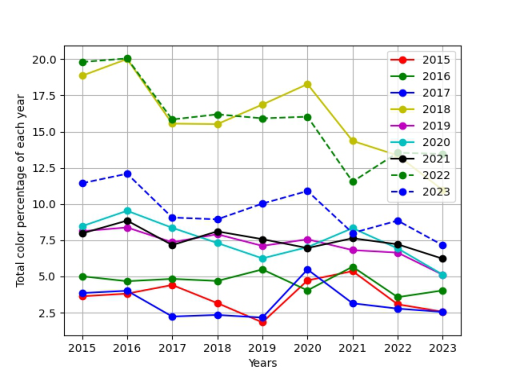
1) There is essentially no regularity in terms of a particular year’s color influencing the current or subsequent year’s fashion color. This research found that Pantone colors appearing on Vogue in the current year shows even a higher frequency than onward years after the predictions. Year 2016, 2017 and 2018 are typical examples. 2) This research compared the total percentage of all Pantone colors each year appearing in Vogue magazines of different years (see Figure 5), with each line representing the annual change in the total percentage of all Pantone colors of the year that appeared in Vogue magazines of each year. For example, the green dash line illustrates the total percentage share for 2022. The line segments to the left and right of the horizontal axis data 2022 represent the percentages before and after the release of the Pantone color, respectively. Similar to the results presented for individual colors, the total share of colors does not reflect the influence of the color of the year, but it is possible to see that the overall share is largely on a downward trend, especially for years 2018, 2022, and 2023.
Figure 5: Line plot of total color percentage for each of the 9 years.
3) The percentages of Classic Colors is higher than these of Fashion Colors, demonstrated by the lighter color grids. The blue boxes are the colors with
8 Shao
the highest percentage values, which are Glacier Gray (2015), Sharkskin (2016), Hazelnut (2017), Tofu (2018), Paloma (2019), Ash (2020), Coconut Milk (2018 & 2023), Ultimate Gray (2021), Coconut Cream (2021), and Snow White (2022). Within those colors, Coconut Milk (2018 & 2023), Snow White (2022) and Ultimate Gray (2021) have the highest percentage. Most of these colors show a similarity to black, white, and gray, colors that are more accessible to the general public. This research also found that after Pantone Color Institution differentiated between Fashion and Classic Colors since 2018, those with the highest percentage share are all from the Classic Color section.
DISCUSSION
Trend report is a communication that connects positions of important segments such as designers, customers, and managers on both ends, and the design language of Pantone Color is thereby transmitted to a certain extent. This paper explores the impact of this communication and the extent to which it is transmitted through a quantitative study of Pantone and Vogue’s data from 2015 to 2023. The results show that the influence of Pantone colors did not meet the company’s expectations, and while color-based communication is a complex process in society, there may be some possible reasons for this result:
1) Pantone colors does not have as much influence as how the company propagandized. The present research confirms the conclusion of the cross-sectional study of the 2019 Pantone predicted colors in the article by Han etc. that Pantone’s predictions do not substantially influence designers’ use of colors. When looked horizontally on specific colors from the result tables, it can be indicated that Vogue Magazine’s fashion collections did not reflect many of the predictions in seasonal Pantone Color Palette. As stated the Introduction section, Pantone’s goal is to impact globally, but the present result shows that their color predictions do not have a lot of impact on magazines like Vogue. 2) The limited influence of Pantone colors may be due to designers’ increasing resistance to standardized palettes. As Pantone noted for the 2024 palette, designers aim to "amplify and liberate their unique artistic spirit" (Pressman, 2023). Trend colors are often short-lived; King (2015) describes "iconic or high fashion colors" as "relatively transient," lasting only briefly within a season. Designers may therefore prioritize personal expression and long-term brand identity over fleeting trends. Figure 5 illustrates this, as Vogue increasingly avoids Fashion Colors in favor of more stable choices. 3) This research only focused on data in US, and with a larger sample size, it may have been possible to find more obvious or different aspects of the pattern. The reference for this research was the New York Fashion Week colors and the Vogue US magazine, but Pantone also has forecasts for French Fashion Week and other runways, and Vogue includes magazines from all over the world. Thus, a comparison of results from different
Exploring the Influence of Pantone Color Trend Report on Design Communication 9
regions may give a more comprehensive picture of Pantone’s influence in different places. 4) The audience accepts more of the stable and consistent Classic Colors. The percentage data for these colors varied little, if at all, and appeared with roughly the same percentage frequency each year. The Fashion Colors, on the other hand, are more of a social significance, and are not directly related to popular aesthetics. For instance, for Spring/Summer 2020, the designers explained that they wanted the year’s colors to infuse “heritage and tradition with a colorful update that creates... energizing and optimistic pairings”(Pantone, 2020). This may also be the designers’ response to the epidemic back then, hoping that people would slow down and look at the past in the midst of tough times, and still remain positive. The colors of other years also represent social and humanistic focuses such as on minorities and celebration of individual power.
Neither Pantone and Vogue have reached the market yet, so discussions about popularity is unsuitable in this case as it can only be reflected through marketing data. The low and scattered use of colors shown in the results supports this. Nonetheless, although in terms of the dissemination of Pantone Color as a design language and trend-setting, the Pantone Fashion Color Trend Report is not as influential to the design community as it is advertised to be, the report is successful in fostering a collective awareness of societal shifts through color language. Vogue, as a leading fashion platform, similarly contributes to this cultural dialogue, highlighting designers’ responses to these societal themes. Hedifi points out that “colour is associated with a social framework... within a social context, in a relationship to social events, social phenomena or technological developments” (Hedifi, 2017). Within this social conversation, Pantone’s and Vogue’s efforts towards cultural communication are also beneficial towards their brand building.
CONCLUSION
This paper suggested a long-term comparison research with Big Data Analysis, using machine learning to process image data. Particularly, this research focused on Pantone’s color trend predictions and its influence to leading designers in terms of their colors used in fashion works presented in Vogue magazine. Unlike past color trend studies, this research does not focus on the popularity and influence in relation to a single year, but rather compares them over a long-term time span and uses big data analytic to quantify the influences.
However, there are some limitations in this research. First, the data source was a fashion magazine, so the experiments ignored the effects of likely tonal treatments, lighting effects, and color variations due to artistic processing. Second, since unsupervised learning was used to process a significant amount of images, it is hard to check the accuracy of the results and there will be a chance of misrecognition issues. Thus, should better machine learning algorithms be developed, further research would allow a greater accuracy in
10 Shao
terms of image processing in large quantity. Nevertheless, the results of this current research demonstrates usefulness for the fashion industry.
On the basis of this research, there may be two directions of expansion. First, Although this research uses an objective approach and logic, user surveys such as interviews with different designers may enrich the findings. Second, future research could expand the current research scope by incorporating data from additional platforms such as retail channels, social media, and fashion media beyond Western contexts. Comparative studies across different regions such as the distribution of colors in underdeveloped and developing countries could explore how socio-cultural characteristics, living standards, and economic status influence the reception and implementation of Pantone color forecasts in more diverse societies.
ACKNOWLEDGMENT
I would like to express my sincere gratitude to my mentors Yunyang Di, Wenjie Yu, Jiayun Guo and other faculty members for their invaluable guidance, critical feedback, and unwavering support throughout this project. Our discussions profoundly shaped the methodological framework of this study.
REFERENCES
Bay Area Fashionista (2014) Pantone Spring 2015 color report from New York Fashion Week. Bay Area Fashionista. Available at: https:// www.bayareafashionista.com/2014/09/04/pantone-spring-2015-color-report- from-new-york-fashion-week/ (Accessed 14 April 2024). Detenber, B. H., Simons, R. F. and Reiss, J. E. (2000) The emotional significance of color in television presentations. Media Psychology, 2(4), pp. 331–355. doi: 10.1207/s1532785xmep0204_02. Han, A., Kim, J. and Ahn, J. (2021) Color trend analysis using machine learning
with fashion collection images. Clothing and Textiles Research Journal, 40(4), p. 0887302X2199594. doi: 10.1177/0887302x21995948. Hidefi, M. (2012) Understanding and forecasting colour trends in design. doi: 10.1016/b978-0-08-101270-3.00012–6. Kim, E. S. and Bae, S. J. (2011) An analysis on the color trend of street fashion in Dalian, China (paper no.1) - Focused on 2010 Summer -. Fashion Business, 15(3), pp. 51–66. doi: 10.12940/jfb.2011.15.3.051. King, J. A. (2011) Colour trend forecasting and its influence on the fashion and textile
industry. In: Textile Design, pp. 193–206. doi: 10.1533/9780857092564.3.193. Lee, K. S. (2015) The Color of the Year: A Textual Analysis of Pantone’s Color Communication Techniques through the Application of Barthes’ Semiotic. Lee, Y. K. and Powers, J. M. (2005) Comparison of CIE lab, CIEDE 2000, and DIN
99 color differences between various shades of resin composites. International Journal of Prosthodontics, 18(2). Li, Z., Golwala, G., Sundaram, S. and Allebach, J. (2019) A data-driven approach for garment color classification in on-line fashion images. Electronic Imaging, 31, pp. 1–5.
Exploring the Influence of Pantone Color Trend Report on Design Communication 11
Nadeem, K., Ahmad, M., Javed, Z. and Habib, M. A. (2022) Development of a machine learning model for prediction of colour trends in fashion industry. In: 2022 International Conference on Frontiers of Information Technology (FIT). IEEE, pp. 296–301. Nitse, P. S. et al. (2004) The impact of color in the ecommerce marketing of fashions:
an exploratory study. European Journal of Marketing, 38(7), pp. 898–915. Pantone (2016) Fashion Color Report Fall 2016. Available at: https:// www.pantone.com/articles/fashion-color-trend-report/fashion-color-report- fall-2016 (Accessed: 29 April 2024). Pantone (2016) Fashion Color Report Spring 2017. Available at: https:// www.pantone.com/articles/fashion-color-trend-report/fashion-color-report- spring-2017 (Accessed: 29 April 2024). Pantone (2018) Fashion Color Trend Report New York Fashion Week Fall/Winter
2018. Available at: https://www.pantone.com/articles/fashion-color-trend-report/ fashion-color-trend-report-new-york-fashion-week-fall-winter-2018 (Accessed: 29 April 2024). Pantone (2019) Fashion Color Trend Report New York Fashion Week Fall/Winter
2019. Available at: https://www.pantone.com/articles/fashion-color-trend-report/ new-york-fashion-week-autumn-winter-2019-2020 (Accessed: 29 April 2024). Pantone (2020) Fashion Color Trend Report New York Fashion Week Spring/ Summer 2020. Available at: https://www.pantone.com/articles/fashion-color- trend-report/new-york-fashion-week-spring-summer-2020 (Accessed: 29 April 2024). Pantone (2020) Fashion Color Trend Report New York Fashion Week Spring/
Summer 2021. Available at: https://www.pantone.com/articles/fashion-color- trend-report/new-york-fashion-week-spring-summer-2021 (Accessed: 29 April 2024). Pressman L. (2021) Fashion Color Trend Report New York Fashion Week Spring/ Summer 2021/2022. Pantone. Available at: https://www.pantone.com/articles/ fashion-color-trend-report/new-york-fashion-week-autumn-winter-2021-2022 (Accessed: 29 April 2024). Pressman L. (2021) Fashion Color Trend Report New York Fashion Week Fall/
Winter 2022. Pantone. Available at: https://www.pantone.com/articles/fashion- color-trend-report/new-york-fashion-week-spring-summer-2022 (Accessed: 29 April 2024). Pressman L. (2023) How does Pantone Select the Pantone Color of the Year. Pantone.
Available at: https://www.pantone.com/articles/color-of-the-year/choosing-the- pantone-color-of-the-year (Accessed: 29 April 2024). Pressman L. (2023) Fashion Color Trend Report New York Fashion Week Autumn/ Winter 2023/2024. Pantone. Available at: https://www.pantone.com/articles/ fashion-color-trend-report/new-york-fashion-week-autumn-winter-2023-2024 (Accessed: 29 April 2024). Pressman L. (2023) Pantone Fashion Color Trend Report: New York Fashion
Week Spring 2024. Pantone. Available at: https://www.pantone.com/articles/ fashion-color-trend-report/new-york-fashion-week-spring-2024 (Accessed: 29 April 2024). Singh, S. (2006) Impact of color on marketing. Management Decision, 44(6), pp. 783–789. Vanderbilt, T. (2012) Sneaking Into Pantone HQ: How color forecasters really decide
which hue will be the new black. Slate. Available at: https://slate.com/culture/ 2012/04/pantone-color-forecasts-are-they-accurate.html (Accessed 9 April 2024).
12 Shao
Vogue Archive (2024) Vogue Archive. Available at: https://archive.vogue.com/ issues (Accessed 13 March 2024). Vogue Runway (2024) Vogue Runway. Available at: https://www.vogue.com/ fashion-shows/designers (Accessed 13 March 2024).
LISTED IN THE AHFE DIGITAL BOOKSTORE CATALOGUE
Explore the complete digital volume
Human Factors in Communication of Design
Read this individual research paper free through the original publisher, or explore the full digital proceedings book.
ISBN 978-1-964867-53-3
Explore this ISBN in the AHFE Bookstore ↗Listed in the July 2026 bookstore catalogue; search by ISBN to confirm current availability · Digital book purchase optional