Junyang Hou, Xue Chen (2025). Parametric Design for Exhibition Displays: Innovations in Form and Function. In: Interdisciplinary Practice in Industrial Design. AHFE Open Access, vol. 183, pp. 207–216. https://doi.org/10.54941/ahfe1006442
The application research of parametric design is one of the current research hotspots in the field of design, but there are few studies on its application in exhibition design. Based on this background, this study selects the Grasshopper visual programming plug-in, takes the exhibition space of the School of Mechanical Science and Engineering of Huazhong University of Science and Technology as the application scenario, and applies the parametric design method to the exhibition design. It aims to explore the unique advantages of parametric design that breaks through the boundaries of traditional design and provide new ideas for the exhibition design of display space. Starting from the concept of parametric design, this paper explores its research status and characteristics, and analyzes the advantages of parametric design in a multi-dimensional comparison with traditional design. And guided by the conceptual definition and design requirements of exhibition design, combined with the rich data of the audience group's demand for exhibition space obtained from the survey, parametric technology is effectively applied to exhibition design. Based on the above theoretical research, according to the college characteristics, application scenarios and audience needs, a tailor-made exhibition design scheme for the lobby of the mechanical building is created, and it is realized through parametric technology. Through in-depth research on the innovative application of parametric design in exhibition design, the unique advantages of parametric design in creative efficiency, design needs, and concept communication after being integrated into exhibition design are demonstrated. In the future, we can further explore the application of parametric design methods in different scenarios, promote innovation and change in exhibition design, and promote the development and progress of exhibition space design in colleges and universities.
In this era of constant change and challenges, every innovation in the exhibition industry drives the convergence of art and technology. As a core element of exhibition spaces, exhibition furniture not only fulfills functional requirements but also embodies the perfect fusion of creativity and technology. Traditional design methods struggle to meet the growing demand for personalization and complexity, necessitating new approaches to break
these limitations. Parametric design, with its powerful algorithmic support and flexible form-generation capabilities, unlocks limitless possibilities for exhibition furniture design. This study explores the innovative applications of parametric design in exhibition furniture, aiming to reveal how this approach transcends the boundaries of traditional design, endowing exhibition structures with unique artistic expression and functionality while injecting fresh vitality and momentum into the industry’s future development.
PARAMETRIC DESIGN OVERVIEW Parametric design is actually parameterized design, that is, the design parameters are quantified, that is, the design is controlled by the parameters, each parameter controls or indicates some important properties of the design result, and changing the value of the parameter will change the design result.
Rhino is a 3D modeling software based on nurbs surfaces. Compared with traditional mesh modeling methods, it can better control the curvature of the object surface and achieve more complex shapes and structures. Rhino also has an open plug-in architecture, allowing users to integrate various plug-ins as needed to expand the software’s functions. Grasshopper used in the study is one of Rhino’s plug-ins.
Grasshopper is a visual programming plug-in developed based on Rhino software. Developers can condense many programming instructions into the battery module, so that even designers without computer programming background can logically sort according to specific battery names or image icons, thereby generating an algorithm program for the data model and completing the visual display of the model in Rhino software.
EXHIBITION DESIGN OVERVIEW Display props refer to objects used in display activities. They are designed based on the properties, volume, quantity and other characteristics of the exhibits. Display props can not only divide and enclose the display space, but also protect and carry the exhibits. Finally, display props also play the role of creating a display atmosphere. The purpose of display prop design is to display the exhibits in the best way through creative and professional design techniques, highlight the characteristics of the exhibits, and enhance the exhibition effect.
The design elements of exhibition equipment, such as form and color, are often important factors in determining the overall display style. At present, exhibition equipment is classified as industrial products and manufactured, especially modern exhibition equipment. The advancement of exhibition equipment reflects the level of a country’s display. In this study, the exhibition equipment design is applied to the exhibition area in the lobby of the School of Mechanical Engineering. Through the exhibition equipment, the latest progress and achievements in the field of mechanical engineering are shown to visitors, which stimulates the interest and curiosity of students and the public, promotes academic exchanges and cooperation, and enhances the visibility and reputation of the school.
Parametric Design for Exhibition Displays: Innovations in Form and Function 209
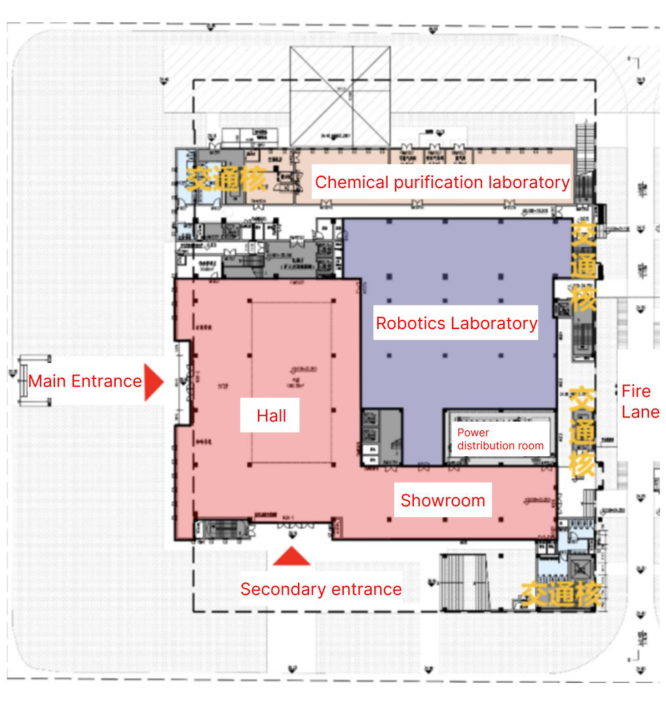
APPLICATION OF PARAMETRIC TECHNOLOGY IN EXHIBITION DESIGN The School of Mechanical Engineering is systematic and rigorous, focusing on innovation and practicality, and focusing on cultivating multidisciplinary cross-disciplinary capabilities. These characteristics are consistent with the characteristics of parametric technology. In addition, the School of Mechanical Engineering has a wide range of disciplines, strong scientific research capabilities and rich cultural heritage. These have played an important reference value for subsequent designs. This design is applied to the lobby of the Mechanical Building. As the official entrance of the college, the lobby is the first stop for visitors and undertakes important functions such as welcoming guests and exhibitions. The lobby is the “face”of the building, and its design directly reflects the image and atmosphere of the college. Therefore, the design of the internal exhibits in the lobby is particularly important.
Figure 1: Schematic diagram of the first floor of the mechanical building.
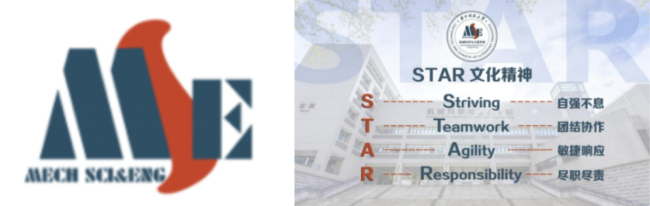
The college highlights its own characteristics with its unique emblem. The main design element of the emblem, “MSE”, represents the English name of
210 Hou and Chen
the college, “School of Mechanical Science & Engineering of HUST”, which is concise and recognizable. In terms of spiritual culture, the college adheres to the “STAR” culture. These four letters represent the core values of the college, which run through all aspects of education and teaching, scientific research and innovation, and social services, becoming the common spiritual bond between teachers and students of the college. These design elements can not only serve as an important part of the college logo, but also provide rich inspiration and reference for the college’s brand image building and subsequent exhibition design.
Figure 2: The emblem of the school of mechanical science and engineering and STAR spirit (adapted from mse.hust.cn, 2025).
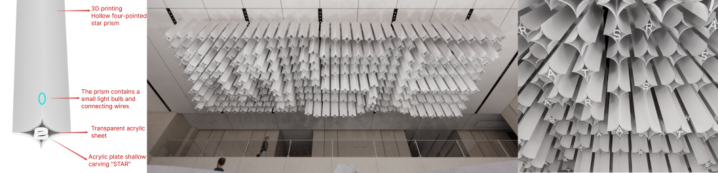
The top device forms the “MSE” shape through the repeated array of “four-pointed star” columns and the vertical height difference, which corresponds to the abbreviation of the college name. The single column adopts a hollow structure, and the central space is used to place wires and light bulbs. The use of lights gives users an immersive feeling, increasing the fun and visual appeal of the exhibits.
Figure 3: Single component diagram and renderings.
The four-pointed star plate under the column is made of acrylic. Based on the principle that acrylic has a stronger ability to refract light after laser shallow engraving, the small lights are always on, highlighting the letters “S”, “T”, “A” and “R” on the acrylic plate. Other unprocessed columns and small lights light up as users approach. This solution not only highlights the culture of the college, but also creates a good visual effect. At the same time, the interaction of lights brings users an immersive experience, enhances the sense of technology, and fits the temperament of the college.
Parametric Design for Exhibition Displays: Innovations in Form and Function 211
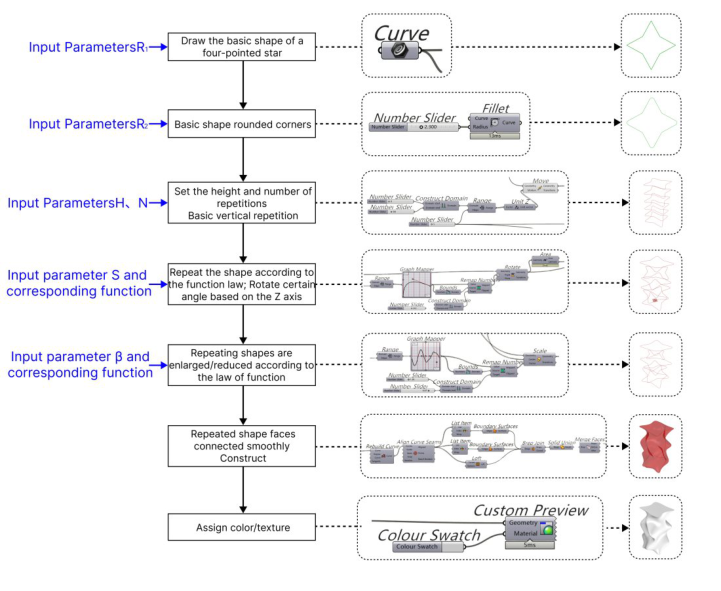
Based on the expected model effect, deduce the modeling logic in Grasshopper.
The bottom booth also uses the “four-pointed star” as the main design element, twisting and stretching it in a “natural” way to create a unique, flowing aesthetic. This shape is not only stunning, but also shows the understanding of the perfect fusion of nature and geometry. The booth shapes are all made using parametric modeling, so serialized designs can be quickly implemented. In the same exhibition, similar but unique booth designs form a unified theme display and enhance the overall effect. At the same time, the user’s demand for seats found in the design survey is also well met through serialization. The seats provide visitors with conditions for rest and relaxation, improving comfort and experience quality.
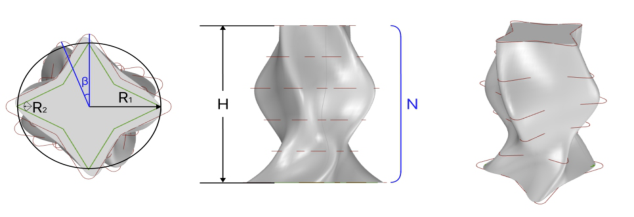
Based on the design concept, the characteristic variables of the booth form are extracted. According to the modeling logic, the content and order of the variable input and operator nodes in Grasshopper are determined. By using multiple operators to build a parametric model, the parameter relationship of points, lines and surfaces is realized, the logical relationship is realized, and the reconstruction form of diversified development is presented. The common booth height based on adults is usually between 90 cm and 120 cm. This height range is suitable for most adult audiences, and they can browse the contents of the booth comfortably whether standing or sitting. Therefore, Hmin = 90 and Hmax = 120 are set. The area of the exhibition surface usually depends on the type of exhibits, the layout of the exhibition space and the goal of the exhibition. Based on the design scenario, R1min = 200, R1max = 350, R2min = 20, and R2max = 30 are set.
Table 1: The meaning and scope of the model morphological characteristic parameters.
Table available in the original PDF paper.
Parameter Name Parameter Meaning Characteristic Parameter Range H Booth height/cm Hmin<H<Hmax R1 Basic four-pointed star circumscribed circle R1min<R1<R1max
radius/mm
R2 Basic four-pointed star chamfer radius/mm R2min<R2<R2max S Single plane magnification 0.75<S<1.25 β Single plane rotation angle/
0<β<360 N Plane repetition quantity 2<N<+∞
212 Hou and Chen
Figure 5: Model morphological feature parameters.
Based on the modeling logic of “joining planes into a body” after repeating planes longitudinally, there are N characteristic variable parameters S and β in the model, so they are presented in the form of arrays in parametric calculation. By adjusting the change law function of these two parameters, the effect of the model morphology is adjusted. Under the premise of fixing other variables, adjust the parameters. Finally, select the functions Perlin and Bezier as the change law curves of parameters S and β respectively.
Table 2: The parameters β different functions correspond to the model effect.
Table available in the original PDF paper.
Bezier Conic Gaussian Sinc Perlin Parabola Function Name
Change curve (β)
Model Effect
Table 3: The parameters S different functions correspond to the model effect.
Table available in the original PDF paper.
Bezier Conic Gaussian Sinc Perlin Parabola Function Name
Change curve (β)
Model Effect
The modeling of the booth is based on the vertical repetition, scaling, and rotation of a single plane of the basic four-pointed star, and finally all the single planes are smoothly connected to form a “body”. The input variables
Parametric Design for Exhibition Displays: Innovations in Form and Function 213
are the morphological characteristic variables summarized above, and the final model shape can be adjusted by adjusting the variable values.
Figure 6: Creating a booth model diagram.
The construction of the booth shape in the study relies on parametric design, so the model can be quickly serialized and customized. After the basic model is established, the parameters can be adjusted as needed to make the booth design more diverse, while also leaving room for future innovation and development. The seating design requirements derived from the scenario analysis can also be quickly modeled and realized through parameter adjustment.
Figure 7: Serial display of booth shapes.
Figure available in the original PDF paper.
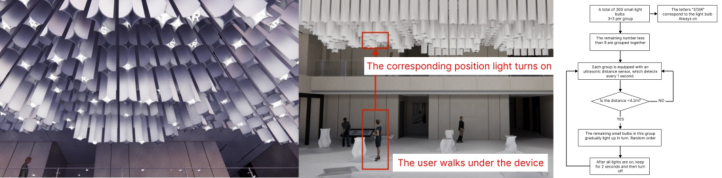
INTERACTIVE DESIGN OF EXHIBITION EQUIPMENT BASED ON ARDUINO PLATFORM The whole device uses 300 small light bulbs, of which 120 “STAR” small lights are always on, and the rest of the specific interaction logic is shown in Figure 10. The device uses distance sensor triggering, and the light bulbs light
214 Hou and Chen
up along the user’s movement trajectory. The array arrangement of the small light bulbs and their longitudinal height difference according to the “MSE” law give people a feeling of “galaxy”, which is also the original intention of the project design. The School of Mechanical Engineering is shining and brilliant in teaching achievements, scientific and technological achievements, spiritual culture, etc.
Figure 8: The effect of the letter light being always on and the interactive logic diagram.
Arduino is an open source electronic development platform. In this study, the small light bulbs, sensors and other modules are all controlled by Arduino. After the basic port settings, the ultrasonic sensor continues to detect the distance until the distance is less than the set value. The output port connected to the small light bulb gradually changes from low level to high level, so that the small light bulbs light up one by one.
Figure 9: Bulb interaction code logic.
Figure available in the original PDF paper.
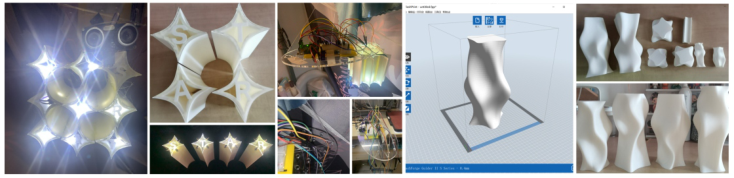
The top device of the physical model is divided into three parts, namely the Arduino board, the control module such as the battery, the suspension support part, and the actual display content. The model has achieved the interactive effect of triggering the light bulbs to light up one by one by detecting the distance. The model of the bottom booth is made by 3D printing of PLA material.
Figure 10: Interactive exhibit model renderings.
Parametric Design for Exhibition Displays: Innovations in Form and Function 215
CONCLUSION
In the context of the gradual development of parametric design, but its application in the field of exhibition equipment design is relatively rare, this paper conducts an in-depth study of the application practice of parametric design in exhibition equipment design. The study found that parametric design has great potential for future development in this field, which can effectively improve the creative efficiency of designers and facilitate the subsequent multi-scene, multi-demand, serialized and customized design of exhibition equipment. At the same time, research and practice have proved that parametric design can effectively integrate design elements such as culture and technology, and efficiently convey design concepts. In the current era of rapid development of science and technology, the emergence of processing methods such as 3D printing also guarantees the final presentation effect of the design. It can be foreseen that parametric design will play a huge positive role in future development and promote innovation and change in exhibition equipment design.
REFERENCES
Ascenzi, A., Brunelli, M., & Meda, J. (2021). School museums as dynamic areas for widening the heuristic potential and the socio-cultural impact of the history of education. A case study from Italy. Paedagogica Historica, 57(4), 419–439. https://doi.org/10.1080/00309230.2019.1660387 Bai Lu & Zhu Xiaodong. (2023). Application of parametric technology in furniture
design. Furniture (03), 22–26. doi: 10.16610/j.cnki.jiaju.2023.03.005. Cai Xiuyun. (2024). Renewal of public interaction space in university teaching buildings based on environmental behavior: A case study of the No. 2 teaching building of Zhejiang Sci-Tech University. Design (01), 86–89. doi: 10.20055/ j.cnki.1003–0069.001428. Li Xikun, Yu Shishi, Jing Jianxiong & Ni Ni. (2023). A review of the domestic application of Grasshopper parametric design method based on bibliometrics. Packaging Engineering (S1), 34–41. doi: 10.19554/j.cnki.1001– 3563.2023. S1.006. Liao Letian. (2016). Research on the usability and artistry of museum exhibition
design (Master’s degree thesis, Wuhan University of Technology). Master https://kns.cnki.net/kcms2/article/abstract?v=YvzTZTPVeK7gMxUx6683LO dslXXvnxSKfHTnqupooW2Wbo3oaHtl-IHZ4Yqg7tJdmq609ctW6tNWFvEqex_ up0SeQoYVCsnpURi_FkOAnXyexcvdlsMw_mZtkHqIKbLik31HXJaqZdj4gh3 P7stdhSRLxymILSPocv0dI6_lenJDWAPIJ5eCzEPpofT5H139P_OmH4KvrUg=& uniplatform=NZKPT&language=CHS. Lü Mengying & Zhong Shilu. (2023). On the application of regional elements in the parametric design of urban furniture. Furniture (03), 58–61+114. doi: 10.16610/ j.cnki.jiaju.2023.03.012. Qu Wenqian. (2023). Research on humanized design of public activity space in
university teaching buildings. Housing (24), 98–101. Wang Ke & Liu Yang. (2017). Research on the coordinated development of parametric design and 3D printing. Packaging Engineering (16), 147–151. doi: 10.19554/j.cnki.1001–3563.2017.16.033.
216 Hou and Chen
Xiang Jun. (2008). Research on the application of modularization in exhibition design (Master’s degree thesis, Jiangnan University). Master https://kns. cnki.net/kcms2/article/abstract?v=YvzTZTPVeK65PnUZ7RHVd30-zO5d6tU5 SPtsGf5arIgtGdcDCeIE56ryuquEdecOcyduBf4hrBPWFi-DKZay0eEl08PwtSJH SXDeFR9QY6w7tbhxJqUdj4ybE6buoaONVO_mpcB43rVzn9ovkUNquHg7lK H6aTzKghGRzxvoVa7_tEegeIs3JsylgznlV_Ci&uniplatform=NZKPT&lang uage=CHS. Xu Weiguo. (2011). Parametric design and algorithmic generation. World Architecture (06), 110–111. doi:10.16414/j.wa.2011.06.016. Yu Wenjing & Li Feng. (2023). Research on the application of parametric technology
in the design of daily-use ceramic products. Design (22), 144–147. doi: 10.20055/ j.cnki.1003–0069.001323. Zeng Li. (2021). A preliminary study on the introduction of Rhino modeling software into environmental art design teaching. Shoe Technology and Design (18), 58–60. Zhang Dian. (2018). Research on the design of display props in folk museums (Master’s degree thesis, Wuhan University of Technology). Master https://kns.cnki.net/kcms2/article/abstract?v=YvzTZTPVeK5jzPdVkY YJCnFUydPsDLMhE2R9sgAcURHQhLKShimN9DiZly1vINdb_hl9UDlRkNnd5 BmerXnSjJNH0pKYSfImyIqxicVHnbczZznMH5Kg2CcJraDdpWWagU2bj10q Sw7zGbDDWj7kTRyGhuT92tIDHu7hMgDbsdgHljeVi4GDY2bd8- xpr9LsqEjmyh4Dc9U=&uniplatform=NZKPT&language=CHS. Zhao Fanghua, Li Mingyi, Wang Xuan & Zhang Xiao. (2023). Research on
parametric generation of bionic products under deconstruction and reconstruction thinking. Packaging Engineering (22), 52–61. doi: 10.19554/j.cnki.1001– 3563.2023.22.007. Zhou Jing, Yang Yan, Feng Yuxue. (2000). Artistic characteristics and development trends of display design. Journal of Zhengzhou University of Light Industry (01), 68–70.
LISTED IN THE AHFE DIGITAL BOOKSTORE CATALOGUE
Explore the complete digital volume
Interdisciplinary Practice in Industrial Design
Read this individual research paper free through the original publisher, or explore the full digital proceedings book.
ISBN 978-1-964867-59-5
Explore this ISBN in the AHFE Bookstore ↗Listed in the July 2026 bookstore catalogue; search by ISBN to confirm current availability · Digital book purchase optional