David Smith (2025). Empathy and Interaction: Students Design Helpful Mobile App Concepts for Underserved Populations. In: Interdisciplinary Practice in Industrial Design. AHFE Open Access, vol. 183, pp. 63–69. https://doi.org/10.54941/ahfe1006427
The act of design in the broadest of terms is seen as using skills to make people’s lives more safe, efficient, and/or pleasant. In particular, graphic design is seen as making visual communication more clear, focused, and/or compelling. The typical graphic designer finds their work in the service of business, promoting goods and services to consumers or other businesses. In this role of promoting goods and services for a business, a graphic designer might not feel any responsibility to question potential negative societal impacts their work might generate. Is there room in the role of a graphic designer to take on any of that responsibility? Do they have agency enough to make positive impacts on our society? University students in an introduction to interactive media course were given the opportunity to practice this kind of decision making by conceiving of mobile phone apps that might possibly benefit individuals with specific needs that are seen as societal gaps. Students conceived, designed, and tested mobile app prototypes for several different types of underserved populations. This mobile app project gave the students insights into how their work can be a positive influence on society as well as broadening their perspective on the role of graphic design in general.
A simple definition for design is conceiving of ways to move from an existing situation to a preferred situation (Simon, 1996). In contrast, Victor Papanek, in his 1971 book Design for the Real World, writes in the first lines of the preface, “There are professions more harmful than industrial design, but only a very few of them. And possibly only one profession is phonier. Advertising design, in persuading people to buy things they don’t need, with money they don’t have, in order to impress others who don’t care, is probably the phoniest field in existence today.” Harsh words for those involved in advertising design who create a preferred situation for their employers and clients. Advertising design is considered a subset within the discipline of graphic design (Tenekedjieva, 2024). The term advertising design is becoming outdated, and most design insiders would consider it to be graphic design in the service of business, marketing goods and services using all types of media, including how businesses brands themselves. This type of work includes a
good portion, if not most, of the graphic design community. While it is debatable whether or not most of graphic design is a phony profession, the statement does make one stop to ask what it is that most graphic designers are ultimately achieving with their skills.
Although discussion of graphic design’s negative impacts has been around for decades, it is still not broadly discussed. The original First Things First Manifesto was penned in 1963, which scolds the advertising industry for wasting design talent promoting trivial products which in the greater scheme of things doesn’t add to education, culture, or greater global awareness. The Manifesto has been updated three times with the latest version in 2020 (Poyner, 2023). However, while this document has worldwide exposure, it doesn’t have tremendous traction within the larger graphic design community.
For students studying graphic design as their chosen field, understanding the value of their work is an important issue. While most graphic design students see graphic design as informing, persuading, organizing, stimulating, locating, identifying, attracting attention, and providing pleasure (Poggenpohi, 1993), they may not be aware that many individuals view their work the same way as Victor Papanek did. How can these students discover ways to make their work deliver more positive impacts on our society? While it is common for graduate design programs to study how their work fits into the bigger picture, undergraduate graphic design programs need to focus on teaching the skills to become a graphic designer and seldom include environmental and social impacts of their work within the curriculum. However, it is not uncommon to find instances of projects within graphic design courses that do touch on how their work can be used for the greater good rather than just all business.
AN INSTANCE OF GREATER GOOD During the 2024 Fall semester of a university undergraduate graphic design program course named Interactive Media, 15 students were tasked with designing prototypes for a mobile phone application. This is not an unusual assignment, most courses dealing with interactive design will include a project designing a mobile app. The unusual aspect of the project is the subject matter of the app.
Students were tasked with using a human-centered design approach to help underserved populations through the development of a mobile app. Using a design thinking model, the students started the process with research, learning about underserved groups in the categories of finance, food insecurity, healthcare, and education. After an initial dive into the subject matter, the students were placed into small groups to compare and extend their research about underserved groups. Using empathy, the students discovered multiple pain points for people in each of these categories. For example, in the education category, a high school student living in a rural area may not have the same support mechanisms and staff in their high school for pursuing higher education as a student living in a suburban community. The small groups then were required to choose one issue within an underserved
Empathy and Interaction: Students Design Helpful Mobile App Concepts 65
category on which to focus. Without yet trying to solve the specific problem, the students as a group wrote a challenge statement defining the problem they want to address.
It should be said here that forcing the medium of a mobile app to solve a problem is not an optimal way to find the best answers. Particularly a wicked problem, which is a difficult or impossible social or cultural problem to solve because of its complexity (Wong, 2024). This goes against best practice for solving problems. However, it is a way to teach interactive media that challenges the typical approach to graphic design by making social and cultural discovery integral to the project.
The small groups last task was to come up with as many mobile app ideas that addresses their chosen issue as they possibly could without prejudging the feasibility of the ideas. This proved difficult for the students, as most people are so used to self-editing themselves so as not to appear silly. However producing wild ideas is important as they lead to innovative ideas (Chuan, 2017). Again, this is part of the design thinking process.
Now working individually, each student converged on what they felt were the best and most feasible ideas generated by their group to explore as interfaces for a mobile app. Starting with wireframes they had to use empathy to figure out what is important to the user, and create a flow chart structure for user journeys through the app. From the wireframes, students developed screen layouts with content made up of text and images to visualize the appearance of their app concept. Multiple iterations of screen designs are explored until a sequence of screens make sense as an interface for an app user. In addition to content and sequencing, students were required to design an overall design scheme with appropriate color, typography, and visual treatment.
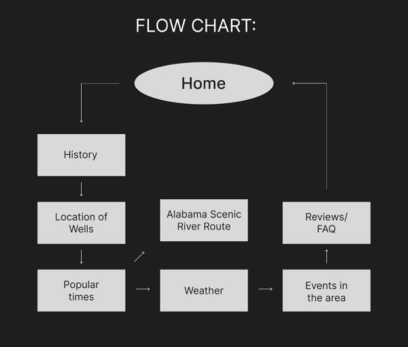
Figure 1: Sample flow chart from student mobile app project about water access.
66 Smith
Testing is Critical User experience and User interface designers will tell you that testing your designs early with a real person is important because it allows you to discover and fix flaws that will frustrate a user. It will also reveal if the app is allowing the user to accomplish the tasks they desire rather than what the designers suppose they desire (Kurzweg, 2024). Students used Figma software to create prototypes of their app that mimic how the app would appear and react if actually built. Students were required to conduct testing of their prototypes in multiple stages of development. An issue with this project is that it can be awkward to access target users of the app who identify as part of a underserved group. While in rare cases students found potential users for testing their prototypes, most students had to settle for a person using empathy to put themselves in place of the users to test the prototype.
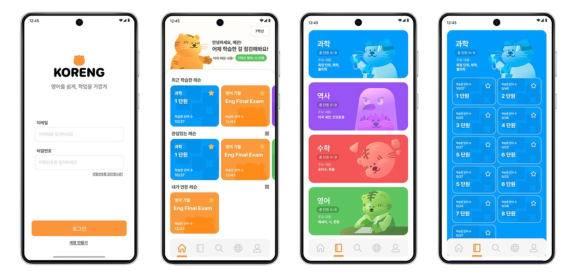
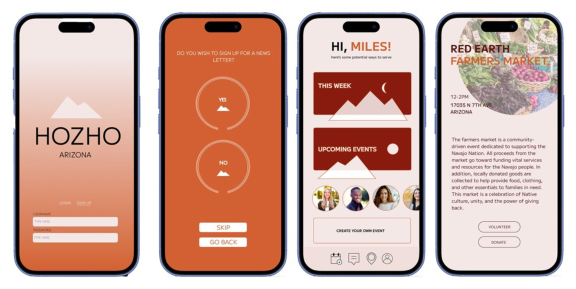
FINAL APP PROTOTYPES After testing and refinements of multiple iterations of the mobile app prototype, the final design is presented explaining how the app might make a positive difference in the lives of the users. Shown below are screen captures from student prototypes of their mobile apps. Figure 1 below depicts an app designed to help Korean children just learning English in American classroom settings understand their lessons easier by transitioning language and making it friendly with cute characters. This student happened to be American Korean who tutors native Korean children in her community. She did have first-hand knowledge of their struggles, and she was able to test her designs with actual target users of the app concept. Figure 2 represents an app that would be of use to people living on a Navaho Nation Reservation. This student spent time on a reservation one summer and has friends who used to live on the reservation and understand the many issues with this underserved population. She was also able to reach out to actual target users with her prototype to get legitimate feedback on the design.
Figure 2: Screen images from student mobile app prototype to help Korean children in America with their school work.
Empathy and Interaction: Students Design Helpful Mobile App Concepts 67
Figure 3: Screen images from student mobile app prototype for use by the Navaho Nation.
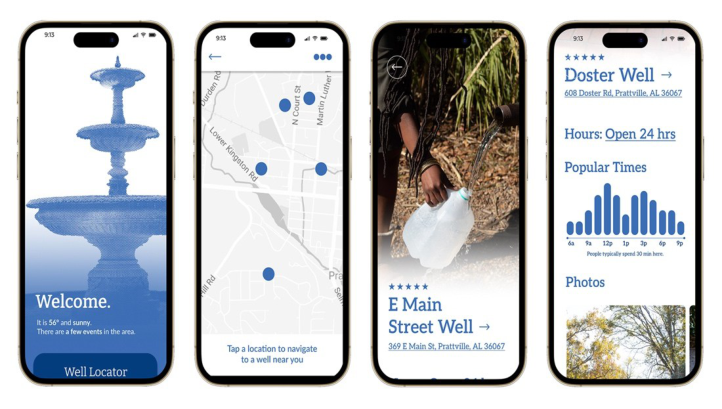
Figure 3 displays screens from a student’s mobile app prototype that locates multiple public fountains from artesian wells in the Prattville, Alabama area. At one time there were more than 400 active wells in use for this one time rural area. Some are still in service and used by certain members of the community. This app helps users locate active wells and gives advice on how to safely use them.
Figure 4: Screen images from student mobile app prototype about fresh water access.
Students in this course were given a survey at the end of the mobile app project with questions asking about certain perceptions they held and if they changed as a result of the project. While most of the students already had an awareness of underserved populations and the potential reach of graphic design, some did express a new appreciation for it.
68 Smith
“Yes, I was aware of unserved groups before working on the mobile app project but my level of awareness has definitely deepened after doing research.”
“Yes, I became more aware of the language barrier non-English speaking residents of the U.S. face especially in healthcare settings.”
“I knew the importance (of graphic design) from previous classes in Design History and Processes, but hadn’t fully processed the way it had transformed in the present until this class.”
“Depends on the scope of the social issue. An app isn’t going to solve global hunger, but it can improve the lives of at least a few people, or connect a community to resources they might not be aware of.”
“Yes, targeting the app design for the benefit of underserved made me realize how graphic design is not just for the consumer.”
CONCLUSION
Simply put, graphic design is about making visual communication understandable and enjoyable. However, from a historical perspective much of this communication is in the service of promoting goods and services for clients as the primary goal, and not about considering the end user’s needs. While the advent of interactive applications on mobile phones should make the user a priority, in most cases the objectives of the apps are still driven by client goals. Professional practitioners are caught up with business operations, servicing their clients, and keeping up with technology with little time to consider the potential impact of design on society. To effect change in future practice, there is a need to focus design education towards more human-centered projects. Projects that can provoke awareness and be a catalyst towards design students’ understanding that good design is not only possible, but also can make a difference in the lives of people who it helps. Although the results from the subject of this paper represent a small sample of 15 students, we can see that it did inform students of their ability to have a positive influence on society through design.
REFERENCES
Chuan, F. (2017) IDEO Shopping Cart Project. 24 May. Available at: https:// www.youtube.com/watch?v=W6EgoiPxNDs (Accessed: 28 February 2025). Kurzweg, J. (2024) ‘How to conduct mobile app usability testing: 2025 Guide’,
UXCam Blog, 18 November. Available at: https://uxcam.com/blog/conduct- mobile-app-usability-tests/ (Accessed: 28 February 2025). Papanek, V. (1971) Design for the Real World. Chicago, IL: Academy Chicago Publishers. Poggenpohl, E. and Helmer, S. (1993) Graphic Design: A Career Guide and
Education Directory. New York, NY: American Institute of Graphic Arts. Poyner, R. (2021) ‘The Evolving Legacy of Ken Garland’s First Things First Manifesto’. AIGA Eye on Design, 12 August 2021. Available at: https:// eyeondesign.aiga.org/why-ken-garlands-first-things-first-manifesto-keeps- getting-updated/ (Accessed: 28 February 2025). Simon, H. (1996) The Sciences of the Artificial. Cambridge, MA: MIT Press.
Empathy and Interaction: Students Design Helpful Mobile App Concepts 69
Tenekedjieva, S. (2024) ‘Advertising Design vs. Graphic Design: What’s the Difference?’, Manypixels, 2024. Available at: https://www.manypixels.co/blog/ graphic-design/advertising (Accessed: 28 February 2025). Wong, E. (2024) ‘What Are Wicked Problems and How Might We Solve Them?’, Interaction Design Foundation, 2024. Available at: https://www.interaction- design.org/literature/article/wicked-problems-5-steps-to-help-you-tackle- wicked-problems-by-combining-systems-thinking-with-agile-methodology#: ∼: text=Horst%20W. J., of%20Planning”%20(1973) (Accessed: 28 February 2025).
LISTED IN THE AHFE DIGITAL BOOKSTORE CATALOGUE
Explore the complete digital volume
Interdisciplinary Practice in Industrial Design
Read this individual research paper free through the original publisher, or explore the full digital proceedings book.
ISBN 978-1-964867-59-5
Explore this ISBN in the AHFE Bookstore ↗Listed in the July 2026 bookstore catalogue; search by ISBN to confirm current availability · Digital book purchase optional