Daisuke Suzuki, Chizuru Nakagawa, Hajime Akatsuka, Naohiro Akiu (2025). Analysis of Subjective Sleepiness Considering the Influences of Driving Workload, Duration between Stations, and Driving Duration in Railway Driving. In: Advances in Human Factors of Transportation. AHFE Open Access, vol. 186, pp. 466–471. https://doi.org/10.54941/ahfe1006536
Railway drivers are required to maintain wakefulness while driving to confirm that the area in front of their vehicle is safe and to cope with extraordinary events. However, the driving environment, which includes being alone in the cab and performing monotonous tasks, tends to induce sleepiness. Therefore, in this study, we analyzed subjective sleepiness to investigate the relationship between drivers’ sleepiness and driving conditions. This study aimed to identify the influences that the driving workload, duration between stations, and driving duration have on drivers’ sleepiness.We used a railway driving simulator to conduct the experiment. Thirty males participated in our study. The participants drove in two ways: (1) the participants controlled the velocity of the simulated train, referred to as “high driving workload,” and (2) the system controlled the velocity of the simulated train, referred to as “low driving workload.” The durations between stations included the following three conditions: 1.5, 3.0, and 5.5 minutes. The duration of stopping at a station was 0.5 minutes. After practicing, the participants drove under six experimental conditions, consisting of a combination of two kinds of driving workload and three durations between stations. We randomized the order of the experimental conditions for each participant. The driving duration was 18 minutes per experimental condition. At every minute while driving, the participants were required to rate their subjective sleepiness using the Karolinska Sleepiness Scale, with the following grades: “Extremely alert” (score = 1) and “Extremely sleepy – fighting sleep” (score = 9).We conducted a multiple regression analysis in which the objective variable was the mean of the subjective sleepiness score, and the explanatory variables included the driving workload (high or low), the driving duration after stopping at a station (from 0 to 5 minutes), and the total driving duration (from 1 to 18 minutes).The results of the multiple regression analysis revealed that the score of subjective sleepiness was significantly associated with the driving workload, the driving duration after stopping at a station, and the total driving duration. The findings from the partial correlation coefficient indicated that with all other variables being constant, subjective sleepiness increased by 1.52 when the driving workload was low compared with when it was high. Subjective sleepiness also increased by 0.16 when the driving duration after stopping at a station increased by 1 minute. Furthermore, subjective sleepiness increased by 0.06 when the total driving duration increased by 1 minute. Additionally, the standardized partial regression coefficient showed that the driving workload had the largest influence among the three variables.With regard to the influence of driving workload, a previous study in the automobile industry showed that reducing driving workload caused “passive fatigue,” leading to sleepiness. Our results also showed that a low driving workload induced sleepiness. Furthermore, in terms of the effect of the driving duration after stopping at a station, another previous study in the automobile industry referenced “highway hypnosis,” whereby the monotony of the road environment tended to induce sleepiness. Our results showed that a long driving duration after stopping at a station was thought to be monotonous. Additionally, with regard to the total driving duration, the previous study indicated that the levels of sleepiness increased during driving. Our results also indicated that sleepiness increased with a longer driving durations.
Japan’s aging population and declining birthrate make it increasingly difficult for railway operational companies to recruit and train professional drivers. This labor shortage poses a serious challenge in maintaining safe and efficient railway operations. To address this, railway operational companies are exploring ways to improve operational efficiency and reduce labor requirements. One promising solution is the development of systems that control train velocity, which can reduce the need for human intervention. It is essential to conduct fundamental research to ensure that railway crew members can perform their duties effectively in such new systems.
Analysis of Subjective Sleepiness Considering the Influence of Driving Workload, Duration 467
Railway drivers must maintain wakefulness while driving to confirm that the area in front of their train is safe and to cope with extraordinary events. However, the driving environment, which includes being alone in the driver’s room and performing monotonous tasks, tends to induce sleepiness.
Many previous studies have examined sleepiness within the railway, aviation, and automobile fields. In the railway industry, Dunn and Williamson (2012) conducted an experiment with 56 participants using the Microsoft Train Simulator to compare fatigue, including sleepiness, in a low- demand scenario with that in a high-demand scenario. Findings obtained based on self-reported data showed that the low-demand task was rated as more fatiguing overall. In the aviation industry, Cabon et al. (1993) collected physiological data and observed pilots’ tasks in 41 actual flights. Results showed a high occurrence of decreased vigilance, particularly during phases of low workload, such as when cruising.
There is a phenomenon in the automobile industry known as “highway hypnosis,” which has been defined as a state in which signs of sleepiness are exhibited resulting from driving a motor vehicle with low event occurrence, indicating monotony. Cerezuela and Tejero (2004) investigated the data recorded during the actual driving experience of 14 participants on motorways and conventional roads. The results showed that sleepiness was higher on highways than on conventional roads. Ting et al. (2008) analyzed 30 young male participants during laboratory-simulated highway driving. The results revealed that the sleepiness ratings increased over time.
Nakagawa et al. (2024), one of the authors of the present study, explored strategies for staying awake with participants who were not professional railway drivers, which can be included in railway driving tasks. The findings indicated that the countermeasures of implementing active behavior and receiving positive responses contributed to a decrease in sleepiness. Particularly, the previous study suggested that finger-pointing and calling, verbal responses to finger-pointing and calling by a system, and voluntarily recording the situation around the tracks were identified as effective strategies for maintaining wakefulness.
Maintaining alertness while driving is critical for ensuring safety and security in the railway industry. It is particularly important to address situations where staying awake may be challenging. This study aimed to investigate how different driving conditions, such as simulated driving workload, the duration between stations, and the total driving duration, influence subjective sleepiness. To explore these effects, we used a railway driving simulator to create an environment that mimicked highly monotonous driving conditions to induce sleepiness.
METHODS
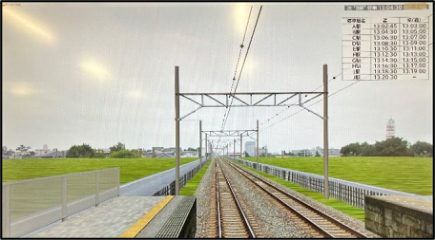
Apparatus To mimic railway driving, we used a railway driving simulator in our experiment. Figure 1 shows the scenery ahead used in the experiment. The driving device was a one-handle controller manufactured by ONGAKUKAN Co., Ltd. The display devices were a 40-inch monitor that showed the scenery
in front of the simulated train and two 13-inch monitors that showed the view of the side camera on the simulated train vehicle to confirm the situation on a railway station platform. We used the computer graphic content prepared by the railway driving simulation software “BVE.”
To mimic the driving condition in which the simulated workload was low (referred to as the “low driving workload”), meaning that the system controlled the velocity of the simulated train, we added the following three devices: buttons to request departure, a button to activate the emergency brake, and switches to open and close doors.
During the experiment, we mimicked both simulated driving conditions in which a participant controlled the velocity of the simulated train (i.e., a high driving workload) and simulated driving conditions in which the system controlled the velocity of the simulated train (i.e., a low driving workload). We used a straight driving course with the monotonous scenery and stations of the same shape to induce sleepiness.
Figure 1: Scenery ahead used in the experiment.
Participants The participants in the experiment included 30 men who had an automobile driver’s license and no disorders of vision or hearing. The participants were included in their 20 s, 30 s, 40 s, 50 s, and 60 s. This study was approved by the Ethical Committee in Research Institute of Human Engineering for Quality Life, Japan (Approval number: E23-1-1).
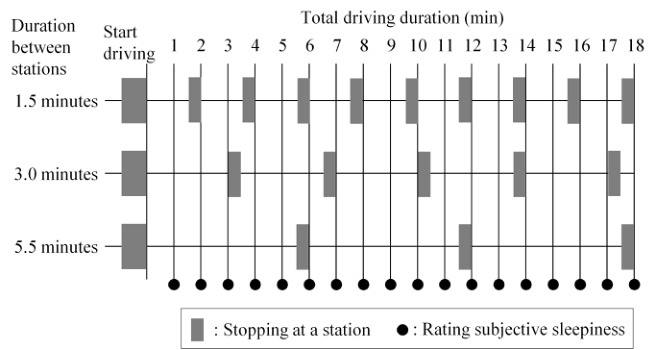
Experimental Condition In the experiment, we used a straight driving course with monotonous scenery to induce sleepiness. Driving conditions included were simulated driving workload (high and low) and duration between stations (1.5, 3.0, and 5.5 minutes). Ten stations were present in the driving condition with a duration of 1.5 minutes between stations, six stations in the condition with 3.0 minutes between stations, and four stations in the condition with 5.5 minutes between stations. Figure 2 shows the timing of stopping at a station. The combination of simulated driving workload and duration between stations resulted in a total of six kinds of experimental conditions.
Analysis of Subjective Sleepiness Considering the Influence of Driving Workload, Duration 469
Experimental Procedure First, after the participants received explanations about the railway driving simulator, they practiced under the condition of a high driving workload, in which they controlled the velocity of the simulated train and the duration between stations of 1.5 minutes until they were able to stop the simulated train at a designated stop position. The participants then practiced under the condition of a low driving workload, in which the system controlled the velocity of the simulated train, before they took a 5-minute break.
In the experimental condition, participants drove 18 minutes from the first station to the final station after stopping at the first station for 3 minutes. Participants repeated driving with taking recesses until the six experimental conditions were complete. To reduce the influence of the order effects, we randomized the order of the experimental conditions.
At every minute while simulated driving, the participants were required to rate their subjective sleepiness using the Japanese version of Karolinska Sleepiness Scale (Kaida et al., 2006), using the following scale: 1 = extremely alert to 9 = extremely sleepy—fighting sleep. Each participant provided 18 ratings in the experimental condition, for a total of 108 ratings. Figure 2 shows the timing of rating subjective sleepiness.
Figure 2: Timing of stopping at a station and rating subjective sleepiness.
Analysis Method We calculated the mean of subjective sleepiness of the 30 participants. We conducted a multiple regression analysis in which the objective variable was the mean of the subjective sleepiness score, and the explanatory variables included the simulated driving workload (high or low), the driving duration after stopping at a station (from 0 to 5 minutes), and the total driving duration (from 1 to 18 minutes). We determined the driving duration after stopping at a station as follows. For example, when the duration between stations was 1.5 minutes, the simulated train had been stopped at a station from 1.5 to 2.0 minutes. Then, when the total driving duration was 3.0 minutes, the driving duration after stopping at a station was 1.0 minute.
RESULTS
Table 1 shows the results of the multiple regression analysis, which revealed that the score of subjective sleepiness was significantly associated with the simulated driving workload, driving duration after stopping at a station, and total driving duration. The findings from the partial regression coefficient indicated that with all other variables being constant, the subjective sleepiness increased by 1.52 with a low driving workload as compared with a high driving workload. The subjective sleepiness also increased by 0.16 when the driving duration after stopping at a station increased by 1 minute. Furthermore, when the total driving duration increased by 1 minute, the subjective sleepiness increased by 0.06.
Table 1: Results of the multiple regression analysis.
Table available in the original PDF paper.
Variable Partial Regression
Standardized Partial
p Value
Coefficient
Regression Coefficient 0.16 0.25 <0.05 Driving workload 1.52 0.84 <0.05 Driving duration after stopping at a station
Total driving duration 0.06 0.32 <0.05 Constant 2.53 <0.05
DISCUSSION
The results of the multiple regression analysis showed that subjective sleepiness increased when the simulated driving workload was low compared with when it was high. Previous studies in the railway field (Dunn and Williamson, 2012) showed that the low-demand task was rated as more fatiguing, including sleepiness. Previous studies in the field of aviation (Cabon et al., 1993) also reported that decreased vigilance occurred during phases of low workload. Our results in this study corresponded with those of previous studies, which showed that low workload induced sleepiness.
With regard to the duration between stations, the results of the multiple regression analysis showed that subjective sleepiness increased with longer driving duration after stopping at a station. Because the driving course in this study consisted of a straight railroad with stations of the same shape to induce sleepiness, it is possible that stopping at a station contributed to a decrease in the monotony of driving. A previous study in the automobile field (Cerezuela and Tejero, 2004) showed that sleepiness was higher on highways, which had a low event occurrence, as compared with conventional roads. The results of the present study corresponded with those of previous studies, which showed that a monotonous driving condition induced sleepiness.
In addition, the results of the multiple regression analysis showed that subjective sleepiness increased in accordance with the total driving duration. A previous study in the automobile field (Ting et al., 2008) showed that sleepiness increased over time. Our results corresponded with the findings of
Analysis of Subjective Sleepiness Considering the Influence of Driving Workload, Duration 471
previous studies, which showed that the passage of time induced sleepiness in a monotonous task.
The present study has some limitations. First, the participants were not professional railway drivers working for railway operational companies. The occurrence of sleepiness might vary when professional drivers drive a physical train while on duty due to the sense of tension and responsibility. Second, the overall workload includes the driver’s cognitive workload, such as confirming the safety of the level crossing and the conditions around the railway track, and dealing with extraordinary events; however, this study examined only simulated driving workload, which includes only controlling velocity. Additionally, the monotonous nature of the simulated driving course may have intensified sleepiness, which may not fully reflect the conditions encountered in actual railway driving. Finally, the total driving duration in this study was shorter than that in actual driving. The results in this study could apply only to subjective sleepiness occurring within 18 minutes. Further study is needed to investigate the behavior of professional railway drivers in real driving conditions over a longer duration.
CONCLUSION
In this study, we investigated the influence of simulated driving workload, duration between stations, and total driving duration on subjective sleepiness. The results of the multiple regression analysis showed that with all other variables being constant, the subjective sleepiness increased by 1.52 when the simulated driving workload was low compared with when it was high. The subjective sleepiness also increased by 0.16 when the driving duration after stopping at a station increased by 1 minute. Furthermore, when the total driving duration increased by 1 minute, the subjective sleepiness increased by 0.06.
REFERENCES
Cabon, P., Coblentz, A., Mollard, R. and Fouillot, J. P. (1993). Human vigilance in railway and long-haul flight operation, Ergonomics, Vol. 36, No. 9, pp. 1019–1033. Cerezuela, P. G. and Tejero, P. (2004). Wertheim’s hypothesis on ‘highway hypnosis’:
empirical evidence from a study on motorway and conventional road driving, Accident Analysis & Prevention, Vol. 36, No. 6, pp. 1045–1054. Dunn, Naomi and Williamson, Ann. (2012). Driving monotonous routes in a train simulator: The effect of task demand on driving performance and subjective experience, Ergonomics, Vol. 55, No. 9, pp. 997–1008. Kaida, K., Takahashi, M., Åkerstedt, T., Nakata, A., Otsuka, Y., Haratani, T.
and Fukasawa, K. (2006). Validation of the Karolinska sleepiness scale against performance and EEG variables, Clinical Neurophysiology, Vol. 117, No. 7, pp. 1574–1581. Nakagawa, C., Akatsuka, H., Suzuki, D., Akiu, N. and Suzuki, H. (2024).
Fundamental study on arousal maintenance strategies with high affinity for train driving tasks, The Japanese Journal of Ergonomics 60 (Supplement) 2E2-2. Ting, P. Hwang, J. Doong, J. and Jeng, M. (2008). Driver fatigue and highway driving: A simulator study, Physiology & Behavior, Vol. 94, No. 3, pp. 448–453.
LISTED IN THE AHFE DIGITAL BOOKSTORE CATALOGUE
Explore the complete digital volume
Advances in Human Factors of Transportation
Read this individual research paper free through the original publisher, or explore the full digital proceedings book.
ISBN 978-1-964867-62-5
Explore this ISBN in the AHFE Bookstore ↗Listed in the July 2026 bookstore catalogue; search by ISBN to confirm current availability · Digital book purchase optional