Georgios Lykos, Nikolaos Ventikos (2025). Navigating Safety in the Maritime Sector: Developing Leadership Skills through Simulated Environments. In: Advances in Human Factors of Transportation. AHFE Open Access, vol. 186, pp. 546–554. https://doi.org/10.54941/ahfe1006544
The maritime industry is one of the most complex and high-risk sectors globally, where effective leadership is critical to ensuring safety, preventing accidents, and fostering a culture of continuous improvement. Given the dynamic and often hazardous nature of maritime operations, developing strong leadership skills is essential for both current and future maritime professionals. This paper explores the role of simulated environments in enhancing safety leadership within the maritime sector, with a focus on measuring human performance and the development of leadership skills. Simulators offer a unique advantage by providing realistic, risk-free experiences that help improve human performance and assess the characteristics of effective leadership.Today safety within a maritime organization is often evaluated through the safety climate and the Non-Technical Skills (NTS) of seafarers in the framework of proactive safety. NTS encompass the cognitive, social, and personal abilities that complement technical skills, and are visibly observable in safe behaviors aboard ships. Leadership is a key component of social NTS, both on real vessels and in simulated environments. The safety climate is assessed using questionnaires and interviews specifically designed for this purpose. To capture the NTS of seafarers working on Greek-owned vessels, an attitude questionnaire was distributed to a sample of 905 Greek seafarers at KESEN and 316 Filipino seafarers in Manila, as part of their training at Marine Educational Training (MET) centers. A total of 1,221 valid questionnaires were analyzed using factor analysis and related statistical tests to identify, assess, and classify NTS with a focus on leadership, and their impact on maritime safety.While traditional leadership training often relies on theoretical knowledge and classroom-based instruction, ship-based simulators bridge the gap between theory and practice by providing immersive, real-world scenarios. These simulations allow trainees to develop situational awareness, decision-making skills, and crisis management capabilities, all while reinforcing the importance of leadership in enhancing safety outcomes under pressure. This paper focuses on deck and engineering officers of Greek-owned vessels who participated in fire and evacuation simulations—such as firefighting, emergency response drills, search & rescue, and coordinated team tasks. These simulated exercises provide valuable insights into the challenges maritime leaders face and help them prepare for the unpredictable nature of real-world operations.This study examines the advantages of simulation-based training in developing key leadership competencies, including situational awareness, decision-making under stress, risk assessment, and team coordination. It also explores the impact of human limitations—such as fatigue and stress—on leadership effectiveness and human performance in extreme situations. Furthermore, the paper highlights the essential components of successful simulation-based leadership training programs, such as the use of firefighting and evacuation simulators, the integration of realistic scenarios, and the importance of feedback mechanisms that allow trainees to reflect on their actions and improve their skills.In conclusion, this paper argues that simulated environments are an invaluable tool for developing the leadership skills required to navigate the complexities of maritime safety. By integrating simulation-based training into leadership development programs, maritime organizations can cultivate a new generation of leaders who are better prepared to address the challenges of a high-risk industry and improve safety standards across the sector.
Navigating Safety in the Maritime Sector: Developing Leadership Skills 547
INTRODUCTION
The maritime industry is one of the most complex and high-risk sectors globally, where effective leadership plays a crucial role in ensuring safety, preventing accidents, and fostering a culture of continuous improvement. Given the dynamic and often hazardous nature of maritime operations, developing strong leadership skills is essential for both current and future maritime professionals.
This paper explores the role of simulated environments in enhancing safety leadership within the maritime sector, with a focus on measuring human performance and the development of leadership skills. Simulators offer a unique advantage by providing realistic, risk-free experiences that help improve human performance and assess the characteristics of effective leadership. By integrating simulation-based training into leadership development programs, maritime organizations can cultivate a new generation of leaders who are better prepared to address the challenges of a high-risk industry and improve safety standards across the sector.
THE IMPORTANCE OF LEADERSHIP IN MARITIME SAFETY Maritime leaders are responsible for ensuring the safety of both crew and cargo, mitigating risks, and responding effectively to emergencies. Leadership in the maritime sector involves not only technical competencies but also Non- Technical Skills (NTS), such as communication, decision-making, teamwork, and situational awareness.
Today, safety within a maritime organization is often evaluated through the safety climate and the NTS of seafarers within the framework of proactive safety. NTS encompass cognitive, social, and personal abilities that complement technical skills and are visibly observable in safe behaviors aboard ships. Leadership is a key component of social NTS, both on real vessels and in simulated environments.
Challenges in Leadership Development Despite its importance, leadership development in the maritime sector often relies on traditional training methods, such as classroom-based instruction and theoretical knowledge transfer. These methods, while useful, fail to fully prepare seafarers for the high-pressure, real-world decision-making scenarios they will encounter. Additionally, human limitations such as stress and fatigue can severely impact leadership effectiveness, making it essential to incorporate resilience training into leadership programs.
Over the past 30 years, the adoption of the International Safety Management (ISM) Code in maritime transport, along with broader guidelines on ship construction and crew procedures, has significantly enhanced safety. However, emergency situations on board continue to pose a real threat to maritime transport. Reducing the number of maritime accidents caused by human error (HE) requires a focus on minimizing potential errors, mitigating the psychological impact on seafarers, and improving crisis management skills (Rothblum, 2000; Corovic & Djurovic, 2013). It is widely
548 Lykos and Ventikos
believed that shipping can overcome this uncertainty through appropriate simulator-based training (Hanzu-Pazara et al., 2008).
Several researchers (Psaraftis et al., 1998) and maritime experts have emphasized the importance of crew competency in emergency situations. Zhang, Zhan, and Tan (2009) state that technical skills alone are not sufficient; a lack of experience and training, especially in emergencies, leads to mistakes that result in accidents. In fact, advanced training not only improves crew capabilities in acquiring knowledge and skills related to emergencies but also helps reduce stress and fatigue levels. Stress (Sneddon, Mearns & Flin, 2013) and fatigue (Akhtar & Utne, 2014) are recognized as the two most critical factors contributing to, HE in both normal working conditions and emergency situations (Milen, 2009).
The International Maritime Organization (IMO) has repeatedly examined the need for improved crew training in emergency situations (IMO, 2008), particularly for fire and evacuation scenarios, to minimize errors. The IMO (2008) also highlights that inadequate training contributes to significant HE- related accidents.
Leadership Challenges in the Maritime Sector Leadership plays a critical role in ensuring the safety and efficiency of maritime operations. Effective leadership directly influences decision- making, crew performance, and the overall resilience of maritime teams in crisis situations. However, the maritime domain presents unique leadership challenges, including:
i. Cultural and Linguistic Diversity – Maritime crews are often composed of individuals from various nationalities, which can lead to communication barriers and differences in leadership expectations (Hetherington, Flin & Mearns, 2006). Effective leaders must foster a culture of inclusivity and ensure that safety protocols are understood by all crew members. ii. Decision-Making Under Pressure – Captains and senior officers must make critical decisions in high-stress environments, often with incomplete information. Crisis leadership training and situational awareness development are essential to reducing the risk of poor decision-making (Berg, Storgård & Lappalainen, 2013). iii. Crew Morale and Mental Health – Extended periods at sea, isolation, and fatigue can impact crew morale and mental well-being. Strong leadership requires not only technical expertise but also the ability to support crew members emotionally and psychologically (Sampson & Ellis, 2019). iv. Balancing Safety and Operational Efficiency – Leaders must find a balance between operational demands and safety compliance. Commercial pressures may sometimes lead to compromised safety decisions, making it essential for maritime leaders to uphold ethical and regulatory standards (Bailey, Ellis & Sampson, 2016). v. Crisis Management and Resilience Building – Leadership in maritime emergencies requires adaptability and resilience. The ability to anticipate,
Navigating Safety in the Maritime Sector: Developing Leadership Skills 549
respond, and recover from unexpected crises is a key component of effective leadership at sea (Hollnagel, 2013).
Through high-quality simulator training, crews come one step closer to achieving the resilience levels required in maritime transport. The four dimensions of resilience, as classified by Hollnagel (2013), provide a framework for successfully managing emergency situations: i. LEARN – Recognize what has happened. ii. RESPOND – Identify what actions can be taken. iii. MONITOR – Be aware of what indicators to observe. iv. ANTICIPATE – Predict what to expect.
The importance of developing resilience in ship crews is of paramount significance and has been highlighted by various industry leaders. Notably, the major oil company Shell pioneered this approach in 2015 by mandating that its partner shipping companies adopt training programs that promote crew resilience and psychological endurance.
Leadership Challenges in Crisis Management Leadership plays a crucial role in maritime emergency training, as the success of crisis management depends heavily on decision-making, coordination, and psychological resilience. Several leadership challenges emerge in these high- stress training environments:
i. In fast-evolving emergency scenarios, leaders must rapidly assess the situation, make informed decisions, and direct the crew effectively. The uncertainty and escalation of the fire simulation scenarios test leaders’ ability to anticipate risks and make calculated decisions under extreme pressure. ii. In emergency situations, clear communication is critical. However, stress, environmental hazards, and physical exhaustion can impair communication effectiveness. Leaders must learn to issue concise and decisive orders while ensuring their team understands and executes them correctly. iii. The claustrophobic simulator intentionally induces high levels of stress and fear, simulating real-life maritime disasters. Effective leaders must remain calm, manage their team’s psychological state, and prevent panic- driven errors that could compromise safety. iv. Leaders must weigh risk against operational effectiveness. Training scenarios provide an opportunity to develop risk assessment skills, ensuring that leaders prioritize crew safety while efficiently managing fire suppression and rescue efforts. v. The controlled training environment allows leaders to reflect on their decisions, reactions, and communication methods. Instructors analyze human behavior during simulations and provide feedback, helping leaders develop stronger adaptive thinking and crisis response strategies.
550 Lykos and Ventikos
Leadership Challenges in Crisis Management Human limitations in maritime transport operations, specifically stress and fatigue, are considered decisive factors in increasing the likelihood of human error, which contributes to maritime accidents (Oses & Ventikos, 2006). This has been confirmed through the development of the initial Human Performance Model (HPM). In emergency situations, the impact of stress and fatigue becomes even more critical, making it essential for seafarers and maritime leaders to recognize and manage these human limitations effectively.
Effective maritime leadership plays a crucial role in mitigating the effects of stress and fatigue on a vessel’s crew. Leaders must be able to identify the early signs of cognitive and physical exhaustion, make real-time risk assessments, and implement preventative measures to maintain high- performance standards under extreme conditions. This highlights the need for leadership training that incorporates human performance management and psychological resilience.
The optimal approach to achieving this is through enhanced competency development of seafarers via experiential training, such as simulator-based exercises. These training scenarios expose maritime leaders to realistic crisis conditions, allowing them to develop adaptive thinking skills, improve decision-making under pressure, and cultivate effective crew management strategies in high-stress environments.
The Role of Leadership in Stress and Fatigue Management Emphasis was placed on observing how trainees perceive stress and fatigue levels during an emergency scenario, as well as how leadership influences their ability to cope with these challenges. A similar assessment process was conducted through Maritime Training Centers (MTC) questionnaires in KESEN and Manila, where it was commonly observed that seafarers struggle to recognize the effects of human limitations on performance.
This finding is particularly significant for ship captains and senior officers, who are responsible for maintaining crew efficiency and safety while navigating through operational and emergency stressors. Research has shown that leaders who fail to acknowledge the effects of fatigue on themselves and their crew are more likely to make poor decisions, misinterpret critical information, and compromise shipboard safety (Ventikos et al., 2014).
To compare the perception of stress and fatigue levels among different crew members and leadership positions, a specific perception scale was utilized as a measurement tool for evaluating human limitations. This scale (rating from 1 to 10) is considered optimal due to its simplicity and reliability in monitoring and assessing perceived stress and fatigue levels among maritime professionals.
Seafarers and maritime leaders were asked to self-assess how they perceived their fatigue and stress levels during three key moments: i. During a relatively calm period ii. During a break iii. At the start of the training
Navigating Safety in the Maritime Sector: Developing Leadership Skills 551
It must be mentioned that the study aimed to gain insights into how seafarers and maritime leaders perceive stress and fatigue, as well as their ability to manage these limitations effectively in high-pressure maritime environments. The results serve as an indicator of how well maritime leadership strategies contribute to crew well-being, decision- making efficiency, and overall safety performance.
Implications for Maritime Leadership Training The findings reinforce the importance of leadership training in human performance management. Effective maritime leaders must be equipped with the skills to:
Recognize the physiological and psychological effects of stress and fatigue on themselves and their crew.
Develop and implement fatigue-mitigation strategies, including workload distribution and rest periods.
Enhance crisis communication skills to ensure clear and concise instructions during high-pressure situations.
Foster a shipboard culture that prioritizes well-being without compromising operational efficiency.
Stress and fatigue awareness should be integrated into leadership development programs in such a way that maritime organizations can improve crew resilience, reduce human error, and enhance overall safety in ship operations.
Implications for Maritime Leadership Training At the conclusion of the training process, participants were asked additional questions regarding their overall impressions and the perceived impact of experiential training on their professional competency. The same rating scale as presented above was used to assess their responses.
81% of participants rated experiential training as highly beneficial (9-10 on the scale) for their professional careers.
The remaining 19% also responded positively, stating that the training was “very useful” for their competency development.
92% of participants agreed that the theoretical component of the training was essential for enhancing both their technical and non-technical knowledge in emergency response.
Additionally, participants evaluated the realism of the training scenarios:
56% of participants rated the training as very realistic (7–8 on the scale).
38% found it to be extremely realistic (9–10).
Only 6% considered it moderately realistic compared to real-life emergency situations at sea.
One of the most significant findings relates to the psychological challenges faced during training:
552 Lykos and Ventikos
67% of participants reported experiencing serious doubts (4–6 on the scale) about their ability to successfully complete the training when exposed to the highly realistic and escalating scenarios.
17% expressed high levels of fear (7–8) regarding potential failure.
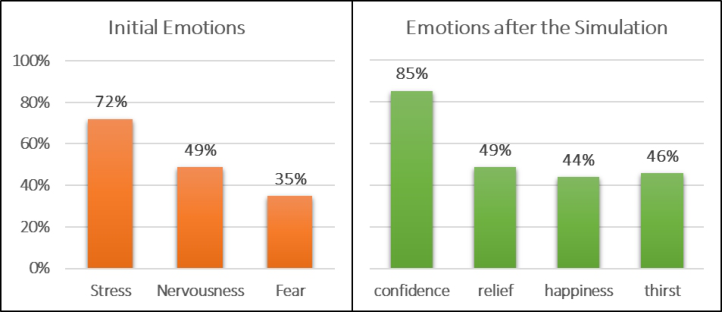
To further investigate the emotional impact of training, a team of psychologists assisted in analyzing participants’ emotions at two key moments: i. When the simulated scenario began. ii. After completing the simulated scenario.
Participants were asked to describe their emotions using specific words. As shown in the following Figure 1 the dominant responses included:
Stress (72%) – highlighting the intense psychological pressure during emergency simulations.
Self-confidence (85%) – demonstrating a significant shift in participants’ mental resilience and leadership mindset by the end of training.
Figure 1: Graphical representation of the participants’ emotional perception before and after the experiential training within the simulator.
CONCLUSION
These findings reinforce the indispensable role of leadership in maritime operations, particularly in navigating high-pressure environments, managing stress, and making critical decisions that impact safety and efficiency. Strong leadership is the cornerstone of effective crisis management, requiring individuals who can remain composed, confident, and decisive under extreme conditions. Maritime leaders must not only possess technical expertise but also demonstrate the ability to inspire trust, maintain morale, and coordinate their teams with precision during emergencies.
A key aspect of effective maritime leadership is crisis decision-making, where leaders must rapidly assess risks and implement well-informed strategies to mitigate potential threats. Emotional intelligence is equally
Navigating Safety in the Maritime Sector: Developing Leadership Skills 553
vital, as self-awareness, self-confidence, and the ability to regulate emotions enable leaders to foster a sense of security and assurance among their crew. Furthermore, the demands of maritime operations necessitate exceptional physical and psychological endurance. The ability to withstand fatigue and stress while maintaining sharp cognitive function ensures that leaders can perform optimally even in prolonged crises.
Leadership in maritime crises extends beyond individual capabilities to encompass team dynamics and coordination. Clear, authoritative communication is essential for ensuring that directives are understood and executed efficiently, while strategic team management enhances collaboration and reduces the likelihood of miscommunication or operational errors. Leaders who cultivate a culture of resilience, accountability, and proactive problem-solving within their teams can significantly improve crisis response effectiveness.
To strengthen these leadership qualities, it is imperative to integrate resilience-focused training into maritime leadership development programs. By equipping leaders with the skills needed to manage stress, maintain composure, and make sound decisions under pressure, organizations can enhance their overall crisis preparedness and reduce human error. Ultimately, fostering strong, resilient leadership within maritime operations is not only vital for ensuring safety and efficiency but also for shaping a professional culture that prioritizes adaptability, strategic thinking, and excellence in crisis management.
REFERENCES
Akhtar, M. J., & Utne, I. B. (2014). Fatigue at sea: A review of research and practice.
Safety Science, 62, 129–140. Bailey, N., Ellis, N., & Sampson, H. (2016). A race to the bottom? The impact of globalization on maritime safety and working conditions. Maritime Policy & Management, 43(5), 517–528. Berg, N. G., Storgård, J., & Lappalainen, J. (2013). Maritime safety culture: A
study on decision-making and risk perception in the shipping industry. Journal of Maritime Safety, 45, 87–102. Corovic, B., & Djurovic, P. (2013). Human error as a cause of maritime accidents and a contributing factor to navigational safety. The Journal of Navigation, 66(4), 541–552. Eglin, C. (2007). The physiological and psychological demands of firefighting and
their implications for training. Journal of Occupational Safety, 22(1), 15–29. Flin, R., & O’Connor, P. (2017). Crew resource management: Implications for leadership and decision-making in maritime operations. Theoretical Issues in Ergonomics Science, 18(3), 275–291. Grech, M. R., Horberry, T., & Koester, T. (2008). Human factors in the maritime
domain. CRC Press. Håvold, J. I. (2010). Safety culture aboard offshore vessels: A comparison of safety attitudes among senior and junior crew members. Safety Science, 48(4), 394–403. Hanzu-Pazara, R., Arsenie, P., & Surugiu, F. (2008). Simulation-based training in
maritime education and its impact on safety. Maritime Technology and Research, 2(3), 45–57.
554 Lykos and Ventikos
Hetherington, C., Flin, R., & Mearns, K. (2006). Safety in shipping: The human element. Journal of Safety Research, 37(4), 401–411. Hollnagel, E. (2013). The four cornerstones of resilience engineering. Springer Series
in Reliability Engineering, 27–42. IMO (2008). Guidelines for emergency response training in maritime operations.
International Maritime Organization Publications. Milen, A. (2009). Fatigue and human error in the maritime sector: A systematic review. Maritime Health & Safety, 22(1), 14–29. Österman, C., Hult, C., & Praetorius, G. (2019). The impact of leadership and crew
coordination on maritime safety performance. Safety Science, 116, 135–145. Oses, N., & Ventikos, N. (2006). Human error as a key factor in maritime accidents: A risk-based approach. Journal of Maritime Safety and Human Factors, 3(2), 47–62. Psaraftis, H. N., Kontovas, C., & Ventikos, N. (1998). Crew competency in
emergency situations: A maritime safety perspective. Maritime Policy and Safety Review, 12(2), 21–37. Rothblum, A. M. (2000). Human error and maritime safety: Understanding the connection. U. S. Coast Guard Research and Development Center Report. Sampson, H., & Ellis, N. (2019). Seafarers’ mental health and well-being: Examining
the impact of shipboard leadership. International Maritime Health, 70(3), 175–184. Sneddon, A., Mearns, K., & Flin, R. (2013). Psychological factors affecting human error in maritime operations. Human Factors in Maritime Safety, 59(2), 231–249. Ventikos, N., Papanikolaou, A., & Kontovas, C. (2014). Human performance and
limitations in maritime operations: Linking fatigue and stress to human error. Safety Science, 68, 35–47. Zhang, W., Zhan, Q., & Tan, L. (2009). The role of experience and training in maritime emergency situations. Maritime Education & Training Journal, 31(4), 85–101.
LISTED IN THE AHFE DIGITAL BOOKSTORE CATALOGUE
Explore the complete digital volume
Advances in Human Factors of Transportation
Read this individual research paper free through the original publisher, or explore the full digital proceedings book.
ISBN 978-1-964867-62-5
Explore this ISBN in the AHFE Bookstore ↗Listed in the July 2026 bookstore catalogue; search by ISBN to confirm current availability · Digital book purchase optional