Elena Caselli, Andrea Vottero, Sandra Pieraccini, Stefano Pastorelli, Laura Gastaldi (2025). Evaluation of Human Movement Smoothness and influence of signal processing techniques. In: Human Factors and Systems Interaction. AHFE Open Access, vol. 192, pp. 157–166. https://doi.org/10.54941/ahfe1006638
Movement smoothness is a pivotal parameter for evaluating the quality of human motion, reflecting its fluidity and continuity. This parameter holds significant importance in fields such as industrial ergonomics, medical rehabilitation and sports performance optimization. Metrics such as Spectral Arc-Length (SPARC) and Log of Dimensionless Jerk (LDLJ) are commonly used to quantify smoothness, but the impact of signal segmentation on these measurements remains underexplored. This study investigates how segmenting motion signals influences smoothness assessments in different movement tasks.Objective:The primary aim of this research is to assess the effect of signal segmentation on movement smoothness, specifically comparing smoothness values derived from whole signal analysis versus segmented signal analysis. The study also examines how these effects differ across various movement tasks, such as walking and upper limb motion.Methods:Both synthetic and real-world motion signals were analyzed. Synthetic signals, modeled as sinusoidal and Gaussian profiles, simulate idealized movement behaviors, allowing for controlled examination of the segmentation effect. Real-world motion data were collected using motion and force sensors, representing natural human movements. SPARC and LDLJ metrics were calculated in MATLAB® to evaluate the smoothness of each signal, comparing the results obtained from whole and segmented signals.Results:The analysis reveals that signal segmentation significantly affects smoothness measurements. In periodic movements, segmenting the signal into individual steps leads to different smoothness values compared to analyzing the entire movement as a continuous cycle. These findings underscore that smoothness is context-dependent and influenced by the segmentation approach.Conclusions:This study demonstrates that movement smoothness is not only an inherent property of the movement itself, but it is also a measure influenced by signal processing techniques. The results highlight the importance of standardized segmentation methods for reliable smoothness evaluations. The study provides practical guidelines for using SPARC and LDLJ metrics in different contexts and suggests future research directions to refine smoothness assessment methodologies.
The study of movement smoothness is valuable in various fields, including sports performance optimization, rehabilitation, clinical assessments, and human-machine interaction in industrial contexts (Balasubramanian et al., 2009; Chandler et al., 2021a; Digo et al., 2023). For instance, in
rehabilitation, smoothness metrics can help clinicians track motor recovery and tailor interventions, while in ergonomics, these metrics improve workstation design by analyzing movement efficiency.
Over the years, several quantitative metrics have been developed to assess smoothness, with Spectral Arc-Length (SPARC) and Log Dimensionless Jerk (LDLJ) emerging as reliable and widely adopted methods (Balasubramanian et al., 2012; Refai et al., 2021). Both metrics require pre-processing of the recorded motion signals, typically involving signal segmentation to extract the relevant movement portion. However, the lack of standardization in segmentation techniques across different tasks and contexts can affect the accuracy and comparability of smoothness measurements. This is particularly true in repetitive or rhythmic movements, where segmentation decisions— whether to analyze whole signals, individual cycles, or smaller sub-cycles— can produce substantially different smoothness values (Balasubramanian et al., 2015).
Several studies have explored segmentation techniques when evaluating smoothness in different tasks. For instance, studies on walking tasks have estimated smoothness using SPARC and LDLJ by applying event-based segmentation (Chandler et al., 2021a; Figueiredo et al., 2020; Pinto et al., 2019). A different approach was proposed by do Vale Garcia et al. (2021), who applied a windowing method to reduce the effects of long and continuous data without following event-based segmentation. In contrast, other research projects have investigated walking tasks without introducing any segmentation processes (Beck et al., 2018; Belluscio et al., 2019). Similarly, numerous works have examined movement smoothness in upper limb tasks, often without standardized signal processing techniques. For example, Saes and colleagues focused on velocity signals obtained during reach-to-grasp tasks, where signal segments were identified as the entire forward movement (Saes et al., 2021). Other studies on upper limb tasks analyzed unconstrained activities of daily living, processing data by considering the entire movement of reaching or object manipulation (Engdahl and Gates, 2019; Rincón Montes et al., 2014). Finally, Bayle et al. (2023) applied segmentation by separating the forward phase from the backward phase in point-to-point movements. Despite the growing use of SPARC and LDLJ, the effect of signal segmentation on smoothness evaluation remains underexplored. This study addresses this gap by investigating how different segmentation approaches impact smoothness assessments. Specifically, we compare smoothness values derived from whole signal analysis versus segmented signal analysis using both synthetic and experimental motion data.
The aim of this work is to investigate the effect of signal segmentation on movement smoothness estimation. Specifically, smoothness values derived from whole signals are compared with those obtained through different segmented signal analysis.
METHODS
SPARC and LDLJ This work focuses on two metrics exploited for the evaluation of movement smoothness: SPARC and LDLJ (Balasubramanian et al., 2012). SPARC metric
Evaluation of Human Movement Smoothness and Influence of Signal Processing Techniques159
is shown in Equation (1), where index ηSPARC represents the smoothness index. bS(ω) is the Fast Fourier Transform (FFT) of the signal profile in time s(t), normalized with respect to its maximum and ωc is the cut-off frequency. Equation (2) describes the LDLJ index ηLDLJ formula, where a(t) is the acceleration profile, aPEAK corresponds to the maximum acceleration peak between t1 and t2, which are the start and end instants of the movement.
!2
2
1
Z ωc
dbS (ω) + dω (1)
ηSPARC = −
v u u t dt ωc
0
!
da (t)
Z t2
t2 −t1
2 dt
(2)
ηLDLJ = −ln
dt
a2 t1
PEAK
Metrics algorithms were implemented in Matlab® (MathWorks, USA) and applied to all signals.
Synthetic Signals The first type of synthetic signal studied is characterized by a Gaussian trend or a combination of Gaussians, as it is frequently chosen in the state of the art for validating the implemented procedures (Balasubramanian et al., 2012; Mohamed Refai et al., 2021b). Moreover, a signal with a Gaussian trend can be associated with certain simple human movements involving the upper limbs, for instance the velocity profile of a point-to-point movement (Hogan and Sternad, 2009). Indeed, pick and place gestures, often repetitive, are frequently assimilable to Gaussian or sinusoidal profiles. Since the state of the art suggests different signal post-processing in the presence of rhythmic signals, the analysis of sinusoidal signals is introduced to evaluate the proposed approach.
For both types of synthetic signals, different frequencies were tested, within a range from 0.22 Hz to 1.27 Hz. In the case of the sinusoidal signal, this corresponds to its fundamental frequency. For the Gaussian signal, it defines the repetition rate of a complete Gaussian segment. This frequency range was selected to match the range observed in experimental tests (Antonelli et al., 2023). The signal amplitude was set to a unitary value. The initial analysis focused on the frequency influence on smoothness. Then, the study progressed to evaluating the influence of other parameters.
To investigate smoothness in the context of periodic signals, the sinusoidal signal is used as a reference for comparison with other versions. Specifically, the sinusoidal signal is compared with a π/2 phase-shifted sine profile maintaining the same amplitude and the fundamental frequency, as well as with a sine wave phase-shifted by π. Finally, a further analysis involved both the sinusoidal and Gaussian signals. The influence of segmentation on movement smoothness (1/10 amplitude of the carrier) was evaluated in the presence of noise. More specifically, a sine wave with a smaller amplitude (1/10 amplitude of the carrier) and a frequency of 10 Hz was added to the original signals. Before the implementation of the SPARC metric, average
values of the signals were subtracted to simulate the removal of the DC frequency component in experimental post-processing.
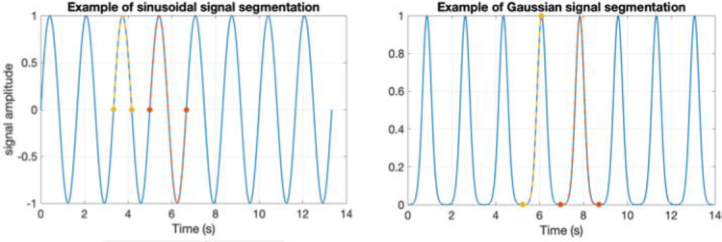
Signals Segmentation As mentioned before, previous works have suggested guideline to implement the signal processing for the movement smoothness evaluation. The first step suggested by authors consists in identifying signals segments based on the recognition of interest events (event-base segmentation). Segmentation process was performed for both types of synthetic signals presented: Gaussian and sinusoidal profiles. Each initial signal included eight repeated movement cycles. Smoothness evaluation was conducted on the entire signal (Stot), on each complete cycle of the signal (Scycle), and on each half of all cycles (Shalf cycle). Figure 1 shows an example of the segmentation technique applied to a sinusoidal signal on the left and a Gaussian profile on the right. For each signal, results include a unique smoothness value for the Stot data, eight smoothness values for the eight segments Scycle and sixteen smoothness values in the case of Shalf cycle. The analysis aimed to compare three different segmentation approaches within a single task.
Figure 1: Segments identification for a sinusoidal (left) and a Gaussian signal (right).
RESULTS
The comparison of movement smoothness values obtained by implementing SPARC and LDLJ metrics on signals processed by different segmentations are here reported. The evaluation was performed on two types of synthetic signals: a Gaussian profile (case G) and a sinusoidal (case S). As mentioned before, all profiles include eight complete cycles of the reference movement. Results are shown in Table 1. Values showed in Table 1 summarize results obtained for the 0.6 Hz frequency signals. Table 1 include values obtained applying SPARC and LDLJ to synthetic signals, case G on the left and case S on the right. Three different segmentations are summarized in three rows: Stot, Scycle and Shalf cycle.
Evaluation of Human Movement Smoothness and Influence of Signal Processing Techniques161
Table 1: Movement smoothness values for both signals: sinusoidal signal (case S) and Gaussian signal (case G).
Table available in the original PDF paper.
Case G SPARC LDLJ Case S SPARC LDLJ Stot −9.92 −6.68 Stot −4.67 −7.14 Scycle −2.50 −2.52 Scycle −2.66 −2.98 Shalf cycle −2.93 −1.14 Shalf cycle −4.94 −1.56
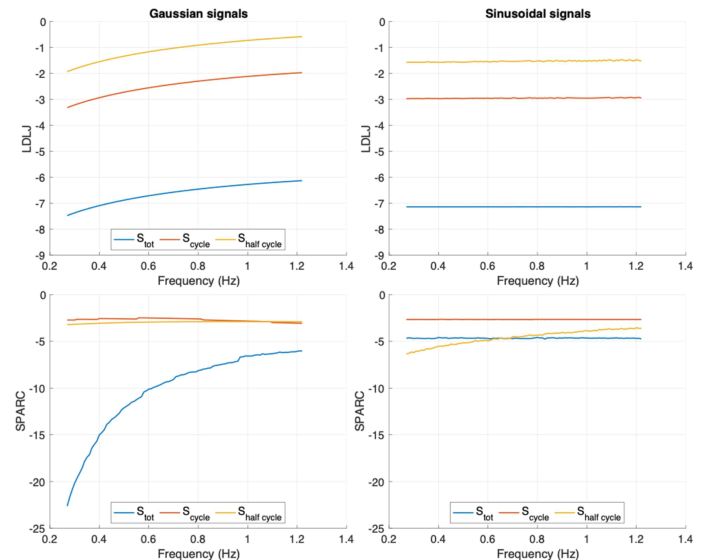
However, smoothness evaluation was conducted for various frequencies within the range mentioned above. All obtained results are summarized in Figure 2. Proposed graphs show values including both gaussian and sinusoidal profiles for all frequencies analyzed in this work, in the left and right column respectively. Trends obtained through the application of Stot segmentation are shown in blue, Scycle in red and Shalf cycle in yellow. Results highlight discrepancies in the application of the different segmentations across all analyzed signal types. In general, Stot results in a worse value than the others. An additional consideration concerns the difference between Scycle and Shalf cycle. Results obtained using SPARC are better for Scycle compared to Shalf cycle, whereas the opposite trend is observed with LDLJ.
Figure 2: Influence of segmentation on movement smoothness for different frequencies. Values for gaussian signals on the left and for sinusoidal signals on the right.
A further analysis has focused on comparing smoothness evaluation on sinusoidal signals with different phase-shifts. In particular, Table 2 included
movement smoothness values obtained for the π/2 and π phase-shifted sinusoidal signal.
Table 2: Movement smoothness values for the π/2 and π phase-shifted sinusoidal signal.
Table available in the original PDF paper.
Case S + π/2 SPARC LDLJ Case S + π SPARC LDLJ Stot −4.72 −7.14 Stot −4.69 −7.14 Scycle −4.61 −2.97 Scycle −2.66 −2.95 Shalf cycle −4.23 −1.58 Shalf cycle -−4.95 −1.60
Regarding the Stot segmentation, SPARC and LDLJ results show minimal differences among the three analyzed versions of the sinusoidal signal. Moreover, Scycle and Shalf cycle show very similar results to the original sinusoidal profile in the case of a π phase−shift. On the contrary, different segmentations introduce significant effect comparing smoothness values of Case S and Case S + π/2. More in details, SPARC results (in bold) decrease from −2.66 to −4.61 when considering Scycle, while for Shalf cycle, they increase from −4.94 to −4.23.
Lastly, this work aimed to study the influence of smoothness in case of disturbed signals, simulating real cases in which there could be some tremor. In Table 3, smoothness values for the signals case G and S with noise are reported.
Table 3: Movement smoothness values for the Gaussian disturbed signals (case G + 10 Hz noise) and the sinusoidal disturbed signals (case S + 10 Hz noise).
Table available in the original PDF paper.
Case G + Noise SPARC LDLJ Case S + Noise SPARC LDLJ Stot −11.64 −7.38 Stot −6.00 −7.56 Scycle −3.20 −3.27 Scycle −2.88 −3.39 Shalf cycle −3.02 −1.91 Shalf cycle −4.86 −1.99
As shown in Table 3, the addition of noise has caused a smoothness worsening applying all types of segmentation. SPARC results show only an exception for Shalf cycle in case S, increasing smoothness values considering the same signal without noise.
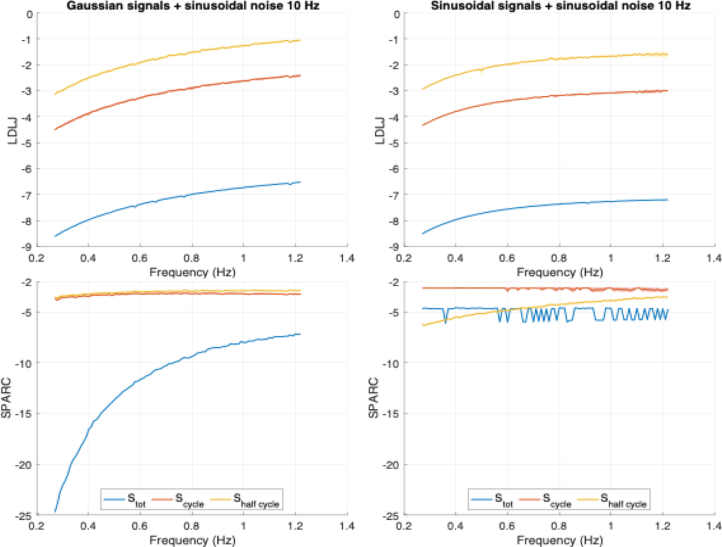
In Figure 3, smoothness results are shown. The proposed graphs show trends similar to those presented for signals without noise in the case of Gaussian signals. In this comparison, differences arise in the decreasing of the obtained smoothness values. On the other hand, the fundamental frequency influences final results when analyzing values obtained by applying the metrics to sinusoidal signals. Moreover, regarding the Stot segmentation, the trend appears non-monotonic.
Evaluation of Human Movement Smoothness and Influence of Signal Processing Techniques163
Figure 3: Influence of segmentation on movement smoothness for different frequencies. Values for gaussian signals on the left and for sinusoidal signals on the right in presence of sinusoidal noise (10 Hz).
DISCUSSION
The study highlights how movement smoothness evaluation is significantly influenced by the choice of signal segmentation, with crucial implications for both ergonomics and robotics. A key insight is that a lower smoothness index reflects less fluid and more irregular motion, meaning that segmentation choices can lead to an underestimation of movement quality. This has direct consequences in fields where precise motion analysis is essential for performance optimization, injury prevention, and interaction safety.
In ergonomics, movement smoothness serves as a critical metric for assessing worker efficiency, fatigue, and injury risks, particularly in environments involving repetitive or physically demanding tasks. A lower smoothness index suggests that movements are more abrupt or inconsistent, which can indicate inefficiencies and potential strain on the musculoskeletal system. For example, in manual assembly line work or material handling, repetitive but irregular movements can contribute to muscle fatigue and increase the likelihood of injuries. The study demonstrates that whole- signal analysis generally produces lower smoothness values compared to segmented approaches, suggesting that prolonged movement tracking may overemphasize inconsistencies. Cycle-based segmentation, however, often results in higher smoothness values because it isolates smaller, more controlled segments of movement. This distinction is crucial for ergonomic
assessments since evaluating entire work shifts without segmentation could exaggerate perceived inefficiencies, whereas analyzing movements in discrete cycles allows for a more accurate identification of problem areas. If ergonomic interventions are based on improperly segmented data, there is a risk of misinterpreting movement quality and failing to implement the most effective solutions. Standardizing segmentation techniques would lead to more consistent evaluations and better-informed strategies for workstation design and injury prevention.
In robotics, movement smoothness is equally important, particularly in industrial automation and human-robot interaction. A lower smoothness index in robotic motion often indicates a lack of precision and fluidity, which can negatively impact safety, efficiency, and user experience. The study’s findings suggest that segmentation techniques play a crucial role in determining how robotic movement is assessed and optimized. For instance, industrial robots operating in manufacturing settings must move smoothly to ensure precise handling and seamless collaboration with human workers. If smoothness is evaluated over an entire movement sequence, small inconsistencies, such as brief pauses between tasks or transitions between movement phases, may lead to artificially low smoothness scores. By segmenting robotic movements into distinct phases, engineers can isolate specific areas for improvement, ensuring that robots operate more predictably and efficiently.
Similarly, in assistive robotics, including prosthetics and exoskeletons, movement smoothness is a key factor in user comfort and functionality. A lower smoothness index for a prosthetic limb, for example, could indicate that the device produces jerky or unnatural movements, making daily activities more challenging for the user. The study demonstrates that different segmentation techniques can lead to variations in smoothness values, meaning that the same movement might be interpreted differently depending on the analysis method used. If smoothness is measured across an entire movement sequence, it may not capture the specific moments where the device functions optimally. By adopting a segmentation approach that analyzes movement in cycles, it is possible to refine control algorithms to improve adaptation and responsiveness.
The study’s findings on noise influence are also highly relevant in robotic applications. In real-world scenarios, robots often operate in environments where external disturbances, such as mechanical vibrations or user tremors, can affect movement quality. The results indicate that adding noise generally lowers smoothness values across all segmentation methods, emphasizing the need for effective filtering techniques. In industrial robotics, where precision is crucial, segmentation combined with noise reduction can help ensure that movement smoothness evaluations reflect actual performance. Similarly, in assistive robotics, distinguishing between voluntary movement and involuntary tremors through proper segmentation can enhance device responsiveness and user experience.
Given the impact of segmentation on movement smoothness evaluation, future research should focus on refining segmentation methods tailored to specific applications in ergonomics and robotics. Expanding the analysis to
Evaluation of Human Movement Smoothness and Influence of Signal Processing Techniques165
real-world datasets would provide further validation of the findings and improve practical implementation. Additionally, improving noise filtering techniques would help prevent artificial reductions in smoothness scores due to external disturbances. Another promising direction is the development of adaptive segmentation algorithms that dynamically adjust based on movement context, ensuring that smoothness assessments are both accurate and meaningful.
By addressing these challenges, movement smoothness evaluation can become a more reliable tool for optimizing workplace ergonomics and refining robotic motion control. Ensuring consistency in segmentation methods will enhance the accuracy of movement quality assessments, leading to safer and more efficient human-robot interactions and better-designed work environments.
CONCLUSION
This study demonstrates that movement smoothness is not solely an inherent property of motion but is also influenced by signal segmentation techniques. The findings highlight that improper segmentation can lead to misinterpretations of movement quality, affecting applications in ergonomics and robotics. In ergonomics, accurate segmentation is crucial for assessing worker efficiency and preventing injuries, while in robotics, it ensures fluid and precise motion for industrial automation and assistive devices. Standardizing segmentation methods and refining noise reduction techniques are essential for improving smoothness evaluation and optimizing human- machine interactions. Future research should focus on developing adaptive segmentation strategies to enhance movement analysis across different contexts.
REFERENCES
Antonelli, M., Caselli, E., Gastaldi, L., Janssens, L., Pastorelli, S., Bjerkefors, A., Vanlandewijck, Y., 2023. Movement Smoothness Metrics in Human-Machine Interaction, in: Mechanisms and Machine Science. Springer Science and Business Media B. V., pp. 333–340. https://doi.org/10.1007/978-3-031-32439-0_38 Balasubramanian, S., Melendez-Calderon, A., Burdet, E., 2012. A robust and
sensitive metric for quantifying movement smoothness. IEEE Trans Biomed Eng 59, 2126–2136. https://doi.org/10.1109/TBME.2011.2179545 Balasubramanian, S., Melendez-Calderon, A., Roby-Brami, A., Burdet, E., 2015.
On the analysis of movement smoothness. J Neuroeng Rehabil 12, 112. https:// doi.org/10.1186/10.1186/s12984-015-0090-9 Balasubramanian, S., Wei, R., Herman, R., He, J., 2009. Robot-measured Performance Metrics in Stroke Rehabilitation, in: ICME International Conference on Complex Medical Engineering. IEEE. Bayle, N., Lempereur, M., Hutin, E., Motavasseli, D., Remy-Neris, O., Gracies, J. M., Cornec, G., 2023. Comparison of Various Smoothness Metrics for Upper Limb Movements in Middle-Aged Healthy Subjects. Sensors 23. https://doi.org/10.3390/s23031158
Beck, Y., Herman, T., Brozgol, M., Giladi, N., Mirelman, A., Hausdorff, J. M.,
2018. SPARC: A new approach to quantifying gait smoothness in patients with Parkinson’s disease. J Neuroeng Rehabil 15. https://doi.org/10.1186/s12984-018- 0398-3 Belluscio, V., Bergamini, E., Tramontano, M., Bustos, A. O., Allevi, G., Formisano, R., Vannozzi, G., Buzzi, M. G., 2019. Gait quality assessment in survivors from severe traumatic brain injury: An instrumented approach based on inertial sensors. Sensors (Switzerland) 19. https://doi.org/10.3390/s19235315 Chandler, E. A., Stone, T., Pomeroy, V. M., Clark, A. B., Kerr, A., Rowe, P., Ugbolue, U. C., Smith, J., Hancock, N. J., 2021a. Investigating the Relationships Between Three Important Functional Tasks Early After Stroke: Movement Characteristics of Sit-To-Stand, Sit-To-Walk, and Walking. Front Neurol 12. https://doi.org/10.3389/fneur.2021.660383 Digo, E., Caselli, E., Polito, M., Antonelli, M., Gastaldi, L., Pastorelli, S., 2023. Test–
Retest Repeatability of Human Gestures in Manipulation Tasks. Applied Sciences (Switzerland) 13. https://doi.org/10.3390/app13137808 do Vale Garcia, F., da Cunha, M. J., Schuch, C. P., Schifino, G. P., Balbinot, G., Pagnussat, A. S., 2021. Movement smoothness in chronic post-stroke individuals walking in an outdoor environment-A cross-sectional study using IMU sensors. PLoS One 16. https://doi.org/10.1371/journal.pone.0250100 Engdahl, S. M., Gates, D. H., 2019. Reliability of upper limb movement quality
metrics during everyday tasks. Gait Posture 71, 253–260. https://doi.org/10.1016/ j.gaitpost.2019.04.023 Figueiredo, A. I., Balbinot, G., Brauner, F. O., Schiavo, A., Baptista, R. R., Pagnussat, A. S., Hollands, K., Mestriner, R. G., 2020. SPARC Metrics Provide Mobility Smoothness Assessment in Oldest-Old With and Without a History of Falls: A Case Control Study. Front Physiol 11. https://doi.org/10.3389/ fphys.2020.00540 Hogan, N., Sternad, D., 2009. Sensitivity of Smoothness Measures to Movement
Duration, Amplitude, and Arrests, Journal of Motor Behavior. Mohamed Refai, M. I., Saes, M., Scheltinga, B. L., van Kordelaar, J., Bussmann, J. B. J., Veltink, P. H., Buurke, J. H., Meskers, C. G. M., van Wegen, E. E. H., Kwakkel, G., van Beijnum, B. J. F., 2021a. Smoothness metrics for reaching performance after stroke. Part 1: Which one to choose? J Neuroeng Rehabil 18. https://doi.org/10.1186/s12984-021-00949-6 Pinto, C., Schuch, C. P., Balbinot, G., Salazar, A. P., Hennig, E. M., Kleiner, A. F. R., Pagnussat, A. S., 2019. Movement smoothness during a functional mobility task in subjects with Parkinson’s disease and freezing of gait - An analysis using inertial measurement units. J Neuroeng Rehabil 16. https://doi.org/10.1186/s12984-019- 0579-8 Rincón Montes, V., Quijano, Y., Chong Quero, J. E., Villanueva Ayala, D.,
Pérez Moreno, J. C., 2014. Comparison of 4 Different Smoothness Metrics for the Quantitative Assessment of Movement’s Quality in the Upper Limb of Subjects with Cerebral Palsy, in: Pan American Health Care Exchanges (PAHCE) : Conference, Workshops, and Exhibits : Cooperation. IEEE. Saes, M., Mohamed Refai, M. I., van Kordelaar, J., Scheltinga, B. L., van Beijnum, B. J. F., Bussmann, J. B. J., Buurke, J. H., Veltink, P. H., Meskers, C. G. M., van Wegen, E. E. H., Kwakkel, G., 2021. Smoothness metric during reach-to-grasp after stroke: part 2. longitudinal association with motor impairment. J Neuroeng Rehabil 18. https://doi.org/10.1186/s12984-021-00937-w
LISTED IN THE AHFE DIGITAL BOOKSTORE CATALOGUE
Explore the complete digital volume
Human Factors and Systems Interaction
Read this individual research paper free through the original publisher, or explore the full digital proceedings book.
ISBN 978-1-964867-68-7
Explore this ISBN in the AHFE Bookstore ↗Listed in the July 2026 bookstore catalogue; search by ISBN to confirm current availability · Digital book purchase optional