Adriana Salatino, Arthur Prével, Emilie Caspar, Salvatore Lo Bue (2025). The Impact of Time Constraints on Moral Decision-Making during Human-AI Interaction. In: Human Factors and Systems Interaction. AHFE Open Access, vol. 192, pp. 68–75. https://doi.org/10.54941/ahfe1006629
Human beings are nowadays increasingly collaborating with autonomous systems in a wide range of activities. As this collaboration has an impact on human decision-making and behavior, it is essential to advance research on Human-Artificial Intelligent (AI) interactions. AI systems are now even employed to support decision-making in sensitive areas such as medicine or defence and security, which can involve decisions with a moral dimension. Understanding better the consequences of the interaction in those contexts is crucial to ensure that both efficiency in the decisions made and ethical considerations are effectively addressed. While AI can improve the quality and speed of decisions and reduce mental workload, it also carries risks such as complacency, loss of situational awareness and skill decay, mainly because AI remains imperfect and errors may occur. These issues are more pronounced with higher AI autonomy, which has been linked to reduced accuracy and responsibility in human decision-making, especially in moral contexts. Task difficulty, such as time pressure, may exacerbate over-reliance on AI. However, these aspects have not yet been sufficiently explored. The present study aims to investigate whether task difficulty, induced by time pressure, could influence moral decision-making in a military population interacting with AI systems. To this end, we conducted an experiment with an ad hoc task in which participants took on the role of drone operators and were asked to decide whether to launch an attack (or not) based on factors such as the presence of enemies and potential risks to allies, civilians, and infrastructure. Participants completed morally and non-morally challenging scenarios under low (15 seconds) and high (4 seconds) time pressure, with and without AI assistance. We hypothesised that increased time pressure would lead to increased overreliance, which would lead participants to rely more on AI advice and influence moral decision-making.
The Impact of Time Constraints on Moral Decision-Making During Human-AI Interaction 69
INTRODUCTION
In recent years, the collaboration between humans and autonomous systems has impacted a wide range of activities in daily life and several other domains. From personal aids, such as virtual assistants, to more complex and sophisticated applications in areas such as medicine, military defence and autonomous vehicles (Kawamoto et al., 2005; Sutton et al., 2020; Wasilow & Thorpe, 2019; Rashid et al., 2023), the reliance of humans on artificial intelligence (AI) systems has progressively increased. The integration of AI into decision-making processes, especially in areas where critical, life-and- death decisions are involved, brings both opportunities and challenges. On the one hand, AI offers unique benefits that translate into higher decision quality, faster and more efficient decision-making (Chavaillaz et al., 2018; Goh et al., 2005), a reduction of errors (Rovira et al., 2007; Sarter & Schroeder, 2001) and a reduction in users’ mental workload (Chen & Barnes, 2012; Wright et al., 2018). On the other hand, the use of AI entails potential risks that need to be carefully considered, especially in moral and ethical contexts. One of these risks is that reliance on AI can lead to complacency (Parasuraman & Manzey, 2010) if human decision-makers become overly dependent on automated recommendations and fail to critically engage in the decision-making process. This decreased engagement can lead to a diminished sense of responsibility (Berberian et al., 2012; Salatino et al., 2025), as individuals may defer moral and ethical responsibility to the AI system (Sharkey, 2019; Salatino et al., 2025). Furthermore, high autonomous systems reliability seems to be associated with an increased tendency for overreliance on automation, (Mosier and Manzey, 2019), which in turn, could reduce the ability to make informed decisions when the AI system fails or makes incorrect recommendations (Parasuraman & Riley, 1997). Taken together, these concerns emphasize the importance of better understanding the potential negative impacts of Human-AI interactions, particularly in contexts where moral and ethical considerations are central to decision- making, such as in the military domain, where morally complex decisions involving conflicting moral values frequently arise.
Research has highlighted that these negative effects may be influenced by multiple factors. For example, previous studies have shown that the impact of Human-AI interaction seem to correlate with the degree of autonomy of these systems (Rovira et al., 2007; Berberian et al., 2012), demonstrating that a higher degree of autonomy can lead to a decrease in the sense of responsibility (Berberian et al., 2012). Another factor that can negatively impact Human- AI interactions is task difficulty, which is often due to time pressure. Recent studies have identified time pressure as a critical determinant in Human- AI interactions (Rieger & Manzey, 2022; Tatasciore & Loft, 2024). It has been shown that time pressure may lead to overreliance on automation (Parasuraman and Manzey, 2010), which may be associated with increased misuse of automated advice. For example, Rieger and Manzey (2022) conducted a study in which participants performed a luggage screening task either manually or using decision support systems (DSS). Time pressure
was manipulated by varying the time available for inspecting X-rays: in one condition, participants had 4.5 seconds, while in the other condition they had 9 seconds to make their decision. The results showed that time pressure affected performance regardless of whether the task was performed manually or using a DSS, with participants agreeing with many incorrect DSS recommendations. This highlights the detrimental effects of time pressure on the quality of decision making. In the recent study by Tatasciore and Loft (2024), participants performed an unmanned vehicle (UV) management task in which they had to assign the most appropriate UV to complete missions by either accepting or rejecting automated advice. Decisions were made under two time-pressure conditions: a low time- pressure condition, in which participants had 25 seconds to decide, and a high time pressure condition, in which only 12 seconds were available for decision making. The results showed that high time pressure resulted in less accurate use of automation, as the rate of detection of an error from the AI decreases under high time pressure. Taken together, these results suggest that time pressure may increase over-reliance on automated systems and thus affect human decision making and performance. However, the extent and nature of these effects have not yet been sufficiently explored.
The present study aims to investigate whether the difficulty induced by time pressure could affect moral decision-making when people interact with AI/DSS. To this aim, we conducted an experiment with an ad hoc task in which participants (i.e., military cadets and officers) assumed the role of drone operators and were asked to decide whether or not to launch an attack based on factors such as the presence of enemies and potential risks to allies, civilians, and infrastructure. We hypothesized that the time pressure would lead to increased overreliance, so that participants would rely more on the AI’s advice, and which would in turn influence their decisions. We also hypothesized that the interaction with AI would reduce the sense of responsibility when compared to a situation in which they made a decision without assistance.
METHOD
A sample of 36 cadets and officers (M.age = 26.4, SD: 10.5, 9 who identified as females) from the Royal Military Academy (Brussels) took part in the study. On arrival, the participants were informed about the nature of the study and given an overview of the task they would be performing. They were instructed to take on the role of a drone pilot who must make decisions in real time during military operations. On each trial, participants had to decide whether to launch an attack on a target (i.e., a group of enemies) based on the information provided in the scenario. The decision was complicated by the presence of various potential risks, including enemy forces, civilians, allies, and critical infrastructure. They were tested with three trial types: i) Moral, which represented ethically complex situations where the potential for harm to civilians or infrastructure was high while a military advantage (eliminating enemies) was also present; importantly, choosing not to attack could also
The Impact of Time Constraints on Moral Decision-Making During Human-AI Interaction 71
lead to negative consequences, such as the risk of damage to allied troops; ii) Attack, which represented not morally challenging situations where an attack was clearly justified by the presence of enemy forces and absolutely no risk to civilians or infrastructure; iii) No-Attack, which represented not morally challenging situations in which the correct decision was to refrain from an attack because either no enemies were present or the risk to civilians and infrastructure exceeded the potential military benefit. Participants were required to make their choice by pressing a response button, after which an image displaying the outcome of their decision was presented. There were four possible outcomes: one positive and one negative for each decision type (i.e., an attack could result in a positive or negative outcome, and a non-attack could similarly yield either a positive or negative outcome). A horizontal scale from −100 to 100 was then displayed. Participants were instructed to indicate on the scale the extent to which they felt responsible for their decision, with −100 indicating ‘not at all responsible’ and 100 indicating ‘fully responsible’, to obtain a judgement of responsibility.
Time Pressure Manipulation The difficulty of the task was manipulated by varying the time available for decision-making. The experiment consisted of four blocks of 15 Moral, four blocks of 15 Attack, and four blocks of 15 Not-Attack trials. In two blocks, participants had 15 seconds to make a decision (low-time pressure), while in the other two blocks they had only 4 seconds (high-time pressure). If the participants had not made a decision within the given time, the next trial automatically begun. In addition, decision making was tested under two conditions: with and without AI support. The AI recommendations were presented after the participants had reviewed the details of the scenario, but before they made their final decision.
Data Analysis We conducted separate repeated-measures ANOVAs for decision- making (percentage of attacks, i.e. % Attack), and sense of responsibility with trial type (Moral vs. Attack vs. No- Attack), Time Pressure (Low- vs. High- time pressure) and AI Condition (AI vs. No- AI) as within-subjects factors.
RESULTS
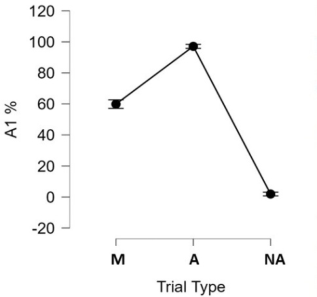
Analyses on Decision-Making The analysis on % Attack revealed a main effect of trial type (F (1.02, 27.68) = 225.65, p < .001, ηp2 = .89). Post hoc tests (Bonferroni’s correction) showed that all comparisons were significant (all p < .001) with a higher percentage of attacks during Attack trials (mean = 95.8, SE = 0.74) compared to No-Attack (mean = 1.82, SE = 0.35) and Moral trials (mean = 60.25, SE = 2.8).
Figure 1: Percentage of attacks performed. There were significantly (p < .001) fewer attacks in the Moral Decision-Making trials (M) than in the Attack trials (A); in addition, the difference between the trials with A and No-Attack (NA) was significant (p < .001).
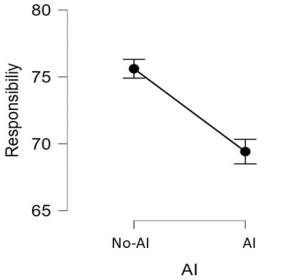
Analyses on the Feeling of Responsibility The analysis on Responsibility (Figure 2) revealed a significant main effect of AI (F (1, 33) = 11.03, p = .002, ηp2 = .25), with a significant decrease (p = .002) in the subjective sense of Responsibility during the interaction with AI (mean = 69.11, SE = 1.01) compared to No-AI condition (mean = 75.22, SE = 0.64).
Figure 2: Assessment of responsibility. A significant difference was found between the No-AI and AI conditions (p = .002), with a lower rating of responsibility during the interaction with AI.
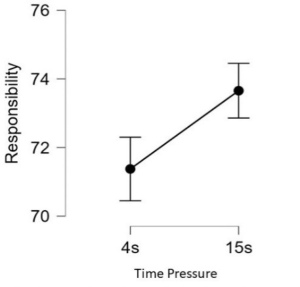
In addition, the analysis revealed a significant main effect of Time Pressure on Responsibility (Figure 3) (F (1, 33) = 7.24, p = .01, ηp2 = .18), with a significant decrease (p = .01) in the subjective sense of responsibility in the high time pressure condition (i.e., in the 4s condition, (mean = 70.82, SE = 0.95), compared to the low time pressure condition (i.e., in the 15s condition, (mean = 73.26, SE = 0.80).
The Impact of Time Constraints on Moral Decision-Making During Human-AI Interaction 73
Figure 3: A significant difference (p = .01) was found between the high- and low- time pressure condition (p = .02), with lower rating of responsibility in the high-time pressure condition.
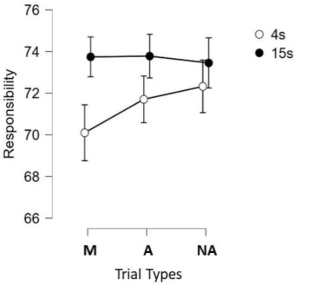
Lastly, a significant interaction (Figure 4) between trial type and Time Pressure on Responsibility (p = .02), with lower rating in Moral trials in high- time pressure condition (i.e., in the 4s condition, (mean = 70.28, SE = 1.61), compared to low-time pressure condition (mean = 73.82, SE = 1.29).
Figure 4: A significant interaction (p = .02) was found between trial type and time pressure, with responsibility ratings being lower for moral trials in the high time pressure condition.
DISCUSSION AND CONCLUSION The purpose of this study was to investigate whether task difficulty induced by time pressure could influence moral decision-making in interaction with AI/decision support systems (DSS). By simulating a drone task in a military context with different trial types that included both moral and non-moral situations, AI support, and time constraints, we aimed to determine whether time pressure affects participants’ moral decision-making and sense of responsibility. Our results showed a significant effect of trial type on decision- making. Indeed, although a group of enemies was present in the Moral trials, participants were less likely to attack compared to the Attack trials,
suggesting that conflicting values lead to more careful response selection. Conversely, participants were more likely to attack in the Attack trials than in either the Moral or Non-Attack trials, further supporting the idea that moral dilemmas lead to more careful decision-making.
Based on previous findings (Berberian et al., 2012; Vantrepotte et al., 2022; Salatino et al., 2025), we expected participants’ subjective sense of responsibility to be lower during interaction with the AI than when participants made decisions alone. Our results confirm our expectation, as shown by the lower responsibility ratings in the AI condition compared to the no-AI condition. This result is also consistent with the recently described human tendency to attribute moral responsibility to non-human agents, which may lead people to be more willing to blame them (Furlough, et al., 2021; Kneer and Stuart, 2021; Liu and Du, 2022). Importantly, we also found a significant effect of time pressure on participants’ sense of responsibility. In fact, participants in the high-time pressure condition (4 seconds) reported lower responsibility scores than those in the low-time pressure condition (15 seconds). This result supports the hypothesis that time pressure increases cognitive load and may lead to overreliance on automated systems (Rovira et al., 2007). Interestingly, the interaction between trial type and time pressure showed that moral trials were particularly sensitive to time pressure, with responsibility ratings being significantly lower under high time pressure. This suggests that the cognitive demands of solving moral dilemmas are more susceptible to the effects of time pressure, further complicating decision-making in these scenarios.
The results of the present study have significant implications for the design and implementation of AI systems in military and other high-stakes domains. The observed reduction in the sense of responsibility under AI-assisted conditions raises important ethical concerns, especially in military contexts where the moral and strategic consequences of decisions have to be balanced (Oimann & Salatino, 2024). These findings also emphasize the ethical considerations associated with the use of AI in contexts involving moral decision-making. As AI systems become more sophisticated and autonomous, it is important to ensure that their use does not compromise the moral engagement and ethical judgement of users or lead to unjustified decisions.
Further research should explore how to balance the benefits of AI support with the need for human operators to remain actively engaged in ethical decision-making. Indeed, with the increasing integration of AI into sensitive domains, it is imperative to address these challenges to ensure that human operator behaviour promotes responsible and ethical decision-making.
REFERENCES
Berberian, B., Sarrazin, J. C., Le Blaye, P., Haggard, P. (2012). ‘Automation technology and sense of control: A window on human agency’. PloS one, 7(3), e34075. Chavaillaz, A., Schwaninger, A., Michel, S., Sauer, J. (2018). ‘Automation in visual
inspection tasks: X-ray luggage screening supported by a system of direct, indirect or adaptable cueing with low and high system reliability’. Ergonomics, 61(10), pp. 1395–1408.
The Impact of Time Constraints on Moral Decision-Making During Human-AI Interaction 75
Chen, J. Y., Barnes, M. J. (2012). ‘Supervisory control of multiple robots: Effects of imperfect automation and individual differences’. Human Factors, 54(2), pp. 157–174. Furlough, C., Stokes, T., & Gillan, D. J. (2021). ‘Attributing blame to robots: I. The
influence of robot autonomy’. Human factors, 63(4), pp. 592–602. Goh, J., Wiegmann, D. A., Madhavan, P. (2005). ‘Effects of automation failure in a luggage screening task: A comparison between direct and indirect cueing’. In Proceedings of the Human Factors and Ergonomics Society Annual Meeting (Vol. 49, No. 3, pp. 492–496). Sage CA: Los Angeles, CA: SAGE Publications. Kawamoto, K., Houlihan, C. A., Balas, E. A., & Lobach, D. F. (2005). ‘Improving
clinical practice using clinical decision support systems: A systematic review of trials to identify features critical to success’. Bmj, 330(7494), p. 765. Kneer, M., Stuart, M. T. (2021). ‘Playing the blame game with robots’. In Companion of the 2021 ACM/IEEE international conference on human-robot interaction (pp. 407–411). Liu, P., Du, Y. (2022). ‘Blame attribution asymmetry in human–automation
cooperation’. Risk Analysis, 42(8), pp. 1769–1783. Mosier, K. L., Manzey, D. (2019). ‘Humans and automated decision aids: A match made in heaven?’. In Human performance in automated and autonomous systems’ (pp. 19–42). CRC Press. Oimann, A. K., Salatino, A. (2024). ‘Command responsibility in military AI contexts:
balancing theory and practicality’. AI and Ethics, 1–11. Parasuraman, R., & Manzey, D. H. (2010). ‘Complacency and bias in human use of automation: An attentional integration’. Human factors, 52(3), pp. 381–410. Parasuraman, R., Riley, V. (1997). ‘Humans and automation: Use, misuse, disuse,
abuse’. Human factors, 39 (2), pp. 230–253. Rashid, A. B., Kausik, A. K., Al Hassan Sunny, A., Bappy, M. H. (2023). ‘Artificial intelligence in the military: An overview of the capabilities, applications, and challenges’. International Journal of Intelligent Systems, 2023(1), 8676366. Rieger, T., Manzey, D. (2022). ‘Human performance consequences of automated
decision aids: The impact of time pressure’. Human factors, 64(4), pp. 617–634. Rovira, E., McGarry, K., Parasuraman, R. (2007). ‘Effects of imperfect automation on decision making in a simulated command and control task’. Human factors, 49(1), pp. 76–87. Salatino, A., Prével, A., Caspar, E., & Bue, S. L. (2025). Influence of AI behavior
on human moral decisions, agency, and responsibility. Scientific Reports, 15(1), 12329. Sarter, N. B., Schroeder, B. (2001). ‘Supporting decision making and action selection under time pressure and uncertainty: The case of in-flight icing’. Human factors, 43(4), pp. 573–583. Sharkey, A. (2019). ‘Autonomous weapons systems, killer robots and human dignity’.
Ethics and Information Technology, 21(2), pp. 75–87. Sutton, R. T., et al. (2020). ‘An overview of clinical decision support systems: benefits, risks, and strategies for success’. NPJ digital medicine, 3(1), p. 17. Tatasciore, M., & Loft, S. (2024). ‘Can increased automation transparency mitigate
the effects of time pressure on automation use?’. Applied Ergonomics, 114, p. 104142. Vantrepotte, Q., Berberian, B., Pagliari, M., Chambon, V. (2022). ‘Leveraging human agency to improve confidence and acceptability in human-machine interactions’. Cognition, 222, p. 105020. Wasilow, S., Thorpe, J. B. (2019). ‘Artificial intelligence, robotics, ethics, and the
military: A Canadian perspective’. AI Magazine, 40(1), pp. 37–48. Wright, J. L., Chen, J. Y., Barnes, M. J. (2018). ‘Human–automation interaction for multiple robot control: The effect of varying automation assistance and individual differences on operator performance’. Ergonomics, 61(8), pp. 1033–1045.
LISTED IN THE AHFE DIGITAL BOOKSTORE CATALOGUE
Explore the complete digital volume
Human Factors and Systems Interaction
Read this individual research paper free through the original publisher, or explore the full digital proceedings book.
ISBN 978-1-964867-68-7
Explore this ISBN in the AHFE Bookstore ↗Listed in the July 2026 bookstore catalogue; search by ISBN to confirm current availability · Digital book purchase optional