Yazmin Diaz, Peter Hancock (2025). Knowledge of Results (KR) and Vigilance: Are Feedback Effects Due to Information or Motivation?. In: Human Factors and Systems Interaction. AHFE Open Access, vol. 192, pp. 87–98. https://doi.org/10.54941/ahfe1006631
Vigilance is the mental capacity required to monitor for rare but critical signals in a sequence of non-signal events. Vigilance predominates in many safety-critical fields as well as everyday activities. Unfortunately, humans consistently fail at sustaining attention. Existing vigilance research has found that the provision of feedback in the form of knowledge of results (KR) positively impacts performance. However, the underlying mechanisms driving this performance enhancement remain unclear. The present study evaluated the impact of both informational and motivational dimensions of KR on vigilance task performance. A between-subject design manipulated KR on a simultaneous, cognitive vigilance task. One control, one informational feedback, one motivational feedback, and two neutral feedback conditions were employed in the design. Only those in the informational condition showed improved RTs compared to controls. These observed RT enhancements provide further support for the existing research regarding the effectiveness of KR as well as the Goal Setting Hypothesis. Our findings suggest that the effectiveness of KR is due to the information quality. The motivational component of KR is possibly a product of goal setting and not the primary mechanism driving KR’s effectiveness. This study has implications for training and the design of human-computer systems.
Sustained attention is the ability to maintain an operator’s focus on task relevant stimuli for an extended period of time (Warm, 1984; Hancock, 2017). Vigilance tasks require individuals to monitor signals on a display(s) and to only respond when an infrequently occurring target (critical) signal is presented. Performance on these tasks is typically measured in terms of response time (RT) and/or accuracy metrics (i.e., hits, misses, false alarms, correct rejections). Sustained attention is thus thought critical to maintain performance on these tasks (Szalma et al., 2004). Unfortunately, humans are notoriously poor at this (Mackworth, 1950; Hancock, 2013). They show a decrement in performance sometimes within a few minutes of beginning the task (Nuechterlein, Parasuraman and Jiang, 1983). One of the practical problems here is that safety-critical domains often place humans in this role
of monitor (Szalma et al., 2006; Warm, 1993). This latter role is now more commonplace as technology becomes increasingly automated (Hancock, 2017).
Knowledge of Results Due to the longstanding recognition of this weakness, researchers have dedicated much effort in investigating methods to mitigate the vigilance decrement. Among the methods heavily researched of these is the provision of Knowledge of Results (KR). KR consists of providing participants with feedback regarding either the speed of their responses (RT) or the accuracy thereof. Previous studies have manipulated differing elements of KR, such as its frequency (Szalma et al., 2000) and its accuracy (Weidenfeller, Baker and Ware, 1962), in efforts to determine how each underlying KR component impacts subsequent performance. A systematic review of the extant KR literature has demonstrated an inverse relationship between feedback type and performance on measures of accuracy and speed. Accuracy feedback tends to enhance detection accuracy while negatively impacting RT, and RT feedback tends to enhance detection speed while negatively impacting accuracy (Diaz, Hancock, and Hancock, 2025). The present study serves to further explore the efficacy of these differing dimensions of KR in mitigating the vigilance shortfall.
One dimension of uncertainty relates to the motivational as compared to the informational nature of KR. Some research has suggested that the effects of KR are primarily motivational in nature (Hardesty, Trumbo and Bevan, 1963; Mackworth, 1970; Warm, Hagner and Meyer, 1971). This motivational effect of KR is further supported by research finding that psuedofeedback, feedback not contingent upon task performance, helps prevent an increase in response latency (Loeb and Schmidt, 1963). Others contend that KR’s effects are informational, or possibly due to learning (Wiener and Attwood, 1968; Teo et al., 2014), with studies showing that the effects of KR can transfer from training to later testing (Davies and Tune, 1969; Uszak and Szalma, 2020). The present study aims to explore this contrast. It also seeks to further refine the taxonomy of vigilance, specifically in the domain of KR, by including multiple facets of performance in our analyses (i.e., both RT and accuracy). This is because much existing literature regarding KR has failed to report the effects of their KR manipulation on both speed and accuracy. Such measures are crucial to understanding the full picture of KR’s impact on performance and the circumstances under which any particular pattern of results will be observed.
Facial Expressions and Reinforcement Research classifies smiles into three categories: reward, affiliative, and dominance smiles (Martin et al., 2017; Rychlowska et al., 2017). Reward smiles are characteristically open smiles, convey positive emotions (Rychlowska et al., 2021) and positive social signals (Orlowska et al., 2018). Affiliative smiles are closed smiles that invite and maintain social bonds, while dominance smiles manage hierarchical relationships (Martin
Knowledge of Results (KR) and Vigilance 89
et al., 2017). Research on reward smiles have shown that they reinforce desired behaviors (Martin et al., 2017) and are useful for learning (Klinnert et al., 1986). Despite the literature suggesting that human faces can be useful in training, little research exists investigating the utility of facial expressions as forms of KR in vigilance.
Previous Study and Current Direction The present study seeks to determine the effectiveness of facial stimuli as a motivational form of KR. It also seeks to answer the question as to whether the effectiveness of KR is primarily due to its informational component or a motivational dimension.
In efforts to assess the effect of KR manipulation on performance, a feedback condition with highly motivating stimuli, which provided little information regarding response accuracy, was compared to another condition assessed to be lower in motivation but providing more detailed information. The former condition, called the motivational feedback condition, provided participants with feedback contingent on detection accuracy using either happy or angry facial expressions. In this condition, participants were shown a happy face whenever they executed a hit and an angry face whenever they committed a miss or false alarm. The latter condition, called the informational feedback condition, provided participants with verbal feedback regarding their performance. It provided participants with specific accuracy feedback by using the terms “Hit”, “Miss” and “False Alarm”, in accordance with the dimensions of Signal Detection Theory (SDT) (Green and Swets, 1966), and presented participants with their response time, in milliseconds, for each trial. Thus, this condition provided participants with more information regarding their performance than the motivational condition. This condition was also deemed to be less motivational in that it did not provide relative performance feedback (i.e., they were not told whether a particular response was faster or slower than that of a previous trial or a pre-specified standard) but rather absolute feedback (i.e., exact response time and response type: hit, miss, or false alarm). This was done so as not to aid participants in setting performance goals for future trials, though this behavior may not be feasibly entirely eliminated (see Locke et al., 1968 for further information regarding the effects of KR and goal setting on performance).
Two neutral feedback conditions and one condition void of any feedback were also included. The first neutral feedback condition, called the Saved condition, provided participants with feedback confirming the registration of their response via the presentation of the word “Saved” when an overt response was made (i.e., a hit or a false alarm). This condition was included to control for the effects of merely receiving verbal feedback on performance potentially observed in the informational feedback condition. A difference in detection performance between this group and those in the informational feedback condition would imply that the performance feedback provided to participants impacted performance. This manipulation, therefore, allows us to assess the effects of providing participants with KR, not just textual
90 Diaz and Hancock
feedback, on performance. In order to control for the effects of seeing human faces on performance, the neutral social feedback condition provided participants with neutral faces whenever they overtly responded. A difference in performance (i.e., RT or detection accuracy) between the neutral social feedback condition and the motivational feedback condition (e.g., those in the motivational feedback conditions exhibiting greater detection accuracy or shorter RTs) would indicate that the feedback provided by expressive facial expressions impacted performance. Therefore, any differences between the two experimental groups and their neutral counterparts would provide support for the motivational/informational components in the experimental conditions, rather than the graphic/textual nature of the stimuli.
Hypotheses H1: Participants in the informational and motivational feedback conditions will outperform those in the control, saved, and neutral social feedback conditions by exhibiting greater accuracy (i.e., more correct detections, fewer misses and false alarms) and shorter response times.
H2: Participants in the informational feedback condition will exhibit shorter response times than those in the motivational feedback condition, however, there will be no significant difference in terms of detection accuracy between the two.
H3: Participants in the motivational and informational feedback conditions will report higher levels of motivation than those in the neutral and control conditions.
METHOD
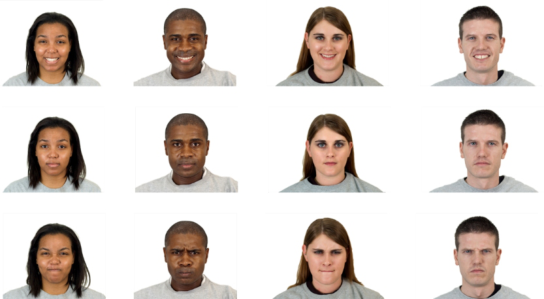
Pilot Study A total of 40 black and white, male and female human faces, from the Chicago Face Database (CFD), were randomly selected from their pool of 597 images of unique individuals. The pool from which faces could be selected consisted solely of individuals showing happy, angry, and neutral expressions. Individuals missing one or more of these expressions were excluded. Such exclusion resulted in a limited range of racial diversity. A random series of numbers were generated and used to select from the CFD database of faces. The final stimuli set consisted of an even distribution of 40 angry, neutral, and happy (both open and closed smiles) faces per racial and gender category, for a total of 160 faces. A representative sample of faces used is provided in Figure 1.
A pilot study was then conducted in order to determine the extent to which participants (N = 12) found each face motivating. Images were presented and assessed using a sliding scale that ranged from “−100”, indicating that they found the image demotivating, to “100”, indicating that they found the image motivating. The midpoint, “0”, indicated a neutral image. The five most motivating, demotivating, and neutral rated images were then used to conduct the present study.
Knowledge of Results (KR) and Vigilance 91
Figure 1: Representative sample of faces used in pilot study.
Participants A total of 160 participants were recruited through the SONA research participation system associated with the University of Central Florida’s Psychology Department. Students were compensated with SONA points, which could be used as course credit. Participation was voluntary and individuals could withdraw from the study at any time without penalty. Each participant provided informed consent. This study was approved by the UCF’s Institutional Review Board and adhered to all APA approved procedures.
Experimental Design The present study used a 5 × 6 between-within subject design, with repeated measures on the second factor (trial block), to evaluate the effect of the different forms of feedback on a simultaneous cognitive vigilance task. A total of five conditions were included that manipulated KR. These included one control condition, one informational feedback condition, one motivational feedback condition, and two neutral feedback conditions. Under the KR manipulation, the control group completed the vigilance task with no feedback. Participants in the saved feedback condition were only provided with an acknowledgment of their responses via the phrase “Saved”. Participants in the informational feedback condition were informed of their RT and the accuracy of their response. Participants in the motivational feedback condition were given feedback using human faces with a smiling face indicating a correct response and a frowning face indicating an incorrect response. Participants in the neutral social feedback condition were given feedback using a neutral facial expression following each overt response.
Investigative Materials This study used a cognitive mathematics task (adapted from Warm and Jerison, 1984). The task consisted of a simultaneous presentation of two- digit numbers (i.e., 00–99) on a computer display. The vigil lasted a total of 30 minutes in order to approximate Mackworth’s task duration (Mackworth,
92 Diaz and Hancock
1950), and was later divided into 6 blocks of 5 minutes for the purpose of analyzing performance across time. Participants were instructed to monitor the display and to press the space bar as quickly as possible any time they saw a critical signal appear on the screen. They were to refrain from responding when no critical signal was present. Critical signals occurred when the difference between the two digits was “0” or “1.”
In each condition, the stimulus was presented for 1,000 milliseconds (ms) followed by an equivalent interstimulus interval (ISI) of 1,000 ms. All stimuli, across all conditions, were presented in the center of the screen. In the control condition, participants received no feedback and were presented with a fixation cross during the ISI.All other conditions received their corresponding feedback during the ISI. A fixation cross was shown during the ISI when no feedback was provided.
Participants could respond at any time during the stimulus presentation interval. Responding during the stimulus interval did not, however, advance the display. Thus, all stimuli were shown for 1,000 ms regardless of response initiation latency. The event rate was thus set to 30 events per minute in order to observe a vigilance decrement according to Parasuraman’s (1979) classification. There was a total of 900 events during the 30-minute vigil, and a total of 60 events during the 2-minute practice period that preceded the full vigil. This practice period was devoid of feedback. The base rate signal probability was 0.066 (i.e., an average of 2 critical signals per minute) for both the practice session and the vigilance task.
Prior to the vigil, participants were asked to complete a survey consisting of demographic questions (age, gender, race/ethnicity). Upon completion of the task, participants were asked to complete the Interest/Enjoyment, Effort/Importance, and Pressure/Tension subscales of the Intrinsic Motivation Inventory (IMI; Ryan, 1982). The IMI is a validated, multidimensional scale designed to assess participants’ subjective experience regarding a specified laboratory task.
Investigative Procedure Participants were provided with a link to a Qualtrics survey through which they first consented to participate and were then given access to complete both the questionnaire and the vigilance task. Participants completed the procedure on a desktop computer in a laboratory setting and were not monitored but were required to complete the study in one session.
Participants were randomly assigned to one of the five conditions upon entering the Qualtrics system. Each participant first completed the demographics questionnaire, was given task instructions, received an explanation of SDT terminology, and completed a brief pre-quiz. The pre-quiz consisted of five questions designed to test the participants’ understanding of the task instructions (e.g., “Would the number 56 be considered a critical signal?”). Participants then completed a practice session, were reminded of the task instructions and proceeded to complete the vigilance task. Upon completion of the task, each participant was instructed
Knowledge of Results (KR) and Vigilance 93
to complete the IMI post-task survey and was then thanked for their participation. Participants did not receive monetary compensation.
RESULTS
Participant Demographics Analyses excluded participants with corrupted data and individuals who 1) refreshed the page, therefore altering their exposure to the stimuli; 2) did not complete the entire vigil; 3) incorrectly answered any of the pre- quiz questions, indicating that they did not understand the task instructions, 4) reported having been diagnosed with either dyslexia and dyscalculia, and 5) had no standard deviation in response time, indicating that they did not actively participate in the study. After these exclusions, the data contained (n = 119) complete cases. The participants consisted of 45 males and 74 females, with an average age of 18.43 years (SD = 1.59 years, Mdn = 18.00 years, Range = 15).
Vigilance Performance Participant data was analyzed in 6 blocks of 5 minutes to determine the presence of a decrement. In order to determine the relationship between feedback and vigilance performance (in terms of accuracy and RT), a 5 (condition) x 6 (periods of watch of 5 minutes each) Mixed Analysis of Variance (ANOVA) was run on each dependent variable: Accuracy (hits, misses, false alarms, and correct rejections), median response time, and the SDT measures of sensitivity and bias. IMI subscale scores were analyzed with a one-way ANOVA.
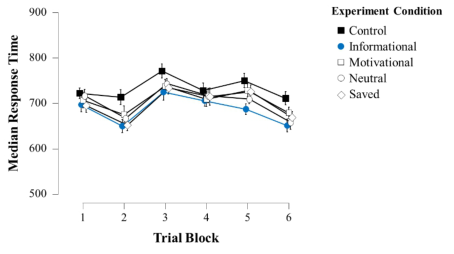
Response Time Response time was calculated for each overt response (i.e., hits and false alarms). A significant main effect was found for trial block on median RT (F(4.40, 501.97) = 29.73, p <.001, ηp2 = 0.21), and experimental condition on median RT (F(4, 114) = 2.71, p <.05, ηp2 = 0.09). No significant interaction effect was found (p = .695, ηp2 = 0.03).
Figure 2: Plot of response time across trial blocks by condition. Error bars are standard errors (SE).
94 Diaz and Hancock
To investigate the nature of the condition effect, post-hoc comparisons were conducted, with the Bonferroni p-value adjustment to correct for multiple comparisons and possible type-1 errors. The results showed a significant difference between those in the control condition and those in the informational feedback condition (t(114) = 3.15, p <.05). This provides further support for the finding that RT feedback is effective in maintaining successful vigilance performance in terms of RT (see Church and Camp, 1965; McCormack et al., 1962; Warm et al., 1974). No significant difference was found between any of the other experimental conditions (p > .05).
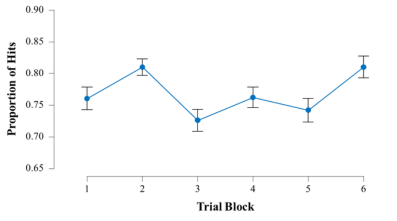
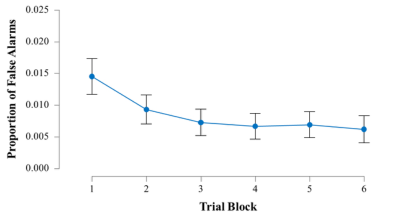
Accuracy Measures A mixed ANOVA, with repeated measures on trial block, was run on the accuracy measures. The Greenhouse-Geisser correction was used for violations of sphericity. There was a significant main effect for trial block on each measure of accuracy: hits and misses (F(4.49, 511.97) = 8.37, p <.001, ηp2 = 0.07), false alarms and correct rejections (F(2.21, 251.48) = 13.32, p <.001, ηp2 = 0.11). Descriptive plots show that the proportion of correct detections fluctuates, ultimately increasing, across trial blocks and that the number of false alarms gradually decreases throughout the vigil (see Figures 3–4). No significant main effect for experimental condition, nor interaction effect between condition and trial block, on any of the accuracy measures were found (p > .05).
Figure 3: Plot of proportion of hits across trial blocks. Error bars are SE.Figure 4: Plot of proportion of false alarms across trial blocks. Error bars are SE.
Knowledge of Results (KR) and Vigilance 95
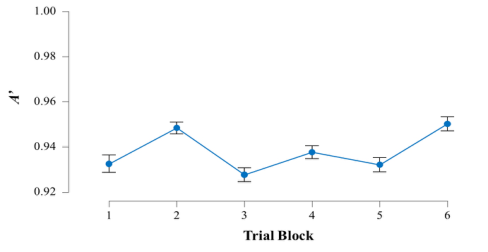
Signal Detection Theory A Signal Detection Theory (SDT) analysis was used to measure sensitivity (d′) and response bias for each condition (β), this was done using the non- parametric equivalents (A′ and β′′
D) due to the violations of normality (See et al., 1995). Results showed a significant main effect for trial block on sensitivity (F(4.38, 499.70) = 8.41, p <.001, ηp2 = 0.07) as well as bias (F(5, 570) = 2.34, p <.05, ηp2 = 0.02). Changes in sensitivity are shown in Figure 5. The bias measure exhibited a steady increase from trial blocks 1 to 3, followed by a decline leading up to the final trial block 6. No significant main effect for condition, nor interaction effect between condition and trial block, was found on either measure (p > .05).
Figure 5: Plot of sensitivity across trial blocks. Error bars are SE.
Self-Report Measures Analyses run on the three IMI subscale scores did not show a significant difference in scores between experimental conditions (p > .05).
DISCUSSION
The first postulated hypothesis was partially supported. Although the results revealed a significant difference between the control condition and the informational feedback condition, this performance difference was observed in RT, not detection accuracy. Additionally, no significant differences in accuracy or RT were observed between any of the other conditions. Hypotheses 2 and 3 were not supported. No significant performance differences were observed between the experimental conditions. No significant differences between conditions on any of the IMI scales were found.
Overall participant performance on this task did not indicate the presence of a vigilance decrement. Response time improved from the beginning of the task to the end; the proportion of false alarms decreased, and the proportion of hits increased with time on task. This could be due to the cognitive and simultaneous nature of the task, two characteristics that have been associated with vigilance increments (See et al., 1995). It is possible that the
96 Diaz and Hancock
nature of the task has produced a ceiling effect, therefore making it difficult to discern differences in performance between conditions. Future research should seek to analyze the different performance effects of motivational and informational KR utilizing a more challenging version of the vigilance task.
CONCLUSION
Results yielded a significant main effect for experimental condition on RT but not on accuracy. Only those in the informational condition showed improved RTs compared to controls. These observed RT enhancements provide further support for the existing research regarding the effectiveness of KR as well as the Goal Setting Hypothesis (Locke, Cartledge and Koeppel, 1968). This hypothesis states that goal setting mediates the effects of KR on performance. Therefore, KR affects performance indirectly by influencing performance goals. The informational condition provided specific RT feedback, allowing participants to set RT goals. Our findings suggest that the effectiveness of KR is due to the information quality. The motivational component of KR is possibly a product of goal setting and not the primary mechanism driving KR’s effectiveness.
REFERENCES
Church, R. M. and Camp, D. S. (1965) ‘Change in Reaction-Time as a Function of Knowledge of Results’, The American Journal of Psychology, 78(1), pp. 102–106. Available at: https://doi.org/10.2307/1421087. Davies, D. R. and Tune, G. S. (1969) ‘Human vigilance performance’. Elsevier. Diaz, Y. V., Hancock, P. A., and Hancock, G. M. (2025). The effects of KR format
on sustained attention. Under Review. Green, D. M. and Swets, J. A. (1966) Signal detection theory and psychophysics.
Oxford, England: John Wiley (Signal detection theory and psychophysics), p. xi, 455. Hancock, P. A. (2013) ‘In search of vigilance: The problem of iatrogenically created psychological phenomena’, The American Psychologist, 68(2), pp. 97–109. Available at: https://doi.org/10.1037/a0030214. Hancock, P. A. (2017) ‘On the Nature of Vigilance’, Human Factors, 59(1),
pp. 35–43. Available at: https://doi.org/10.1177/0018720816655240. Hardesty, D., Trumbo, D. and Bevan, W. (1963) ‘Influence of Knowledge of Results on Performance in a Monitoring Task’, Perceptual and Motor Skills, 16(3), pp. 629–634. Available at: https://doi.org/10.2466/pms.1963.16.3.629. Klinnert, M. et al. (1986) ‘Social Referencing. The Infant’s Use of Emotional Signals
From a Friendly Adult With Mother Present’, Developmental Psychology, 22, pp. 427–432. Locke, E. A., Cartledge, N. and Koeppel, J. (1968) ‘Motivational effects of knowledge of results: A goal-setting phenomenon?’, Psychological Bulletin, 70(6, Pt.1), pp. 474–485. Loeb, M. and Schmidt, E. A. (1963) ‘A comparison of the effects of different
kinds of information in maintaining efficiency on an auditory monitoring task’, Ergonomics, 6(1), pp. 75–81. Mackworth, J. F. (1970) Vigilance and attention: A signal detection approach.
Penguin Books.
Knowledge of Results (KR) and Vigilance 97
Mackworth, N. H. (1950) Researches on the measurement of human performance.
(Med. Res. Council, Special Rep. Ser. No. 268.). Oxford, England: His Majesty”s Stationery Office (Researches on the measurement of human performance), p. 156. Martin, J. et al. (2017) ‘Smiles as Multipurpose Social Signals’, Trends in Cognitive Sciences, 21(11), pp. 864–877. Available at: https://doi.org/10.1016/ j.tics.2017.08.007. McCormack, P. D., Binding, F. R. S. and Chylinski, J. (1962) ‘Effects on Reaction- Time of Knowledge of Results of Performance’, Perceptual and Motor Skills, 14(3), pp. 367–372. Nuechterlein, K. H., Parasuraman, R. and Jiang, Q. (1983) ‘Visual sustained
attention: Image degradation produces rapid sensitivity decrement over time’, Science, 220(4594), pp. 327–329. Orlowska, A. B. et al. (2018) ‘Dynamics Matter: Recognition of Reward, Affiliative, and Dominance Smiles From Dynamic vs. Static Displays’, Frontiers in Psychology, 9, p. 938. Parasuraman, R. (1979) ‘Memory Load and Event Rate Control Sensitivity Decrements in Sustained Attention’, Science, 205(4409), pp. 924–927. Ryan, R. M. (1982) ‘Control and information in the intrapersonal sphere: An extension of cognitive evaluation theory.’, Journal of Personality and Social Psychology, 43(3), pp. 450–461. Rychlowska, M. et al. (2017) ‘Functional Smiles: Tools for Love, Sympathy, and
War’, Psychological Science, 28(9), pp. 1259–1270. Rychlowska, M. et al. (2021) ‘Dominance, reward, and affiliation smiles modulate the meaning of uncooperative or untrustworthy behaviour’, Cognition and Emotion, 35(7), pp. 1281–1301. See, J. E. et al. (1995) ‘Meta-analysis of the sensitivity decrement in vigilance.’,
Psychological Bulletin, 117(2), pp. 230–249. Available at: https://doi.org/ 10.1037/0033-2909.117.2.230. Szalma, J. L. et al. (2000) ‘Continuous vs. Partial Knowledge of Results in Training for Vigilance’, Proceedings of the Human Factors and Ergonomics Society Annual Meeting, 44(21), pp. 3-386–3—389. Available at: https://doi.org/10.1177/ 154193120004402102. Szalma, J. L. et al. (2004) ‘Effects of Sensory Modality and Task Duration on
Performance, Workload, and Stress in Sustained Attention’, Human Factors, 46(2), pp. 219–233. Szalma, J. L. et al. (2006) ‘Training for vigilance: The effect of knowledge of results format and dispositional optimism and pessimism on performance and stress’, British Journal of Psychology, 97(1), pp. 115–135. Available at: https://doi.org/ 10.1348/000712605X62768. Teo, G. W. et al. (2014) ‘The Effects of Individual Differences on Vigilance Training
and Performance in a Dynamic Vigilance Task’, Proceedings of the Human Factors and Ergonomics Society Annual Meeting, 58(1), pp. 964–968. Uszak, N. and Szalma, J. L. (2020) ‘Pre-Task Training for Vigilance Using a Video Game-Based Simulation Task’, Proceedings of the Human Factors and Ergonomics Society Annual Meeting, 64(1), pp. 1503–1504. Available at: https:// doi.org/10.1177/1071181320641359. Warm, J. S. (1984) ‘Sustained attention in human performance’. Wiley. Warm, J. S. (1993) ‘Vigilance and target detection’, Workload transition: Implications
for individual and team performance, 1, pp. 139–170.
98 Diaz and Hancock
Warm, J. S., Epps, B. D. and Ferguson, R. P. (1974) ‘Effects of knowledge of results and signal regularity on vigilance performance’, Bulletin of the Psychonomic Society, 4(4), pp. 272–274. Warm, J. S., Hagner, G. L. and Meyer, D. (1971) ‘The Partial Reinforcement Effect
in a Vigilance Task’, Perceptual and Motor Skills, 32(3), pp. 987–993. Warm, J. S. and Jerison, H. J. (1984) ‘The psychophysics of vigilance’, in Sustained attention in human performance. Chichester, United Kingdom: Wiley, pp. 15–59. Weidenfeller, E. W., Baker, R. A. and Ware, J. R. (1962) ‘Effects of Knowledge of
Results (True and False) on Vigilance Performance’. Wiener, E. L. and Attwood, D. A. (1968) ‘Training for vigilance: Combined cueing and knowledge of results.’, Journal of Applied Psychology, 52(6, Pt.1), pp. 474–479.
LISTED IN THE AHFE DIGITAL BOOKSTORE CATALOGUE
Explore the complete digital volume
Human Factors and Systems Interaction
Read this individual research paper free through the original publisher, or explore the full digital proceedings book.
ISBN 978-1-964867-68-7
Explore this ISBN in the AHFE Bookstore ↗Listed in the July 2026 bookstore catalogue; search by ISBN to confirm current availability · Digital book purchase optional