Dmytro Smirnov, J Cecil (2025). AI Integration for Bridging Advanced Analytics and Business Value in a Regulated World. In: Human Factors in Design, Engineering, and Computing. AHFE Open Access, vol. 199, pp. 1116–1124. https://doi.org/10.54941/ahfe1006924
The integration of Artificial Intelligence (AI) and advanced analytics into enterprise strategypromises substantial business value, from improved decision-making to new product innovation.However, realizing this potential is challenging, especially in highly regulated industries wherecompliance, data governance, and ethical constraints are paramount. This paper examines howorganizations can effectively bridge advanced analytics and tangible business value in a worldincreasingly defined by strict regulations. We present a comprehensive review of literature on AIadoption, value creation, and governance, identifying key enablers and barriers to successful AIintegration. A qualitative methodology is employed, synthesizing insights from academicresearch and industry case examples to outline best practices for aligning AI initiatives withbusiness objectives while upholding regulatory compliance. The results and discussion highlightcritical success factors, including strategic alignment of AI use-cases, robust data management,cross-functional governance frameworks, and a culture of responsible innovation. We find thatbalancing agility and compliance is essential: companies must innovate with AI under carefuloversight to avoid legal pitfalls and maintain stakeholder trust. This study contributes anintegrated perspective on deploying AI for business gain in regulated environments and proposesa roadmap to guide organizations. Conclusions emphasize the need for ongoing adaptation, asevolving regulations (such as the EU AI Act) and emerging technologies (like generative AI) willshape future integration efforts. Future work should explore longitudinal case studies to quantifyvalue realization and refine governance models for the next generation of AI solutions.
Artificial Intelligence and advanced analytics have moved from experimental pilots to board-level priorities. Executives overwhelmingly view AI as a strategic opportunity yet scaled business impact is still uncommon (Ransbotham et al., 2017). Analysts project substantial macroeconomic gains from generative and predictive AI, but adoption data shows a maturity gap between investments and outcomes (Boston Consulting Group, 2024; Enholm et al., 2022). Across enterprises, the core execution challenge is
AI Integration: Bridging Advanced Analytics and Business Value 1117
consistent: converting sophisticated models into measurable operating and financial results, rather than isolated proofs of concept (Stackpole, 2020).
In regulated sectors such as finance, healthcare, insurance, and energy, the stakes are higher. Data usage, model risk, and automated decision-making are constrained by comprehensive privacy, safety, and fairness requirements. The EU General Data Protection Regulation (GDPR) has already reshaped enterprises’ data lifecycles (European Union, 2016). The forthcoming EU Artificial Intelligence Act proposes a risk-tiered regime with obligations for documentation, oversight, and post-market monitoring for high-risk AI systems (European Commission, 2021). In the United States, a patchwork of sectoral rules and guidance applies, from model risk management in banking to safety and quality expectations in medical AI, complemented by the National Institute of Standards and Technology’s AI Risk Management Framework (Board of Governors of the Federal Reserve System, 2011; National Institute of Standards and Technology, 2023).
This paper asks a practical question: how can organizations integrate AI-driven analytics to realize business value while remaining compliant and trustworthy? The authors synthesize academic and industry evidence into a concise framework covering strategy, data, governance, process integration, people, and continuous improvement, with special attention to regulatory feasibility and auditability.
LITERATURE REVIEW
Advanced Analytics and Business Value Advanced analytics denotes predictive and prescriptive methods that extend beyond descriptive business intelligence, including machine learning, optimization, and natural language techniques (IBM Cloud Education, 2020). Prior work links AI to operational efficiency, personalization, and innovation, but emphasizes disciplined scoping tied to strategic objectives to avoid “technology in search of a problem” (Davenport and Ronanki, 2018; Fountaine et al., 2019). Davenport and Ronanki suggest focusing on tractable use cases that align with clear value metrics rather than speculative moonshots that rarely scale (Davenport and Ronanki, 2018). Large-scale surveys similarly report that experimentation is widespread but deep, organization-wide integration is rare, explaining the persistent ambition- to-impact gap (Enholm et al., 2022; Stackpole, 2020). A comprehensive survey in the International Journal of Information Management (IJIM) synthesizes technical, managerial, and societal perspectives on AI and outlines a research and practice agenda for adoption and value creation (Dwivedi et al., 2021).
Enablers and Barriers Four enablers recur across the literature: executive sponsorship and strategy alignment, robust data and platform foundations, cross-functional collaboration with “analytics translators,” and explicit measurement of
1118 Smirnov and Cecil
business outcomes to reinforce sponsorship and funding (Fountaine et al., 2019; Remmler, 2025; Rigby et al., 2018). Conversely, common inhibitors include fragmented or low-quality data, skills and capacity shortages, and cultural resistance to model-assisted decisions (Stackpole, 2020; Pumplun et al., 2019; Makarius et al., 2020). Organizational readiness research highlights structure, culture, and capability build-out as prerequisites for scaling AI beyond pilots (Pumplun et al., 2019; Makarius et al., 2020).
Governance and Regulation Data protection rules such as GDPR have institutionalized privacy-by-design, consent management, and rights of access and deletion, directly affecting analytics data pipelines and profiling practices (European Union, 2016). The EU AI Act advances a risk-based framework that requires documentation, transparency, human oversight, and conformity assessment for high-risk systems (European Commission, 2021). In the U.S., financial regulators extend model risk management expectations to machine learning, stressing validation, monitoring, and governance proportional to impact (Board of Governors of the Federal Reserve System, 2011), while NIST’s AI RMF offers a widely referenced structure for risk identification, measurement, mitigation, and governance across the AI lifecycle (National Institute of Standards and Technology, 2023). Ethics scholarship consistently elevates transparency, fairness, accountability, and non-maleficence as normative anchors for responsible AI (Jobin et al., 2019), with practical techniques such as model cards for documentation and explainability now standard in many deployments (Mitchell et al., 2019).
Literature Gap Many contributions examine value creation or responsible governance in isolation. Fewer works integrate both in a pragmatic roadmap for regulated enterprises. The authors address this by articulating a single, managerially actionable framework that links value realization to regulatory feasibility and auditability.
METHODOLOGY
The authors conducted a qualitative synthesis comprising:
1. a structured literature review (2015–2025) of peer-reviewed and reputable industry sources on AI adoption, value realization, data governance, and regulatory developments, following systematic guidelines for source selection and coding (Okoli, 2015); 2. cross-industry case insights publicly documented by firms, regulators, and press, emphasizing regulated use cases to surface practical implementation patterns and pitfalls; 3. a thematic integration into six dimensions that organizations can operationalize; and
AI Integration: Bridging Advanced Analytics and Business Value 1119
4. validation of salience against recognized guidance and expert commentary on governance and adoption dynamics (Remmler, 2025; National Institute of Standards and Technology, 2023).
While secondary-source synthesis has limitations, triangulation across academic and industry evidence, combined with explicit attention to regulation, provides a robust foundation for a concise, practice-ready framework.
RESULTS & DISCUSSION
1. Strategic Alignment and Value Discipline
Effective programs begin with strategy, not tooling. Leadership must articulate where AI advances enterprise priorities and risk appetite, then curate a portfolio of use cases ranked by expected impact and feasibility (Ransbotham et al., 2017; Fountaine et al., 2019; Remmler, 2025). A value backlog replaces a technology backlog, emphasizing measurable outcomes such as reduced churn, lower loss rates, or throughput gains. Early engagement of legal and compliance steers scoping toward use cases that are both impactful and deployable within current rules, reducing late-stage rework (Remmler, 2025).
Strong sponsorship also supports staged funding and change management when short-term productivity dips precede long-term gains. Organizations that narrate value routinely and credibly to executives and boards show higher persistence through pilot-to-scale transitions (Rigby et al., 2018).
2. Data Foundations, Quality, and Stewardship
Analytics results are constrained by data condition. Persistent issues include incomplete lineage, inconsistent master data, siloed stores, and unclear ownership. High performers invest in master data management, governed data lakes, and fine-grained access controls to democratize use while enforcing least-privilege access (Fountaine et al., 2019, McKinsey & Company, 2024). Teams frequently devote the majority of effort to cleaning and joining data; the literature quantifies this burden and ties it directly to project risk (Stackpole, 2020). Organizations that formalize model oversight, data stewardship, and decision rights score higher on readiness scales and progress faster from pilots to production (AlSheibani et al., 2018).
Regulatory expectations elevate design choices: privacy-by-design, data minimization, role-based access, encryption, de-identification where feasible, and retention policies consistent with stated purposes (European Union, 2016). Data stewardship roles and cross-functional data councils adjudicate new data uses and ensure that legal bases, notices, and risk controls are in place before model training proceeds. This governance is not overhead; it is an enabler of safe reuse and auditability.
3. AI Governance, Risk, and Compliance
An AI governance program translates principles into policy, process, and controls. Risk-based management tailors oversight to system impact, aligning
1120 Smirnov and Cecil
with the EU AI Act’s tiering and NIST’s AI RMF (European Commission, 2021; National Institute of Standards and Technology, 2023). Core practices include:
pre-deployment validation with independent challenge to test performance, stability, and data representativeness;
bias and fairness assessments with appropriate parity or opportunity metrics, especially where outcomes affect customers or employees (Jobin et al., 2019);
explainability commensurate with use, which may involve post-hoc techniques or inherently interpretable models in high-stakes settings (Mitchell et al., 2019);
robust documentation through model cards, versioning, lineage, and decision rationale to support regulators and internal audit (Mitchell et al., 2019);
continuous monitoring for drift, performance degradation, and incident management, with triggers for retraining, rollback, or human escalation (Board of Governors of the Federal Reserve System, 2011; National Institute of Standards and Technology, 2023).
Notorious failures underscore the cost of skipping governance. Amazon’s recruiting prototype was scrapped after it learned gender-skewed patterns from historical data, illustrating why fairness testing and feature governance are not optional (Dastin, 2018). In banking, SR 11–7 extends to machine learning models, requiring clear model ownership, independent validation, and ongoing monitoring proportional to risk (Board of Governors of the Federal Reserve System, 2011).
Embedding AI into Business Processes Value materializes only when outputs reliably change decisions and workflows. This “last mile”demands user-centric design, operational change, and MLOps (Machine Learning Operations).
User-centric delivery. Recommendations must be contextual and actionable in existing tools. Sales, service, and operations users adopt insights that arrive inside their system of work with rationale and confidence indicators (Davenport and Ronanki, 2018; McKinsey & Company, 2024).
Process re-engineering. Risk scores should route work differently, service levels may bifurcate by predicted complexity, and exceptions must have human review paths that satisfy legal and fairness expectations (European Union, 2016; Fountaine et al., 2019).
Automation with oversight. Automate routine, reversible actions; keep humans in the loop for material or contestable outcomes, both for legal compliance and to maintain trust (European Union, 2016).
MLOps. Productionization requires CI/CD for models, feature stores, observability, and safe rollback. These engineering capabilities reduce cycle time from insight to impact and sustain reliability at scale (Kreuzberger et al., 2022).
AI Integration: Bridging Advanced Analytics and Business Value 1121
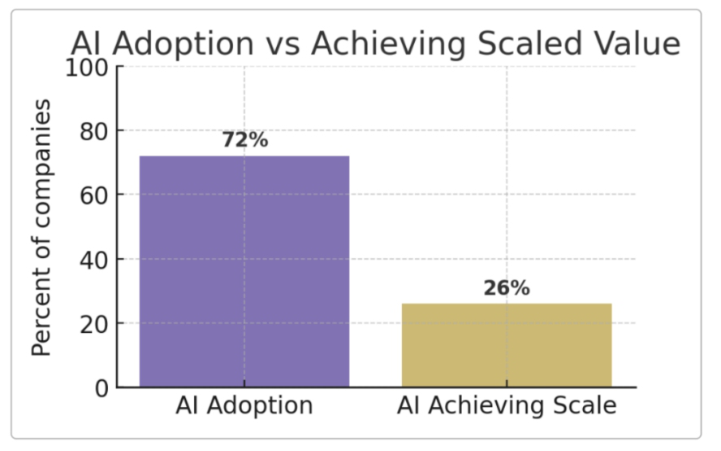
Figure 1 reference. Adoption is broad but scaled impact remains limited: while most firms report some AI deployment, only a minority achieve enterprise-level value, reflecting difficulties in integration, governance, and change absorption (Pumplun et al., 2019; Makarius et al., 2020). The adoption-value gap persists until organizations treat deployment and process design as first-class work, not afterthoughts.
Figure 1: Roughly 72% of organizations report using AI in at least one business function, yet only 26% report the capabilities to generate tangible value at scale (McKinsey & Company, 2024; Boston Consulting Group, 2024).
People, Skills, and Culture AI programs are socio-technical transformations. Skill gaps in data engineering, ML engineering, and domain-savvy product management are common. Effective organizations combine hiring with upskilling through internal academies and cohort-based training that raise literacy across business roles (Fountaine et al., 2019; Remmler, 2025; Makarius et al., 2020).
The “analytics translator” function reduces friction between technical teams and operators by converting business questions into data and model requirements, and by explaining model outputs in operational terms (Remmler, 2025). Cultural barriers are addressed by transparent communication about goals, showcasing quick wins tied to user pain points, and aligning incentives to the use of AI-assisted decisions. Compliance awareness is embedded into curricula, so teams understand why certain variables are restricted and how to handle explanations, appeals, and documentation (National Institute of Standards and Technology, 2023; Jobin et al., 2019).
1122 Smirnov and Cecil
Measuring Impact and Continuous Improvement Define outcome KPIs up front, not after deployment. Tie models to financial and operational metrics, establish baselines, and monitor both value and model health in production (Rigby et al., 2018; Kreuzberger et al., 2022). Introduce A/B testing, champion-challenger models, and explicit triggers for retraining when drift or decay occurs. Incorporate user feedback loops; expert overrides are valuable signals for model refinement. Document realized benefits and lessons learned to reinforce sponsorship and inform portfolio reprioritization.
Finally, regulatory agility matters. As requirements evolve, organizations should maintain lightweight mechanisms to update notices, documentation, explanations, and controls without destabilizing operations, which argues for modular architectures and disciplined configuration management (European Union, 2016; European Commission, 2021; National Institute of Standards and Technology, 2023).
ACKNOWLEDGMENT
The authors would like to acknowledge the path from analytical promise to durable business value in regulated contexts is clear in concept but execution-intensive. The evidence supports a holistic approach organized around six reinforcing disciplines: strategic alignment, governed data foundations, risk-based AI governance, process embedding with MLOps, people and culture enablement, and rigorous measurement with continuous improvement. Organizations that integrate these disciplines reduce pilot purgatory, accelerate compliant deployment, and compound value.
Three practitioner implications stand out. First, treat compliance as a design constraint, not a late-stage hurdle. Early legal and risk engagement increases deployability and lowers lifecycle cost. Second, invest as heavily in data and engineering as in modeling. Stable pipelines, feature stores, and observability are prerequisites for scale. Third, operational ownership is decisive. When business units own KPIs and co-design workflows with AI teams, adoption and impact rise.
For researchers, priorities include quantifying the marginal impact of specific governance interventions on AI ROI; developing maturity models that incorporate regulation-readiness; and studying sectoral nuances as the EU AI Act and related regimes take effect. As models evolve toward larger, more capable systems, the interplay among explainability, fairness, and accountability will remain central.
Enterprises that build these capabilities now will be better positioned to harness new AI waves while safeguarding customers, complying with law, and sustaining trust.
AI Integration: Bridging Advanced Analytics and Business Value 1123
REFERENCES
A. Jobin, M. Ienca, and E. Vayena (2019). “The global landscape of AI ethics guidelines.” Nature Machine Intelligence, vol. 1, no. 9, pp. 389–399, 2019. A. Okoli (2015). “A guide to conducting a standalone systematic literature
review.” Communications of the Association for Information Systems, vol. 37, pp. 879–910, 2015. B. Stackpole (2020). “10 best practices for analytics success (including 3 you can’t ignore).” MIT Sloan: Ideas Made to Matter, Sep. 22, 2020. [Online]. Available: https://mitsloan.mit.edu/ideas-made-to-matter/10-best- practices-analytics-success-including-3-you-cant-ignore. Board of Governors of the Federal Reserve System (2011). “SR 11–7: Guidance on Model Risk Management.” Supervisory Letter, Apr. 4, 2011. [Online]. Available: https://www.federalreserve.gov/supervisionreg/srletters/sr1107.htm. Boston Consulting Group (2024). “AI Adoption in 2024: 74% of Companies
Struggle to Achieve and Scale Value.” Press release, Oct 24, 2024. [Online]. Available: https://www.bcg.com/press/24october2024-ai-adoption-in-2024–74- of-companies-struggle-to-achieve-and-scale-value. D. Kreuzberger, N. Kühl, and S. Hirschl (2022). “Machine Learning Operations (MLOps): Overview, Definition, and Architecture.” 2022. [Online]. Available: https://arxiv.org/abs/2205.02302. D. Rigby, J. Sutherland, and A. Noble (2018). “Agile at Scale.” Harvard Business
Review, vol. 96, no. 3, pp. 88–96, May-Jun. 2018. [Online]. Available: https:// hbr.org/2018/05/agile-at-scale. E. E. Makarius, D. Mukherjee, J. D. Fox, and A. K. Fox (2020). “Rising with the machines: A sociotechnical framework for bringing artificial intelligence into the organization.” Journal of Business Research, vol. 120, pp. 262–273, 2020. European Commission (2021). “Proposal for a Regulation laying down harmonised
rules on Artificial Intelligence (Artificial Intelligence Act).” COM (2021) 206 final, Apr. 21, 2021. European Union (2016). “Regulation (EU) 2016/679 of the European Parliament and of the Council (General Data Protection Regulation).” Official Journal of the European Union, Apr. 27, 2016. I. M. Enholm, E. Papagiannidis, P. Mikalef, and J. Krogstie (2022). “Artificial
Intelligence and Business Value: A Literature Review.” Information Systems Frontiers, vol. 24, no. 6, pp. 1709–1734. IBM Cloud Education (2020). “What is Advanced Analytics?” IBM, Aug. 4, 2020.
[Online]. Available: https://www.ibm.com/cloud/learn/advanced-analytics. J. Dastin (2018). “Amazon scraps secret AI recruiting tool that showed bias against women.” Reuters, Oct. 11, 2018. [Online]. Available: https://www.reuters.com/ article/world/insight-amazon-scraps-secret-ai-recruiting-tool-that-showed-bias- against-women-idUSKCN1MK0AG/. L. Pumplun, C. Tauchert, and M. Heidt (2019). “A New Organizational Chassis for
Artificial Intelligence - Exploring Organizational Readiness Factors.” Proceedings of the 27th European Conference on Information Systems (ECIS), Stockholm- Uppsala, Sweden, 2019, pp. 1–16. M. Fountaine, B. McCarthy, and T. Saleh (2019). “Building the AI-Powered Organization.” Harvard Business Review, vol. 97, no. 4, pp. 62–73. M. Mitchell, et al. (2019). “Model Cards for Model Reporting.” FAT* 2019 (now
McKinsey & Company (2024). “The state of AI in early 2024.” May 30, 2024.
[Online]. Available: https://www.mckinsey.com/capabilities/quantumblack/our- insights/the-state-of-ai-2024. National Institute of Standards and Technology (2023). “Artificial Intelligence Risk Management Framework 1.0 (NIST AI 100–1).” Jan. 2023. [Online]. Available: https://doi.org/10.6028/NIST.AI.100-1. S. AlSheibani, Y. Cheung, and C. Messom (2018). “Artificial Intelligence Adoption: AI-readiness at Firm-Level.” Proceedings of the 22nd Pacific Asia Conference on Information Systems (PACIS 2018), Yokohama, Japan, 2018. [Online]. Available: https://aisel.aisnet.org/cgi/viewcontent.cgi?params=/context /pacis2018/article/1036/&path_info=paper_98.pdf. S. Ransbotham, D. Kiron, P. Gerbert, and M. Reeves (2017). “Reshaping Business
with Artificial Intelligence: Closing the Gap Between Ambition and Action.” MIT Sloan Management Review, vol. 59, no. 1, pp. 1–9. T. H. Davenport and R. Ronanki (2018). “Artificial Intelligence for the Real World.”
Harvard Business Review, vol. 96, no. 1, pp. 108–116. Y. K. Dwivedi, et al. (2021). “Artificial Intelligence (AI): Multidisciplinary perspectives on emerging challenges, opportunities, and agenda for research, practice and policy.” International Journal of Information Management, vol. 57, p. 101994. Y. Remmler (2025). “AI And Compliance: How Regulated Industries Can Innovate Safely.” Forbes Business Council, Mar. 17, 2025. [Online]. Available: https://www.forbes.com/councils/forbesbusinesscouncil/2025/03/ 17/ai-and-compliance-how-regulated-industries-can-innovate-safely/.
LISTED IN THE AHFE DIGITAL BOOKSTORE CATALOGUE
Explore the complete digital volume
Human Factors in Design, Engineering, and Computing
Read this individual research paper free through the original publisher, or explore the full digital proceedings book.
ISBN 978-1-964867-75-5
Explore this ISBN in the AHFE Bookstore ↗Listed in the July 2026 bookstore catalogue; search by ISBN to confirm current availability · Digital book purchase optional