Kusum Bhattarai Sharma, Ila Wallace, Shreya Upreti, Ruchi Kukde, Shetay Ashford Hanserd (2025). A Qualitative Study on the Factors and Mechanisms Impacting STEM+C Undergraduates’ Enrollment and Persistence. In: Human Factors in Design, Engineering, and Computing. AHFE Open Access, vol. 199, pp. 1465–1475. https://doi.org/10.54941/ahfe1006958
Over the last few decades, the graduation rates for post-secondary education in science, technology, engineering, mathematics, and computing (STEM+C) have stayed consistently low despite efforts to increase participation in STEM+C disciplines. Prior teaching and educational research have primarily focused on one specific degree pathway within STEM+C, such as computer science. However, understanding the common factors and mechanisms that influence STEM+C students to persist in their different degree programs has been left largely unexplored. In this study, the research team investigates the factors that influence the enrollment and persistence of undergraduate STEM+C majors at a large, public Hispanic-Serving Institution (HSI) in Texas. As part of a larger mixed-methods investigation, data were collected from a total of 168 undergraduate STEM+C majors using the ACCEYSS STEM+C survey instrument to evaluate factors impacting their enrollment and persistence in their degree programs. Qualitative analysis was performed on the survey responses from 65 science majors, 45 computing majors, 36 engineering majors, and two mathematics majors. Participants were asked about their career aspirations, the types of learning experiences they participated in prior to college, and the factors that influenced them to pursue their major. Also, participants were asked to describe what students needed to be successful in their chosen field and what advice they believe would help incoming students persist to graduation. The findings of this study revealed that students across all majors: (a) indicated their decisions to pursue STEM+C majors were mainly influenced by personal aspirations and motivation, followed by self-confidence, self-efficacy, and perceived intelligence; (b) offered advice for incoming STEM+C majors focused on building resilience, effectively utilizing resources, developing strong learning strategies, and maintaining motivation throughout their academic journey; and (c) identified key factors for success in STEM+C degree programs such as establishing efficient time management skills, cultivating good study habits, and engaging in self-directed learning with an emphasis on continuous skill development and problem-solving approaches. The results of this study provide key insights and recommendations to help guide post-secondary educators’ and policymakers’ decision-making to cultivate a university environment that actively supports more students to persist in STEM+C degree programs and reach graduation.
The technological advancements and contributions made by science, technology, engineering, mathematics, and computing (STEM+C) fields over the last few decades have been one of the primary sources driving economic growth in the United States (US), creating a wealth of new jobs and occupations for workers to fill. Yet, at the same time, the forecast is dire for meeting the demands of filling these jobs as the projected change in employment between 2024 and 2034 is 8.1% for STEM occupations compared to 3.1% for all other non-STEM occupations (U.S. Bureau of Labor Statistics, 2025). For example, during the 2021 to 2022 academic year, approximately 22% of bachelor degrees were granted in STEM fields while around the same time, 52% of the STEM workforce was comprised of workers who did not have a bachelor’s degree (National Center for Science and Engineering Statistics, 2024; Irwin et al., 2024). For those who did have STEM degrees, an added complexity was the mismatch between the number of graduates in STEM+C fields and the actual labor market demand for such jobs (Xue & Larson, 2015; Chen & Thomas, 2009). Consequently, this has led to an economic contradiction with a surplus of STEM workers vying for a limited number of jobs requiring little or no education or those not in high demand. At the same time, there is a perceived deficit of STEM workers for an overabundance of jobs that either require significant education credentials and training to qualify for or not many workers are interested in pursuing. (Consortium of Social Science Associations, 2020; Xue & Larson, 2015; National Science Board, 2024).
To address these concerns, government and industry-based initiatives such as “Engage to Excel” focused on increasing the rate of retention in STEM+C education programs (President’s Council of Advisors on Science and Technology, 2012) and other initiatives such as “Learn to Code” and “Computer Science for All” focused on introducing K–12 students to computer science and basic computing literacy to encourage interest in STEM+C fields (National Science Foundation, 2016) have emerged. Despite various STEM+C programs and initiatives, enrollment rates in these disciplines remain low as compared to non-STEM+C fields (Allen- Ramdial & Campbell, 2014; National Science Board, 2024; Consortium of Social Science Associations, 2020). Regarding graduation rates, from 2011 to 2021, the number of bachelor’s STEM+C degree earners went from approximately 286 thousand to 437 thousand, accounting for roughly ∼8% of the total bachelor degrees awarded, which went from 1.7 million to 2.1 million (National Center for Education Statistics, 2022; Institute of Education Science, 2023). As a result, identifying the potential socio- economic and institutional factors that influence students before and during their undergraduate studies is of interest to researchers to increase participation across all STEM+C disciplines.
To better understand these influences, prior research has focused on examining key periods of students’ educational development, such as undergraduate studies. Green & Sanderson (2018) offered exploring the experiences of professionals in STEM+C careers as well as implementing
A Qualitative Study on the Factors and Mechanisms 1467
polices for better mathematics preparation for secondary students to increase participation and meet the demands of the STEM+C workforce. Others have explored this trend by tracking the lived experiences of STEM+C students, especially during the first two years of their college, as this is the time when students are most likely to change majors at least once (Griffith, 2010). Similarly, King (2015) compared STEM versus non-STEM undergraduate students and found that even though STEM students started out with a higher level of persistence and perception of college achievement compared to their counterparts, those who earned lower than average grades in their courses were highly likely to switch fields. In contrast, Morganson et al. (2015) built upon existing STEM education research by looking at the factors that help students to persist in STEM majors using embeddedness theory. Findings of this study suggest that framing STEM fields as being challenging as normal may help students to build their resiliency during the crucial first few years of college. Pedraza & Chen (2021) evaluated student persistence in STEM using the two-factor theory model and found that the motivational factors part of the model was key for students to earn a STEM degree; however, the exact cause or development of these motivational factors identified by the study was not known.
Yet, identifying the commonalities that exist between STEM+C students in how they persist in their degree programs and how exactly these overlaps may help influence decision-making for teachers and leaders within educational institutions has been rarely explored. For this study, we are focused on the undergraduate educational process while also drawing upon the experiences and opportunities students remember from their secondary educational journey. As such, the purpose of this study is to examine the experiences of current STEM+C undergraduate students at a Hispanic-Serving Institution (HSI) in Texas to provide insight and offer recommendations regarding decisions impacting future students in these degree programs. To accomplish this, our research study aims to answer the overarching questions: (1) What factors influence undergraduate students to enroll and persist in STEM+C majors? and (2) What are the essential skills, qualities, and advice that undergraduate students need to persist in STEM+C majors?
METHODOLOGY
This study employed a mixed-methods research design to investigate the lived experiences of undergraduate students in STEM+C disciplines. As part of a larger study, this research study focused on the qualitative strand, which analyzed students’ responses to open-ended questions included in the ACCEYSS STEM+C Majors (ASCM) survey instrument.
A total of 168 undergraduate students participated in the study. All participants were at least 18 years of age and self-identified as Hispanic/Latino, Black/African American, or multiracial with one of these backgrounds. Students represented a diverse set of majors across STEM+C disciplines. Specifically, 65 participants were science majors, 45 were computing majors, 36 were engineering majors, and two were mathematics majors. Demographic information was collected through the survey. Of the
168 respondents, 87 identified as female and 81 identified as male. The majority of students (n = 142) self-identified as Hispanic/Latino, while 26 identified as Black or multiracial. Participants’ ages ranged from 19 to 38 years, with the majority between 19 and 22 years (n = 116). Academic grade levels were relatively balanced, with 43 freshman, 43 sophomores, 42 juniors, and 39 seniors.
Q1. What are your career aspirations after you complete your education? Q2. List any related informal or formal pre-college learning experiences in which you participated. Q3. How did the item you selected influence you to pursue your degree? [follow up to most important influence on picking and pursuing degree] Q4. What do you think students in your major need in order to be successful in your major? Q5. What advice would you give to an incoming student into your field to help them successfully reach graduation?
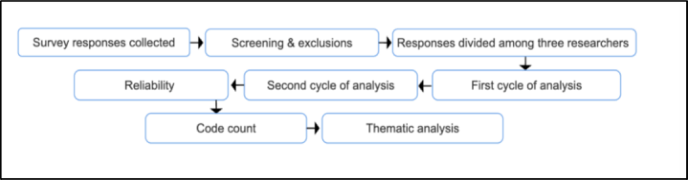
Figure 1: Qualitative analysis workflow.
Data was collected through the ASCM survey instrument administered in Fall 2024. The survey consisted of forty-three items, including five open-ended questions designed to capture students’ perspectives on career aspirations, learning experiences, factors influencing their degree choice, and perceived needs for success. Table 1 displays the open-ended survey questions that were central to the qualitative analysis conducted in this study. Survey distribution involved the research team working with the university registrar to distribute direct email invitations. Participation was voluntary, and students completed the survey electronically through Qualtrics. The study employed thematic analysis to examine qualitative responses. Incomplete records were excluded from analysis. The remaining records were evenly divided among three researchers, each independently analyzing a subset of the data.
During the first cycle of analysis, the researchers employed a shared codebook (Wallace et al., 2025) to identify initial themes across responses. The codebook was developed during a pilot study and iteratively refined to clarify code definitions and merge overlapping categories (Wallace et al.,
A Qualitative Study on the Factors and Mechanisms 1469
2025). Researchers documented decision rules and examples to support coding consistency. The second cycle of analysis involved researchers refining and merging codes, identifying broader themes across the dataset by grouping all the majors together. Figure 1 illustrates the qualitative analytic process including coding, refinement, and synthesis. To ensure credibility, the researchers compared coding decisions until consensus was reached. Codes reflected recurring factors that influenced persistence in STEM+C pathways. Through this process, the research team identified key themes related to enrollment and persistence as discussed in the Findings section.
FINDINGS Using qualitative coding of survey responses alongside thematic analysis, three major findings emerged regarding influences, success factors, and advice from students.
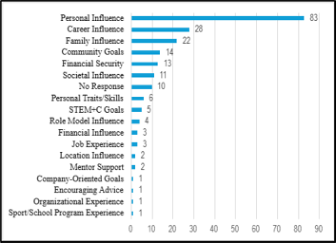
Key Influences on Pursuing a STEM+C Degree Survey responses revealed that personal motivations overwhelmingly shaped students’ decisions to pursue STEM+C majors. Students articulated aspirations deeply tied to their sense of identity, self-efficacy, and career aspirations. For example, a biology major expressed a desire to “apply my scientific knowledge to make a meaningful impact,” emphasizing a commitment to ongoing learning and practical application in biotechnology and environmental science. This intrinsic drive was again articulated by an electrical engineering student who stated, “Just knowing that I have it within myself to be able to finish anything I put my mind to is what led me to pick my major.” Such affirmations demonstrate the critical role of students’ confidence and belief in their abilities as foundational motivators. These findings highlight that intrinsic motivation, aspirations, and self-efficacy are critical to student persistence in STEM+C disciplines (Hedge, 2024; Wallace et al., 2025). As shown in Fig. 2, additional influences noted were career influence, family influence and community goals.
Figure 2: Code frequencies representing key influences on pursuing a STEM+C degree.
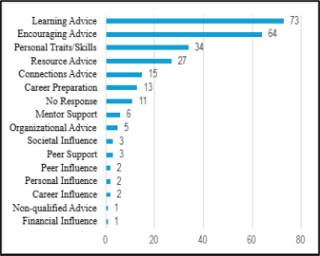
Advice for Incoming Students to Succeed in STEM+C Fields When asked what advice would help incoming STEM+C students persist, participants emphasized the importance of strong learning strategies, building resilience and efficient utilization of resources. As shown in Fig. 3, learning advice was the predominant theme, accompanied by encouraging advice and resource advice. A computer engineering major advised, “Mistakes are going to happen and that perfection is overrated… failure is okay and necessary in order to grow,” reflecting a perspective on academic challenges and encouraging the incoming students to remain positive. Students also noted the importance of peer and mentor networks, as another student stated “Find an organization… Having peers and networking is important. …Talk to your professors about opportunities outside of the classroom…” Another student emphasized campus resources, “Any question that you may have, I guarantee that you have at least 5 professionals to guide you, just ASK!” These insights resonate with recent studies highlighting resourcefulness, supportive networks, and engagement with learning communities for persistence (Sung et al., 2024; Wallace et al., 2025).
Figure 3: Code frequencies representing advice for incoming students.
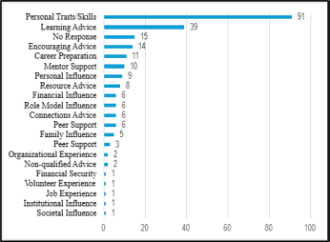
Essential Factors for Success in STEM+C Programs When asked about critical factors for success, students pinpointed personal discipline, effective study habits, and time management as the most frequent themes (ref Figure 4). These personal traits and skills constituted the core of student perceptions on what leads to success in STEM+C majors. A biology major stated, “To be successful… students need to be very disciplined and driven. It is not enough to be motivated because motivation will come and go, but discipline will never fail you… students must also be adaptable because there will be setbacks and unexpected changes… never an excuse to give up. Overall, a student… should be resilient and above all confident in their abilities.” Students also valued self-regulated continuous learning, while emphasizing the importance of intrinsic motivation over extrinsic reward, with one computer science major asserting, “…You will 100% fail if your only motivation is money and not the major you paid to learn!... unite and prepare for the hardships, as life is just not fair and it can lead to success if
A Qualitative Study on the Factors and Mechanisms 1471
we have this mindset.” This focus on self-directed learning and adaptability not only reflects individual agency but also signals broader institutional and cultural factors influencing student success (Wallace et al., 2025).
Figure 4: Code frequencies representing essential factors for success in STEM+C majors.
These results highlight that student persistence in STEM+C is driven by strong aspirations and self-efficacy, reinforced by effective study habits and a proactive approach to making use of available resources. Advice aimed at incoming students centers on resilience, connection, and community. The emerging themes not only confirm prior findings on STEM+C persistence but offer new insights specific to the context of undergraduate students at an HSI (Wallace et al., 2025; Hedge, 2024; Wolters & Brady, 2020; Sung et al., 2024).
DISCUSSION
The research findings reinforce a broad body of STEM education research emphasizing self-efficacy, motivational orientation, habitual study behaviors, and structured support as core predictors of persistence and success in STEM pathways (Allen-Ramdial & Campbell, 2014; Hedge, 2024; Xu, 2016). Our data pronounced focus on personal aspirations, intrinsic motivation, and internal self-belief is consistent with studies identifying the role of science identity and community cultural wealth in fostering enduring engagement within STEM+C among populations of interest (Ashford-Hanserd et al., 2024; Yosso, 2005). The prevalence of personal motivation as the main driver behind choosing a STEM+C major aligns with existing research highlighting the formation of a strong science personal identity, future aspirations, and internalized career goals (Pedraza & Chen, 2022; Hedge, 2024). The unique weight of intrinsic factors in this HSI sample is especially meaningful against calls from national reports for more culturally responsive and individualized interventions in STEM (President’s Council of Advisors on Science and Technology, 2012). As Wallace et al. (2025) and Ashford-Hanserd et al. (2024) argue, successful STEM+C engagement depends not only on external access or pipeline
support, but also on nurturing students’ sense of self-efficacy and their identity as change-makers.
Advice from students consistently advocated for building resilience, leveraging campus resources, self-regulated learning, and engaging with peer/mentor networks, themes widely affirmed in research on STEM persistence (Sung et al., 2024; Allen-Ramdial & Campbell, 2014). The salience of mutual aid and institutional support in our findings calls for institutional recommendations for evidence-based interventions, such as learning communities, active advising, and mental health resources for undergraduate students (President’s Council of Advisors on Science and Technology, 2012).
Student emphasis on discipline, strategic learning, and time management as keys to success directly resonates with the literature on academic self- regulation, which shows that well-developed learning routines and adaptable mindsets predict performance and retention in STEM (Wolters & Brady, 2020; Xu, 2016). Sung et al. (2024) demonstrate that structured support systems, coupled with deliberate practice, build not only knowledge but also the psychological resilience required to navigate setbacks. Green & Sanderson (2018) highlight that study skills, positive learner traits, and continuous engagement are vital for traditionally marginalized STEM students in high-challenge programs.
While many studies give substantial weight to familial and community capital in STEM+C, this study found these factors to be less prominent as compared to personal agency and internal motivators. For example, cultural and community influences, though present, were cited less as compared to the previous study (Wallace et al., 2025), indicating a potential shift in the pattern of driving factors behind student enrollment and persistence in STEM+C. Likewise, external motivators like financial need or institutional influence were also less central in this cohort.
These findings suggest that interventions aiming to boost STEM+C persistence should prioritize fostering personal motivation, discipline, and resilience through targeted mentorship, skill-building workshops, and supportive community-building. Recommendations include implementing these interventions during the first two years of college and providing additional support focused on skill development to support students throughout their postsecondary education. This especially applies to students who are traditionally vulnerable to dropping out of college or switching out of a STEM+C major before graduation due to perceived or realized social, economic, and institutional influences (King, 2015; Oppenheimer et al., 2020; Xu, 2016; Allen-Ramdial & Campbell, 2014). There is also clear value in ensuring accessible, academic and social resources for students. Policy decisions that focus solely on financial or structural interventions may miss the greater impact of developing students’ intrinsic self-belief and providing opportunities for meaningful engagement and drive towards their degrees.
A Qualitative Study on the Factors and Mechanisms 1473
LIMITATIONS This study’s qualitative analysis used a blended deductive-inductive coding approach, emphasizing recurrent themes of student motivation and academic skills. However, ambiguous or minimally supported themes and findings on career aspirations and extracurriculars were excluded due to low response rates. Framed initially by Yosso’s (2005) community cultural wealth model and its validation (Ashford-Hanserd et al., 2024), the cohort showed limited cultural capital evidence, leading to its omission to prevent overinter- pretation. These findings diverge partially from prior research, where cultural capital and extracurriculars were prominent, yet align with the pilot (Wallace et al., 2025) in highlighting persistent motivation and self-efficacy.
CONCLUSION
By using a qualitative approach and integrating the perspectives of 168 undergraduates, this study provides nuanced insight into the persistent factors driving enrollment and persistence in STEM+C students. We recommend that educators and institutional policy decision-makers consider developing students’ intrinsic motivation and self-efficacy through culturally responsive curricula that highlight personal aspirations and real-world applications of STEM+C fields. Implementing targeted interventions such as mentorship programs, skill-building workshops for time management and problem-solving skills, and accessible resource networks during the earlier years of their undergraduate studies can support persistence among students at HSIs.
Despite the large number of participants, the main limitation of this study is that the data collected was from one university. While this was not within the scope of this research study, it is important to note that student populations in different locations around the U.S. may have distinct perspectives and experiences associated with those locations. To address this limitation in future studies, our research group aims to include data gathered from additional colleges and universities to help distinguish between unique institutional characteristics to find the commonalities that may be shared by all STEM+C undergraduate students studying in the U.S., regardless of geographic location. Future research should focus on analyzing the responses of former STEM+C students who switched majors and students who switched into STEM+C majors from other non-STEM+C degree programs. These groups of students represent two types of diverging paths that are possible with STEM+C educational outcomes that are not well represented in existing literature. Ultimately, the key insights gained from this study, and potential future studies in this area of research, will help guide educational and institutional decisions to help more undergraduate students graduate from STEM+C degree programs.
ACKNOWLEDGMENT
This material is based upon work supported by the National Science Foundation under grant number #2304197. Any opinions, findings, and
conclusions or recommendations expressed in this material are those of the author(s) and do not necessarily reflect the views of the National Science Foundation.
REFERENCES
Allen-Ramdial, S.-A. A., & Campbell, A. G. (2014). Reimagining the Pipeline: Advancing STEM Diversity, Persistence, and Success. BioScience, 64(7), 612–618. https://doi.org/10.1093/biosci/biu076 Ashford-Hanserd, S., Carrera, L. F., Hough, T. D., Moreno, T. D., Mouton, A. J.,
& Wallace, I. (2024). Influence of community cultural wealth on undergraduate Hispanic and Black women’s persistence in the STEM+C workforce pipeline. Association for Career and Technical Education Research. 49(2), 47–64. https: //doi.org/10.5328/cter49.2.47 Chen, X., & Thomas, W. (2009). Students Who Study Science, Technology, Engineering, and Mathematics (STEM) in Postsecondary Education. Stats in Brief. NCES 2009–161. National Center for Education Statistics. https://files.eric.ed.go v/fulltext/ED506035.pdf Consortium of Social Science Associations. (2020). STEM and the American
workforce. An inclusive analysis of the jobs, GDP, and output powered by science and engineering. https://www.cossa.org/wp-content/uploads/2020/02/AAAS-STE M-Workforce-Report_1-24-2020.pdf Green, A., & Sanderson, D. (2018). The Roots of STEM Achievement: An Analysis of Persistence and Attainment in STEM Majors. The American Economist, 63(1), 79–93. https://www.jstor.org/stable/26754432 Griffith, A. L. (2010). Persistence of women and minorities in STEM field majors:
Is it the school that matters? Economics of Education Review, 29(6), 911–922. https://doi.org/10.1016/j.econedurev.2010.06.010 Hedge, B. (2024). Persistence of STEM Majors in Higher Education. Journal of Research in Science, Mathematics, and Technology Education, 27–41. https:// doi.org/10.31756/jrsmte.312si Institute of Education Science. (2023). Report on the condition of education
(NCES 2023-144). National Center for Education Statistics. U.S. Department of Education. https://nces.ed.gov/pubs2023/2023144.pdf Irwin, V., Wang, K., Jung, J., Kessler, E., Tezil, T., Alhassani, S., Filbey, A., Dilig, R., and Bullock Mann, F. (2024). Report on the Condition of Education 2024 (NCES 2024-144). U.S. Department of Education. Washington, DC: National Center for Education Statistics. https://nces.ed.gov/pubsearch/pubsinfo.asp?pubid=2024144 King, B. (2015). Changing college majors: Does it happen more in STEM and do
grades matter? Journal of College Science Teaching, 44(3), 44–51. http://www.js tor.org/stable/43631938 Morganson, V. J., Major, D. A., Streets, V. N., Litano, M. L., & Myers, D. P. (2015).
Using Embeddedness Theory to Understand and Promote Persistence in STEM Majors. Career Development Quarterly, 63(4), 348–362. https://doi.org/10.1002/ cdq.12033 National Center for Education Statistics. (2022). Table 318.45 Number and percentage distribution of science, technology, engineering, and mathematics (STEM) degrees/certificates conferred by postsecondary institutions, by race/ ethnicity, level of degree/certificate, and sex of student: Academic years 2011– 12 through 2020–21. U.S. Department of Education. Integrated Postsecondary Education Data System (IPEDS). https://nces.ed.gov/programs/digest/d22/tables/d t22_318.45.asp
A Qualitative Study on the Factors and Mechanisms 1475
National Center for Science and Engineering Statistics. (2024). U.S. STEM workforce: Size, growth, and employment. Figure LBR-1 U.S. workforce, by STEM occupation group and education level: 2021. U.S. National Science Foundation. https://ncses.nsf.gov/pubs/nsb20245/u-s-stem-workforce-size-grow th-and-employment National Science Board. (2024). The STEM labor force: Scientists, engineers, and skilled technical workers (NSB-2024-5). National Science Foundation. National Center for Science and Engineering Statistics. https://ncses.nsf.gov/pu bs/nsb20245 Oppenheimer, S. B., Mills, J. I., Zakeri, A., Payte, T. R., Lidgi, A., & Zavala,
M. (2020). An Approach to Improving Student Success in Science, Technology, Engineering, and Mathematics (Stem) Career Pathways. Ethnicity & Disease, 30(1), 33–40. https://doi.org/10.18865/ed.30.1.33 Pedraza, L., & Chen, R. (2022). Examining Motivator Factors of Stem Undergraduate Persistence through Two-Factor Theory. Journal of Higher Education, 93(4), 532–558. https://doi.org/10.1080/00221546.2021.1999722 President’s Council of Advisors on Science and Technology (2012). Engage to Excel: Producing One Million Additional College Graduates with Degrees in Science, Technology, Engineering, and Mathematics. https://obamawhitehouse.archives.g ov/sites/default/files/microsites/ostp/pcast-engage-to-excel-final_2-25-12.pdf Sung, E., Liu, L., & Kuang, K. (2024). Cultivating resilience in science, technology,
engineering, and mathematics education. Engineering Education Review, 2. https: //doi.org/10.54844/eer.2024.0630 U.S. Bureau of Labor Statistics. (2025). Table 1.11 Employment in STEM occupations, 2024 and projected 2034 (Employment in thousands). U.S. Department of Labor. https://www.bls.gov/emp/tables/stem-employment.htm#B LStable_2025_7_24_11_57_%5B1%5D Wallace, I., Upreti, S., Saha, A. K., Sharma, K. B., Sullivan, C., Hough, T. D., Kukde, R. D., & Ashford-Hanserd, S. (2025). Examining aspects of cultural capital influencing persistence among Hispanic and Black students in computing education. 2025 Annual Meeting of the American Educational Research Association. https://doi.org/10.3102/2189972 Wolters, C. A., & Brady, A. C. (2020). College students’ time management: A
self-regulated learning perspective. Educational Psychology Review, 33(4), 1319– 1351. https://link.springer.com/article/10.1007/s10648-020-09519-z Xu, Y. J. (2016). Attention to Retention: Exploring and Addressing the Needs of College Students in STEM Majors. Journal of Education and Training Studies, 4(2), 67–76. https://doi.org/10.11114/jets.v4i2.1147 Xue, Y., & Larson, R. C. (2015). STEM crisis or STEM surplus? Yes and yes. Monthly Labor Review, U.S. Bureau of Labor Statistics. https://doi.org/10.21916/mlr.2015.14 Yosso, T. J. (2005). Whose culture has capital? A critical race theory discussion of
community cultural wealth. Race Ethnicity and Education, 8(1), 69–91. https: //doi.org/10.1080/1361332052000341006
LISTED IN THE AHFE DIGITAL BOOKSTORE CATALOGUE
Explore the complete digital volume
Human Factors in Design, Engineering, and Computing
Read this individual research paper free through the original publisher, or explore the full digital proceedings book.
ISBN 978-1-964867-75-5
Explore this ISBN in the AHFE Bookstore ↗Listed in the July 2026 bookstore catalogue; search by ISBN to confirm current availability · Digital book purchase optional