Ruchi Kukde, Jaymeen Shah, Aindrila Chakraborty (2025). Analyzing Diabetes-Related Hospitalizations: Trends and Insights from NIS 2016–2019 for Health Informatics Applications. In: Healthcare and Medical Devices. AHFE Open Access, vol. 171, pp. 180–190. https://doi.org/10.54941/ahfe1006204
Potentially preventable hospitalizations are a major area of concern as they represent a huge financial burden across the healthcare ecosystem. To alleviate this issue, this research investigates characteristics, risk factors, and outcomes related to hospital inpatient stays in the context of diabetic patients. Diabetes is a major public health issue that is approaching epidemic proportions globally. Compared to the early 2000s, the prevalence of diabetes in individuals within the age group of 20 - 79 years has increased by 53.3% in the US. In addition to clinical factors, prior studies emphasized the role of socio-economic factors, health conditions, demographics, and quality of care in influencing hospitalization rates. In this retrospective cohort study, Healthcare Cost and Utilization Project (HCUP) National Inpatient Sample (NIS) dataset (2016-2019) was analyzed. This study identified trends in length of stay (LOS) by highlighting disparities related to demographics, income and payer type with an overall goal to guide administrators and policy makers involved in the design and development of systems and health policy services to implement new action plans and quality initiatives.From 2016 to 2019, it was observed that diabetes-related hospitalizations increased by 6.8%. Females accounted for 51–52% of cases, and most patients were between 18–68 years. White patients comprised the largest proportion (52–53%), while individuals in the lowest income quartile accounted for 38.9–40.8% of diabetes-related hospitalizations. The mean LOS for diabetes-related stays increased slightly from 3.17 to 3.25 days over the four years, with older adults and males experiencing longer stays. Most patients were treated in private, non-profit hospitals, with urban teaching hospitals accounting for most admissions. A multivariate linear regression model was used to analyze the impact of variables such as age, gender, payer type, income, hospital characteristics, and severity of illness on LOS. The results indicate that among diabetic patients, risk factors such as age, demographics, income, and insurance policies associated with in-patient stays are critical and warrant further investigation. Findings of this study suggest that awareness, timely screening, and lifestyle changes from a young age can reduce diabetes-related complications and eventually lower preventable hospitalizations, thus improving the effectiveness of healthcare delivery.
Analyzing Diabetes-Related Hospitalizations: Trends and Insights 181
INTRODUCTION
Hospitalizations in the United States have long been a subject of concern and research interest, as they offer valuable insights into the healthcare ecosystem and public health (Siddique et al., 2021; Kukde, 2023). Hospitalizations serve as a key indicator of quality of healthcare, reflecting both the severity and complexity of medical conditions that require interventions or treatments (Rubens et al., 2022). They present an opportunity to support patients with coordinated care and observation in a facility. Hospital outcomes such as complications, length of stay, in-hospital mortality, and hospitalization costs are commonly used to evaluate hospitalizations. The study aims to evaluate hospital in-patient stays and associated risk factors in the context of diabetes patients. Affecting millions of individuals globally, diabetes is an urgent public health concern for payers, hospital systems, and policymakers (Chakraborty et al., 2021). With contributing factors attributed to longer life expectancy, increasing obesity, sedentary lifestyle, and an aging population, diabetes is confirmed to be the fastest-growing health emergency of the 21st century (International Diabetes Federation, 2021).
In 2021, the mortality attributable to diabetes for the population in the 20–79 age group was reported to be around 670 thousand resulting in one trillion USD in direct health expenditure (International Diabetes Federation, 2021). In the United States, the frequency of diabetes mellitus is increasing at a faster rate compared to chronic conditions of heart disease, cancer, and respiratory illnesses. Over eight million diabetes patients were discharged from hospitals in the US in 2018, accounting for approximately 30% of all discharges (Fingar and Reid, 2021). The average length of stay for all-cause hospital admissions from 2016 to 2019 was recorded as 4.62, 4.62, 4.66, and 4.70 days, respectively (Kukde, 2023).
Hospitals and health systems are at risk of prolonged lengths of stay because of clinical, social, or economic barriers that prevent patients from being discharged on time (Siddique et al., 2021; Kalgotra and Sharda, 2021). Research studies investigated healthcare inequalities for diabetes- related hospitalizations emphasizing social factors such as socioeconomic status, race, income, payer type, area of residence, disease complications, and hospital characteristics (Siddique et al., 2021; Kukde, 2023). It is also noted that diabetes can complicate medical and surgical conditions leading to an increased rate of hospitalizations (Rubens et al., 2022). Furthermore, diabetes-related hospitalizations are indirect indicators of primary care performance, as prevention measures could potentially reduce these admissions (Rubens et al., 2022).
With an objective to gain deeper insights into patient outcomes, this study conducted a detailed examination of the length of stay (LOS) for individuals hospitalized with diabetes. By analyzing a nationwide dataset, this longitudinal study aimed to identify key patterns and factors influencing lengths of stay for diabetes-related hospitalizations in the United States. Specific research questions included: (1) What are the trends in the length of stay for diabetes-related hospitalizations across different years in a nationwide dataset? (2) What are the key predictors of prolonged hospital in-patient stays among patients hospitalized with a primary diagnosis of diabetes?
EXPLORING THE NIS DATASET: VARIABLE SELECTION AND DATA OVERVIEW As part of the Healthcare Cost and Utilization Project, the National Inpatient Sample (NIS) is a comprehensive, publicly available all-payer inpatient database (Agency for Healthcare Research and Quality, 2025). Weighted to represent 97% of the total US population, it supports studies on healthcare utilization, financial impact, quality measures, access, and patient outcomes (Ferdinand et al., 2019; Alemu et al., 2020; Kim et al., 2022). The discharge data for diabetes-related hospitalizations from the NIS datasets 2016–2019 was utilized for this study. The primary outcome of interest was the hospital in-patient stay, measured by LOS, for patients with a primary diagnosis of diabetes. We included records with principal diagnosis related groups (DRGs) of diabetes mellitus without complications, diabetes mellitus with complications, Type 1 and Type 2 diabetes mellitus, and diabetes mellitus due to an underlying condition, drug- or chemical-induced causes, or other specified types. Patients with other metabolic and endocrine disorders and those with secondary diagnoses of diabetes were excluded.
Characteristics of patients were described by age, sex, patient location, payer type, disposition type, mortality, median quartile income, and ethnicity. NIS defines median household income based on the patient’s ZIP code, with values varying by the year of analysis. The details of these categories are provided in Table 1. The 2016–2019 data was carefully examined for missing values, with variables re-coded and special attention was given to outliers. Additionally, data preprocessing and exploratory analysis were conducted to gain deeper insights into the data. Chi-square and ANOVA were employed to understand the significance and differences in these characteristics.
Table 1: Year-wise description of quartile ranges of median household income (USD).
Patient Demographics in Diabetes-Related Hospitalizations The total number of patients with diabetes as the principal diagnosis in 2016 was obtained as 71,839 which comprised of 50,866 patients with complications and comorbidities. The cohort contained 36,661 females (51%) (SE 0.019) in total. On average, most patients were 18–68 years of age. A significant proportion (52.7%) of the patients were of White ethnicity (SE 0.017). A total of 29,314 patients (40.8%) were in the lowest income group. In the 2016 cohort, 62.1% were hospitalized in urban teaching hospitals and 71.3% in privately owned hospitals. While in 2017, in total, there were 75,603 hospitalizations with primary diagnosis of diabetes. Patients in this
Analyzing Diabetes-Related Hospitalizations: Trends and Insights 183
cohort group were mostly 52–68 years old (26.2%) and 36,862 were females. White ethnicity continued to account for a significant portion of the patients (52.8%) (SE 0.016). As of 2016, the lowest income group consisted of 30,358 patients (40.2%). Among the hospitalized cohort members, 65.5% were in urban teaching hospitals, and 71.9% were in privately owned hospitals.
The study of 2018 and 2019 NIS datasets revealed 76,601 and 76,741 hospitalizations with primary diagnoses of diabetes, respectively. There were 39,515 (51.6%) female patients in 2018 and 40,067 female patients (52.2%) in 2019. In 2018, an estimated 24.2% (SE 0.021), 23.2% (SE 0.025), and 26.5% (SE 0.029) of respondents were between the ages of 18–34, 35–51, and 52–68 years, respectively. The age-wise distribution of hospitalized patients in 2019 was obtained as 24.4%, 23.1%, and 26.7% for age groups 18–34, 35–51 and 69–85 years, respectively. As observed in 2016 and 2017, most patients were of White ethnicity in the years 2018 (53%) and 2019 (53.3%). In these two years, the lowest median household income group (Q1) was the most frequent, accounting for approximately 39.7% (year 2018) and 38.9% (year 2019) of total diabetes-related hospitalizations. For years 2018 and 2019, the percentage of admissions to urban teaching hospitals was 67.9% and 69.9%, respectively. In 2018, 72% of patients (55,152 individuals) were hospitalized in privately owned non-profit hospitals, increasing to 72.6% (55,706 patients) in 2019.
ASSESSING HOSPITAL IN-PATIENT STAY: A REGRESSION-BASED APPROACH Research studies frequently employ regression models to predict relationships between independent and dependent variables, given their simplicity and interpretability (Mourad et al., 2020; Thyagaturu et al., 2021; Heaton et al., 2016). A multivariate linear regression model was developed to estimate the LOS for diabetes-related hospitalizations to assess the relationships between different independent variables and the outcome variable: LOS. To facilitate this analysis, a generalized linear model was developed using JMP Pro 15 software. The level of significance was fixed at 0.05. Since the NIS data is weighted, stepwise regression could not be performed. To evaluate the impact of variables on the outcome of interest, a univariate analysis was initially performed to identify relevant factors for multivariate regression. The most appropriate model was then chosen for the final analysis. The data visualization tools in IBM SPSS Statistics 28 were utilized to generate insights for the longitudinal study.
A multivariate linear regression was developed to estimate LOS using the following independent variables: (1) age, (2) sex, (3) disposition type, (4) payer type, (5) patient location, (6) race, (7) median household income, (8) hospital type, and (9) hospital control. The model equation was formulated as: LOS = β0 + β1 Age + β2 Sex + β3 Disposition Type + β4 Payer Type +
β5 Patient Location + β6 Race + β7 Median household income + β8 Hospital Type + β9 Hospital Control + ε,
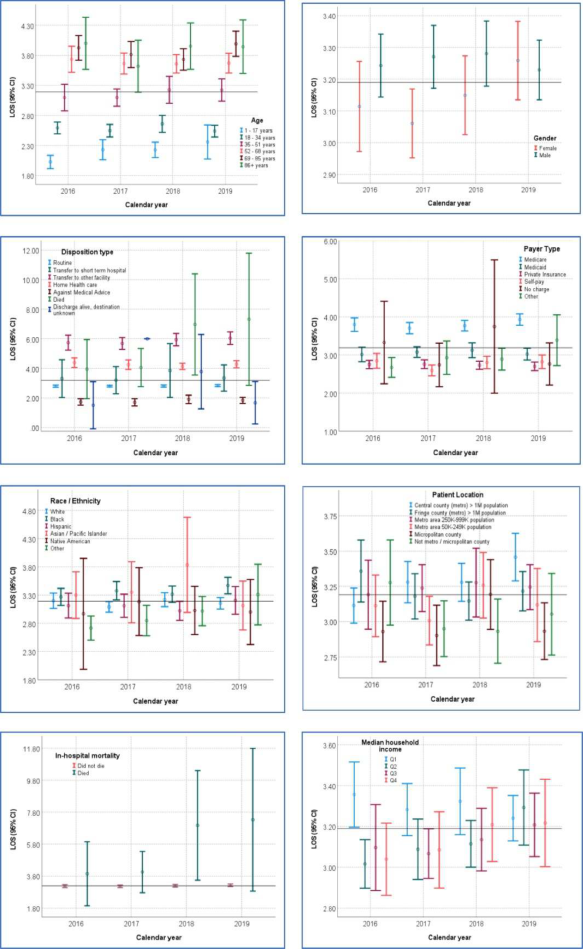
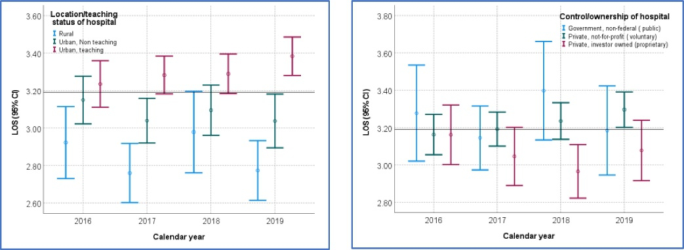
with β0 representing the intercept, βi (i = 1, 2 . . . 9) denoting regression coefficients for the predictors and ε being random error in the model. The results of the multivariate regression analysis are shown in Table 2. Figures 1 and 2 depict the mean LOS (with 95% confidence intervals) for patients hospitalized due to primary diagnosis of diabetes over the span of four years (2016–2019) assessed in this research study.
Table 2: Multivariable regression analysis of factors affecting hospital in-patient stays of diabetes-related complications in the US from 2016–2019.
Table available in the original PDF paper.
Analyzing Diabetes-Related Hospitalizations: Trends and Insights 185
TRENDS IN LOS FOR DIABETES-RELATED HOSPITALIZATIONS Results reveal that diabetes-related inpatient stays had a mean LOS of 3.17 days in 2016, increasing slightly to 3.18 days in 2017, 3.24 days in 2018, and 3.25 days in 2019. Increasing age was associated with a significant increase in the LOS of the hospitalized patients. The LOS was 2.03 days (p<0.0001*) for individuals below 17 years of age and 4.00 days for older patients (86+ years) in 2016. In 2017, the mean LOS was 2.23 days for <17 years age group and 3.62 for patients aged 86 years and older (p<0.0001*). Similar increasing trends were observed in 2018 and 2019 with LOS ranging from 2.23 days to 3.95 days and 2.36 to 3.99 days for these two categories, respectively. Male sex was significantly associated with longer LOS as compared to females in the years 2016 to 2018 (p<0.0001*). However, it was noted that there was a rising trend in mean LOS from 3.06 days to 3.26 days for female patients from 2017 to 2019. In 2019, the mean LOS for males (3.23) was slightly lower than for females (3.26).
Despite the high hospitalization frequencies among White ethnicities, the mean LOS for this group was in the range of 3.02 days to 3.20 days over the span of four years. Mean LOS was higher for Black patients (3.27–3.47 days) and patients belonging to Asian racial community (3.11–3.87 days). Patient location was also significantly associated with longer LOS. The individuals residing in central counties with over a million population showed a rising trend of mean LOS with 3.11 days in 2016 increased to 3.46 days in 2019 (p<0.0001*). Those residing in micropolitan counties had lower mean LOS as compared to metropolitan residents. The length of in-patient stays among the four income quartile groups significantly declined with the highest LOS for Q1 at 3.36 days to the lowest for Q4 at 3.04 days (for 2016). However, over the course of three years (2017 to 2019), it was observed that mean LOS for Q2, Q3, and Q4 exhibited a linearly increasing trend from 3.09 to 3.30 days, 3.07 to 3.21 days, and 3.09 to 3.22 days, respectively. Considering that the income ranges for the subsequent years were higher than the previous (see Table 1), these results are significant indicators of the association between median household income and LOS.
Patient disposition was also strongly associated with LOS. The patients discharged through routine processes exhibited an average LOS of 2.8 days (p<0.0001*). On the other hand, patients transferred to home health care after hospital discharge showed high LOS: 4.38 days (2016), 4.25 days (2017), 4.13 days (2018), and 4.28 days (2019). Patients transferred to other facilities exhibited an even higher mean LOS of 5.83 days from 2016– 2019. It was noted that the LOS increased from 3.95 days to 7.32 days for patients who died in the hospital during in-patient stays from 2016 to 2019. The group of patients who were discharged against medical advice spent an average of 1.8 days in hospitals. When compared to Medicare, Medicaid, private insurance, and self-pay indicated lower LOS. It was found that the average length of in-patient stays for Medicare-insured patients was 3.74 days, while it was 3.02 days for Medicaid, 2.75 days for private insurance, and 2.67 days for self-pay payers (p<0.0001*).
Among the hospital categories, urban teaching hospitals showed an increased LOS as compared to rural and urban, non-teaching hospitals. The
average LOS for rural hospitals was observed to be 2.84 days as compared to the mean LOS of 3.28 days for urban hospitals having teaching status. The highest frequency of hospitalizations of patients was reported from private (non-profit) hospitals. Over the years 2016 to 2019, the mean LOS was observed to be gradually increasing from 3.16 days to 3.30 days for privately owned (non-profit) hospitals.
Figure 1: Mean length of stay with 95% CI by demographics, income, and patient location for diabetes-related hospital in-patient stays in the US for years 2016–2019.
Analyzing Diabetes-Related Hospitalizations: Trends and Insights 187
Figure 2: Mean length of stay with 95% CI by hospital characteristics for diabetes- related hospital in-patient stays in the US for years 2016–2019.
UNDERSTANDING SOCIAL DETERMINANTS OF HEALTH: INSIGHTS FROM NIS DATA This study analyzed nationwide electronic health records from 2016–2019 to examine in-patient stays for diabetes-related hospitalizations, providing valuable insights into this high-risk population. By integrating cross-sectional and longitudinal analyses, the research explored socioeconomic factors and hospital characteristics to better understand the predictors of prolonged lengths of stay. Findings of the study revealed that older age (52+ years) was associated with an increased LOS of approximately 2 days over the younger group (<17 years) of patients. To improve patient outcomes and reduce hospital stays, providing geriatric-specific care, including regular health checkups and glucose monitoring, is essential. Additionally, implementing age-specific initiatives such as home healthcare services, telemedicine, community-based programs, and support systems may help alleviate hospital burden by facilitating timely discharges. A rising trend in mean length of stay (LOS) from 3.06 days to 3.26 days was observed among female patients from 2017 to 2019. In contrast, in 2019, the mean LOS for males (3.23 days) was slightly lower than that for females (3.26 days). These findings align with existing literature on healthcare disparities by sex (Gucciardi et al., 2008). While there appeared to be a relationship between male sex and variables of interest, interestingly, our analysis of data from 2016–2019 revealed that female patients had a higher incidence of hospitalizations.
While most hospitalized patients were discharged through routine process (mean LOS: 2.8 days); patients transferred to home health care (mean LOS: 4.28 days) and other facilities (mean LOS: 5.83 days) exhibited longer hospital in-patient stays for 2016–2019. The group of patients who were discharged against medical advice spent an average of 1.8 days in hospitals. Despite the high hospitalization frequency among White patients, their mean LOS ranged from 3.02 to 3.20 days over the four years studied. Analysis of NIS data revealed that the mean LOS was higher for Black patients (3.27–3.47 days) and Asian patients (3.11–3.87 days). Research has shown that cultural factors related to ethnicity can influence disease management compliance (Maldonado et al., 2003).
Hospital LOS varied across income levels, with lower-income groups initially experiencing longer stays. However, from 2017 to 2019, a gradual increase in LOS was observed among higher-income groups, highlighting the evolving impact of socioeconomic factors on hospitalization trends. Hospital conditions influenced LOS trends from 2016 to 2019, with privately owned non-profit hospitals experiencing a gradual increase in LOS. Additionally, urban teaching hospitals had longer stays compared to rural and non-teaching urban hospitals, signifying disparities in healthcare facility types and resource availability. These findings highlight the complex relationship between socioeconomic status, hospital characteristics, and healthcare accessibility in determining LOS. Addressing these disparities through targeted interventions, such as increased awareness, timely medical screenings, and sustained lifestyle changes, can play a crucial role in minimizing diabetes-related complications, reducing preventable hospitalizations, and enhancing overall healthcare efficiency.
LIMITATIONS As with other database studies, the NIS dataset relies on International Classification of Diseases-10 (ICD-10) coding, which may introduce some degree of underreporting or inaccuracies in modifier coding. Additionally, a few variables included in the analysis had low-frequency classification categories, potentially impacting the validity and usefulness of statistical estimates. In the NIS dataset, patient income data is reported as median income by ZIP code rather than individual income levels, limiting the ability to precisely assess its association with health outcomes. Education and employment status are considered significant drivers of health literacy and access to healthcare resources. However, the absence of variables on patient education and employment status presents a limitation that should be considered when interpreting the findings.
CONCLUSION
This study highlights the evolving trends in the length of stay (LOS) for diabetes-related hospitalizations and examines the key predictors influencing prolonged in-patient stays. Analysis of the longitudinal National Inpatient Sample (NIS) dataset (2016–2019) revealed a growing burden on the US healthcare system, with socioeconomic factors such as income, insurance type, and urbanization playing a significant role in hospitalization trends and LOS. Older adults and male patients experienced longer hospital stays, with most admissions occurring in private, non-profit, and urban teaching hospitals. A multivariate linear regression model identified critical predictors of LOS, including age, gender, income, insurance type, and hospital characteristics. These findings emphasize the need for targeted interventions, such as early screening, preventive care, and policy-driven healthcare improvements. Implementing proactive strategies can help reduce preventable hospitalizations, optimize healthcare resource allocation, and improve patient outcomes.
Analyzing Diabetes-Related Hospitalizations: Trends and Insights 189
REFERENCES
Agency for Healthcare Research and Quality (AHRQ), 2025. HCUP Databases: Healthcare Cost and Utilization Project (HCUP). Rockville, MD: Agency for Healthcare Research and Quality. Available at: www.hcup-us.ahrq.gov/ nisoverview.jsp [Accessed 12 June 2023]. Alemu, B. T. et al. (2020) ‘Characteristics of hospitalized adults with opioid use
disorder in the United States: Nationwide inpatient sample’, Journal of Pain Management, 13(1), pp. 41–47. Available at: https://research.ebsco.com/linkpro cessor/plink?id=d1490770-2ed4-31e0-8a13-c6f04e472b5f. Chakraborty, A., Pearson, O., Schwartzkopff, K. M., O’Rourke, I., Ranasinghe, I., Mah, P. M., Adams, R., Boyd, M. and Wittert, G. (2021) ‘The effectiveness of in-hospital interventions on reducing hospital length of stay and readmission of patients with Type 2 Diabetes Mellitus: A systematic review’, Diabetes Research and Clinical Practice, 174, p. 108363. https://doi.org/10.1016/j.diabres.2020. 108363 Ferdinand, A. O. et al. (2019) ‘Diabetes-related hospital mortality in the U.S.:
A pooled cross-sectional study of the National Inpatient Sample’, Journal of Diabetes and Its Complications, 33(5), pp. 350–355. doi: 10.1016/ j.jdiacomp.2019.01.007. Fingar, K. R. and Reid, L. D. (2021) Diabetes-related inpatient stays, 2018’, HCUP Statistical Brief #279. Agency for Healthcare Research and Quality (AHRQ). Available at: https://hcup-us.ahrq.gov/reports/statbriefs/sb279-Diabetes-Inpatie nt-Stays-2018.jsp (Accessed: 12 January 2025). Gucciardi, E., Wang, S. C.-T., DeMelo, M., Amaral, L. and Stewart, D. E. (2008)
‘Characteristics of men and women with diabetes: Observations during patients’ initial visit to a diabetes education centre’, Canadian Family Physician, 54(2), pp. 219–227. Heaton, P. C., Desai, V. C. A., Kelton, C. M. L. and Rajpathak, S. N. (2016) ‘Sulfonylurea use and the risk of hospital readmission in patients with type 2 diabetes’, BMC Endocrine Disorders, 16, p. 4. doi:10.1186/s12902-016-0084-z. International Diabetes Federation (2021) International Diabetes Federation Annual
Report 2021. Available at: https://www.idf.org/our-activities/advocacy-awarenes s/resources-and-tools/174-annual-report-2021.html (Accessed: 17 March 2024). Kalgotra, P. and Sharda, R. (2021) ‘When will I get out of the Hospital?
Modeling Length of Stay using Comorbidity Networks’, Journal of Management Information Systems, 38(4), pp. 1150–1184. doi: 10.1080/ 07421222.2021.1990618. Kim, S. J. et al. (2022) ‘Healthcare utilization disparities among lung cancer patients in US hospitals during 2010–2014: Evidence from the US Hispanic population’s hospital charges and length of stay’, International Journal of General Medicine, 15, pp. 1329–1339. doi: 10.2147/IJGM. S348159. Kukde, R. (2023) Analysis of Hospital In-Patient Stays and Readmissions of
Diabetic Patients in the United States. Available at: https://research.ebsco.com/ linkprocessor/plink?id=d6c3e407-87d5-36d7-bbb3-0bd6beb9c931 (Accessed: 2 January 2025). Maldonado, M. R., Chong, E. R., Oehl, M. A. and Balasubramanyam, A. (2003) ‘Economic impact of diabetic ketoacidosis in a multiethnic indigent population: Analysis of costs based on the precipitating cause’, Diabetes Care, 26(4), pp. 1265–1269. doi: 10.2337/diacare.26.4.1265.
Mourad, M., Wen, T., Friedman, A. M., Lonier, J. Y., D’Alton, M. E. and Zork, N.
(2020) ‘Postpartum readmissions among women with diabetes’, Obstetrics and Gynecology, 135(1), pp. 80–89. doi: 10.1097/AOG.0000000000003551. Rubens, M., Ramamoorthy, V., Saxena, A., McGranaghan, P. and McCormack- Granja, E. (2022) ‘Recent trends in diabetes-associated hospitalizations in the United States’, Journal of Clinical Medicine, 11(22), p. 6636. https://doi.org/10. 3390/jcm11226636 Siddique, S. M., Tipton, K. and Leas, B. (2021) ‘Interventions to reduce hospital
length of stay in high-risk populations: A systematic review’, JAMA Network Open, 4(9), p. e2125846. Available at: https://doi.org/10.1001/jamanetworkope n.2021.25846 Thyagaturu, H. S., Bolton, A. R., Li, S., Kumar, A., Shah, K. R. and Katz, D.
(2021) ‘Effect of diabetes mellitus on 30- and 90-day readmissions of patients with heart failure’, The American Journal of Cardiology, 155, pp. 78–85. doi: 10.1016/ j.amjcard.2021.06.016.
LISTED IN THE AHFE DIGITAL BOOKSTORE CATALOGUE
Explore the complete digital volume
Healthcare and Medical Devices
Read this individual research paper free through the original publisher, or explore the full digital proceedings book.
ISBN 978-1-964867-47-2
Explore this ISBN in the AHFE Bookstore ↗Listed in the July 2026 bookstore catalogue; search by ISBN to confirm current availability · Digital book purchase optional