Atsunori Someya, Manabu Sawaguchi (2025). Semi-Integral Architecture: A Strategic Perspective on Sustainable Maintenance and Repair Innovation in Social Infrastructure. In: Human Factors in Design, Engineering, and Computing. AHFE Open Access, vol. 199, pp. 1894–1904. https://doi.org/10.54941/ahfe1007000
In Japan, maintaining and repairing aging infrastructure has become urgent. Beyond substantial costs, the country faces a compound challenge: a shortage of engineers driven by an aging and declining population. This paper advances a strategic perspective, grounded in product architecture, for reconciling technological innovation and sustainability. Although product architecture is commonly classified as modular (high independence) or integral (high interdependence), this dichotomy fits poorly with infrastructure—such as bridges—designed for long-term service under ongoing maintenance and repair. To address this gap, we previously proposed Semi-Integral Architecture, a sustainable design concept that combines the interdependence of integral systems with the independence of modular systems, enabling partial modification and addition of components while maintaining overall system functionality. We also proposed two innovation models that capture technological change in maintenance and repair technologies: the Partial Innovation Model and the Additional Innovation Model. This study integrates these concepts and examines them through analyses of bridge improvement cases on Japan’s urban expressways. The results indicate that the Semi-Integral type serves as the structural basis for both models, confirm that the two models are used in combination, and identify the existence of spatial-constraint-induced radical innovation, whereby stringent spatial constraints trigger radical innovation. The findings further suggest that the Semi-Integral type aligns closely with Open Innovation (OI)–type collaboration and that this process provides an effective foundation for Human-Centered Design (HCD).
In Japan, roads and bridges built during and after the high-growth era have aged rapidly. Alongside this trend, maintenance and repair costs are rising, and an aging, shrinking population has created a shortage of civil engineers. Ensuring long-term infrastructure sustainability and advancing innovation in maintenance and repair are therefore urgent. Building on prior work, we proposed Semi-Integral Architecture (hereafter, Semi-Integral type) as
Semi-Integral Architecture: A Strategic Perspective on Sustainable Maintenance 1895
a sustainability-oriented design foundation compatible with infrastructure that presupposes ongoing, long-term maintenance and repair (Someya & Sawaguchi, 2024). We also introduced two innovation models that capture technological continuity in bridge maintenance and repair: the Partial Innovation Model and the Additional Innovation Model (Someya & Sawaguchi, 2023). This study constructs an integrated analytical framework that unifies these concepts and examines, through bridge improvement cases on Japan’s urban expressways, whether the Semi-Integral type functions as the basis for both the Partial Innovation Model and the Additional Innovation Model. The paper aims to bridge technology management and civil engineering, offering an analytical perspective with scholarly and practical value for sustainable infrastructure management.
PRIOR RESEARCH Definition and Classification of Product Architecture
Product architecture is “a design philosophy concerning how the functional elements of a product are mapped to physical components (parts) and how interdependencies among those components are configured” (Ulrich, 1995). The concept extends beyond a technical framework into organizational theory, competitive strategy, and innovation studies (Baldwin & Clark, 2000; Clark & Fujimoto, 1991; Fine, 1998; Henderson & Clark, 1990; Leonard- Barton, 1992). Based on intercomponent characteristics, product architecture is commonly classified as modular (combination-type) or integral (tightly coupled) (Fujimoto, 2003). Modular architectures exhibit one-to-one mapping between functions and components and low interdependence; products are assembled via standardized interfaces. Integral architectures lack one-to-one mapping and feature high interdependence, requiring cross- component adjustments for optimal design. These classifications evolved largely from domains such as consumer electronics and automobiles with internal combustion engines. In contrast, infrastructure—e.g., bridges— operates under a premise of long-term maintenance and repair rather than replacement. Japanese technical standards specify a 100-year design service life for bridges (Japan Road Association, 2017), with comparable periods in Europe and the United States (AASHTO, 2020; CEN, 2002). Here, maintenance and repair denotes partial or additive actions to preserve, restore, add, or strengthen the functions and structures of existing infrastructure.
Semi-Integral Architecture The Semi-Integral type is a product-architecture concept tailored to infrastructure. It combines the interdependence of integral systems with the independence of modular systems, enabling partial modification of specific components and functional additions while maintaining overall system functionality. This property suits long-lived infrastructure predicated on maintenance and repair. As a sustainable design framework that supports life extension and functional enhancement through improvement and expansion
1896 Someya and Sawaguchi
of existing structures, it aligns closely with Open Innovation (OI) and the Circular Economy (CE) (Someya & Sawaguchi, 2024).
Innovation Models in Maintenance and Repair Technologies Drawing on bridge product development cases on urban expressways and interview surveys, we proposed two models for maintenance and repair technologies: the Partial Innovation Model and the Additional Innovation Model. The Partial Innovation Model addresses improvements to existing components and tends toward incremental innovation, whereas the Additional Innovation Model adds new components and tends toward radical innovation. The models are distinguished by the presence or absence of technological continuity. Developed from a product-architecture perspective, they recognize the interdependence among bridge components and categorize systems into innovative parts, existing parts, and coupling. This categorization enables analysis of characteristics and challenges and clarifies the mechanism through which innovation emerges. Coupling is also noted to entail mutual adjustment among components (Someya & Sawaguchi, 2023).
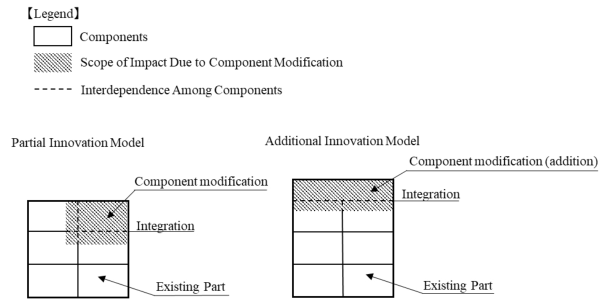
Gaps in Prior Research and Positioning of this Study Conventional work on infrastructure maintenance has emphasized individual technological developments, with limited incorporation of a technology management (MOT) perspective in civil engineering. This study integrates the Semi-Integral type with the above innovation models to theoretically elucidate component changes during the maintenance and repair phase from the standpoint of technological continuity. Figure 1 presents the integrated conceptual diagram of the two theories. The goal is to provide a strategic perspective that helps reconcile technological innovation with sustainability in the maintenance phase of infrastructure.
Figure 1: Conceptual diagram of the semi-integral type and maintenance and repair innovation models. Prepared by the authors based on Someya and Sawaguchi (2023; 2024).
Semi-Integral Architecture: A Strategic Perspective on Sustainable Maintenance 1897
RESEARCH METHODS Analytical Targets
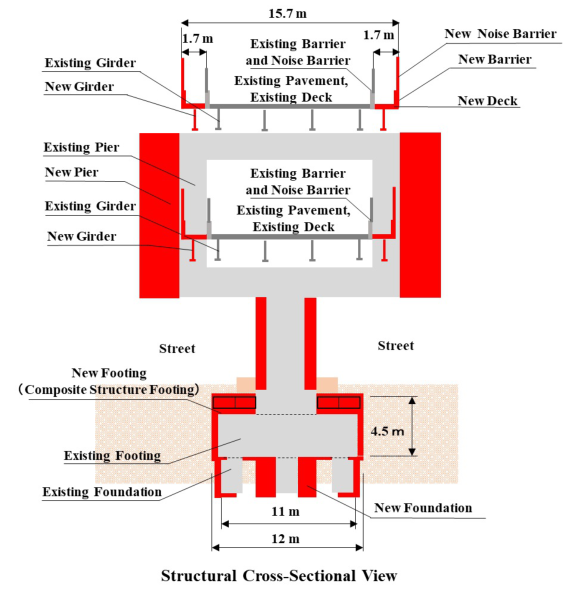
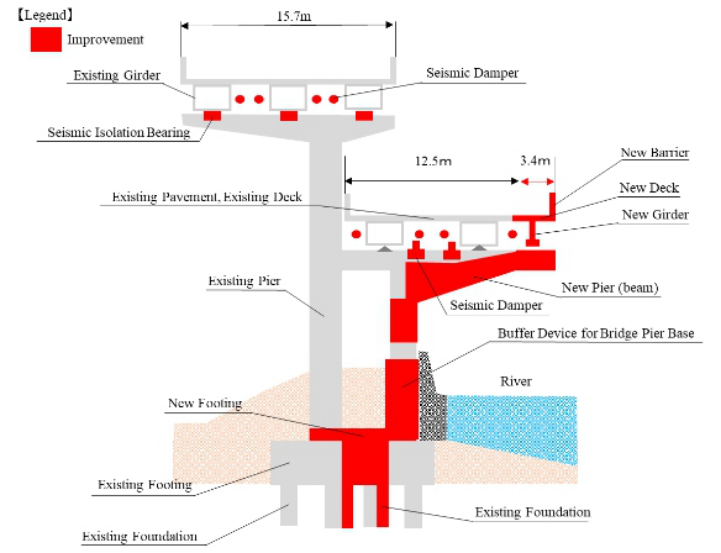
We analyze two bridge improvement cases on urban expressways, a core element of urban infrastructure. These cases were used previously to validate the suitability of Semi-Integral Architecture (Someya & Sawaguchi, 2024). The projects sought to enhance functionality to accommodate increased traffic capacity and involved large-scale interventions spanning the entire bridge system—main girders, deck slabs, piers, foundations, and ancillary facilities—with adoption of new technologies. Such system-wide interventions are well suited to examining partial modification or addition while maintaining the existing system. In Improvement Case 1, a 520 m section was widened from three to four lanes in a heavy-traffic corridor. The bridge, a double-deck structure with racket-type piers, is located above a street 40 m wide (Figure 2). Both upper and lower decks were widened by 1.7 m. In Improvement Case 2, the lower deck of a 560 m section was widened from three to four lanes. The maximum widening was 3.4 m. Situated within the river levee zone, the project implemented seismic isolation and vibration control to improve seismic performance while minimizing effects on the substructure (Figure 3).
Figure 2: Improvement case 1.
1898 Someya and Sawaguchi
Figure 3: Improvement case 2.
Case Analysis and Classification Methods We analyzed each case using the integrated concept in Gaps in prior research and positioning of this study, following the classification and organization flow in Table 1; the details of prior classifications are also summarized in Table 1. To limit subjectivity and ensure objectivity, we conducted interviews with two civil engineers involved in the bridge-improvement design and validated the results. Case data were drawn from published technical papers on design and construction methods (Ito et al., 2018; Someya et al., 2018; Someya & Usui, 2021).
RESULTS
We focus on classifications by the Partial Innovation Model and Additional Innovation Model, as well as on technological continuity. As shown in Table 2, among 19 improved components, Improvement Case 1 includes four Partial, three Additive, and three combined instances. According to Table 3, Improvement Case 1 comprises eight incremental and two radical innovations. By contrast, Improvement Case 2 includes one Partial, seven Additive, and one combined instance; for technological continuity, it comprises eight incremental and one radical innovation. Table 4 details these classifications.
Semi-Integral Architecture: A Strategic Perspective on Sustainable Maintenance 1899
Table 1. Classification and organization flow. Prepared by the authors based on Someya and Sawaguchi (2023; 2024).
Table available in the original PDF paper.
No. Step Name Classification/Content
Superstructure Main Girders, Deck, etc.
1 Structure Classifications
Substructure Piers, Footings, and Foundations, etc.
2 Classification of Components
Main Girder, Deck, Barrier, Barrier Curb, Noise Barrier, Pavement, Pier, Footing, Foundation, Scaffolding, Compartment Line, Road Marking, Waterproof Deck, Bearing, Seismic Control Device, Anti-Drop Fence, Bridge Decorative Equipment, and Other.
3 Outline of Improvements
Outline of improvements, etc., of each component is described.
4 Category of innovation models
Partial Innovation Model
Model in which innovation is established by the existing change of components.
Additional Innovation Model
Model in which innovation is established by newly adding components to existing components.
Incremental innovation
Handled through the extension of existing technology (technology from a specific company).
5 Category depending on the existence or nonexistence of technological continuity
Radical innovation New technology is required (technology from a specific company).
High It has a significant impact on the main structural components involved.
6 Evaluation of Impact on Other Components
Medium It has a limited impact on connected structural components.
Low It has almost no impact on connected structural components.
Table 2: Classification by Innovation Model Case Category Count Share
Table available in the original PDF paper.
Improvement Case 1
Partial Innovation Model 4 40% Additional Innovation Model 3 30% Partial + Additive (combined use) 3 30% Total 10 100% Improvement
Case 2
Partial Innovation Model 1 11% Additional Innovation Model 7 78% Partial + Additive (combined use) 1 11% Total 9 100%
1900 Someya and Sawaguchi
Table 3: Classification by technological continuity.
Table available in the original PDF paper.
Case Category Count Share Improvement Case 1 Incremental Innovation 8 80% Radical Innovation 2 20% Total 10 100% Improvement Case 2 Incremental Innovation 8 89% Radical Innovation 1 11% Total 9 100%
DISCUSSION
Our analysis indicates that the Semi-Integral type functions effectively as the basis for both the Partial Innovation Model and the Additional Innovation Model.
Semi-Integral Architecture and the Innovation Models All 19 improved components were classifiable as Partial, Additive, or a combination of the two. This suggests that the Semi-Integral type—conceived as a sustainability-oriented design concept for infrastructure under long- term maintenance and repair—serves as a practical analytical foundation for capturing ensuing technological change. Notably, combined use was observed (three instances in Improvement Case 1; one in Case 2), underscoring that large-scale infrastructure upgrades proceed through interdependent improvements to existing components and additions of new components rather than as isolated processes. This lens complements prior studies focused on individual technologies.
Spatial-Constraint-Induced Radical Innovation For the technologies classified as radical—No.8 double-racket pier and No.9 composite-structure footing in Case 1, and No.14 seismic isolation and vibration control devices in Case 2—we found a shared driver: stringent spatial constraints. Although upgrades to the primary structural system were essential to meet traffic growth and ensure seismic performance, constrained urban settings and river areas made conventional approaches infeasible, prompting shifts to non-incremental solutions. Thus, constraints can act as triggers for innovation rather than barriers. This observation aligns with Keupp & Gassmann (2013) and Acar et al. (2019), while extending their arguments specifically to spatial constraints and introducing the concept of spatial-constraint-induced radical innovation.
Semi-Integral Architecture: A Strategic Perspective on Sustainable Maintenance 1901
Table 4. Detailed classifications.
Table available in the original PDF paper.
1902 Someya and Sawaguchi
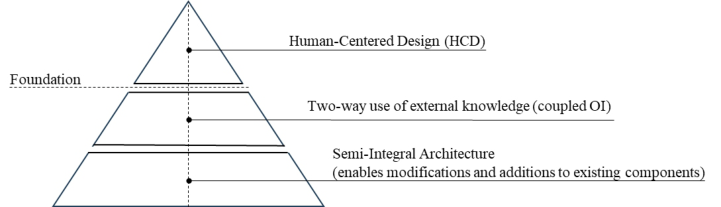
Collaborative Mechanisms: The Composite-Structure Footing No. 9 composite-structure footing exemplifies a radical shift in product architecture induced by spatial constraints. Embedding steel lattice members within the footing added a structural mechanism and reconfigured load paths among the pier, footing, foundation, and existing structures—a reconstruction of inter-component coupling characteristic of the Semi- Integral approach. Addressing this challenge required interorganizational collaboration: the infrastructure operator articulated human-centered requirements (user safety and drivability; noise, vibration, and landscape considerations; effects on adjacent roads); the engineering consultant designed under these constraints; and the contractor advanced and demonstrated new technologies and methods through detailed site design and construction expertise. The joint development integrated specialized knowledge and resulted in a patent (Ihara et al., 2018). Treating the operator as a user, the team’s bidirectional knowledge exchange corresponds to the Coupled type in Open Innovation (OI). Consequently, the Semi-Integral approach fosters mutual knowledge complementarity and flexible responses for service-life extension and functional enhancement. These collaborative and knowledge-integration processes align closely with Human-Centered Design (HCD) principles; Figure 4 depicts the relationship between product architecture and HCD. By enabling component modification and addition on a reconfigurable, flexible foundation, the Semi-Integral type facilitates team knowledge integration and supports user involvement throughout development, multidisciplinary team formation, and iterative evaluation and improvement (ISO, 2019).
Figure 4: Relationship between the semi-integral architecture and human-centered design.
Limitaions and Future Directions Because our findings rest on two cases, generalizability is limited. Future work should extend the analysis to other infrastructure to further test the framework. In addition, we aim to systematize the bidirectional external-knowledge practices observed in the composite-structure footing case using the perspectives of HCD and Participatory Design (PD). Establishing participatory approaches within the construction industry’s complex, division-of-labor context appears critical for sustaining radical innovation.
Semi-Integral Architecture: A Strategic Perspective on Sustainable Maintenance 1903
CONCLUSION
Analyzing urban expressway bridge improvements, we find that the Semi- Integral approach, proposed previously, effectively underpins the innovation models relevant to the urgent challenge of maintaining and repairing aging infrastructure. We provide theoretical and practical perspectives on innovation in this context. First, the Semi-Integral approach accommodates the Partial and Additional models and offers a flexible foundation for incremental and radical innovation. Second, we introduce spatial-constraint- induced radical innovation, wherein stringent spatial constraints act as triggers. Third, through the composite-structure footing case, we showed that the Semi-Integral approach aligns with Coupled-type Open Innovation (OI) and can support HCD as an effective foundation. Overall, we propose a design and management framework that reconciles innovation and sustainability by combining the Partial and Additional models under a Semi- Integral foundation and by reconfiguring inter-component coupling while maintaining overall functionality to optimize existing structures. Aligning component coupling with organizational collaboration offers a strategic pathway for integrating external knowledge through Coupled-type OI and HCD. These results suggest that the Semi-Integral approach is a strategic design concept for balancing infrastructure sustainability and technological innovation, with meaningful implications for practice and for bridging technology management and civil engineering toward sustainable social infrastructure.
REFERENCES
Acar, O. A., Tarakci, M. & van Knippenberg, D., 2019. Creativity and innovation under constraints: A cross-disciplinary integrative review. Journal of Management, 45(1), pp. 96–121. American Association of State Highway and Transportation Officials (AASHTO),
2020. LRFD Bridge Design Specifications. 9th ed. Washington, DC: AASHTO. Baldwin, C. Y. & Clark, K. B., 2000. Design Rules: The Power of Modularity.
Cambridge, MA: MIT Press. Clark, K. B. & Fujimoto, T., 1991. Product Development Performance: Strategy, Organization, and Management in the World Auto Industry. Boston, MA: Harvard Business School Press. European Committee for Standardization (CEN), 2002. Eurocode – Basis of
Structural Design (EN 1990:2002). Brussels: CEN. Fine, C. H., 1998. Clockspeed: Winning Industry Control in the Age of Temporary Advantage. Reading, MA: Perseus Books. Fujimoto, T., 2003. N¯oryoku k¯ochiku ky¯os¯o: Nihon no jid¯osha sangy¯o wa naze
tsuyoi no ka [Capability building competition: Why Japan’s automobile industry is strong]. Tokyo: Ch¯u¯ok¯oron Shinsha. [in Japanese]. Henderson, R. M. & Clark, K. B., 1990. Architectural innovation: The reconfiguration of existing product technologies and the failure of established firms. Administrative Science Quarterly, 35(1), pp. 9–30. Ihara, S., et al., 2018. K¯osei hashira to f¯uchingu no setsug¯o k¯oz¯o oyobi sono sek¯o h¯oh¯o [Steel column and footing joint structure and its construction method]. Japanese Patent JP6266246B2, 24 Jan 2018. Available at: https:// patents.google.com/patent/JP6266246B2/ja (accessed 29 Aug 2025). [in Japanese].
1904 Someya and Sawaguchi
International Organization for Standardization (ISO), 2019. ISO 9241–210:2019 Ergonomics of human-system interaction — Human-centred design for interactive systems. Geneva: ISO. Ito, H., Migitaka, Y., Kanemaru, T., Seo, T. & Miyamoto, Y., 2018. Itabashi-
Kumanomachi JCT kan kairy¯o jigy¯o ni okeru kabuk¯oz¯o no sek¯o [Construction of substructures in the Itabashi–Kumanomachi JCT improvement project]. Kyouryou to Kiso (Bridge and Foundation), 52(5), May 2018. [in Japanese]. Japan Road Association (JRA), 2017. D¯oroky¯o shih¯osho d¯o kaisetsu: I Ky¯ots¯u-hen, II K¯oky¯o/K¯o bubun-hen [Specifications for highway bridges and commentary: Part I General, Part II Steel bridges and members]. Tokyo: Japan Road Association. [in Japanese]. Keupp, M. M. & Gassmann, O., 2013. Resource constraints as triggers of radical
innovation: Longitudinal evidence from the manufacturing sector. Research Policy, 42(8), pp. 1457–1468. Leonard-Barton, D., 1992. Core capabilities and core rigidities: A paradox in managing new product development. Strategic Management Journal, 13(S1), pp. 111–125. Someya, A. & Sawaguchi, M., 2023. Ky¯ory¯o no iji-sh¯uzen gijutsu ni okeru inob¯eshon
moderu [Innovation models in bridge maintenance and repair technologies]. Nihon Keiei Shisutemu Gakkai-shi (Journal of Japan Association for Management Systems), 40(1), pp. 49–64. [in Japanese]. Someya, A. & Sawaguchi, M., 2024. Semi-Integral Architecture: Sustainable Infrastructure Concept. In: Proceedings of PICMET ’24: Portland International Conference on Management of Engineering and Technology, pp. 1–12. Someya, A., Sumida, R., Saito, T., Kadota, T. & Ishibe, T., 2018. Itabashi-
Kumanomachi JCT kan kairy¯o jigy¯o ni okeru j¯obuk¯oz¯o/kabuk¯oz¯o no sekkei [Design of superstructure and substructure in the Itabashi–Kumanomachi JCT improvement project]. Kyouryou to Kiso (Bridge and Foundation), 52(5), May 2018. [in Japanese]. Someya, A. & Usui, T., 2021. Ch¯u¯okanj¯osen kin¯o ky¯oka jigy¯o ni okeru k¯oky¯o no kairy¯o jirei [Case study of steel bridge improvement in the Central Circular Route functional enhancement project]. In: Dai-24-kai Hashi ni kansuru Shinpojiumu: K¯oky¯o no REBORN gijutsu – Jizoku-teki na katsuy¯o ni muketa jisedai e no k¯oky¯o no kairy¯o (Proceedings of the 24th Symposium on Bridges: REBORN technology for steel bridges toward next generation), pp. 83–94. [in Japanese]. Ulrich, K. T., 1995. The role of product architecture in the manufacturing firm.
Research Policy, 24(3), pp. 419–440.
LISTED IN THE AHFE DIGITAL BOOKSTORE CATALOGUE
Explore the complete digital volume
Human Factors in Design, Engineering, and Computing
Read this individual research paper free through the original publisher, or explore the full digital proceedings book.
ISBN 978-1-964867-75-5
Explore this ISBN in the AHFE Bookstore ↗Listed in the July 2026 bookstore catalogue; search by ISBN to confirm current availability · Digital book purchase optional