Lena Plum, Elisabeth Shi (2025). Raising Awareness for Confusion - Stimulating the Discussion About Robustness of Mode Awareness Assessment in Automated Driving. In: Human Factors in Design, Engineering, and Computing. AHFE Open Access, vol. 199, pp. 2110–2119. https://doi.org/10.54941/ahfe1007023
Mode awareness is a complex psychological construct concerning the awareness of the currently active mode in an entire multi-mode system such as vehicles equipped with driving automation systems. The article aims to stimulate scientific discussion around the test quality of mode awareness assessment related to driving automation. Often, behavioral metrics are examined to draw conclusions on drivers’ understanding of the driving automation system and its status. Here, behavior deemed adequate for the active driving mode is subsequently attributed to mode awareness, while mode inadequate behavior is attributed to mode confusion. Besides cognitive representation of information, other influencing variables can contribute to the observed behavior. Considering basic psychological processes of information processing and action selection, the authors highlight how alternative explanations for observed behavior emerge. The authors advocate following recent approaches of combining metrics to capture human-machine-interactions holistically and draw more reliable conclusions while ruling out alternative explanations.
Human factors researchers have considered the concept of mode awareness in multiple contexts before similar research in the automated driving context arose. For instance, in aviation, switching between autopilot-modes and manual modes for operating an aircraft has long been investigated to identify weaknesses in safety systems. Researchers have developed cognitive and computational models, measured pilots’ behaviors to identify challenges when switching between modes of operation and came up with solutions to avoid resulting hazardous situations (e.g. Björklund et al., 2006; Borst et al., 2014; Kaber & Kim, 2011; Sivaramakrishnan et al., 2019). In less momentous fields, such as use of text editors, “mode awareness” plays a role when switching between modes of keying especially when keys serve multiple functions. Adjustments in the design of text editors or keying were researched in terms of their capacity to help avoid misunderstandings of which mode is
Raising Awareness for Confusion—Stimulating the Discussion 2111
currently active (Monk, 1986; Thimbleby, 1982). In the past decade, the concept of mode awareness has gained great attention in the context of automated driving.
USERS’ AWARENESS OF TODAY’S AVAILABLE DRIVING MODES Today, driving automation systems up to SAE Level 3 (SAE International, 2021) are available for purchase. Driver assistance systems of SAE Level 1 and SAE Level 2 offer an assisted driving mode where drivers are supported, but not released from their driving task (Döring et al., 2016). When driving automation systems meet criteria of at least SAE Level 3, they offer an automated driving mode. Level 3 systems perform the entire driving task within their operational design domain, and release their drivers from the driving task for the respective period of time (SAE International, 2021). Lately, Level 2 hands-off systems have entered the market. In Level 2 hands- off driving mode, drivers do not hold the steering wheel anymore, but are not released from the driving task (e.g. General Motors, 15.02.24.) All driving modes described are available to the general public even on the same vehicle (e.g. BMW Group, 25.06.24). To keep themselves and other road users safe, today’s drivers must possess a clear understanding of the currently active system or driving mode and their corresponding responsibilities for vehicle operation at all times. A situation can become dangerous, for instance, if drivers fail to fulfill their monitoring responsibilities while operating a Level 2 system, thereby overlooking a system limit and subsequently causing an accident. Such issues have been documented in on-road incidents involving drivers of vehicles equipped with active Level 2 systems (e.g. NTSB, 2017). The increasing variety of available driving modes may increase risk for such errors, thereby posing challenges to road safety (e.g. Lassmann et al., 2020). Researchers have investigated the concept of mode awareness in the context of automated driving to identify and address emerging issues at an early stage (e.g. Tinga et al., 2023).
MOTIVATION, AIM AND SCOPE Like other fields of empirical research, human factors research is based on drawing inferences from observable behavior on mental states. In methodological terms, a mental state that is not directly observable and is inferred from other variables and referred to as a latent variable. In contrast, manifest variables are directly observable and measurable. Ideally, combined manifest variables correlate highly, which allows the assumption that they are suitable to reflect a common latent variable. In the field of mode awareness related to driving modes, inferences are typically based on driving related measures and self-report on participants’ mode awareness (Lassmann et al., 2020). In psychological terms, “A psychological test is a scientific data collection procedure that consists of several test items (…), and defined rules for their application and evaluation (…). The aim of a psychological test is to measure a latent psychological characteristic (…) - in its absolute or relative expression for research purposes or for practical decisions.” (Döring
2112 Plum
et al., 2016, p. 431). There are specific procedures to develop a psychological test to fulfill the test quality criteria of objectivity, reliability and validity. These shall not be described in further detail here, but kept in mind when it comes to mode awareness. To the authors’ knowledge, there is no established standardized approach to measure mode awareness related to driving modes. This article critically discusses the space between the latent variable “mode awareness” and the manifest variables of observable driver behaviors that serve as indicators for its assessment. Thereby, this paper aims at
1. providing a methodological contribution that provokes novel conversations around the robustness of inferences drawn from manifest variables of driver behavior on the latent variable of mode awareness
2. motivating and provoking conversations and future work on objective, reliable and valid mode awareness assessment.
MODE AWARENESS OF DRIVING MODES: CHALLENGES OF DEFINITIONS AND ASSESSMENT Research in the context of driving automation highlights different facets of mode awareness. The understanding and definition of mode awareness differs greatly across studies. Some definitions focus on the awareness of the currently activated driving mode and its potential states: For instance, Hesse et al. (2011) state that “Mode awareness is determined by the driver’s knowledge and understanding of the system’s actual and future status based on the current mode” (p. 286). Other definitions focus on awareness of available driving modes on the currently driven vehicle: For instance, Novakazi et al. (2021) bases their definition of mode awareness on Monk (1986): “Monk (…) differentiated between two types of mode awareness. First, the awareness of the existence of different levels of automation and second, the awareness of the currently active mode.” (p. 79). These examples for the current notion of mode awareness show that researchers have different perspectives on mode awareness. The concept of mode awareness can refer to only one mode and its respective states. For others, mode awareness includes not only the currently active driving mode with its states, but also all other driving modes potentially available on the vehicle.
From a psychological perspective, mode awareness appears to be an abstract concept involving multiple cognitive processes such as perception, mental representation, decision making, recall and use of learned information. It is noticeable that background knowledge as well as situational understanding about the functionality and limits of the system and its different states play a significant role in mode awareness. Such information must be learned, remembered and recalled in interaction with the system.
Kurpiers et al. (2020) further distinguishes between two types of knowledge relevant for mode awareness: Type 1 awareness refers to the overall knowledge of a system’s individual modes and their functionality; Type 2 awareness refers to being aware of the currently active mode. As such, mode awareness comprises understanding the system both in general and in a specific situation. In other words, the mental representation a person forms or has regarding their interaction with the system is of importance.
Raising Awareness for Confusion—Stimulating the Discussion 2113
State-of-the-Art Mode Awareness Assessment Given the differences in definitions of mode awareness, it does not surprise that operationalizations differ as well. Nonetheless, the general approaches to assess mode awareness do not diverge that much. This may hint towards general validity of the examined approaches. Typical manifest variables include for example drivers’ reactions to automation errors (Boos et al., 2020), engagement in non-driving related activities (Damböck, 2013), eye-tracking data (Liu et al., 2022) and questionnaires, often on drivers’ situation awareness (Revell et al., 2021). The idea is that mode adequate driver behavior indicates mode awareness, while mode inadequate behavior indicates a lack of mode awareness. Here, mode adequate driver behavior describes driver behavior that is in accordance with their role in the interaction with a currently active driving automation system. Mode inadequate driver behavior describes driver behavior that is not in accordance with their role in the interaction with a currently active driving automation system.
As early as 1995, Sarter and Woods (1995) advocated for a process- oriented rather than a product-oriented approach to the construct of “situation awareness.” While their focus was on the process of product development, a similar perspective can be applied to the investigation of other psychological constructs.
The knowledge component underlying mode awareness emerges from both recalling learned information and processing situational information. This increases complexity of mode awareness assessment as it requires, among other aspects, assessing mental models – a challenging domain on its own. Still, many studies have examined mode awareness by focusing on one or a few specific metrics, thereby overlooking the assessment of the whole construct as defined (Gauer, 2022, N. Stanton, 2021). In this respect, others emphasize the insufficiency of pinning a complex latent variable such as mode awareness to a single metric (Björklund et al., 2006). However, more recent approaches and recommendations for mode awareness assessment take a step into a more comprehensive direction. Kurpiers et al. (2020) encourage combining several methods and emphasize the need to consider alternative explanations for observed behavior. Other researchers subdivide the construct of mode awareness itself to unravel more specifically how mode awareness and mode confusion play together. Haghzare et al. (2022) for example state that mode confusion arises when driver’s Type 1 awareness is accurate, while lacking Type 2 awareness.
Selecting a method to accurately trace back observed participant behavior to mode awareness or mode confusion requires careful consideration of the assumed cognitive processes.
Challenges of Mode Awareness Assessment The following example is used to illustrate the challenges of mode awareness assessment: A driver uses a Level 2 hands on system and receives a text message from their spouse. The driver takes their cellphone to read the message and texts back. Texting while driving in assisted mode depicts a
2114 Plum
behavior inadequate to the driving mode. One explanation for this behavior is that the driver is unaware of the current driving mode and expects to be in automated driving mode instead of assisted driving mode. In this case, the driver’s mode inadequate behavior traces back to their lack of mode awareness. Another possibility is that the driver deliberately prioritizes texting their spouse over their driving task. In this case, the driver possesses mode awareness and still acts inadequately to the current driving mode (e.g. Boos et al., 2020). This is typically referred to as misuse (Parasuraman & Riley, 1997). In the absence of mode awareness, mode adequate behavior is unlikely as it would occur by chance only rather than being informed by knowledge. Conversely, even when users are fully aware of the current driving mode, they may still choose to engage in non-driving-related activities, such as texting, despite a clear understanding of the associated risks.
Regarding the assessment of mode awareness, this raises the question if (and to what extent) we can infer mode awareness from observed mode adequate or mode inadequate behavior. Mode confusion and mode awareness are constructs describing if the driver’s mental representation of driving modes is suitable or not. Such mental representation can influence mode adequate or inadequate behavior, but like human behavior in general, driver behavior is influenced by multiple factors. Dimensions such as trust, distraction, workload or risk-awareness as well as situational factors may influence or lead to different types of observable behaviors like gaze behavior, driving behavior, correcting driver assistance systems, executing mode changes or engaging in non-driving related activities (see Table 1; Kurpiers et al., 2020; Dönmez Özkan et al., 2021; Sarter & Woods, 1995; Othersen, 2016; Feldhütter et al., 2018)
Table 1: Compilation of exemplary variables influencing displayed driver behavior.
- Instruction and experience (Type 1) influenced by HMI and capacity to sustain (Type 2) - Range/detail of knowledge (limits, functionality, current status, own role/responsibility/duties) The absence of mode awareness, or the opposite of mode awareness is often referred to as “mode confusion” (Reason, 1990). If drivers lack mode awareness, they might believe they act adequately to the current mode, however, as they confused modes, they in fact do not act mode adequately. Such unexpected mode inadequate driver behavior is referred to as “mode error” (Norman, 1980). Conversely, mode adequate behavior does not necessarily imply full mode awareness. Until a specific behavior is displayed, influences can act at different levels and can change the selection
Raising Awareness for Confusion—Stimulating the Discussion 2115
and execution of the behavior. These influencing factors may comprise more than only drivers’ mode awareness. However, to our impression, other influencing factors are not discussed sufficiently and critically enough in research on mode awareness assessment.
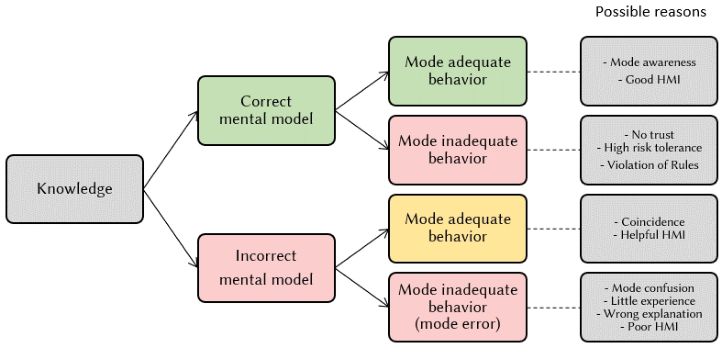
DIVING INTO THE GAP BETWEEN MODE AWARENESS AND ITS MANIFEST VARIABLES To shed light on the gap between mode awareness as the latent variable of interest and observable driver behaviors, the following tree diagram was created (Figure 1). It aims to illustrate where certain behaviors branch off, and what background there may be for a behavior that is eventually observable.
The tree diagram begins on the left with the knowledge a person has acquired about the driving automation system they are interacting with, encompassing both its functionality (Type 1 awareness) and the current mode in a given situation (Type 2 awareness). This knowledge may be either correct or incorrect, indicating that the person either possesses a correct or incorrect mental model of the system and its status.
Figure 1: Tree diagram illustrating the emergence process of adequate and inadequate behavior in the context of mode awareness while considering alternative explanations.
If the driver’s mental model of the system and its current status is correct (upper half), they have accurate mode awareness. Assuming that mode awareness involves drivers understanding their tasks and responsibilities in each mode, then they would also be aware of the mode adequate behaviors and be able to execute them effectively. Despite knowing how to act mode adequately, they could still choose to behave differently. Exemplary reasons for this are listed on the right of the diagram. If the driver’s mental model of the system and its current status is incorrect (lower half), they may confuse the activated mode and its functionality with another mode, leading unintentionally to mode inadequate behavior. In this case, the driver was mode confused and produced a mode error. Yet, even with an incorrect mental model, a driver can still show mode adequate behavior. This could
2116 Plum
be due to mere coincidence, or even because the system’s HMI was designed so they were nudged into executing mode adequate behavior.
The tree diagram illustrates that mode awareness was the underlying factor for mode adequate behavior in one path only, while mode confusion was the potential cause of mode inadequate behavior in just one path. The visualization suggests that each path carries a specific probability, which can be taken into account during method selection.
Differentiating between Type 1 and Type 2 awareness could even specify this further: a driver may understand the system but misidentify the active mode, resulting in mode inadequate behaviour and showing that mode confusion may arise when Type 2 awareness is incorrect even when Type 1 awareness was correct. Additionally, it should be noted that both background knowledge about the system and situational knowledge may be partially correct or incorrect, which could be even further branched off in the diagram. Hence, we assume that mode awareness and mode confusion are not binary constructs but must be considered on a spectrum. Precisely for this reason, the tree diagram depicted in Figure 1 is not an all-encompassing or sufficient representation of the constructs of mode awareness and mode confusion but rather a thought-provoking impulse to visualize the importance of considering alternative explanations for observable information and selecting methods accordingly. Especially the method of combining different manifest variables aims at strengthening the robustness of the inference that resulting behavior can be attributed to a latent variable in question and serves as a bridge to overcome the gap between not directly observable mental states and directly observable behavior. Mode awareness assessment would benefit greatly from this approach.
FUTURE RESEARCH To shape future research, the discussed insights on mode awareness in driving must be acknowledged, including the importance of human processing theories and experimental psychology. Considering diverse explanatory processes can improve assessment quality. Since mode awareness is rarely studied directly but rather appearing in HMI evaluations, the need for dedicated methodological research is evident. Crucially, mode awareness must be clearly defined and its components analyzed to develop targeted measures, rule out alternative explanations, and distinguish it from related concepts like situation awareness.
Main Message and Conclusion With increasing driving automation, users may find many different driving automation systems in their new vehicles. This motivates research on non-expert users’ mode awareness and understanding of their role in the interaction with different driving automation systems. Methods to assess mode awareness regarding driving automation modes are mostly based on metrics derived from observable human behavior (including self-report). While mode awareness is often viewed as the final outcome, it could also be regarded as a mental state embedded in a more abstract and complex cognitive process. Mode awareness may be followed by mode adequate
Raising Awareness for Confusion—Stimulating the Discussion 2117
behaviors, but human behavior is rarely mono-causal and there may be numerous alternative explanations for an observed behavior. Hence, we emphasize to carefully consider the complexity of human experience and behavior when selecting methods for mode awareness assessment. We argue in favor of more recent approaches combining methods to capture human interactions more holistically with the aim to draw more robust conclusions while ruling out alternative explanations. This also stresses the need for thorough validation of assessment methods.
This article provides a thought-provoking impulse to stimulate methodological reflections around the objectivity, reliability and validity of mode awareness assessment methods. It stimulates discussion on the robustness of inferences made from observable human behavior regarding the unobservable mental state of mode awareness. In this sense, the article touches on several potential strings of further research, e.g. test quality of mode awareness, test methods or computing probabilities for adequate or inadequate behavior - potentially even depending on factors like HMI design. The authors aim to stimulate conversations and future work on the quality of assessment methods of mode awareness.
ACKNOWLEDGMENT
This work is a result of the joint research project STADT:up. The project is supported by the German Federal Ministry of Economic Affairs and Energy (BMWE), based on a decision of the German Bundestag. The authors are solely responsible for the content of this publication.
CREDIT AUTHOR STATEMENT Lena Plum: writing – original draft preparation; writing – review & editing; methodology; conceptualization; formal analysis; validation.
Elisabeth Shi: writing – original draft preparation; writing – review & editing; conceptualization (supporting); funding acquisition; project administration; supervision
REFERENCES
Björklund, C., Alfredson, J., & Dekker, S. (2006). Mode monitoring and callouts: An eye-tracking study of two-crew automated flight deck operations. The International Journal of Aviation Psychology, 16(3), 263–275. https://doi.org/10. 1207/s15327108ijap1603_2 Boos, A., Feldhutter, A., Schwiebacher, J., & Bengler, K. (2020). Mode errors and
intentional violations in visual monitoring of level 2 driving automation. In 2020 IEEE 23rd International Conference on Intelligent Transportation Systems (ITSC) (pp. 1–7). IEEE. https://doi.org/10.1109/ITSC45102.2020.9294690 Borst, C., Grootendorst, F. H., Brouwer, D. I. K., Bedoya, C., Mulder, M., & van Paassen, M. M. (2014). Design and Evaluation of a Safety Augmentation System for Aircraft. Journal of Aircraft, 51(1), 12–22. https://doi.org/10.2514/1.C031500
2118 Plum
BMW Group. (25.06.24). Road to autonomous driving: BMW is the first car manufacturer to receive approval for the combination of Level 2 and Level 3 [Press release]. https://www.press.bmwgroup.com/global/article/detail/T0443285EN/ro ad-to-autonomous-driving:-bmw-is-the-first-car-manufacturer-{\penalty\z@}to- receive-approval-for-the-combination-of-level-2-and-level-3?language=en Damböck, D. (2013). Automationseffekte im Fahrzeug – von der Reaktion zur
Übernahme [Dissertation]. TU München. Dönmez Özkan, Y., Mirnig, A. G., Meschtscherjakov, A., Demir, C., & Tscheligi, M.
(2021). Mode Awareness Interfaces in Automated Vehicles, Robotics, and Aviation: A Literature Review. In 13th International Conference on Automotive User Interfaces and Interactive Vehicular Applications (pp. 147–158). ACM. https://doi.org/10.1145/3409118.3475125 Döring, N., Bortz, J., Pöschl-Günther, S., Werner, C. S., Schermelleh-Engel, K., Gerhard, C., & Gäde, J. C. (2016). Forschungsmethoden und Evaluation in den Sozial- und Humanwissenschaften (5. Aufl. 2016). Springer-Lehrbuch. Springer Berlin Heidelberg. http://nbn-resolving.org/urn:nbn:de:bsz:31-epflicht-1624548 https://doi.org/10.1007/978-3-642-41089-5 Feldhütter, A., Segler, C., & Bengler, K. (2018). Does Shifting Between Conditionally
and Partially Automated Driving Lead to a Loss of Mode Awareness? In N. A. Stanton (Ed.), Advances in Intelligent Systems and Computing. Advances in Human Aspects of Transportation (Vol. 597, pp. 730–741). Springer International Publishing. https://doi.org/10.1007/978-3-319-60441-1_70 Gauer, L. J. (2022). Entwicklung und Validierung eines Anzeigekonzeptes für den Erstkontakt mit vollautomatisiertem Fahren [Dissertation]. Katholischen Universität Eichstätt-Ingolstadt. General Motors. (15.02.24). GM Expands Super Cruise Network to 750,000 Hands-Free Miles, Largest in North America [Press release]. https://investor.gm.com/news-releases/news-release-details/gm-expands-supe r-cruise-network-750000-hands-free-miles-largest/ Haghzare, S., Campos, J. L., & Mihailidis, A. (2022). Classifying older drivers’ gaze
behaviour during automated versus non-automated driving: A preliminary step towards detecting mode confusion. International Journal of Human–Computer Interaction, 40(2), 241–254. https://doi.org/10.1080/10447318.2022.2112933 Hesse, T., Engström, J., Johansson, E., Varalda, G., Brockmann, M., Rambaldini, A., Fricke, N., Flemisch, F., Köster, F., & Kanstrup, L. (2011). Towards User- Centred Development of Integrated Information, Warning, and Intervention Strategies for Multiple ADAS in the EU Project interactIVe. In C. Stephanidis (Ed.), Lecture Notes in Computer Science: Vol. 6767, Universal access in human- computer interaction: 6th international conference, UAHCI 2011, held as part of HCI International 2011, Orlando, FL, USA, July 9-14, 2011; proceedings (pp. 280–289). Springer. https://doi.org/10.1007/978-3-642-21666-4_31 Kaber, D. B., & Kim, S.-H. (2011). Understanding cognitive strategy with adaptive
automation in dual-task performance using computational cognitive models. Journal of Cognitive Engineering and Decision Making, 5(3), 309–331. https: //doi.org/10.1177/1555343411416442 Kurpiers, C., Biebl, B., Mejia Hernandez, J., & Raisch, F. (2020). Mode Awareness and Automated Driving—What Is It and How Can It Be Measured? Information, 11(5), 277. https://doi.org/10.3390/info11050277 Lassmann, P., Othersen, I., Fischer, M. S., Reichelt, F., Jenke, M., Tüzün, G.-J.,
Bauerfeind, K., Mührmann, L., & Maier, T. (2020). Driver’s experience and mode awareness in between and during transitions of different levels of car automation. In D. de Waard, A. Toffetti, L. Pietrantoni, T. Franke, J.-F. Petiot, C. Dumas, A. Botzer, L. Onnasch, I. Milleville, & F. Mars (Eds.), Proceedings of the Human Factors and Ergonomics Society Europe Chapter 2019 Annual Conference. https: //www.hfes-europe.org/wp-content/uploads/2019/10/lassmann2019.pdf
Raising Awareness for Confusion—Stimulating the Discussion 2119
Liu, W., Li, Q., Wang, Z., Wang, W., Zeng, C., & Cheng, B. (2022). Research on the Effects of in-Vehicle Human-Machine Interface on Drivers’ Pre and Post Takeover Request Eye-tracking Characteristics. In 2022 2nd International Conference on Intelligent Technologies (CONIT) (pp. 1–9). IEEE. https://doi.org/10.1109/CO NIT55038.2022.9848040 Monk, A. (1986). Mode errors: A user-centered analysis and some preventative
measures using keying-contingent sound. International Journal of Man-Machine Studies, 24(4), 313–327. https://doi.org/10.1016/s0020-7373(86)80049-9 Norman, D. A. (1980). Errors in Human Performance, Report 8004. Novakazi, F., Johansson, M., Erhardsson, G., & Lidander, L. (2021). Who’s in charge? It - Information Technology, 63(2), 77–85. https://doi.org/10.1515/ItIt -2020-0020 NTSB (2017). Collision Between a Car Operating With Automated Vehicle Control
Systems and a Tractor-Semitrailer Truck Near Williston, Florida, May 7, 2016. https://www.ntsb.gov/investigations/accidentreports/reports/har1702.pdf Othersen, I. (2016). Vom Fahrer zum Denker und Teilzeitlenker: Einflussfaktoren und Gestaltungsmerkmale nutzerorientierter Interaktionskonzepte für die Überwachungsaufgabe des Fahrers im teilautomatisierten Modus. AutoUni – Schriftenreihe: Vol. 90. Springer Fachmedien Wiesbaden. http://gbv.eblib.com/patron/FullRecord.aspx?p=4620114 Parasuraman, R., & Riley, V. (1997). Humans and Automation: Use, Misuse, Disuse,
Abuse. Human Factors: The Journal of the Human Factors and Ergonomics Society, 39(2), 230–253. https://doi.org/10.1518/001872097778543886 Reason, J. T. (1990). Human error (1. publ). Cambridge University Press. Revell, K. M., Brown, J. W. H., Richardson, J., Kim, J., & Stanton, N. A.
(2021). How Was It for You? Comparing How Different Levels of Multimodal Situation Awareness Feedback Are Experienced by Human Agents during Transfer of Control of the Driving Task in a Semi-Autonomous Vehicle. In Designing Interaction and Interfaces for Automated Vehicles (pp. 101–113). CRC Press. https://doi.org/10.1201/9781003050841-8 SAE International (2021). Taxonomy and Definitions for Terms Related to Driving Automation Systems for On-Road Motor Vehicles (SAE J3016). SAE International. https://www.sae.org/standards/content/j3016_201806/ Sarter, N. B., & Woods, D. D. (1995). How in the World Did We Ever Get into That Mode? Mode Error and Awareness in Supervisory Control. Human Factors: The Journal of the Human Factors and Ergonomics Society, 37(1), 5–19. https: //doi.org/10.1518/001872095779049516 Sivaramakrishnan, V., Thapliyal, O., Vinod, A., Oishi, M., & Hwang, I. (2019).
Predicting mode confusion through mixed integer linear programming. In 2019 IEEE 58th Conference on Decision and Control (CDC). IEEE. https://doi.org/10. 1109/cdc40024.2019.9029901 Stanton, N. (2021). Advances in Human Aspects of Transportation (Vol. 270).
Springer International Publishing. https://doi.org/10.1007/978-3-030-80012-3 Thimbleby, H. (1982). Character level ambiguity: Consequences for user interface design. International Journal of Man-Machine Studies, 16(2), 211–225. https://do i.org/10.1016/s0020-7373(82)80057-6 Tinga, A. M., Petermeijer, S. M., Reus, A. J. de, Jansen, R. J., & van Waterschoot, B. M. (2023). Assessment of the cooperation between driver and vehicle automation: A framework. Transportation Research Part F: Traffic Psychology and Behaviour, 95, 480–493. https://doi.org/10.1016/j.trf.2023. 04.002
LISTED IN THE AHFE DIGITAL BOOKSTORE CATALOGUE
Explore the complete digital volume
Human Factors in Design, Engineering, and Computing
Read this individual research paper free through the original publisher, or explore the full digital proceedings book.
ISBN 978-1-964867-75-5
Explore this ISBN in the AHFE Bookstore ↗Listed in the July 2026 bookstore catalogue; search by ISBN to confirm current availability · Digital book purchase optional