Mikko Pohjola, Tanja Matarma, Ismo Hämäläinen, Elisa Hakamäki, Anssi Saari, Ashley Pryke, Eero Savolainen, Johanna Ihalainen, Tomi Vänttinen, Elina Kontio (2026). Invisible Monitoring of Human Performance. In: Human Factors, Business Management and Society. AHFE Open Access, vol. 215, pp. 162–170. https://doi.org/10.54941/ahfe1007597
Human performance encompasses e.g. speed, quality, resource efficiency, productivity, impact, sustainability, and adaptability and is influenced by physical, psycho-social, and cognitive factors, as well as the environmental context. Assessing overall performance by collecting, processing, and utilizing extensive data sets is very resource intensive and can cause disruption and disturbance for objects of observation. It remains unclear whether the benefits consistently outweigh the associated burdens of human performance monitoring and management. The ongoing RDI project Invisible Monitoring in Development of Well-being and Performance investigates the potential of invisible monitoring methods to minimize the burden of data collection, analysis and use while maintaining the practical value of the information produced. The project systematically tests and evaluates approaches to invisible monitoring, focusing first on applications in sports, but investigating also the potential to adapt these methods to other domains. Preliminary main findings from the ongoing project are: 1) Identifying relevant data is a challenge 2) The whole chain from data collection to decision-making needs to be addressed in terms of both benefits and burdens 3) Invisible monitoring is technology-driven 4) Solutions from sports can be applied to other domains concerning human performance 5) Ethical and secure data handling is essential 6) The greatest bottleneck is the ability of using information in decision making. A new comprehensive concept definition of invisible monitoring is proposed as a basis for developing effective knowledge-based human performance management. It is essential that technology of monitoring and data analysis, the ethical and regulatory practices as well as the competences of the users of the monitoring outputs are developed.
Human activity relies on the capacity of individuals, teams and organizations to perform effectively across diverse contexts. Performance Received February 6, 2026; Revised April 3, 2026; Accepted April 20, 2026; Available online July 20, 2026
Invisible Monitoring of Human Performance 163 is influenced by the intrinsic characteristics of the actors themselves, but also the requirements of the tasks the actors undertake as well as their interaction with the context and environment where the activity takes place (see e.g. Nindl et al., 2015, Karwowski, 2012). Accordingly, overall human performance encompasses not only speed and quantitative outcomes, but covers e.g. also quality, resource efficiency, productivity, impacts, sustainability, and adaptability to changes.
Human performance is relevant across multiple domains, including sport, health, workplace and traffic safety, human resource management, military operations, and service and product design. Although application domains differ in their specific objectives and constraints, common principles apply to how performance is assessed, developed, and managed, while measurement choices and interpretation remain context dependent.
Effective development and management of human performance require information about many factors, e.g. physical, psycho-social and cognitive characteristics, environmental influences as well as activity tracking, that contribute to the overall performance (Gomez-Ruano et al., 2020, Fan & Yang, 2023). Assessing overall performance requires integrating these elements with measures of the outputs and outcomes to evaluate how well a human entity such as an individual, team or organization achieves its objectives within its available resources and operating environment. A holistic approach is therefore required to characterize performance potential, performance readiness, and realized performance in support of knowledge-based management.
However, collecting, processing, and utilizing such extensive data sets often requires specific expertise and can be complicated, time consuming and expensive. Moreover, the practices of monitoring and management can disturb and disrupt the actors and the processes being observed and acted upon. In addition to potential physical burden, monitoring may impose cognitive and organizational burden through data handling, interpretation, communication, and workflow changes, and these burdens may be distributed across monitored individuals, practitioners, and organizations. The means and practices of monitoring and management of human performance must be designed and chosen so that their application provides more benefits in terms of primary and secondary outcomes than it causes burdens to the actors and their activities.
INVISIBLE MONITORING OF HUMAN PERFORMANCE What is Invisible Monitoring?
The term ‘invisible monitoring’ has been used in sport science to describe the collection of performance assessment data during regular training sessions without separate tests or measurements, which can contribute to e.g. physical load and cognitive stress, even without the athletes having to be consciously aware that they are being monitored (Weakley et al., 2023). It emphasizes collecting and assessing athlete status-related data with minimal inconveniences to practice (Leduc & Weaving, 2025).
Originally the focus was primarily on protecting the objects of monitoring, e.g. athletes and teams, from being disturbed by application of more data- intensive methods of tracking training activities and estimating training effects. However, the concept of invisible monitoring in sport science is now evolving to consider techniques and associated data analysis allowing the measurement of single or multiple training effects using a single or combination of measurement tools with a minimal degree of burden to both athletes and the staff (Leduc & Weaving, 2025).
The need for developing more invisible monitoring methods and practices is not specific to the field of sports. Many endeavors with somewhat analogous backgrounds and goals, but different terminology, can be identified in several other domains. For example, unobtrusive measuring refers to video monitoring and automated computer vision as means of advancing public health research (Benton and French, 2024). Passive sensing refers to studying mental health care with wearables or smartphones and machine learning (Shen et al., 2025). Ambient sensing emphasizes the possibilities of modern sensor technologies e.g. in elderly care (Uddin et al., 2018), whereas ambient intelligence aims to provide an invisible, seamless user interface to assistive and predictive technologies that are connected to other devices, resources, and networks (Dunne et al., 2020) for many different areas of application. Invisible security investigates automated defense procedures in the field of cybersecurity (Dykstra, 2020).
Developed technologies have enabled more invisible methods of data collection e.g. with wearables and tracking systems (see e.g. Gu and Qian, 2025), but development and practice of invisible monitoring is not free from challenges. There are, for example, data management issues including high data collection frequency, different formats of data as well as data storage and analysis methods (Leduc & Weaving, 2025). Furthermore, it has been suggested that different monitoring tools should be combined for good quality diagnostics and prediction accuracy, which calls for validation studies of different tools as well as their combinations in different areas of application (Boullosa et al., 2023, Leduc & Weaving, 2025). Invisible monitoring raises also ethical concerns such as transparency of communication regarding how and why data is collected, managed and made use of (Leduc & Weaving, 2025). Some concerns have also emerged about the validity and reliability of invisible measures as there is limited evidence on accuracy, trustworthy and comparability of passive metrics as opposed to traditional assessments (Leduc & Weaving, 2025).
One of the challenges is that a clear and consistent definition for invisible monitoring is still lacking (Leduc & Weaving, 2025). For example, the abovementioned words invisible, unobtrusive, passive and ambient have similar connotations and are sometimes used interchangeably in this context but have somewhat different exact meanings. Also, monitoring, measurement, sensing and intelligence can be identified as overlapping activities related to data collection and analysis, but have somewhat different interpretations. While the intention is to minimize the burden of data collection and analysis, it is also important to consider the associated benefits of data utilization, as well as how the burdens and benefits are distributed among the actors involved in the process.
Invisible Monitoring of Human Performance 165 RDI Project Invisible Monitoring in Development of Well-Being and Performance
The ongoing collaborative research, development and innovation project Invisible Monitoring in Development of Well-being and Performance funded by Business Finland and coordinated by Turku University of Applied Sciences (4/2025-3/2027) investigates the concept of invisible monitoring as well as the technologies, practices and competences for its application in the context of knowledge-based management of human performance. The project involves the Finnish Institute for High Performance Sport KIHU as an external expert partner and five Finnish companies providing invisible monitoring relevant technology-based services and solutions in the fields of sports, physical activity and well-being as business partners.
In the project, the State-of-the-Art in invisible monitoring is studied through literature reviews, expert interviews and workshops. Case studies apply and evaluate existing solutions for invisible monitoring in practical use contexts. In the end, the findings are compiled into an RDI roadmap for invisible monitoring covering academic research as well as practical solutions and business development.
Invisible monitoring has recently become prominent, especially within elite sports, and both the practices and technologies are well developed in that area of application. Accordingly, the project tests and assesses approaches to invisible monitoring focusing first on applications in sports and well-being. In addition, the potential to adapt these methods to other domains, such as business management, facility operations, occupational health, as well as defense and safety is systematically studied in the project. The project considers different technologies for invisible monitoring – from measurement to informed decision making – but scrutinizes them particularly from the point of view of user needs and competences.
The main activities of the first half of the project and corresponding main findings and outputs are briefly described in Table 1.
Table 1: The main activities and corresponding main findings of the first half of the invisible monitoring in development of well-being and performance project.
Table available in the original PDF paper.
Project Activity Main Findings and Outputs Expert workshops 4/2025-6/2025 Aligned understanding of invisible monitoring. Concept definition for invisible monitoring (see Figure 1).
Partner interviews 9/2025-12/2025 Invisible monitoring concept needs operationalization. Irrelevant data collection and inefficient use are common. Monitoring practices overlook parts of the chain from data collection to use, e.g. data processors’ burden.
Stakeholder interviews 1/2026-2/2026 Current technology choices can limit changing to more comprehensive knowledge management practices. Needs and possibilities for invisible monitoring e.g. in sport policy making and facility operations and management.
(Continued)
Table 1: Continued.
Table available in the original PDF paper.
Project Activity Main Findings and Outputs Literature review 9/2025-2/2026 Expanding range of invisible monitoring technologies. Use purpose and context need to be clearly defined. Analysis and communication of monitoring outputs require both expertise and resources. Successful implementation depends on ensuring that the benefits of monitoring outweigh its burdens.
Case study planning 7/2025-3/2026 Framework for evaluating quality of content, applicability and efficiency (Tuomisto et al. 2020) of invisible monitoring solutions in realistic use cases. Case studies ready to start 03/2026.
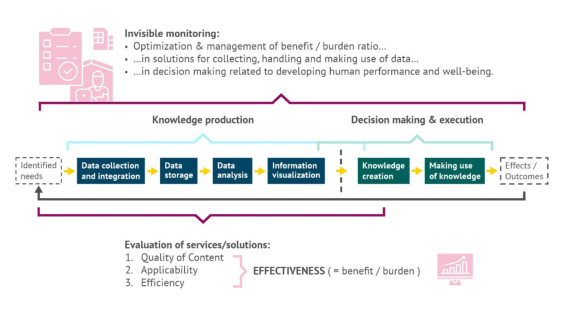
A Proposed New Concept Definition of Invisible Monitoring The starting point of the Invisible Monitoring in Development of Well-being and Performance project was the establishment of a new invisible monitoring concept definition (Figure 1) taking a broader view to whole process of data collection, analysis and utilization as well as expanding to all areas relevant to human performance in addition to sports.
Figure 1: New concept definition of invisible monitoring proposed by the invisible monitoring in development of well-being and performance project.
The concept definition at the top part of Figure 1 emphasizes the potential of invisible monitoring methods to minimize the burden of data collection, handling and use, while retaining, or even increasing, the practical value of the information and knowledge produced. It explicitly includes the whole chain from identified needs to knowledge production, decision making and execution and ultimately the effects and outcomes of informed actions. The evaluative framework description at the bottom part of Figure 1 links monitoring with the practical goals of the activities it intends to serve. In the end the concept boils down to identifying and managing the accumulation
Invisible Monitoring of Human Performance 167 of burdens and benefits across all phases of the processes of data collection, analysis and utilization.
As Leduc and Weaving (2025) have also noted, the question is not whether monitoring is dichotomously visible or invisible. Instead, the new concept definition of invisible monitoring guides towards considering how invisible the monitoring practices are and to whom and what are the overall benefits and burdens associated with making them invisible.
OPPORTUNITIES AND BOTTLENECKS FOR INVISIBLE MONITORING OF HUMAN PERFORMANCE Some important opportunities and bottlenecks for applying and developing invisible monitoring have already been found in the workshops, expert interviews, literature reviews and case study planning of the ongoing RDI project.
1) Modern technology enables data collection, but identifying relevant data for specific purposes remains challenging. As developed solutions have made it easier to collect many kinds of data, it is also easier to collect irrelevant or unnecessary data. Collecting data just because it is possible, without an intended use purpose, is not justified and can be considered as waste of resources. On the other hand, it also makes it possible that too much attention is given to some data with limited relevance leading to conclusions and actions with little practical value and vague reasoning. 2) In the domain of sports, reducing the burden on objects of monitoring is recognized but the burden on other actors along the chain from measurement to decision making are often overlooked. While the idea of avoiding disturbance to the objects of monitoring is a good point of departure for developing means for invisible monitoring, it must be recognized that it may lead to e.g. increased workloads or costs elsewhere in the process. For example, data processing and analysis may require more work when using a monitoring solution, which is invisible particularly to the athletes and/or teams. Too much analysis and interpretation work can exhaust the intended users, e.g. coaches and other experts, and obliterate the potential value of monitoring. 3) The current practices as well as development of invisible monitoring are predominantly technology-driven, rather than needs-driven. The emergence of invisible monitoring owes to technological development in what and how can be measured, processes and analyzed, but the technological emphasis can also become a limitation to the development of invisible monitoring practices. Most existing invisible monitoring solutions build on technologies measuring only one or at most few variables of the monitored actors or activities. Accordingly, virtually any available solution alone is only able to provide partial answers to the practical questions of the real-world needs of knowledge-based decision making.
4) Many invisible monitoring solutions developed and applied in the domain of sports are transferable and adaptable also to other fields of practice relevant to human performance. Despite that the variables captured with certain invisible monitoring technologies can be specific to the areas of application they are originally designed for there are many aspects of invisible monitoring that can be considered universally applicable. Particularly, the principles, methods and practices of balancing the overall burdens and benefits along the chain from data collection to decision making are mostly matters of organizing effective and systematically informed human action and therefore transferable across virtually all areas of application. In addition, many invisible monitoring technologies designed originally for sports can be applied as such or with only minor adaptations in measurement and analysis of human activity or performance characteristics in many other domains, such as the military sector and work wellbeing. 5) Ethical and secure data management is essential. This is true for all monitoring of human activity or performance characteristics, but the invisibility of monitoring as well as developing AI-based technologies of data analysis increase the need for transparency of communication about applied monitoring and data management practices as well as ensuring that they are based on explicit consent of the objects of monitoring. 6) In the end, the primary bottleneck still seems to be the ability of information users, both on individual and organizational level, to effectively apply monitoring outputs in their decision making and action taking. The potential benefits of invisible monitoring are ultimately either realized or lost in the knowledge creating, decision making and action taking human processes that the monitoring is intended to serve. Despite that “data-driven” and “knowledge-based” have been buzzwords for a long time already the capacity of most individuals as well as the practices of most organizations to efficiently and systematically make use of the existing and available data and information in decision making is quite limited in relation to the possibilities provided by the already existing technology. Good small scale or temporary examples of effective and systematic knowledge-informed practice can be found e.g. in the domain of elite sports coaching, but setting up broad, long-lasting and evolving processes of systematic knowledge-based action seems to be a challenge. Developing the competences of knowledge application on both individual and organizational levels is as important as development of technology.
CONCLUSION
The above mentioned opportunities and bottlenecks provide a backdrop for the next steps in developing invisible monitoring of human performance. A comprehensive concept definition of invisible monitoring has been proposed by the Invisible Monitoring in Development of Well-being and Performance project as a basis for developing effective knowledge-based human performance assessment and management. It is essential that alongside the
Invisible Monitoring of Human Performance 169 technological development of monitoring and data analysis, the ethical and regulatory practices as well as the competences of the individuals and organizations intended as users of the monitoring outputs are developed.
ACKNOWLEDGMENT
The authors would like to thank all of the partner companies Eerikkilä Sport & Outdoor Resort, Firstbeat, SPÅT, Fidera and Wisesport, the external expert partner Finnish Institute for High Performance Sport KIHU as well as all steering group members of the Invisible Monitoring in Development of Well-being and Performance project. Special thanks to Aino Alastalo and Marika Tuominen from the Communications and Marketing unit of Turku University of Applied Sciences for helping to prepare Figure 1. This work was partially supported by the Business Finland under grant 7507/31/2024.
REFERENCES
Benton, J.S. and French, D.P. (2024). Untapped potential of unobtrusive observation for studying health behaviors. JMIR Public Health and Surveillance, 10, e46638. Available at: https://doi.org/10.2196/46638 Boullosa, D., Claudino, J.G., Fernandez-Fernandez, J., Bok, D., Loturco, I., Stults-
Kolehmainen, M., García-López, J. and Foster, C. (2023). The fine-tuning approach for training monitoring. International Journal of Sports Physiology and Performance, 18(12), pp.1374–1379. Available at: https://doi.org/10.1123/ijspp.2023-0154 Dunne, R., Morris, T. and Harper, S. (2021). A survey of ambient intelligence. ACM Computing Surveys, 54(4), Article 73. Available at: https://doi.org/10.1145/3447242 Dykstra, J. (2020). Invisible security: Protecting users with no time to spare. In: 2020
IEEE 6th International Conference on Collaboration and Internet Computing (CIC). Available at: https://doi.org/10.1109/CIC50333.2020.00031 Fan, S. and Yang, Z. (2023). Towards objective human performance measurement for maritime safety: A new psychophysiological data-driven machine learning method. Reliability Engineering and System Safety, 233, 109103. Available at: https://doi.org/10.1016/j.ress.2023.109103 Gomez-Ruano, M.A., Ibáñez, S.J. and Leicht, A.S. (2020). Editorial: Performance
analysis in sport. Frontiers in Psychology, 11, 611634. Available at: https://doi. org/10.3389/fpsyg.2020.611634 Gu, L. and Qian, C. (2025). The application of smart wearable devices in the detection of sports energy consumption: A review. Intelligent Sports and Health, 1, pp.67–78. Available at: https://doi.org/10.1016/j.ish.2025.04.001 Karwowski, W. (2012). A review of human factors challenges of complex adaptive systems:
Discovering and understanding chaos in human performance. Human Factors, 54(6), pp.983–995. Available at: https://doi.org/10.1177/0018720812467459 Leduc, C. and Weaving, D. (2025). Invisible monitoring for athlete health and performance: A call for a better conceptualization and practical recommendations. International Journal of Sports Physiology and Performance, 20(6), pp.880–884. Available at: https://doi.org/10.1123/ijspp.2024-0292 Nindl, B.C., Jaffin, D.P., Dretsch, M.N., Cheuvront, S.N., Wesensten, N.J., Kent, M.L.,
Grunberg, N.E., Pierce, J.R., Barry, E.S., Scott, J.M., Young, A.J., O’Connor, F.G. and Deuster, P.A. (2015). Human performance optimization metrics: Consensus findings, gaps, and recommendations for future research. Journal of Strength and Conditioning Research, 29(Suppl 11), pp.S221–S245. Available at: https://doi. org/10.1519/JSC.0000000000001114
Shen, S., Qi, W., Zeng, J., Li, S., Liu, X., Zhu, X., Dong, C., Wang, B., Shi, Y., Yao, J., Wang, B., Lou, X., Gu, S., Li, P., Wang, J., Jiang, G. and Cao, S. (2025). Passive sensing for mental health monitoring using machine learning with wearables and smartphones: Scoping review. Journal of Medical Internet Research, 27, e77066. Tuomisto, J.T., Pohjola, M.V. and Rintala, T. (2020). From insight network to open
policy practice: Practical experiences. Health Research Policy and Systems, 18, 36. Available at: https://doi.org/10.1186/s12961-020-00547-3 Uddin, M.Z., Khaksar, W. and Torresen, J. (2018). Ambient sensors for elderly care and independent living: A survey. Sensors, 18(7), 2027. Available at: https://doi. org/10.3390/s18072027 Weakley, J., Black, G., McLaren, S., Scantlebury, S., Suchomel, T.J., McMahon, E.,
Watts, D. and Read, D.B. (2024.) Testing and profiling athletes: Recommendations for test selection, implementation, and maximizing information. Strength and Conditioning Journal, 46(2), pp.159–179. Available at: https://doi.org/10.1519/ ssc.0000000000000784
LISTED IN THE AHFE DIGITAL BOOKSTORE CATALOGUE
Explore the complete digital volume
Human Factors, Business Management and Society
Read this individual research paper free through the original publisher, or explore the full digital proceedings book.
ISBN 978-1-964867-91-5
Explore this ISBN in the AHFE Bookstore ↗Listed in the July 2026 bookstore catalogue; search by ISBN to confirm current availability · Digital book purchase optional