Timo Holopainen, Thomas Berger, Arto Kuuluvainen (2026). Experiences from Team Sales Competitions. In: Human Factors, Business Management and Society. AHFE Open Access, vol. 215, pp. 89–96. https://doi.org/10.54941/ahfe1007589
Sales competitions are based on a case-scenario situation where student competitors are given a time limit and allowed to conduct sales interactions with a buyer. They are an ideal experiential learning format as they offer concrete experience with feedback provided by the instructors. Our study looks at potential differences between team events and single competition events. There is not much research on team events and they are not often conducted even that team-based sales competitions offer several pedagogical advantages, particularly in their capacity to simulate complex organizational selling scenarios. At the same time assessing individual contributions becomes more difficult when performance is distributed across several members, potentially obscuring disparities in preparation, effort, or interpersonal skill and making judging more difficult. Nevertheless, they should also offer similar benefits for the participants as single events as they also experience a close to real-life sales interaction. We use results from three sales competitions and surveys to compare team and single events. We found that both formats seem to offer benefits for participants, while the concrete benefits mentioned are different. Regarding personality traits, it seems as if in team competitions, being an extrovert does not play such an important role. We also found that judges in team event seem to find it more difficult to judge the competitors then in single event formats as they felt not so confident in judging the performances.
Student sales competitions have become an established pedagogical instrument for developing applied selling skills in higher education. A sales competition is typically an event where students compete in role-playing simulated sales scenarios with a buyer –often from a corporate partner– acting as the counter-part. The performance is judged by a jury and, usually, by a buyer, mostly along pre-defined criteria. In some competitions, the buyer gives also evaluation for the likelihood of making the deal. These competitions are designed to help participants develop and showcase their sales-related skills in a structured, real-world environment. This format is designed to simulate the pressure and ambiguity characteristic of real-world selling environments, requiring competitors to adjust quickly to new information, identify buyer needs, and adapt their communication strategy accordingly. In a standard sales competition, competitors are required to conduct a needs analysis, Received February 6, 2026; Revised April 1, 2026; Accepted April 19, 2026; Available online July 20, 2026
address objections, try to secure a follow-up, and successfully conclude a deal within a designated period in an interactive setting with a counterpart who typically adopts the role of the buyer. The interactions typically last between 10 and 30 minutes.
The case structure also ensures a degree of standardization across competitors, enabling more consistent evaluation of selling competencies such as rapport building, needs diagnosis, value presentation, and objection handling, e.g. for grading as part of a sales module at universities. By combining scenario-based role-play with performance evaluation, sales competitions thus provide a controlled yet realistic context for assessing applied selling skills and for supporting experiential learning in sales education.
The case scenario attempts to simulate the real-life sales meeting as closely as possible and potentially include the entire sales process. It can therefore be seen as a form of experiential learning, propagated by Kolb (1984) and others. According to the theory, learning is “the process whereby knowledge is created through the transformation of experience. Knowledge results from the combination of grasping and transforming experience” (Kolb, 1984). Learning can thus be seen as a cycle where one touches four bases of the learning cycle: experiencing, reflecting, thinking, and acting. Several authors have demonstrated the pedagogical value of role play-based experiential learning in sales education (Levin & Peterson, 2016; Saavedra & Rawal, 2021). Sales competitions can therefore be seen as an ideal learning format for experiential learning if set in an appropriate framework as all four bases are being activated during such a sales competition. Experiential learning with role-plays and sales competitions is widely used nowadays in U.S. university undergraduate courses (and becomes more popular outside the U.S.), often because sales competitions as a special form of role-playing are also seen as an opportunity for reflective learning (Zhang et al., 2025). Especially the numerical standards-based evaluation together with some open comments gives a possibility for comparison of the performances and reflection.
Much research is available on such competitions regarding individual competitions (e.g. Lappalainen et al., 2021; Magnotta et al., 2020; Unger et al., 2021), but next to no literature exists regarding team competitions, with Holopainen et al., 2019 being the exception.
Team competitions typically assess collective sales performance, emphasizing coordination, role negotiation, and shared strategic planning. In contrast, single-competitor formats place responsibility solely on the individual, foregrounding personal selling style, adaptability, and independent decision-making. These structural differences shape not only the learning outcomes but also the types of buyer–seller interactions that can be meaningfully evaluated. Team events are often closer to real and complex organizational selling scenarios in which multiple representatives engage with a buyer– or multiple buyers. One can expect that benefits from such events may be different from those of single events and that personality traits might also be different as being too extravert could be difficult in a team event.
Experiences From Team Sales Competitions 91 This is why we conducted two team competitions and one single competitor event to report on differences in benefits and other characteristics of participants and winners. We also identify research gaps for future studies.
THE STUDY CONDUCTED We collected data from three virtual sales competitions in Germany 2021, 2022 and 2023. The first two were team events, the latter not. All were part of lectures on technical sales in an engineering bachelor study program on technical sales in the last semester of the study programme. The judges were from academia and corporate partners, the buyers from corporate partners unknown to the competitors. All performances were judged based on 10 criteria from small talk over needs analysis, presenting benefits and agreeing on the next steps. There was also an option for leaving comments to the competitors. The buyers had to grade how likely they would buy from that competitor(s) on a scale from 1-“very unlikely” to 10-“very likely”. For the study, we only included the grades and data from the judges for data consistency.
The study was conducted in two parts: questionnaires for the competition participants to study perceived benefits and evaluate their personality traits; and assessment of the competitors and their own perception of the judging itself.
For the competitors we distributed a questionnaire among the participants on past experiences, socio-demographics and personality before the event.
After the events we collected information on the perceived benefits and an overall assessment as seen by the participants. The latter was assessed by asking “Did you find participating useful?” using a Likert scale from 1 (“no, not at all”) to 6 (“yes, very much”). Based on Magnotta et al. (2020), we also asked the following open-ended question about potential benefits: “What benefits did you get from participating in the sales competition in general?” We then used closed questions to ask about the benefits of participating in the event (including the item “I experienced no benefits”). The items were derived from reviewing existing studies with general benefits being asked first before including concrete sales-related items such as sales skills and negotiation skills. The data from the single competition event was chosen for comparison with the data from the team events for scores. All three events were conducted at the same location with the same judges which reduces potential confounding interferences. All competitors were informed about data usage and gave their consent for using the data anonymized.
Open-ended responses on perceived benefits were analyzed using Qualitative Content Analysis following Mayring’s approach. Categories were developed inductively through iterative reviewing and abstraction of the material, guided by the goal of reducing content to a manageable set of meaningfully distinct themes.
Group differences were examined using Pearson’s chi-square tests of independence; when expected cell frequencies were below recommended thresholds, Fisher’s exact test was applied. Effect sizes were reported as Phi coefficients (chi-square tests) or odds ratios (Fisher tests).
We included confidence of the judgement as an item as it might be difficult to come up with a judgement. In addition, it might be more difficult to judge several competitors at the same time. We also included sympathy as an item as people might be influenced in their judgement by sympathy and again, this influence might be different in a team event. During the events we collected information on the performance as well on if the judges had sympathy for the participants and if they felt confident with their evaluation.
RESULTS
Perceived Benefits We had 81 competitors in all events of which 68 filled-out questions on personality (all students from the single event and 37 or 74% from the team events). Of all competitors, 46 participants answered our questions on potential benefits, including 24 single participants (response rate 77.4%) and 22 team participants (response rate: 44.0%). Due to different response rates, sample sizes vary across analyses and are reported for each test. Mean age was 21.9 years (Std: 1.27) with 21.9 years for the team events and 21.7 years for the single event. In the benefits sub-sample, 25.8% were women, in the full sample, 19.4% were women. For the statistical test we used Mann- Whitney U-Tests as the normality assumption was violated.
Mean evaluation scores were computed separately for single and team participants. Results indicated that participants from both event types gave similar evaluation grades (M = 4.5 =) for both events. This means that from a formal standpoint, both forms seem to be useful as reported by the participants.
As we also analyzed the answers to the open-ended question on perceived benefits, we ended up with just 18 entries out of the 46. We worked out two categories from this: Sales skills (four entries) and concrete experiences (eleven entries), the rest being others. Most participants mentioned benefits centered on concrete experiences like “It was a good practice” or “Practical relevance, real-life approach in professional life”. For sales skills, we had entries like “negotiating” or “presentation skills”. As the number of entries was low, we gained only little insights on potential benefits.
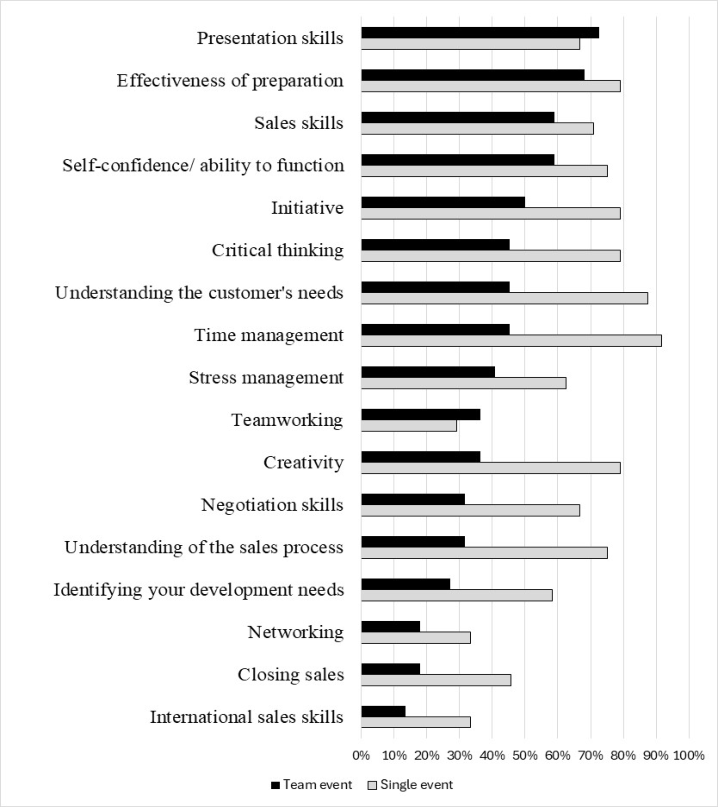
As can be seen in Figure 1, presentation skills, effectiveness of preparation, sales skills and self-confidence were reported the most often by participants of team events (all mentioned by more than 55% of the respondents), while competitors from single events reported time management, understanding customer’s needs, critical thinking, creativity and initiative the most often (all mentioned by over 75%). It is interesting that participants from team events (41.2% of all categories mentioned) reported benefits less often than participants from single events (65.4% of all categories mentioned).
Figure 1: Perceived benefits as a percentage of the responses.
Across all indicators, most items showed no statistically significant differences between participation modes (p > .05). This was not true for creativity (p= 0.006; rBS = .41), time management (p = 0.008; rBS = .36), understanding of the sales process (p = 0.013; rBS =. 38) and critical thinking (p = 0.020; rBS = .34), all with medium effect sizes, indicating a meaningful difference.
Where other significant differences occurred, effect sizes were small, suggesting limited practical relevance.
This shows that differences between team and single events are existent, but often not relevant, meaning that both types of events offer mostly similar benefits, although we have to mention the small sample size as a limiting factor.
Personality Traits Differences We also collected data to check if judging in a team event may be perceived as different from single events. We therefore asked for the level of confidence of the judgments for both event types.
We used a Likert scale with the statement “I am confident about my judgment” and a scale from 6–“fully agree” to 1–“fully disagree” (transformed into percentages) to measure this. For measuring sympathy, we also used a Likert scale with the statement “I have sympathy for the participant” and a scale from 6 –“fully agree” to 1–“fully disagree” (transformed into percentages for analysis).
Judges in the single event were more confident with their judgment (M: .851, SD: .08) then for the team event (M: .784, SD: .08). This difference was statistically significant and signaled a moderate to large effect size (U = 1.96.0; p < .001; RBS = .414). Judges in team events seem to find it more difficult to judge the competitors then in single events, which is not surprising given the fact that two competitors have to be judged parallelly and with interaction effects occurring.
The level of sympathy the judges reported was not statistically significantly different (M: .68 for both events).
We also assessed the level of extraversion as there is a lively debate on the importance of this on sales performance in many studies (Grant 2013, Wilmot et al. 2019). We measured this by using the Mini-IPIP scale (Donnellan et al. 2006). compromising of four items with a scale from 4 (very low levels of extraversion) to 20 (very high levels of extraversion). We found that winners in the team event format were less extravert (M: 10.78, SD: 3.5) than the other competitors (M: 13.94, SD: 2.3), which was statistically significant with a large effect size (T(35) = 2.638; p = .012; g = .989). It seems as if in team competitions, being extrovert does not play such an important role. For the single events, winners (M: 13.78, SD: 3.3) were not significantly different regarding extraversion compared to the other competitors (M: 14.00, SD: .8).
CONCLUSIONS AND FUTURE RESEARCH It is clear from previous studies that sales competitions as an experiential learning method are an important way to enhance sales competencies and skills, and they can offer a variety of benefits to participants. Overall, the sales competitions in our sample resulted in clear improvement in basic sales-related skills and competencies such as negotiating, presentation or understanding customers’ needs. This is in line with findings from the interview-based study by Unger et al. (2022), particularly for communication skills, personal and social skills, professional demeanor and sales acumen. This was also the case in the study by Magnotta et al. (2020), which identified sales skills, networking, and real-world experiences as the most frequently cited categories of benefits. We were surprised that participants of a team event did not tick teamworking as a benefit more often than participants from single events. In theory, teams had to work together and therefore may report this benefit a bit more often. We also found a few differences, but the effect sizes were mostly small.
Experiences From Team Sales Competitions 95 Team-based sales competitions offer a number of pedagogical advantages, particularly in their capacity to simulate complex organizational selling scenarios. Because many real-world sales processes involve multiple representatives—such as account managers, technical specialists, and customer success personnel (i.e. a buying center)—team formats allow students to gain valuable experiences in a structured and safe environment for learning. However, team competitions also have distinct disadvantages. For participants, team formation may not be that easy. For judges, assessing individual contributions becomes more difficult when performance is distributed across several members, potentially obscuring disparities in preparation, effort, or interpersonal skill. Moreover, team events require more extensive organizational planning, including the alignment of schedules, the provision of multiple buyers for a single scenario, and the calibration of judging rubrics to account for shared responsibility. These additional requirements increase the likelihood of judging inconsistencies and must be addressed accordingly.
In our study, only a few specific benefits were assessed statistically significantly different, with medium effect sizes. Future studies should systematically compare team events with single events based on larger sample sizes. Data should also be collected from different cultural environments, to allow comparisons of collectivistic vs. individualistic countries.
ACKNOWLEDGMENT
The authors would like to acknowledge all competition organizers who allowed us to collect data for this research and all competitors, judges and buyers participating in the competitions.
REFERENCES
Donnellan, M. B.; Oswald, F. L.; Baird, B. M.; Lucas, R. E. (2006). The Mini- IPIP scales: Tiny-yet-effective measures of the Big Five factors of personality, Psychological Assessment, vol. 18, 192–203 Grant, A. (2013). Rethinking the Extraverted Sales Ideal: The Ambivert Advantage,
Psychological Science, vol. 24, no. 6, 1024–1030 Holopainen T., Röhr T., Tómasson M., Murzin M., & Ben-Amor M. (2019). sales competition as education method – The case of the European sales engineering team competition. In: Kantola J., Nazir S., Barath T. (eds.) Advances in Human Factors, Business Management and Society. AHFE 2018. Advances in Intelligent Systems and Computing, vol. 783, Springer, Cham. Kolb, D. A. (1984). Experiential Learning Experience as the Source of Learning and
Development.: Prentice Hall, Englewood Cliffs. Lappalainen, H., Rantala, J., Ananda, A. S., Sriphaew, K., & Holopainen, T. (2021, July). Educating Next Generation B2B Sales Experts: First Impressions of B2B Sales Competitions in South-East Asia. In International Conference on Applied Human Factors and Ergonomics (pp. 57–63). Cham: Springer International Publishing. Levin, M. A., & Peterson, L. T. (2015). A sales representative is made: An innovative
Magnotta, S. R., Peev, P., & Steffes, E. (2020). Everyone’s a winner: The initiation and effectiveness of an intracollegiate sales competition. Journal of Marketing Education, 42(3), 243–256. Saavedra Torres, J., & Rawal, M. (2021). Surreal play experience for teaching sales:
Learning how to ask the right questions. Marketing Education Review, 31(2), 76–86. Unger, V., Haas-Kotzegger, U., & Reiterer, J. (2021). Preparing for the next normal: How university sales competitions and the development of students’ sales-relevant skills have changed through COVID-19. Journal for Advancement of Marketing Education, 29(1), 29–41. Wilmot, M. P.; Wanberg, C. R.; Kammeyer-Mueller, J. D.; Ones, D. S. (2019).
Extraversion Advantages at Work: A Quantitative Review and Synthesis of the Meta-Analytic Evidence, Journal of Applied Psychology, vol. 104, no. 12, 1447–1470. Zhang, J., Saran, A., Kalliny, M., & Giri, B. (2025). Marketing Undergraduate Core Course: Sales Course’s Objectives, Content, and Pedagogy. Marketing Education Review, 1–12.
LISTED IN THE AHFE DIGITAL BOOKSTORE CATALOGUE
Explore the complete digital volume
Human Factors, Business Management and Society
Read this individual research paper free through the original publisher, or explore the full digital proceedings book.
ISBN 978-1-964867-91-5
Explore this ISBN in the AHFE Bookstore ↗Listed in the July 2026 bookstore catalogue; search by ISBN to confirm current availability · Digital book purchase optional