Sarah Diefenbach, Lara Christoforakos, Daniel Ullrich, Marie Veihelmann (2026). Sustainable AI: Exploring Gains and Losses of AI in Daily Routines. In: Usability and User Experience. AHFE Open Access, vol. 232, pp. 22–36. https://doi.org/10.54941/ahfe1008032
Artificial Intelligence (AI) has become part of many people's daily routines and provides support in various areas of life, making their lives more comfortable and manageable. However, a question at hand is, whether the effects of AI on individuals and society are purely positive, and whether the perceived gains will remain a profit in the long-run. Our research reflects on the impacts of AI from a sustainability perspective, considering the psychological human needs (e.g., competence, autonomy, relatedness) that are fulfilled or violated through AI and how these effects might unfold over time. As an empirical basis, we present findings from 32 individuals' documentations of their AI usage behavior, and perceived gains and losses over a ten-day period. The qualitative data analysis resulted in 19 categories of gains, and 17 categories of losses. Based on this snapshot of AI in daily routines, we discuss the effects of AI in relations to psychological needs fulfilment as well as societal effects. We relate our findings to previous research in HCI and psychological concepts (e.g., overtrust, boost technologies, psychological biases), and sketch next steps of research.
Artificial Intelligence (AI) has become part of our daily routines. People use ChatGPT, Gemini, Claude and many more tools to brainstorm, discuss their personal issues or assist their writing. Tasks that once required significant effort, like writing a formal letter, preparing a speech, or structuring a paper, can now be supported by or even fully delegated to AI. AI can also assist individuals in presenting themselves to others. For example, when preparing application materials, AI tools can refine the CV and the letter of motivation. And after having finished one task, the AI suggests you what else it could do for you. As a result, many people are impressed by how much easier and more manageable their routines have become with the help of AI and how they feel more self-confident and competent in many areas of daily life.
However, a question at hand is, whether these gains are sustainable and will remain a true profit in the long-run. Considering the issue of individual skills and competence, critics argue that AI might also create losses. As we delegate tasks to AI, we cease to perform these tasks ourselves. As we seek
Sustainable AI: Exploring Gains and Losses of AI in Daily Routines 23 AI support in new tasks, we may never even learn to perform these tasks in the first place. As a consequence, this might lead to a loss of different abilities and, beyond that of autonomy, control or meaningful experiences (Bankins & Formosa, 2023; Wach et al., 2023). For example, when we regularly use AI to write a letter or an essay, over time, we may become less skilled at formulating arguments. Our vocabulary may diminish, our creativity may decline, and we might become less capable of critical reflection. As shown in a recent study from the MIT media lab on LLM-assisted essay writing, LLM users consistently underperformed at neural, linguistic, and behavioral levels, reported lower sense of ownership and also struggled to accurately quote their own work (Kosmyna et al., 2025). Similarly, we might lose specific moments of insight. We probably all know the experience when a thought that seemed very clear in our mind somehow makes less sense when trying to write it down. Such experiences can be important in recognizing one’s own fallibility, improving ideas until they truly work and letting useless ideas go. In this sense, writing things down, in one’s own words is an incredibly valuable activity, converting “the raw material of your thoughts into something usable” (Levy, 2010). However, such insights become rare when we simply prompt and instruct AI to make sense of our bullet points instead of writing full, consecutive sentences. At first sight, each single use case may seem harmless. But in sum, this repeated outsourcing of tasks may, over time, reduce our opportunities to practice and maintain important skills.
The competence perspective and the question of gaining or losing skills through AI represents only one aspect. Similar analyses could be drawn for other human needs and societal issues, such as, for example, autonomy, security or social dynamics. Outsourcing such tasks might also lead to less perceived responsibility for specific tasks and their outcomes (e.g., Diefenbach et al., 2024; Christoforakos et al., 2024). This in turn, as known from psychological theory, can impair perceived self-efficacy and result in motivation loss (Bandura, 1977) and come with general negative consequences for individual well-being (Ryan & Deci, 2002). Thus, what enhances comfort and well-being in the first place, might come with unforeseen effects and reduce well-being in the long run. Consequently, it might become increasingly challenging for individuals and organizations to decide responsibly when and how to use AI.
Based on such considerations, our research reflects on the impacts of AI from a sustainability perspective: not only in terms of environmental effects but how it affects psychological human needs and how it relates to societal transitions. In this paper we present findings from 32 individuals’ documentations of their AI usage behavior, and perceived gains and losses over a ten-day period. Based on this snapshot of AI in daily routines, we use this data to get a broader view of the effects of AI (gains and losses) in relations to individual need fulfilment as well as societal effects. Therefore, we relate our findings to previous research in HCI and psychological concepts (e.g., overtrust, boost technologies), discuss psychological need fulfilment with regards to short-term and long-term goals, and try to project how AI effects will continue over time, and what this might mean for individual needs and society in general.
METHOD
The study was conducted with a student sample (N = 32, 26 female, 6 male) as part of a HCI research seminar at our university. Participation was voluntary and not related to any incentives or grading. Following a type of experience sampling approach (Larson & Csikszentmihalyi, 2014), participants were instructed to document (1) their encounters with AI, (2) experienced benefits and gains, as well as (3) experienced critical developments and losses in an AI diary over a ten-day period. The documentation was self-initiated and not related to fixed prompting-signals. After the assessment period, participants provided their summed up documentation and reflections.
As a typical procedure in qualitative data analysis (Creswell, 2007), the raw data was analyzed for significant statements, highlighting different aspects of the participants experience of the phenomenon, and then categorized into reoccurring issues across the whole sample of participants. This resulted in a total of 720 significant statements, thereof 315 describing encounters, 173 gains, and 232 losses. The coding of gains and losses was performed by two independent raters, resulting in 19 categories of gains, and 17 categories of losses, with high interrater agreement (gains: Krippendorff’s Alpha = .96 , Boostrap Confidence Interval (95% CI): [0.92, 0.99], 200 iterations; losses: Krippendorff’s Alpha = .90 , Boostrap Confidence Interval (95% CI): [0.85, 0.94], 200 iterations). The full list of statements and categories of gains and losses of AI is openly available via https://doi.org/10.5282/ubm/data.776.
In a second step of analysis, we linked the defined categories to basic psychological needs discussed in psychological need theories (for an overview see Sheldon et al., 2001), such as competence, relatedness and autonomy (as discussed in self-determination theory, Ryan & Deci, 2002), self-actualization/finding meaning in one’s activities, or human desires to know and understand (as discussed in Maslow’s needs hierarchy, Maslow, 1943). Referring to an established terminology in human-computer interaction research, our analysis differentiates the needs of competence, security, autonomy, meaning, stimulation, relatedness, and popularity (see Table 1 for short definitions).
Table 1: Psychological needs and short definitions (adapted from Hassenzahl et al., 2010 and Sheldon et al., 2001).
Table available in the original PDF paper.
Need Short Definition Competence feeling that you are very capable and effective in your actions Security feeling safe and in control of your life
Autonomy feeling like you are the cause of your own actions Meaning feeling you are developing your potentials and making life meaningful Stimulation exploring new things, finding new sources of pleasure and enjoyment
Relatedness feeling connected and having regular intimate contact with people who care about you Popularity feeling that you are liked, respected, and have influence over others
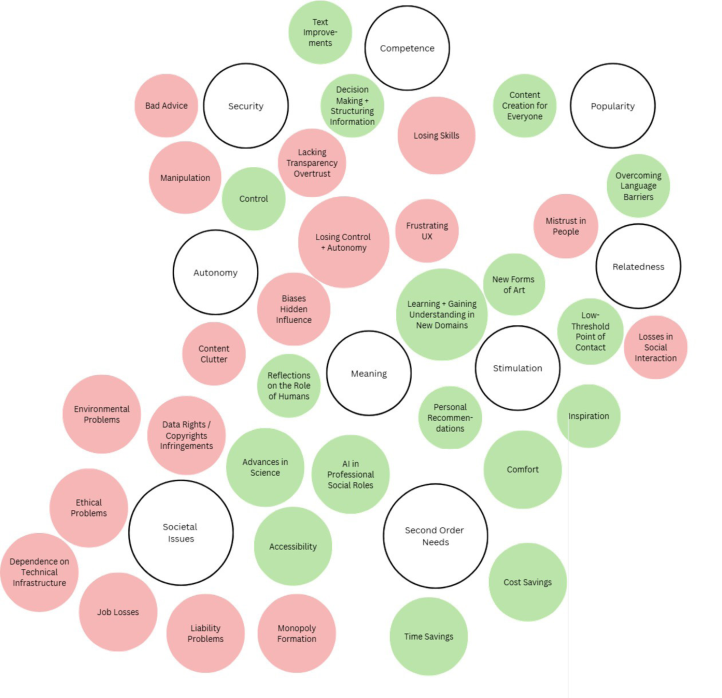
Sustainable AI: Exploring Gains and Losses of AI in Daily Routines 25 Note, that this categorization of needs is not distinct, and many activities may address two or even more needs at the same time. When a basketball player scores a basket in an important match, they may experience a sense of competence but also popularity when they hear the applause from the audience. In addition, this could address the need for meaning, reflecting on the long training period in recent weeks that has now paid off. Similarly, our participants’ AI interactions could often be associated to several needs at the same time. Hence, the resulting mapping of gains and losses of AI along the different psychological needs (see Figure 1) is to be interpreted as a rough overview, showing where the focus lies, and not a definite categorization. Besides, some categories of AI gains and losses could not be linked to one of the mentioned individual psychological needs but represented broader meta- reflections or societal issues (e.g., advances in science, job losses, monopoly formation). Also, some categories rather referred to second-order needs (e.g., time savings, cost savings), which are no means in itself but can potentially free resources for other activities of higher priority.
FINDINGS Encounters With AI
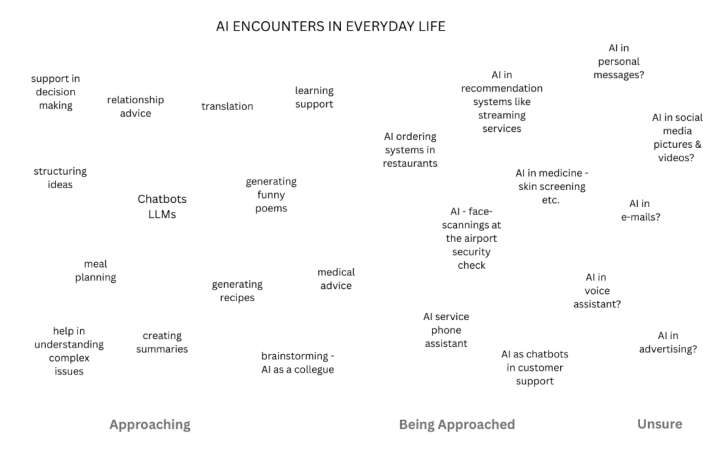
Participants reported encounters with AI spanned a wide variety of scenarios, from asking ChatGPT for assistance with meal planning, translations of scientific literature, or being face-scanned by AI in the security procedure at the airport. Among the total of 315 encounters with AI, we can broadly distinguish three types, namely, actively approaching AI, being approached by AI, or unsure encounters, i.e., instances where one was unsure whether one was confronted with AI or not.
For example, an intentional encounter of actively approaching AI is the specific approach of a chatbot, like ChatGPT. Within this, we can further differentiate between instances of instrumental or inspirational help. In the instrumental use cases AI is accessed with clear instructions to accomplish tasks more efficiently, e.g., summarizations, structuring ideas, translating texts or coding assistance. In other cases, AI is consulted for inspiration and used as an idea generator or a conversation partner, e.g., generating recipes, humorous poems, and talking about personal issues.
Contrary to these situations where usage starts with the clear intention of interacting with AI, in situations of being approached by AI, this contact is not self-initiated, but involuntary, such as when AI is integrated in a system or service one is using. An example was using Netflix and receiving movie recommendations based on the AI-supported analysis of one’s recently watched movies. Moreover, many participants reported situations where they had to talk to an AI service assistant on the phone before being able to talk to a human being.
Finally, unsure encounters comprise situations where people are not sure, if what they see or hear is AI or not: Walking by a more than perfect-looking couple on an advertising poster or getting a very well and elaborately worded e-mail leaves some people with suspicions and the question of whether they are looking at AI-produced media or reading AI-written texts. As one
participant stated: There are […] numerous AI-generated photos and videos on social media that look very real at first glance. […] most people scroll so quickly that they don’t even notice and believe it to be ‘real’” [P24, S189] In summary, using or consuming AI can happen consciously and actively, for inspirational or instrumental purposes, but also involuntarily and without really noticing. Figure 1 shows exemplary instances of actively approaching AI, being approached by AI, or unsure encounters.
Figure 1: Exemplary AI encounters: actively approaching AI, being approached by AI, and unsure encounters.
Gains of AI We identified 19 categories of gains from AI use. Among the gains, the most commonly reported was time savings (22%), e.g. through AI-generated summaries of information searches: “Searches are faster, information is found more quickly, and you can ask questions without having to click through lots of pages.” [P8, S47]. Other frequently mentioned categories were support of learning/understanding in new domains (10%), decision-making/structuring information (6%), text improvements (5%), personalized recommendations (5%, e.g. training plans, cooking recipes), gaining control and independence (1%) when helping yourself quickly without having to ask about the little things in a working environment, overcoming language barriers (4%, e.g., AI-translation), improving accessibility (2%), gaining inspiration and brainstorming ideas (6%). Other participants highlighted the easy content creation (3%, e.g., videos, pictures) for everyone without specialist equipment or expertise, also leading to new forms of art (1%, e.g., new forms of storytelling, entertainment, comedy). Participants also mentioned the role of AI as a low-threshold point of contact (7%), which is always available
Sustainable AI: Exploring Gains and Losses of AI in Daily Routines 27 and allows you to ask questions you would not dare to ask other people: “AI is available around the clock and can be used anywhere there is internet access.” [P26, S5]. Participants also valued the enhanced comfort (8%), when “taking a lot of work off your hands” [P32, S173] and having a “significant relief from routine tasks” [P6, S46], as well as a reduced strain through delegating tasks to AI. Other mentions were advances in science and societal goals through pattern recognition (10%, e.g., in medicine, crime prevention, mobility), AI in professional social roles, supporting or (temporarily) replacing humans (3%, e.g., in teaching, therapy), and economic benefits for companies (4%). One participant mentioned a more conscious reflection on the role of humans (1%), e.g., when reflecting on “what distinguishes and sets humans apart from AI” [P1, S17].
Losses of AI Participants reports indicated 17 categories of losses when using AI. The most prominent aspect among the losses was losing skills (23%), comprising cognitive, emotional and psychological abilities such as critical thinking, tolerance of frustration, willingness to make an effort and creativity. One participant stated “You become lazy and no longer read on your own, your analytical skills decline” [P10, S81]. The second most prominent aspect was content clutter (14%, e.g., false or unreliable information, increasingly uniform, artificial content), making it hard to filter valuable, reliable human- made content. Some participants experience this as a loss of reality, resulting in a general mistrust of whether content (e.g., images, text and pictures) could be generated by AI: “I have personally noticed that I perceive it negatively when I suspect that others have used AI for something. This undermines my trust in others.” [P14, S113]. Participants also discussed the loss of control/autonomy (12%, e.g., regarding data, truthfulness of information) and biases/hidden influence (11%) such as information filter bubbles, false conclusions, biased beauty ideals and getting lost in AI-recommended activities. Some participants also mentioned examples of bad advice through AI, such as when a person seeks advice on how to behave in a relationship and the AI (by its confirming nature) fuels actually destructive behaviour. Participants also named issues of deliberate manipulation (8%, e.g., consumer decisions, political views), and problems of overtrust/lacking transparency (5%), such as when people have an inaccurate picture of AI and its functioning, capabilities and limits such as “overestimation of AI, e.g. use of AI therapists” [P17, S136]. Some also reported frustrating UX (3%), e.g., miscommunication with chatbots. Further categories comprised losses in social interaction (4%), environmental problems (4%), and ethical problems/lacking responsibility (2%) in decisions involving AI, particularly in areas such as justice or medicine. Other statements did not refer to direct effects through AI but addressed societal issues occurring in the context of AI, such as job losses (8%), monopoly formation (0,5%) and dependence on large companies and countries with a pioneering position, dependence on technical infrastructure (2%), data right/copyright infringements (1%), and liability problems (0,5%).
Gains and Losses of AI in Relation to Psychological Needs and Societal Issues
Figure 2 provides an illustrated overview of the categories of gains and losses of AI in relation to psychological needs and societal issues. For example, the gain of content creation for everyone can be linked to a new type of competence experience, but might also fulfil popularity needs and receiving recognition from others. Overcoming language barriers could address popularity (making a better impression on others), and, in this sense, also support experiences of relatedness among people. Another type of relatedness experience is provided by AI as an always available low-threshold point of contact. At the same time, now referring to the mentioned losses through AI, AI counteracts relatedness experiences through the increased mistrust among people (e.g., is this an AI-generated birthday congratulation or did they really think of my birthday and use their own words in this message?).
Figure 2: Categories of gains and losses of AI in relation to psychological needs and societal issues.
Another aspect of diminishing relatedness are the described losses in social interaction when using AI instead of talking to friends or colleagues.
Sustainable AI: Exploring Gains and Losses of AI in Daily Routines 29 Various gains through AI can be linked to the need for stimulation such as receiving personal recommendations and inspirations, developing new forms of arts, or gaining understanding in new domains, which can also be related to new experiences of meaning. The need for autonomy is mostly connected to losses of AI use: Content clutter makes it hard to decide for oneself what to watch or read, as well as biases and hidden influences one is exposed to. Similarly, instances of frustrating UX and misunderstandings in AI interaction diminish autonomy. Also, various losses of AI seem to be linked to experienced impairments in psychological security: AI gives bad advice, participants feel manipulated and there is a lack of transparency, which could lead to overtrust. Further categories of gains highlight new types of competence experiences (e.g., AI supported text improvements) and at the same time, participants highlight losses in competence through AI, as summarized in the category of losing skills. In addition, three categories (i.e., time savings, cost savings, comfort) were related to second order needs. In these cases, the gains were not necessarily related to psychological need fulfillment in a direct way, but can free up time and resources and thus may indirectly support need fulfillment. Finally, various gains and losses of AI addressed societal issues. For example, it can be argued that society gains from AI regarding accessibility, advances in science, and AI in professional social roles. On the other hand, participants reported a number of critical societal aspects linked to AI, such as ethical and environmental problems, as well as a broad dependence on AI - technical infrastructure, job losses, liability problems, as well as data rights and copyrights infringements and monopoly formation from specific tech companies.
DISCUSSION
Main Areas of Gains and Losses of AI Our study examined 32 individuals’ documented AI usage over a ten-day period, focusing on perceived gains and losses associated with these practices. This empirical glimpse of AI embedded in everyday routines provided a basis for reflecting on the broader implications of AI use, both for fulfillment of individual psychological needs and for societal outcomes. Regarding everyday encounters with AI, we found that individuals intentionally approached AI for either instrumental or inspirational purposes. Furthermore, they experienced involuntary encounters, when AI is embedded within systems or when service agents replace human representatives. Finally, they reported also experiencing unsure encounters describing situations in which individuals cannot confidently determine whether content or media is AI-generated or whether their interaction partner is AI or a human being. The experienced gains and losses of AI spanned a wide spectrum, and, in some instances, documented broader reflections on the appropriate role of AI in our world. Besides a bottom-up categorization of gains and losses through classical steps of qualitative analysis, in a second step, we used the terminology of psychological needs as an interpretative frame. This allowed us to combine phenomenological insights with a model-based analysis (for a similar procedure see Diefenbach & Hassenzahl, 2019). As illustrated in Figure 2
and Figure 3, gains of AI often centered around popularity, stimulation and second-order needs such as time savings, cost savings and enhanced comfort. Losses of AI, on the other hand, often referred to autonomy, security, and societal issues. Interestingly, for some of the psychological needs, both gains and losses were experienced. For these needs, in particular competence, relatedness, and meaning, it seems that there is no clear tendency of whether people benefit or lose through AI. However, one relevant factor to explain this seeming contradiction could be whether one focuses on immediate effects or a long-term perspective, and the resulting dynamics that may unfold over time.
In the following sections, we connect this idea to previous research in HCI and psychology, and reflect on immediate effects (where gains seem to dominate) versus long-term dynamics (where losses might become visible).
The Temporal Perspective: Immediate Gains vs. Long-Term Losses Reflections on Competence
When looking at the mentioned gains related to competence, the emphasized benefits typically represent immediate rewards, which may also be associated with fulfilling popularity needs as a by-product. For example, AI-supported text improvements could make users feel competent and proud of themselves, but also create opportunities to receive positive feedback from others. From a psychological perspective, it is therefore understandable that users prioritize such gains, as they provide direct reinforcement (Bandura, 1969) and enable individuals to maintain a favorable self-image both internally and in the eyes of others, consistent with Impression Management Theory (Goffman, 1949).
However, this perception also entails risks. Users may mistakenly believe they have acquired competence or meaningfully mastered new domains of knowledge, even when AI has performed the majority of the cognitive work on their behalf. This dynamic can produce an illusory sense of mastery and may also undermine the development of actual competence by reducing opportunities for practice and feedback (Baldauf et al., 2020). As a consequence, users may become increasingly dependent on AI systems and experience performance decrements when such systems are unavailable.
Within the HCI literature, these processes have been discussed in terms of deskilling (Baldauf et al., 2020) and overreliance (Shukla et al., 2025), suggesting that perceived user competence does not necessarily correspond to actual competence when highly agentic forms of automation are involved. Empirical research in this domain has, for example, examined the neural and behavioral consequences of essay writing assisted by large language models (LLMs). Findings indicate that greater reliance on external tools, particularly LLMs, was associated with lower brain connectivity, reduced cognitive engagement, weaker memory for one’s own writing, and diminished perceived ownership of produced texts. Participants who did not use external tools exhibited the strongest neural and behavioral performance. When tool conditions were subsequently reversed, prior LLM users remained comparatively under-engaged, whereas participants who had not previously relied on external tools showed stronger activation patterns,
Sustainable AI: Exploring Gains and Losses of AI in Daily Routines 31 suggesting potential cognitive costs associated with sustained reliance on LLMs (Kosmyna et al., 2025).
A related debate has emerged within research on technologies for behavior change, where (self-)nudges, technologies that modify decision architectures (Thaler & Sunstein, 2008), have been contrasted with boost approaches that aim to foster users’ competencies for autonomous behaviors change. Within this framework, boosts are understood to promote more durable behavioral change, whereas nudges may leave users unable to sustain desired behaviors once technological support is withdrawn (Herzog & Hertwig, 2025).
Our findings suggest that participants also recognize the risk of deskilling over time, regarding the psychological need of competence, as it was the most frequently mentioned loss associated with AI use. In this, participants referred to a wide range of skills, ranging from very specific ones like essay writing to more abstract ones such as frustration tolerance or “cognitive flexibility” (P6, S47). On a societal level, participants even expressed a worry about dependence on technical infrastructure as a potential consequence of deskilling. In sum, it seems that while participants were mostly aware of the long-term risk of deskilling, they appreciated AI use for its temporary gains, especially in the feeling of temporary competence and stimulation.
Reflections on Relatedness Similarly to the issue of competence, AI may provide new sources of experiencing relatedness (i.e., using AI as a substitute) from a short-term perspective, but from a long-term perspective people already consider risks like less interaction between people and, impairments of relationships through growing mistrust. This stands in line with previous findings in HCI research. For example, research on the human-technology relationship has long suggested that, although loneliness may be associated with increased anthropomorphism of technological systems (e.g., Christoforakos & Diefenbach, 2023; Niemyjska & Drat-Ruszczak, 2013), a characteristic that is also salient in agentic AI systems such as LLMs, such technologies do not appear to meaningfully satisfy users’ social needs (e.g., Christoforakos & Diefenbach, 2023). Consequently, while AI systems may be highly accessible and easy to engage with, intensive and time-consuming interactions with them may contribute to reduced engagement in human social relationships and a diminished reliance on other people, without substantively fostering a sense of relatedness.
Besides, also the current design of conversational AI may foster users’ sense of finding relatedness when interacting with LLMs. Designing AI as a conversational partner (e.g. ChatGPT, Alexa) has huge potential because people intuitively know how to interact with the technology. Users can ‘speak’ to the technology in the same way they are used to from conversations with other humans. However, the conversational metaphor can create a misleading mental model, leading people to attribute more intelligence and human qualities to AI than it can actually provide: When humans speak with eloquence, there is usually true knowledge and understanding behind it, so assuming a correlation between the quality of language and content is valid.
However, in the case of AI, there is no such correlation; the answers are based on the probability of words occurring together. While this can produce beautiful language, it does not necessarily produce meaningful content. In human conversation, speakers often convey degrees of certainty through various implicit or explicit cues (e.g., tone of voice, patterns of eye contact). In the case of AI, answers provide no such cues, and may look the same, regardless of whether they are based on millions of data points, a single piece of information found online, or even pure hallucination. If a real person is friendly and affirming, this is usually a sign of sympathy and approval, which helps to build a trusting relationship. If an AI system confirms its users, it is because it is programmed to encourage continued interaction. Follow-up suggestions and offers of additional services are just two ways of keeping users engaged. Thus, at first glance, there are many similarities between interpersonal interaction and human-AI interaction. However, there are also important differences that tend to be overlooked and might induce misleading mental models of AI. In sum, we may call this a type of human- nature bias, primarily driven by the impressively eloquent language of AI (Diefenbach & Ullrich, 2026).
Reflections on Meaning The question of (colloquially speaking) whether AI creates or destroys meaning can be answered more differentiated when considering the temporal perspective. On the one hand, AI creates a multitude of impressive new opportunities, which can be experienced as opening new horizons, realizing one’s potential and, in short, experiencing meaning. With the help of AI, users can feel as if they were designers, authors, software architects, or painters. Users can create various things that once required enormous effort. However, at second glance, this type of meaning may not last for long. If everybody can “paint” in the style of Monet, and it just takes one click to generate the next picture, this might soon get boring and individuals might have to search for new sources of (true) meaning. Besides the problem that AI-generated experiences of meaning may not last for long, discussions on AI in the work context also warn that AI reduces meaning by taking over what essentially makes a task, and in broader view, work meaningful for people. While this applies especially for highly autonomous forms of human-AI collaboration (Sadeghian et al., 2024), losing meaning appears as a general side-effect of increasing automation in daily life (e.g., Diefenbach et al., 2024). With nowadays technological advances, many mundane tasks, such as brewing a coffee, mowing the lawn, parking a car, or feeding your pet can be automated. However, after some time, people may notice that, what sounds like a perfect lazy life, is also a bit dull, and that, in hindsight, taking some time to prepare a coffee might have actually been a nice ritual to start the day and mowing the lawn a kind of meditative activity and a good balance to office work. Such examples hint at two specific characteristics related to meaning: First, meaning is a need, that seldom appears in isolation and is typically related to other needs (e.g., experiencing meaning through competence, relatedness, or security/rituals, also see Hassenzahl et al., 2014).
Sustainable AI: Exploring Gains and Losses of AI in Daily Routines 33 Second, people do not necessarily know what creates meaning in their life, or which sub steps of a task are meaningful and which might be delegated away without losses.
This might also be reflected in the present findings, were people seemed less sensitive to potential losses associated with AI use at a more abstract, meaning-related level. However, this limited consideration of potential meaning-related losses is comprehensible, for several reasons. In common understanding, technology and interactive products are primarily considered as tools, and our thinking about such artifacts is mainly task-driven. Also, in the HCI literature, methods for the analysis of activities and workflows almost exclusively focus on task content and structure but ignore the more “experiential” aspects of task performance (Lenz et al., 2019). Also, meaning, as a comparatively abstract and integrative psychological need, may be less salient in everyday evaluations of technology use. Because the experience of meaning depends on the sustained satisfaction of multiple underlying psychological needs, it may be particularly vulnerable to indirect disruption. Given participants’ articulated concerns regarding autonomy, security, and relatedness, our findings suggest conditions under which meaning could plausibly be undermined, even if such risks were not explicitly recognized. Furthermore, acknowledging potential threats to meaning may be psychologically aversive, as this need is closely linked to individuals’ broader orientation toward happiness (Hassenzahl et al., 2014). However, as shown in a study by Lenz and colleagues (2019), with some systematic support (here: the method of hierarchical task analysis), people are well able to reflect on “how performing an activity makes meaning”, name experientially important sequences and relate these to feelings and thoughts.
AI Use in the Future: The Question of Sustainability These patterns raise questions regarding the long-term sustainability of AI use in relation to individual well-being, understood as the outcome of satisfied psychological needs (Hassenzahl et al., 2014). AI use appears to be primarily associated with immediate gratification, particularly through opportunities for positive feedback and self-enhancing outcomes. At the same time, participants’ statements, and emerging empirical evidence suggest that prolonged reliance on AI may impair central psychological needs through processes such as deskilling (e.g., Kosmyna et al., 2025) and diminished experiences of autonomy and relatedness (e.g., Christoforakos & Diefenbach, 2023). In addition, we must acknowledge that a number of additional effects, both positive and negative, may occur that we have not yet witnessed. For example, it could be found that AI-supported learning and understanding in new areas leads to long-term benefits in terms of happiness and well-being. At the same time, additional losses may turn-out. For example, the habit of delegating everything to AI could promote lethargy and depression. Fewer cognitive demands could lead to a decline in the IQ of the population. Of course, this is highly speculative – and even if such trends become apparent, it will be difficult to attribute them to clear causes.
From a broader perspective, this tension highlights the challenge of evaluating whether short-term convenience justifies potential long-term costs, including collective deskilling, technological dependency, and social alienation. A further complicating factor concerns self-serving attributions (Heider, 1958), which may lead individuals to overestimate their own contribution within human-AI collaborations and to attribute AI-generated outputs to personal competence. This tendency was reflected in participants’ reports of perceived gains in temporary competence, for example through improved texts or more efficient information structuring. Promoting more responsible AI use may therefore require individuals to engage in accurate self-assessment regarding their contribution to collaborative outcomes and to critically reflect on their motivations for AI use. Ultimately, the sustainability of human-AI interaction may depend on individuals’ capacity to prioritize long-term well-being over immediate convenience, a challenge comparable to other societally crucial domains, such as environmental sustainability.
CONCLUSION
The present study provided a snapshot of people’s encounters with AI in daily life, perceived gains and losses. In addition, our analyses from a psychological needs perspective and societal issues provided a basis for reflections on differential effects of AI on fundamental human needs and values (e.g., autonomy, relatedness) and how these effects might further revolve in the long run.
Our findings are based on a limited sample and may not be representative in many respects (e.g., restricted age range, usage context, cultural and educational background). Also, the defined categories are not necessarily distinct or exhaustive, and cannot provide final conclusions about the consequences of AI. Still, the present insights hint at important questions that societies and their members must answer: What role do we want to assign to AI? What kind of tasks do we want to delegate? Which competencies or responsibilities do we want to keep in the hands of humans? Which costs and dependencies are acceptable (e.g., losing skills, content clutter, manipulation) in return for which experienced gains (e.g., comfort, economic benefits/new business models)? And which kind of gains (e.g., medical AI-support) could be exploited without costs?
Hence, for the present state, our study’s main message is: AI will remain part of our daily life and we must take responsibility for deciding how we use it. In this matter, a long-term perspective is vital. There are a number of complex issues to be resolved, like privacy concerns, legal issues, or ethical questions. Our research, rooted at the intersection of HCI and psychology, can support this societal negotiation process with a view on psychological needs, social dynamics, and typical biases that affect how people interact with AI. As illustrated by the example of the human-nature bias (Diefenbach & Ullrich, 2026) discussed above, if we take the notion of supporting self- determined use seriously, conversational AI would probably need to be designed quite differently than it actually is.
Sustainable AI: Exploring Gains and Losses of AI in Daily Routines 35 In conclusion, to benefit from AI in a positive and sustainable way, we need to understand how humans process encounters with AI and how this relates to human needs and societal dynamics. We must also incorporate such insights into the design of AI and its usage regulations. Our future research aims to provide more systematic support for interpreting the effects of AI from a psychological sustainability perspective for the benefit of individuals, organizations, and society.
ACKNOWLEDGMENT
The authors would like to thank all study participants for their insightful reflections on AI in their daily life. Deepl.com was used to improve writing style. Parts of this research has been funded by the Ministry of Research, Technology and Space (Research Project: MOVEN; 01UU2204B).
REFERENCES
Baldauf, M, Fröehlich, P, Rainer Endl (2020). Trust Me, I’m a Doctor – User Perceptions of AI-Driven Apps for Mobile Health Diagnosis. In Proceedings of the 19th International Conference on Mobile and Ubiquitous Multimedia (MUM ‘20), 167–178. https://doi.org/10.1145/3428361.3428362 Bandura, A. (1977). Self-efficacy: toward a unifying theory of behavioral change.
Psychological review, 84(2), 191–215. Bandura, A. (1969). Social-learning theory of identificatory processes. Handbook of socialization theory and research, 213, 262. Bankins, S., Formosa, P. (2023). The Ethical Implications of Artificial Intelligence (AI)
For Meaningful Work. J Bus Ethics 185 (4), 725–740. https://doi.org/10.1007/ s10551-023-05339-7 Christoforakos, L., Diefenbach, S. (2023). Technology as a social companion? An exploration of individual and product-related factors of anthropomorphism. Social Science Computer Review, 41(3), 1039-1062. https:// doi.org/10.1177/08944393211065867 Christoforakos, L., Kolb, A., Diefenbach, S. (2024). I did it once, but can I do it again? The role of responsibility attribution and self-efficacy in technology for sustainable behavior change. In Proceedings of the 2024 NordiCHI Conference on Human Factors in Computing Systems. https://doi: 10.1145/3679318.368533 Creswell, J. W. (2007). Qualitative inquiry and research design: Choosing among five
approaches. London, UK: Sage Publications. Diefenbach, S., Hassenzahl, M. (2019). Combining model-based analysis with phenomenological insight: A case study on hedonic product quality. Qualitative Psychology, 6(1), 3–26. https://doi.org/10.1037/qup0000096 Diefenbach, S., Ullrich, D. (2026). Why We Need to Destroy the Illusion of Speaking to
A Human: Critical Reflections On Ethics at the Front-End for LLMs. Proceedings of the CHI 2026 Workshop on “Ethics at the Front-End: Responsible User-Facing Design for AI Systems” Diefenbach, S., Ullrich, D., Lindermayer, T., Isaksen, K.-L. (2024). Responsible Automation: Exploring Potentials and Losses through Automation in Human– Computer Interaction from a Psychological Perspective. Information, 15(8), 460. https://doi: 10.3390/info15080460 Goffman, E. (1949). Presentation of self in everyday life. American Journal of
Sociology, 55(1), 6–7.
Hassenzahl, M. (2014). Designing moments of meaning and pleasure. Experience design and happiness. International journal of design. Hassenzahl, M., Diefenbach, S., Göritz, A. (2010). Needs, affect, and interactive
products – Facets of user experience. Interacting with Computers, 22(5), 353–362. https://doi.org/10.1016/j.intcom.2010.04.002 Heider, F. (1958). The psychology of interpersonal relations. New York: John Wiley & Sons. Kosmyna, N., Hauptmann, E., Yuan, Y.T., Situ, J., Liao, X.-H., Beresnitzky, A.V.,
Braunstein, I., Maes, P. (2025) Your brain on ChatGPT: Accumulation of cognitive debt when using an AI assistant for essay writing task. arXiv. https:// doi.org/10.48550/ARXIV.2506.08872 Larson, R., Csikszentmihalyi, M. (2014). The Experience Sampling Method. In: Flow and the Foundations of Positive Psychology. Springer, Dordrecht. https:// doi.org/10.1007/978-94-017-9088-8_2 Lenz, E., Hassenzahl, M., Diefenbach, S. (2019). How performing an activity makes
meaning. In Extended Abstracts of the CHI 2019 Conference on Human Factors in Computing Systems. https://doi.org/10.1145/3290607.3312881 Levy, M. (2010). Accidental genius: using writing to generate your best ideas, insight, and content (2nd ed ed.). San Francisco, CA: Berrett-Koehler. Niemyjska, A., Drat-Ruszczak, K. (2013). When there is nobody, angels begin
to fly: Supernatural imagery elicited by a loss of social connection. Social Cognition, 31(1), 57–71. https://doi.org/10.1521/soco.2013.31.1.57 Ryan, R. M., Deci, E. L. (2002). Overview of self-determination theory: An organismic dialectical perspective. Handbook of self-determination research, 2(3–33), 36. Sadeghian, S., Uhde, A., Hassenzahl, M. (2024). The soul of work: Evaluation of
job meaningfulness and accountability in human-AI collaboration. Proceedings of the ACM on Human-Computer Interaction, 8(CSCW1), 1–26. https://doi. org/10.1145/3637407 Sheldon, K. M., Elliot, A. J., Kim, Y., Kasser, T. (2001). What Is Satisfying About Satisfying Events? Testing 10 Candidate Psychological Needs. Shukla, P., Bui, P., Levy, S. S., Kowalski, M., Baigelenov, A., Parsons, P. (2025).
De-skilling, cognitive offloading, and misplaced responsibilities: potential ironies of AI-assisted design. In Extended Abstracts of the CHI 2025 Conference on Human Factors in Computing Systems. https://doi.org/10.1145/3706599.3719931 Thaler, R. H.,Sunstein, C.R (2008). Nudge: Improving decisions about health, wealth, and happiness. Yale university press. Wach, K., Duong, C.D., Ejdys, J., Kazlauskaitė, R., Korzynski, P., Mazurek,
G., Paliszkiewicz, J., Ziemba, E. (2023). ‘The dark side of generative artificial intelligence: A critical analysis of controversies and risks of ChatGPT’, Entrepreneurial Business and Economics Review, 11(2), pp. 7–30. https://doi. org/10.15678/EBER.2023.110201
LISTED IN THE AHFE DIGITAL BOOKSTORE CATALOGUE
Explore the complete digital volume
Usability and User Experience
Read this individual research paper free through the original publisher, or explore the full digital proceedings book.
ISBN 979-8-950676-08-6
Explore this ISBN in the AHFE Bookstore ↗Listed in the July 2026 bookstore catalogue; search by ISBN to confirm current availability · Digital book purchase optional