Dijana Plantak Vukovac, Tatjana Novosel-Herceg, Ana Karlica (2026). Software Features in eHealth and Speech Applications for Long-Term User Adherence: A Bibliometric Analysis. In: Human Interaction and Emerging Technologies (IHIET 2026). AHFE Open Access, vol. 236, pp. 598–609. https://doi.org/10.54941/ahfe1008135
eHealth applications have become increasingly important in supporting healthcare delivery, rehabilitation, and behaviour change, with speech-language therapy emerging as one of the domains benefiting from these technologies. However, the specific software features and design trends driving engagement and effectiveness in this field remain insufficiently mapped. This research applies bibliometric analysis to identify emerging trends in software features implemented in eHealth and speech therapy applications. The analysis included 560 publications retrieved from IEEE Xplore, MEDLINE, Scopus, and the Web of Science Core Collection databases. Performance analysis examined publication trends, geographical distribution, publication sources, and citation impact, while science mapping was conducted to identify key research themes through keyword co-occurrence analysis. The findings reveal that eHealth research is strongly interconnected around themes including gamification, mobile applications, health games, motivation, physical activity, and medication adherence. Gamification represents a central research theme, emphasizing the role of game elements, motivational mechanisms, and Self-Determination Theory in promoting user engagement and long-term participation. Mobile applications provide the main technological context for implementing these mechanisms, while serious games demonstrate their application in healthcare interventions. The results highlight that effective eHealth solutions, including rehabilitation and speech therapy, require not only technological innovation but also theoretically grounded approaches integrating motivation and behaviour change principles.
eHealth applications, particularly those available on smartphones and wearable devices such as smartwatches, have become an integral part of everyday life by supporting health monitoring and self-management. They enable users to track physical activity and physiological parameters, provide medication reminders, and guide therapeutic or preventive exercises.
Among the healthcare domains that have extensively adopted eHealth applications is speech-language pathology. Various mobile applications
Software Features in eHealth and Speech Applications for Long-Term User Adherence 599 have been used to support children’s speech and language development (Du et al., 2023), as well as games to facilitate skills development in children with autism spectrum disorder (Stankova et al., 2021). However, research on development and usage of eHealth application for stuttering therapy is almost non-existent.
Stuttering is a complex, multi-dimensional speech fluency disorder encompassing communication’s motor, emotional, cognitive, and social components. It should be classified as a disorder only if its severity is such that it markedly impairs the fluency of speech (World Health Assembly, 2019). Maintaining fluent speech is often the most challenging stage of the stuttering therapy interventions, requiring prolonged and repetitive practice, which frequently leads to fatigue and high relapse rates. Modern intensive therapeutic approaches emphasize that long-term success heavily depends on adherence – the client’s ability to actively collaborate and consistently apply therapeutic strategies following the conclusion of the formal clinical phase (World Health Organization, 2003).
Following the completion of intensive stuttering therapy and the patients’ return to their everyday environment, the risk of relapses is most pronounced within the first six months post-intensive therapy. To mitigate the decline in treatment adherence, manifested as irregular home practice during this critical period, the implementation of external motivational systems, such as monetary compliance incentives, has proven successful in clinical practice (Euler et al., 2009). Traditional models based solely on “compliance” are insufficient for such a demanding behavioural change. Therefore, there is an urgent need for solutions that foster intrinsic motivation (Ryan and Deci, 2000; Moazeni, Shamsaee and Nakhshab, 2025). Without consistent engagement and an internal driver, the automation of fluent speech cannot be fully developed.
To bridge this gap, eHealth applications emerge as promising tools, especially gamified mHealth applications, which are broadly acknowledged as an efficacious motivator for individuals weary of traditional therapeutic approaches. The primary advantage of gamification within the domain of digital healthcare is its capacity to transform monotonous, repetitive health interventions into engaging, habit-forming activities (Sardi, Idri and Fernández-Alemán, 2017). By introducing fun, interactivity, and clear goal- setting into daily routines, gamified systems foster personal empowerment and patient engagement, which are critical for sustaining long-term, self- managed speech-language therapy. However, systematic reviews of the literature on gamified e-health applications (ibid) consistently warn that most of the solutions investigated only deliver short-term engagement, achieved primarily through the use of extrinsic rewards.
One of the relevant theoretical frameworks that facilitates intrinsic motivation is the Self-Determination Theory (SDT) (Ryan and Deci, 2000), which posits that sustained behaviour depends on satisfying three basic psychological needs: Autonomy (sense of control), Competence (sense of mastery), and Relatedness (sense of connection). Fulfilment of these needs leads to the internalization of motivation, and addresses behavioural and affective dimensions of adherence that could help in the integration of therapeutic
speech techniques into everyday life following intensive treatment. In speech- language pathology (Mühlhaus et al., 2017) showed that integrating SDT principles into digital speech tools enhances patient motivation for self- sustained home training. However, recent systematic review of 15 papers has uncovered that SDT was applied to increase engagement with the technology rather than offering scaffolding and behaviour change itself, which may not lead to sustained motivation (Alberts, Lyngs and Lukoff, 2024).
Accordingly, the overarching objective of our broader study is to investigate how to develop a software solution that facilitates scaffolding and long- term adherence in speech therapy, particularly after intensive stuttering interventions. The solution should be grounded in a motivational theory and incorporate contemporary software features, such as game mechanics.
The first phase of the study involved a bibliometric analysis of scientific literature to identify emerging trends concerning software features employed in eHealth applications and speech therapy apps, with particular emphasis on SDT-related constructs and gamification elements. The second phase will consist of a scoping review aimed at mapping the mechanisms implemented in various eHealth solutions that may foster sustained user engagement and adherence, thereby informing the design and development of effective mHealth applications in the field of speech therapy, with focus on their usage after intensive stuttering therapy interventions.
This paper reports the findings of the bibliometric analysis, highlighting the most influential countries, journals, and thematic research areas associated with engaging software solutions that support long-term user adherence.
RESEARCH METHODOLOGY Having in mind the double goals of the broader study, our search strategy included queries that would identify a large set of literature appropriate for a bibliometric analysis, yet specific enough to enable identification and categorisation of existing mechanisms, functionalities, and theoretical foundations for the future scoping review.
The goal of the bibliometric analysis conducted in the first phase of our study was to identify major research trends and thematic developments in the literature on software features that support user engagement and long- term adherence, with a focus on eHealth/mHealth applications and speech therapy applications.
Database and Study Selection To ensure comprehensive coverage of the relevant literature, the bibliometric analysis was based on searches conducted in four major scientific databases indexing high-quality journal articles and conference proceedings in software engineering, healthcare, medical sciences, social sciences and related interdisciplinary fields. Databases searched in April 2026 included IEEE Xplore, Medline, Scopus, and Web of Science Core Collection (WoS CC) for the literature published in the last ten years, namely from 2015 until the first quarter of 2026, to include the most recent publications.
Software Features in eHealth and Speech Applications for Long-Term User Adherence 601 To capture all relevant studies, a modular multi-query search strategy based on triadic search queries was employed. That strategy combined terms related to digital health context and speech domain (e.g., speech disorder and intervention context), theoretical and behavioral concepts (e.g., Self- Determination Theory, engagement, adherence), and technological context (e.g., software features, gamification). Five search queries (Q1–Q5) were developed for each database and combined using Boolean operators, resulting in 2,024 studies found in Scopus, 1,513 studies captured in WoS CC, 675 studies found in Medline and 682 studies retrieved from IEEE Xplore. The results obtained from the individual databases were merged, resulting in 4,894 records. After removing 1,904 duplicates and excluding records based on document type, in our case conference reviews (n = 94), and publication year (before 2015; n = 147), 2,749 studies remained for title screening. The first and the third author of this study independently screened the records by title using predefined inclusion and exclusion criteria. Studies were eligible if their titles indicated a digital, technological or app-based intervention in the speech or health domain and referred to at least one of the following: software design or features, gamification elements, SDT constructs, or outcomes related to engagement, motivation, or adherence. Records focusing solely on clinical interventions without a technological component, purely technical solutions without user-centred features, and studies on language learning, vocabulary, curriculum or school context were excluded. Following title screening performed by the authors and verified by the AI tool, with the final decisions resting on the authors, 2,189 records were removed, leaving 560 studies for bibliometric analysis.
Bibliometric Analysis Bibliometric analysis is widely used to summarize large volumes of scholarly output and to reveal the intellectual structure and emerging trends of a research field (Donthu et al., 2021). In this study, two bibliometric techniques were applied: (1) performance analysis and (2) science mapping.
The performance analysis was applied to the 560 records retained after title screening to characterize the field’s temporal growth (publications by year), its publishing landscape (the number and concentration of journals and conferences in which the paper appears), its geographic distribution (countries of author affiliation), and its most influential contributions (publications ranked by citation count).
The science mapping technique was done in the VOSviewer tool (van Eck and Waltman, 2015) to explore co-occurrence of keywords and identify main research themes. Prior to the co-occurrence analysis, author keywords were standardized using a thesaurus file in VOSviewer. Synonyms, spelling variants, abbreviations, and singular/plural forms were merged into unified terms, while generic or non-informative keywords were excluded to improve the interpretability and reliability of the thematic network.
RESEARCH RESULTS Publication Years
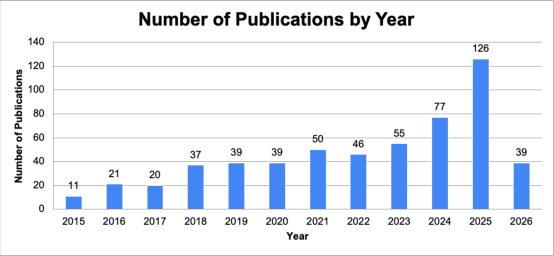
As shown in Figure 1, the number of publications addressing eHealth applications and their design features has exhibited a steady upward trend from 2015 to 2025. The most substantial growth occurred between 2024 and 2025, when the number of publications rose from 77 to 126, representing the highest annual output during the study period. Since the data for 2026 include only publications indexed during the first four months of the year (39 publications), it is reasonable to expect that the final annual output may approach or exceed that of 2025.
Figure 1: Publication trend from 2015 to first quarter of 2026.
Geographical Distribution of Research Contributions The majority of publications originate from researchers affiliated with institutions in the United States, which contributed 100 papers. Other countries showed considerably lower publication outputs, including the United Kingdom (32), Australia (31), Germany (31), Canada (27), China (26), and the Netherlands (24). These were followed by Malaysia and Spain (21 each), India and Italy (15 each), and Brazil, Portugal, and Switzerland (14 each).
Overall, the analysis identified 62 countries represented by the affiliations of first authors.
Significant Journals, Conferences and Publications The 560 papers were published across 334 distinct journals and conference proceedings, with the 8 most influential publication sources listed in Table 1. The Journal of Medical Internet Research and several JMIR sister journals account for the largest share of publications on eHealth applications. The leaders are JMIR Serious Games (42), Journal of Medical Internet Research (22), JMIR Formative Research (19), and JMIR mHealth and uHealth (18).
The most significant publication sources are predominantly represented by journals in the fields of medicine and medical informatics, with computer science journals and conference proceedings contributing to a lesser extent, with rankings from 15th to 19th place (e.g., Lecture Notes in Computer Science (4 papers), IEEE conferences (6 papers) and ACM conference with 3 papers).
Table 1: Most significant journals and conferences by publication count.
Table available in the original PDF paper.
Rank Journal / Conference Number of Publications
1 JMIR Serious Games 42
2 Journal of Medical Internet Research 22
3 JMIR Formative Research 19
4 JMIR mHealth and uHealth 18
5 Studies in Health Technology and Informatics 12
6 BMJ Open 9
7 Digital Health 9
8 JMIR Research Protocols 9
Leading publications based on citation analysis include research on gamification in mHealth applications or fitness applications, presented in Table 2.
Table 2: Top 5 most cited publications.
Table available in the original PDF paper.
Rank Title, Authors, Year Journal Times Cited
406
1 Working out for likes: An empirical study on social influence in exercise gamification (Hamari and Koivisto, 2015)
Computers in Human Behavior
248
European Journal of Preventive Cardiology
2 Effectiveness, acceptability and usefulness of mobile applications for cardiovascular disease self-management: Systematic review with meta- synthesis of quantitative and qualitative data (Coorey et al., 2018)
192
JAMA Internal Medicine
3 Effect of a game-based intervention designed to enhance social incentives to increase physical activity among families: The BE FIT randomized clinical trial (Patel et al., 2019)
188
JMIR mHealth and uHealth
4 Valuable Features in Mobile Health Apps for Patients and Consumers: Content Analysis of Apps and User Ratings (Mendiola, Kalnicki and Lindenauer, 2015)
174
Journal of medical Internet research
5 Determinants of Fitness App Usage and Moderating Impacts of Education-, Motivation-, and Gamification-Related App Features on Physical Activity Intentions: Cross- sectional Survey Study (Yang and Koenigstorfer, 2021)
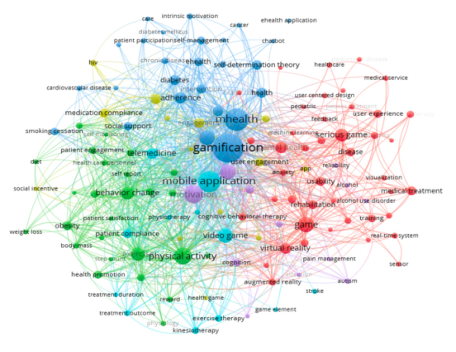
Main Research Themes Keyword co-occurrence in 560 publications was visualised with VOSviewer, where six main clusters were identified. Figure 2 presents keyword co-occurrence network in which the bigger node represents the greater
occurrence of the keyword across publications, while the node colors correspond to thematic clusters, with each cluster labelled according to its dominant research theme.
Figure 2: Keywords co-occurence network with six clusters.
The most influential keywords were identified based on both their occurrence frequency and Total Link Strength (TLS). While occurrence represent the number of publications in which a keyword appears, TLS indicates the extent and intensity of keyword associations with other research themes, indicating its overall connectivity and importance within the thematic network. Table 3 presents the most influential keywords within 6 clusters.
Table 3: Co-occurrence of authors keywords mapped in six clusters.
Table available in the original PDF paper.
Keyword Occurences / Total Link Strength (TLS)
Associated Cluster Name
1. Gamification gamification (237/1079), mHealth (144/673), mobile health (63/339), adherence (34/191), …, self-determination theory (26/103)…
2. Mobile application
mobile application (128/701), video game (57/378), telemedicine (32/229), patient complience (20/174), exercise therapy (13/103)…
3. Health games game (67/325), serious game (47/205), mental health (36/181), rehabilitation (26/129), …, speech therapy (14/46)…
4. Motivation motivation (90/546), digital health (64/345), behavior (17/94), cognition (16/129)…
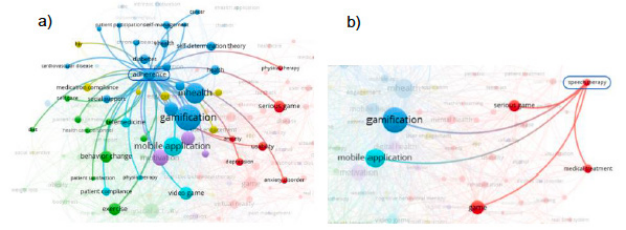
Software Features in eHealth and Speech Applications for Long-Term User Adherence 605 The biggest blue cluster gathers publications around the keyword gamification, which describe game elements as a means to enhance motivation, engagement, and long-term participation, often integrated into mHealth applications. This cluster also includes adherence and self-determination theory as the keywords linked to gamification. As seen in Figure 3.a, the keyword adherence is associated with a broad network of related terms that reflect, on the one hand, the types of applications being studied (e.g. serious game, video game, mobile app) and, on the other hand, various outcomes and medical conditions addressed in the research (e.g. physiotherapy, diabetes, depression, disabilities etc.). In the context of speech-pathology therapy, gamified mHealth app design structured around self-determination theory- informed behaviour change techniques proved to maximise engagement in children with neurodevelopmental disability (Johnson et al., 2022).
The cyan cluster mobile application represents publications related to mobile applications. Although the keyword itself is relatively broad, it is closely associated with terms such as telemedicine and video games, reflecting its technological context. From the perspective of its purpose, these mobile apps are primarily aimed at supporting patient compliance and exercise therapy.
The red cluster comprises the largest number of keywords and focuses on games applied in healthcare, particularly serious games, which are, contrary to gamification, complete digital games developed for a health-related purpose. These games are used e.g. to deliver mental health interventions (Ferrari et al., 2022), support rehabilitation in stroke patients (Van Durme et al., 2025), or facilitate speech therapy based on augmented reality (Ramadhan, Ferdiana and Nasikun, 2025). A closer analysis of the speech therapy keyword revealed additional keywords that frequently co-occurred in publications, beyond game and serious game, including mobile applications, gamification, and medical treatment (see Figure 3.b). This suggests that speech therapy intervention is delivered via mobile application, which, if not implemented as a full digital game, include elements of gamification to support engagement and motivation.
Figure 3: Keywords co-occurence network of a) adherence and b) speech therapy.
The purple motivation cluster comprises publications that examine motivation and motivational theories as the foundation for the effective development of eHealth applications. An example literature review by
(Lurz, Prommegger and Krcmar, 2024) highlights approaches for integrating motivational mechanisms and persuasive technologies to enhance sustained user engagement and long-term adherence.
The green cluster includes papers that promote physical activity, exercise, and behavior change. Behavior change presents a core therapeutic mechanism in various medical interventions (e.g. for chronic disease management or obesity and weight management) and is also recognised as valuable mechanism to enhance speech-language therapy. For example, cognitive behavioural language therapy combining behaviour change principles with language-focused intervention proved to significantly reduced speech anxiety among stuttering school adolescents (Nnamani et al., 2019).
The yellow cluster represents the thematic area related to medication adherence, which is closely related to user engagement in therapy and medication-taking behaviour only. This cluster is connected to the gamification and motivation cluster, a relationship that is consistent with the findings of the scoping review by (Altuwayrib, Win and Freeman, 2023), which reported the use of gamification mechanics, health behaviour change techniques, and motivational theories in the design of application for patients with chronic diseases.
CONCLUSION
By applying a bibliometric analysis this research sheds light on emerging trends in software features implemented in eHealth and speech therapy applications. The analysis was performed on 560 publications identified in the IEEE Xplore, MEDLINE, Scopus, and Web of Science Core Collection databases.
The performance analysis was used to examine publication trends, geographical distribution, publication sources, and citation impact, while science mapping was conducted to analyze keyword co-occurrence and identify the main research themes. The keyword co-occurrence analysis revealed that research on eHealth applications is strongly interconnected around six complementary themes, including gamification, mobile applications, health games, motivation, physical activity, and medication adherence.
Gamification emerges as a central theme, with studies highlighting the role of game elements, motivational mechanisms, and self-determination theory in promoting user engagement and long-term participation. Mobile applications represent the primary technological context in which these mechanisms are implemented, while serious games demonstrate the application of fully developed game-based interventions for healthcare purposes, including rehabilitation and speech therapy.
Furthermore, the association between adherence, motivation, and behaviour change indicates that successful eHealth interventions require not only technological solutions but also theoretically grounded approaches that support sustained user engagement. These findings suggest that the future development of speech-language therapy applications should integrate motivational theories, behaviour change techniques, and gamification
Software Features in eHealth and Speech Applications for Long-Term User Adherence 607 elements to enhance adherence and support long-term therapeutic outcomes, while being developed through interdisciplinary collaboration involving healthcare professionals, domain experts, and software developers.
This study has several limitations. Some relevant publications may have been missed, as the screening process was based on titles only, without abstract assessment. Additionally, due to conference paper constraints, the bibliometric analysis did not include co-authorship analysis or bibliographic coupling. To address these limitations, the next research phase will involve a scoping review to identify mechanisms in eHealth solutions that promote sustained engagement and adherence, guiding the development of mHealth applications for post-intensive stuttering therapy.
ACKNOWLEDGMENT
This work is supported by the project “HeyAIde - Health Empowerment for You through AI Direct Engagement” co-funded by the European Union from the European Regional Development Fund.
REFERENCES
Alberts, L., Lyngs, U. and Lukoff, K. (2024) ‘Designing for Sustained Motivation: A Review of Self-Determination Theory in Behaviour Change Technologies’. arXiv. Available at: https://doi.org/10.48550/arXiv.2402.00121. Altuwayrib, S.A., Win, K.T. and Freeman, M. (2023) ‘Gamified Medication Adherence
Applications for Chronic Health Conditions: Scoping Review’. PERSUASIVE TECHNOLOGY, PERSUASIVE 2023, SPRINGER INTERNATIONAL PUBLISHING AG. Coorey, G.M. et al. (2018) ‘Effectiveness, acceptability and usefulness of mobile applications for cardiovascular disease self-management: Systematic review with meta-synthesis of quantitative and qualitative data’, EUROPEAN JOURNAL OF PREVENTIVE CARDIOLOGY, 25(5). Donthu, N. et al. (2021) ‘How to conduct a bibliometric analysis: An overview and
guidelines’, Journal of Business Research, 133, pp. 285–296. Available at: https:// doi.org/10.1016/j.jbusres.2021.04.070. Du, Y. et al. (2023) ‘They Can’t Believe They’re a Tiger: Insights from pediatric speechlanguage pathologists mobile app users and app designers’, INTERNATIONAL JOURNAL OF LANGUAGE & COMMUNICATION DISORDERS, 58(5). Euler, H.A. et al. (2009) ‘Computer-Assisted Therapy for Speech Disfluency: The
Long-Term Effectiveness of the Kassel Stuttering Therapy (KST)’, Sprache- Stimme-Gehor, 33(4), pp. 193–201. Ferrari, M. et al. (2022) ‘Gaming My Way to Recovery: A Systematic Scoping Review of Digital Game Interventions for Young People’s Mental Health Treatment and Promotion’, Frontiers in Digital Health, 4, p. 814248. Available at: https://doi. org/10.3389/fdgth.2022.814248. Hamari, J. and Koivisto, J. (2015) ‘Working out for likes: An empirical study on social
influence in exercise gamification’, COMPUTERS IN HUMAN BEHAVIOR, 50.
Johnson, R.W. et al. (2022) ‘Intervention Mapping of a Gamified Therapy Prescription App for Children With Disabilities: User-Centered Design Approach’, JMIR Pediatrics and Parenting, 5(3). Available at: https://doi.org/10.2196/34588. Lurz, M., Prommegger, B. and Krcmar, H. (2024) ‘Oh, Won’t You Stay with Me?
A Literature Review on Motivational Features in MHealth Apps’. Procedia Computer Science, Elsevier B.V., pp. 1238–1245. Available at: https://doi. org/10.1016/j.procs.2024.06.292. Mendiola, M.F., Kalnicki, M. and Lindenauer, S. (2015) ‘Valuable Features in Mobile Health Apps for Patients and Consumers: Content Analysis of Apps and User Ratings’, JMIR MHEALTH AND UHEALTH, 3(2). Moazeni, A., Shamsaee, M.M. and Nakhshab, M. (2025) ‘What Factors Contribute to
the Motivation of Adults Who Stutter to Continue Their Treatment? A Qualitative Study’, International Journal of Language & Communication Disorders [Preprint]. Available at: https://onlinelibrary.wiley.com/doi/epdf/10.1111/1460- 6984.70102 (Accessed: 24 June 2026). Mühlhaus, J. et al. (2017) ‘Game-Based Speech Rehabilitation for People with Parkinson’s Disease’, in M. Antona and C. Stephanidis (eds) Universal Access in Human–Computer Interaction. Human and Technological Environments. Cham: Springer International Publishing (Lecture Notes in Computer Science), pp. 76–85. Available at: https://doi.org/10.1007/978-3-319-58700-4_7. Nnamani, A. et al. (2019) ‘Cognitive behaviour language therapy for speech anxiety
among stuttering school adolescents’, Journal of International Medical Research, 47(7), pp. 3109–3114. Available at: https://doi.org/10.1177/0300060519853387. Patel, M.S. et al. (2019) ‘Effectiveness of Behaviorally Designed Gamification Interventions with Social Incentives for Increasing Physical Activity among Overweight and Obese Adults Across the United States: The STEP UP Randomized Clinical Trial’, JAMA Internal Medicine, 179(12), pp. 1624–1632. Available at: https://doi.org/10.1001/jamainternmed.2019.3505. Ramadhan, A., Ferdiana, R. and Nasikun, A. (2025) ‘Augmented Reality-based
Serious Game for Speech Delay Therapy’. 2025 17th International Conference on Information Technology and Electrical Engineering (ICITEE), IEEE, pp. 1–6. Available at: https://doi.org/10.1109/ICITEE66631.2025.11338497. Ryan, R.M. and Deci, E.L. (2000) ‘Self-Determination Theory and the Facilitation of Intrinsic Motivation, Social Development, and Well-Being’. Sardi, L., Idri, A. and Fernández-Alemán, J.L. (2017) ‘A systematic review of
gamification in e-Health’, Journal of Biomedical Informatics, 71, pp. 31–48. Available at: https://doi.org/10.1016/j.jbi.2017.05.011. Stankova, M. et al. (2021) ‘Emotional Understanding Skills Training Using Educational Computer Game in Children with Autism Spectrum Disorder (ASD) - Case Study’. 2021 44th International Convention on Information, Communication and Electronic Technology (MIPRO), IEEE, pp. 672–677. Available at: https:// doi.org/10.23919/MIPRO52101.2021.9596882. Van Durme, M. et al. (2025) ‘Developing an mHealth App-based Telerehabilitation
Programme for Stroke Survivors: A Feasibility and Usability Study’, NeuroRehabilitation, 57(1), pp. 103–110. Available at: https://doi. org/10.1177/10538135251344925.
Software Features in eHealth and Speech Applications for Long-Term User Adherence 609 van Eck, N.J. and Waltman, L. (2015) ‘VOSviewer Manual: Manual for VOSviewer
version 1.6.1.’ Univeristeit Leiden. Available at: http://www.vosviewer.com/ documentation/Manual_VOSviewer_1.6.1.pdf. World Health Assembly, 72 (2019) ‘Eleventh revision of the International Classification of Diseases’. Available at: https://iris.who.int/handle/10665/329357 (Accessed: 24 June 2026). World Health Organization (2003) Adherence to long-term therapies : Evidence
for action. World Health Organization. Available at: https://iris.who.int/ handle/10665/42682 (Accessed: 24 June 2026). Yang, Y. and Koenigstorfer, J. (2021) ‘Determinants of Fitness App Usage and Moderating Impacts of Education-, Motivation-, and Gamification-Related App Features on Physical Activity Intentions: Cross-sectional Survey Study’, Journal of medical Internet research, 23(7), p. e26063. Available at: https://doi. org/10.2196/26063.
SEARCH THE AHFE DIGITAL BOOKSTORE BY ISBN
Explore the complete digital volume
Human Interaction and Emerging Technologies (IHIET 2026)
Read this individual research paper free through the original publisher, or explore the full digital proceedings book.