Josef Pavlíček, Josef Pavlicek, Petra Pavlíčková, Matěj Brnka, Jana Kalabisová (2026). Using BPMN and Chord Wheel Diagram As An Educational Framework For Analysing and Teaching Bob Dylan’s Knockin’ On Heaven’s Door. In: Human Systems Engineering and Design (IHSED2026): Future Trends and Applications. AHFE Open Access, vol. 237, pp. 448–457. https://doi.org/10.54941/ahfe1008184
This paper presents a process-oriented framework for analyzing and teaching harmonic progression using Business Process Model and Notation (BPMN) in combination with a Chord Wheel Diagram. The approach is applied to Bob Dylan’s *Knockin’ on Heaven’s Door*, a song with a simple and repetitive harmonic structure suitable for process-based modeling. The method interprets chord sequences as structured transitions within a tonal system, where each harmonic step represents a state in a cyclic process. BPMN models the temporal structure, including sequence and repetition, while the chord wheel provides a spatial representation of tonal relationships and functional roles. The results show that harmonic progression can be described as a structured and cyclic process linking harmony and melody. Compared to traditional chord representations, the framework separates temporal, tonal, and structural aspects, improving clarity and interpretability, and offering a cognitively accessible and pedagogically effective approach to teaching harmony.
Understanding harmony—the structural foundation of Western tonal music—remains a central challenge in music education, particularly for learners without formal training (Christensen, 2002). Contemporary research interprets harmony as a system of structured relationships rather than a static set of rules (Chew, 2014), a perspective further supported by computational approaches modeling chord progressions as predictable sequences (Paiement et al., 2006; Hedges et al., 2014). Visualization techniques have been introduced to improve accessibility, demonstrating that graphical representations of tonal relationships can reduce cognitive load and enhance understanding (Bunks et al., 2022). In parallel, Business Process Model and Notation (BPMN) provides a formal framework for representing structured processes through sequences of activities and decisions (Kocbek et al., 2015), Received May 7, 2026 Revised June 26, 2026 Accepted July 8, 2026 Available online September 25, 2026
Using BPMN and Chord Wheel Diagram as an Educational Framework 449 and its applicability has been extended beyond business systems into knowledge-based and educational domains (Hassen et al., 2017). Recent studies have applied BPMN to music analysis, demonstrating that harmonic progression can be modeled as a process (Pavlicek et al., 2024), introducing the Chord Wheel Diagram as a visual framework for tonal relationships (Pavlicek et al., 2025), and confirming the educational benefits of combining these approaches (Pavlicek et al., 2026). Despite these advances, existing approaches often address harmonic structure, visualization, or computational modeling separately. Less attention has been given to integrating these perspectives into a unified framework capturing harmony as both a visual and procedural system, particularly in simple and repetitive musical forms. This study addresses this gap by applying BPMN and the Chord Wheel Diagram to the song Knockin’ on Heaven’s Door, focusing on harmonic progression as a cyclic process and its relationship to melody.
METHODOLOGY
Research Approach This study adopts a process-oriented analytical approach, combining concepts from music theory, computational modeling, and process modeling. The aim is not only to describe harmonic structures, but to represent them as procedural systems evolving over time. The approach is based on the assumption that harmonic progression can be interpreted as a sequence of structured transitions within a tonal system. This perspective is consistent with computational models of harmony, which describe chord sequences as predictable and rule-based structures (Paiement et al., 2006; Hedges et al., 2014). In this study, harmonic and melodic elements are translated into process representations using BPMN, enabling a unified interpretation of musical structure as both temporal and logical.
Selection of Musical Material The song Knockin’ on Heaven’s Door was selected due to its simple and repetitive harmonic structure, making it suitable for process-based modeling.
Formal Structure of the Song From a structural perspective, the song follows a simple and repetitive form: Intro – Verse – Chorus – Verse – Chorus – Outro. All sections are based on the same harmonic loop, with variation primarily in lyrical and melodic phrasing. This high degree of structural repetition makes the composition particularly suitable for modeling using iterative process constructs.
Harmonic Representation The harmonic progression is based on the key of G major and can be represented as: G – D – Am – G – D – C. From a functional perspective, the
progression corresponds to: I – V – ii – I – V – IV. This sequence forms a closed loop, repeated throughout the song. The absence of harmonic modulation allows the focus to remain on structural relationships and repetition.
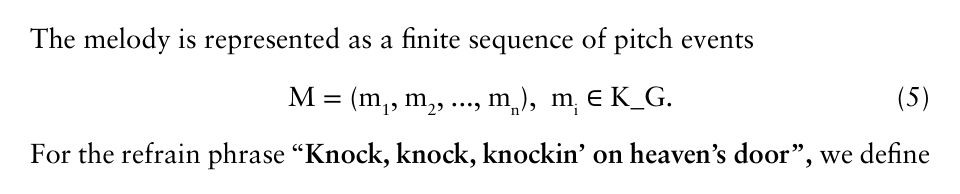
Melodic Representation To enable process-based modeling, the melody is represented as a sequence of discrete pitch events aligned with the harmonic progression. For example, the chorus phrase “Knock, knock, knockin’ on heaven’s door” can be expressed as: B4 – B4 – A4 – A4 – A4 – G4 – A4 – A4. This transformation of melody into a sequence of events allows it to be directly mapped to process elements.
Melody–Harmony Mapping The relationship between melody and harmony is analyzed by aligning pitch events with the corresponding chord.
Each tone is classified as either:
chord tone (stable)
non-chord tone (tension) This mapping enables identification of structural points such as harmonic stability, transition, and resolution.
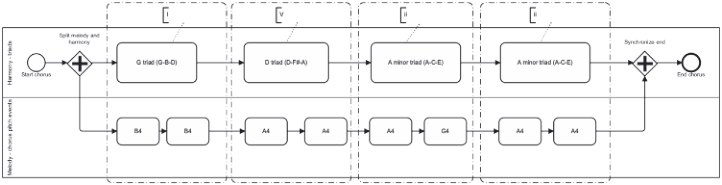
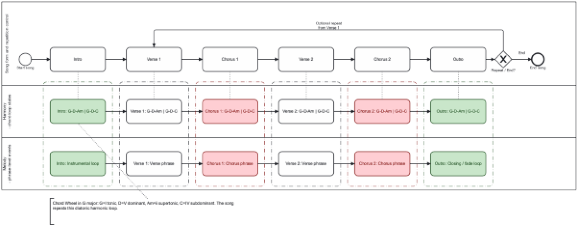
BPMN-Based Representation The structure is modeled using two BPMN lanes: melody (pitch events) and harmony (chord states). BPMN gateways represent repetition of the harmonic loop (see Figure 1), enabling interpretation of the song as a coordinated process.
Figure 1: BPMN-based representation melody and harmony lines.
Chord changes define the harmonic context, while multiple melodic events occur within each harmonic state. BPMN gateways are used to represent repetition of the chord progression, reflecting the cyclic structure of the song. This representation allows the musical structure to be interpreted as a coordinated
process, where harmony provides the framework and melody represents the evolving sequence within it.
Using BPMN and Chord Wheel Diagram as an Educational Framework 451 Mathematical Model of the Melody–Harmony Process
Let the pitch-class universe be defined as P = Z12 = {0,1,...,11}. (1) Let a tonal system be a subset K ⊆ P. For the song excerpt considered here, the key is G major:
K_G = {7, 9, 11, 0, 2, 4, 6}, corresponding to {G, A, B, C, D, E, F#}. (2) A triadic chord is modelled as an ordered triple
C = (r, t, f), (3) where r is the root, t is the third, and f is the fifth. For the chorus excerpt, the harmonic states are
C_G = (G, B, D), C_D = (D, F#, A), C_Am = (A, C, E). (4) The melody is represented as a finite sequence of pitch events
For the refrain phrase “Knock, knock, knockin’ on heaven’s door”, we define
Equation reproduced from the original PDF.
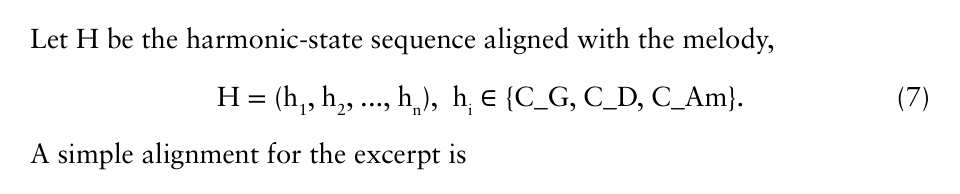
Let H be the harmonic-state sequence aligned with the melody,
A simple alignment for the excerpt is
Equation reproduced from the original PDF.
(B4, B4) → C_G, (A4, A4, A4) → C_D,
(G4, A4, A4) → C_Am. (8) The melody–harmony relation is defined by a mapping
φ : M → H, (9) assigning each melodic event to the currently active chord state.
A tone mi is considered stable if
and non-chordal otherwise.
mi ∈ hi, (10)
The BPMN model can be formalized as a directed graph B = (V, E, τ), (11) where V is the set of BPMN nodes, E ⊆ V × V is the set of sequence flows, and τ assigns node types such as start, task, gateway, and end.
Two swimlanes are defined:
L_H – harmonic lane
L_M – melodic lane. (12) The synchronization between the lanes is defined as
Fork → (L_H || L_M) → Join. (13)
RESULTS AND DISCUSSION
The harmonic structure of Knockin’ on Heaven’s Door can be interpreted as a movement within the tonal space of G major. The chord progression: G – D – Am – G – D – C represents a limited but highly structured subset of diatonic relationships. Using the Chord Wheel Diagram, these chords can be positioned within the tonal system, where each chord corresponds to a specific degree of the G major scale:
G – tonic (I)
D – dominant (V)
Am – supertonic (ii)
C – subdominant (IV) This reveals that the progression operates entirely within the diatonic framework, without modulation or chromatic deviation. From the perspective of the chord wheel, harmonic movement follows a constrained path:
G → D represents movement toward the dominant, increasing tension
D → Am introduces a shift away from the dominant toward a pre-dominant region
Am → G resolves tension back to the tonic
D → C introduces variation by moving toward the subdominant This sequence demonstrates that harmonic progression is not arbitrary, but follows structured transitions within tonal space.
Importantly, the progression forms a cyclic structure, where the return to G re-establishes the tonal centre. This cyclic behaviour aligns directly with the BPMN representation, where the chord sequence is modelled as a repeating process loop. The chord wheel diagram thus provides a spatial interpretation of harmonic relationships, explaining why specific chord transitions are perceived as natural and stable. When combined with BPMN, it complements the temporal process representation by providing an intuitive understanding of the underlying tonal logic.
Using BPMN and Chord Wheel Diagram as an Educational Framework 453 Chord Wheel-Based Interpretation of Harmony
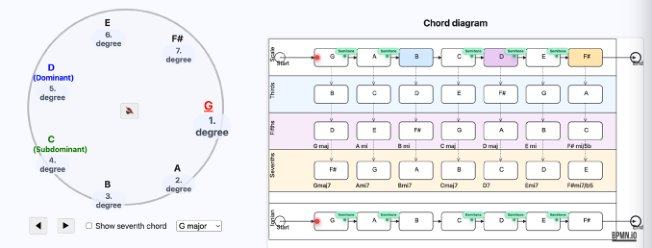
The Chord Wheel Diagram provides a structured and intuitive representation of the tonal system in the key of G major. As shown (see Figure 2), the chord wheel diagram visualizes tonal relationships within the key of G major. The diagram consists of a circular arrangement of scale degrees, where each position corresponds to a tone within the diatonic scale.
In the case of G major, the tones are organized as: G – A – B – C – D – E – F# Each tone represents a scale degree, where:
G – tonic (1st degree)
A – supertonic (2nd degree)
B – mediant (3rd degree)
C – subdominant (4th degree)
D – dominant (5th degree)
E – submediant (6th degree)
F# – leading tone (7th degree) The circular layout highlights the relative positions of tones within the tonal system, allowing users to perceive harmonic relationships spatially rather than symbolically. A key feature of the diagram is the direct mapping between scale degrees and chord types. Each tone serves as a root of a triadic chord, whose quality is determined by its position within the scale:
G – major chord (G–B–D)
A – minor chord (A–C–E)
B – minor chord (B–D–F#)
C – major chord (C–E–G)
D – major chord (D–F#–A)
E – minor chord (E–G–B)
F# – diminished chord (F#–A–C) This mapping explains, for example, why the chord A is minor and appears on the second degree of the G major scale. From the perspective of harmonic analysis, the chord wheel enables immediate identification of functional relationships:
tonic (G) as the central reference point
dominant (D) as a source of tension
subdominant (C) as a transitional function The chord progression of the song: G – D – Am – G – D – C can therefore be interpreted as movement within this circular tonal space. Rather than arbitrary transitions, the progression follows structurally defined paths between functionally related chords. The diagram thus serves as a cognitive bridge between abstract harmonic theory and intuitive understanding. It allows learners to visually grasp why certain chord transitions occur and how they relate to the tonal center. This spatial interpretation directly complements the BPMN-based process model, where the same harmonic relationships are represented temporally as a sequence of transitions. This process-oriented representation is shown in Figure 3.
Figure 3: BPMN-based process model, where the same harmonic relationships are represented temporally as a sequence of transitions.
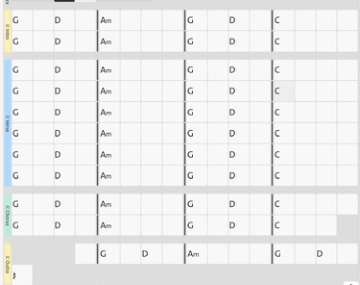
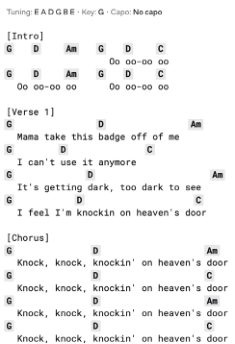
Comparison With Traditional Representations To evaluate the proposed BPMN and chord wheel framework, it is useful to compare it with commonly used representations of chord progressions in popular music platforms such as Chordify and Ultimate Guitar. Chordify presents harmonic progression as a time-aligned sequence of chord blocks. While this representation provides a clear temporal structure, it primarily focuses on playback alignment and does not explicitly convey functional relationships between chords. The progression is displayed as a linear sequence without highlighting tonal roles or structural dependencies. Similarly, Ultimate Guitar represents harmony using chord symbols placed above lyrics. This format is widely used and accessible, but it relies heavily on the user’s prior knowledge of music theory. The representation does not explicitly show relationships between chords, repetition structures, or the underlying tonal system. In contrast, the proposed BPMN-based representation introduces a process-oriented perspective. Harmonic progression is modeled as a structured sequence of activities, including repetition and decision points. This makes the cyclic nature of the song immediately visible and formally defined.
Furthermore, the chord wheel diagram provides a spatial representation of tonal relationships, allowing users to understand why specific chord transitions occur. Unlike linear representations, it explicitly encodes functional
Using BPMN and Chord Wheel Diagram as an Educational Framework 455 roles such as tonic, dominant, and subdominant. The combination of BPMN and chord wheel thus separates three aspects that are typically merged in traditional representations:
temporal structure (BPMN)
tonal relationships (chord wheel)
musical content (melody and chords) This separation reduces cognitive load and improves interpretability, particularly for learners without formal training. The results suggest that the proposed framework provides a more structured and cognitively accessible representation of harmonic progression compared to traditional chord charts.
An example of a time-aligned chord representation is shown in Figure 4. A typical chord–lyrics representation is shown in Figure 5. Figures 4 and 5 illustrate linear representations, in contrast to the structured and process- oriented approach shown in Figures 1–3.
DISCUSSION
The results demonstrate that harmonic progression in Knockin’ on Heaven’s Door can be represented as a structured and cyclic process, supporting the assumption that even simple harmonic patterns can be formalized using process modeling concepts (Kocbek et al., 2015; Hassen et al., 2017). The main contribution lies in integrating temporal structure (BPMN), tonal relationships (Chord Wheel Diagram), and melodic alignment into a unified representation of musical structure, consistent with approaches that interpret harmony as a system of relationships (Chew, 2014). From an educational perspective, separating these layers improves clarity and interpretability compared to traditional chord charts, which combine multiple aspects into a single representation. This aligns with findings that separating structural and semantic information reduces cognitive load and enhances understanding (Bunks et al., 2022). In contrast to platforms such as Chordify and Ultimate Guitar, which primarily support playback and performance, the BPMN- based model explicitly represents functional relationships and structural repetition. The repetitive harmonic loop of the song further highlights the suitability of BPMN constructs such as loops and gateways for modeling musical form, as also observed in previous BPMN-based approaches (Pavlicek et al., 2024, 2025). However, the model abstracts from rhythm, dynamics, and expressive timing and requires a simplified mapping between musical elements and process constructs. Despite these limitations, the framework provides a meaningful bridge between music theory and process modeling, supported by human-centered evaluations (Pavlicek et al., 2026). Future work should extend the approach to more complex musical structures and include empirical validation of its educational effectiveness.
CONCLUSION
This paper presented a process-oriented framework for analyzing and teaching harmonic progression using BPMN and the Chord Wheel Diagram. The results show that harmonic progression can be interpreted as a structured and cyclic process, where each chord transition represents a step within a tonal system. The proposed framework separates temporal structure from tonal relationships, improving clarity and interpretability compared to traditional representations, particularly in educational contexts where reducing cognitive load is essential. The study confirms that harmonic structures can be effectively described using formal process modeling techniques. By combining music theory with process modeling and visualization, the approach provides an interdisciplinary method for analyzing and teaching harmony.
Future work may extend this framework to more complex musical structures and explore its application in interactive educational tools.
REFERENCES
Bunks, C., Weyde, T., Slingsby, A., Wood, J., 2022. Visualization of Tonal Harmony for Jazz Lead Sheets. EuroVis 2022 - Short Pap. 109–113. https://doi.org/10.2312/ EVS.20221102 Chew, E., 2014. Mathematical and Computational Modeling of Tonality: Theory and
Applications, International Series in Operations Research & Management Science. Springer US Imprint: Springer, Boston, MA s.l. https://doi.org/10.1007/978-1- 4614-9475-1 Christensen, T.S. (Ed.), 2002. The Cambridge history of Western music theory, The Cambridge history of music. Cambridge University Press, Cambridge; New York. Hassen, M.B., Keskes, M., Turki, M., Gargouri, F., 2017. BPMN4KM: Design and
Implementation of a BPMN Extension for Modeling the Knowledge Perspective of Sensitive Business Processes. Procedia Comput. Sci. 121, 1119–1134. https:// doi.org/10.1016/j.procs.2017.12.121 Hedges, T., Roy, P., Pachet, F., 2014. Predicting the Composer and Style of Jazz Chord Progressions. J. New Music Res. 43, 276–290. https://doi.org/10.1080/09 298215.2014.925477 Kocbek, M., Jost, G., Hericko, M., Polancic, G., 2015. Business process model and
notation: The current state of affairs. Comput. Sci. Inf. Syst. 12, 509–539. https:// doi.org/10.2298/CSIS140610006K Paiement, J.-F., Eck, D., Bengio, S., 2006. Probabilistic Melodic Harmonization, in: Tawfik, A.Y., Goodwin, S.D. (Eds.), Advances in Artificial Intelligence, Lecture Notes in Computer Science. Springer Berlin Heidelberg, Berlin, Heidelberg, pp. 218–229. https://doi.org/10.1007/11766247_19 Pavlicek, J., Molhanec, M., Pavlíčková, P., 2025. The Chord Wheel Diagram: A
Visual Framework for Guitar Harmony Supported by BPMN. Presented at the 18th annual International Conference of Education, Research and Innovation, Seville, Spain, pp. 5747–5755. https://doi.org/10.21125/iceri.2025.1584 Pavlicek, J., Pavlickova, P., Brnka, M., Rydval, J., 2024. BPMN for Displaying the Progression of Musical Harmony and Chords - Case Study, in: Almeida, J.P.A., Di Ciccio, C., Kalloniatis, C. (Eds.), Advanced Information Systems Engineering Workshops, Lecture Notes in Business Information Processing. Springer Nature Switzerland, Cham, pp. 264–274. https://doi.org/10.1007/978-3-031-61003- 5_23 Pavlicek, J., Pavlickova, P., Strausova, I., 2026. Human-Centered Harmonic Analysis
of the Beatles’ Yesterday: Chord Wheel, Process Diagrams, and Eye-Tracking Insights. Presented at the 9th International Conference on Human Intelligent Systems Integration (IHSI 2026): Disruptive and Innovative Technologies. https:// doi.org/10.54941/ahfe1007097
FIND THE COMPLETE VOLUME IN THE AHFE DIGITAL BOOKSTORE
Explore the complete digital volume
Human Systems Engineering and Design (IHSED2026): Future Trends and Applications
Read this individual research paper free through the original publisher, or explore the full digital proceedings book.