Yejin Lee, Kwangtae Jung (2026). Human-Centered Design of a Multi-Modal Safety Interface for RTK-GPS-Based Coastal Harvesting Mobility. In: Human Factors in Design, Engineering, and Computing. AHFE Open Access, vol. 238, pp. 1163–1173. https://doi.org/10.54941/ahfe1008346
Coastal harvesting activities expose workers to various safety risks, including tidal changes, unstable terrain, and physical fatigue. These risks are particularly critical for elderly harvesters, who often experience reduced physical and cognitive abilities during prolonged outdoor work. Although recent studies have developed RTK-GPS-based coastal harvesting mobility systems to improve transportation efficiency and location tracking, limited attention has been given to the design of human-centered safety interfaces that effectively communicate risk information to users. This study proposes a human-centered multi-modal safety interface for an RTK-GPS-based coastal harvesting mobility system. User requirements were derived based on coastal work characteristics, hazard scenarios, and elderly user characteristics. The proposed interface integrates visual, auditory, and haptic feedback to provide intuitive safety warnings according to different levels of risk. In addition, tide information, real-time location tracking, and emergency notification functions were incorporated to support proactive safety management during harvesting activities. The proposed interface was preliminarily evaluated through a scenario-based review involving eight experts in ergonomics, service design, and coastal safety management. The evaluation indicated positive assessments of the proposed design in terms of usability, safety, and operational applicability, providing preliminary support for its conceptual feasibility. The proposed interface extends previous mobility-centered studies by focusing on human-centered interaction between users and intelligent mobility systems. The findings provide practical HMI design guidelines for intelligent coastal harvesting mobility and contribute to the development of safer and more user-centered coastal work support systems.
Coastal harvesting is an important economic activity in many coastal communities, providing both a source of livelihood for local fishers and recreational opportunities for tourists (Kang, 2025). In Korea, the increasing popularity of mudflat harvesting and coastal ecotourism has resulted in a growing number of participants (Kim et al., 2024). However, harvesting activities are conducted in highly dynamic environments where tidal changes,
1164 Lee and Jung unstable terrain, and long walking distances expose workers to significant safety risks.
Among these hazards, tidal isolation caused by rapidly rising sea levels is one of the most critical. Harvesters often concentrate on collecting marine products while moving across large tidal flats, making it difficult to recognize environmental changes in time. These risks are particularly severe for elderly workers, who generally experience reduced mobility, slower reaction times, and age-related sensory decline.
Recent advances in information and communication technologies (ICT), including RTK-GPS, wearable devices, and real-time environmental monitoring, have enabled the development of intelligent mobility systems for outdoor work (Parasuraman et al., 2000; Eckart et al., 2022). Previous studies have demonstrated the feasibility of RTK-GPS-based coastal harvesting mobility for user tracking, autonomous following, and transportation assistance (Lee et al., 2025). However, relatively little attention has been paid to how safety information should be communicated effectively through human-centered interfaces (Endsley, 2024).
Existing research has mainly focused on hardware development, positioning technologies, and service operation models, while the design of intuitive warning interfaces for elderly users remains limited (Lee and Jung, 2026). Therefore, there is a need for safety interfaces that can effectively communicate environmental risks and support timely responses in dynamic coastal environments.
This study proposes a human-centered multi-modal safety interface for an RTK-GPS-based coastal harvesting mobility system. The proposed interface integrates real-time positioning, tidal information, wearable interaction, and progressive multi-modal warnings to support hazard perception and safe decision-making. The study was conducted in three stages: (1) identification of interface requirements based on coastal work characteristics, elderly user characteristics, and relevant human factors literature; (2) development of the multi-modal safety interface and representative safety scenarios; and (3) scenario-based expert review of the proposed design. Through this process, the study presents interface design requirements, warning scenarios, and a preliminary conceptual evaluation for future intelligent coastal harvesting systems.
USER REQUIREMENTS FOR HUMAN-CENTERED SAFETY INTERFACE Characteristics of Coastal Harvesting Environment
Coastal harvesting is performed in dynamic outdoor environments characterized by tidal fluctuations, uneven terrain, changing weather, and limited accessibility. These conditions reduce workers’ mobility and situational awareness while increasing the risk of slips, falls, and tidal isolation (Kang, 2025; Kim et al., 2024).
Among these hazards, rapidly changing tidal conditions pose the greatest threat. Because harvesters concentrate on collecting marine products, they
Human-Centered Design of a Multi-Modal Safety Interface 1165 may fail to recognize environmental changes until safe evacuation routes become unavailable. In addition, soft mud, rocky surfaces, and long walking distances increase physical workload and fatigue, while fog, rainfall, and poor visibility make it difficult to recognize hazards and maintain orientation (Hatano et al., 2024; Deusdado et al., 2016).
These environmental characteristics indicate that conventional passive safety measures are insufficient. Therefore, coastal harvesting mobility requires an interface capable of providing real-time environmental information and timely safety guidance to support rapid hazard recognition and decision- making (Endsley, 1995).
Characteristics of Elderly Users The majority of coastal harvesters in Korea are older adults, making age- related characteristics an important consideration in interface design. Aging is associated with reduced visual acuity, hearing sensitivity, reaction speed, and cognitive processing, all of which can delay hazard recognition in dynamic outdoor environments (Abi Akle et al., 2014; ISO 9241–210, 2019; Wickens et al., 2004).
Because elderly users often work under visually and acoustically challenging conditions, safety information should be presented in an intuitive and easily recognizable manner. High-contrast graphics, large fonts, simple layouts, and multi-modal interaction combining visual, auditory, and haptic feedback can improve the perception of critical warnings while reducing dependence on a single sensory modality (Morgan et al., 2018; Norman, 2013).
Accordingly, safety interfaces should minimize cognitive workload, support rapid decision-making, and provide consistent interaction across different devices to facilitate safe harvesting activities (Endsley, 2024; ISO 9241–210, 2019).
Interface Design Requirements Based on the environmental characteristics of coastal harvesting and the needs of elderly users, five interface design requirements were identified (Endsley, 2024; ISO 9241–210, 2019; Norman, 2013). These requirements were selected to address the primary interaction challenges identified in the preceding analysis, particularly cognitive demand, outdoor visibility, sensory limitations, timely hazard recognition, and ease of learning.
Simplicity minimizes cognitive effort through concise messages, intuitive icons, and minimal interaction steps (Norman, 2013).
Visibility ensures that warning information remains recognizable under outdoor conditions by using large fonts, high-contrast colors, and consistent warning symbols (Abi Akle et al., 2014).
Multi-modal information delivery combines visual displays, voice guidance, and vibration alerts to improve the perception of critical warnings under varying environmental conditions (Morgan et al., 2018).
Immediate feedback enables rapid hazard recognition by providing real-time warnings based on RTK-GPS positioning and environmental monitoring (Endsley, 1995).
Consistency and learnability employ standardized layouts, colors, icons, and interaction methods to reduce learning time and operational errors (ISO 9241–210, 2019; Norman, 2013).
The identified design requirements provide the foundation for the proposed human-centered multi-modal safety interface presented in the following section.
Table 1: Design requirements for the proposed human-centered safety interface.
Visibility Improve visual recognition in outdoor environments
Large fonts, high-contrast colors, intuitive warning symbols
Multi-modal Information Delivery
Increase perception of safety information
Visual display, voice guidance, vibration alerts
Immediate Feedback Support rapid hazard recognition
Real-time warnings based on RTK-GPS and environmental information
Consistency and Learnability
Improve usability and reduce operational errors
Standardized layouts, colors, icons, and interaction methods
HUMAN-CENTERED SAFETY INTERFACE DESIGN System Configuration
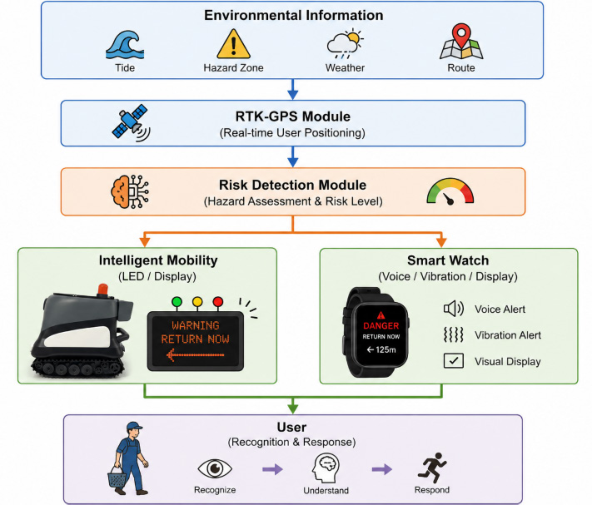
The proposed human-centered safety interface integrates RTK-GPS positioning, environmental monitoring, intelligent mobility, and a smartwatch interface to provide continuous safety support during coastal harvesting (Figure 1). The system consists of five components: an RTK- GPS module, a risk detection module, intelligent mobility, a smartwatch, and the user.
RTK-GPS continuously estimates the user’s location, while the risk detection module analyzes environmental information, including tidal conditions, hazardous areas, and evacuation routes (Lee et al., 2025). Based on the assessed risk level, the intelligent mobility activates visual warnings and transmits safety information to the smartwatch.
The smartwatch serves as the primary interaction device by providing visual messages, vibration alerts, and voice guidance, allowing users to recognize hazards regardless of their viewing direction. Through this integrated information flow, the proposed system is intended to support situational awareness and timely safety decisions (Endsley, 1995).
Figure 1: Overall system configuration of the proposed human-centered safety interface.
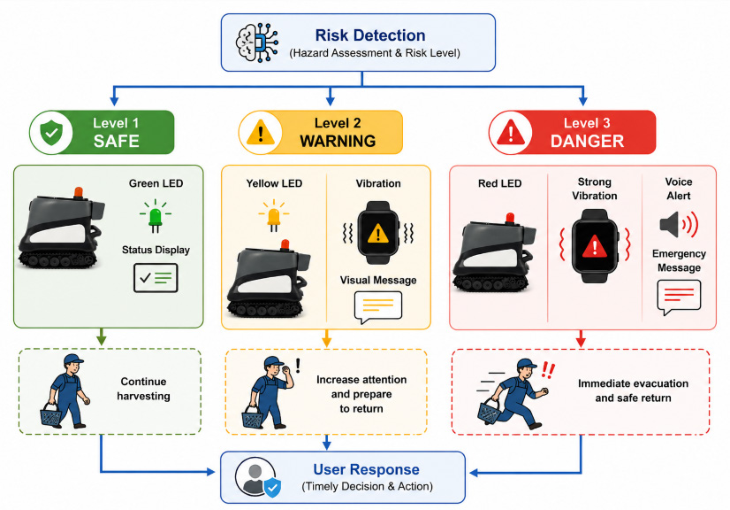
Multi-Modal Warning Interface The proposed interface employs a three-level warning strategy that progressively increases warning intensity according to the detected risk level (Figure 2). The three-level structure was adopted to distinguish normal operation, emerging risk, and immediate danger while maintaining a simple warning hierarchy that can be readily understood by elderly users. Rather than relying on a single warning modality, the system combines visual, auditory, and haptic feedback to support hazard perception under dynamic coastal conditions (Morgan et al., 2018).
Level 1 (Safe) provides only essential status information through a green LED during normal operation.
Level 2 (Warning) is activated when a potential hazard is detected. The system changes the LED indicator to yellow and delivers simultaneous vibration and visual notifications through the smartwatch, encouraging users to increase attention and prepare for possible evacuation.
Level 3 (Danger) is triggered when an immediate threat such as tidal isolation is detected. The system activates a red LED, strong vibration, voice guidance, and emergency messages to provide clear action-oriented instructions for immediate evacuation.
By progressively increasing warning intensity, the proposed strategy is intended to support hazard recognition while reducing the potential for unnecessary alarm fatigue during routine harvesting.
Table 2: Multi-modal warning strategy according to risk level.
Table available in the original PDF paper.
Risk Level System Status Warning Method User Action Level 1 (Safe) Normal operation Green LED, status display Continue harvesting
Level 2 (Warning)
Potential hazard detected
Yellow LED, smartwatch vibration, visual message
Increase attention and prepare to return
Level 3 (Danger)
Immediate hazard detected
Immediate evacuation and safe return
Red LED, voice guidance, strong vibration, emergency message
Figure 2: Multi-modal warning strategy based on risk level.
Interface Components The proposed interface consists of five complementary components that provide continuous communication between the intelligent mobility system and the user (Table 3).
Mobility Display presents system status and warning information using high-contrast graphics and concise messages that remain visible under outdoor conditions.
Smartwatch Display provides wearable notifications, including warning messages, vibration alerts, and evacuation guidance, enabling users to receive safety information regardless of their viewing direction.
Voice Alert delivers action-oriented instructions, such as evacuation guidance, to reduce decision-making time during emergencies (Endsley, 1995).
LED Warning Indicator communicates risk levels using intuitive color coding (green, yellow, and red), allowing immediate recognition of system status.
Emergency Button enables users to request assistance by transmitting RTK-GPS location and emergency information to the operation center through a single, simple action.
Together, these components form an integrated multi-modal interface designed to support rapid hazard recognition, reduce cognitive demands, and facilitate safe behavioural responses during coastal harvesting (Endsley, 1995; ISO 9241–210, 2019).
Table 3: Functions of the proposed interface components.
Table available in the original PDF paper.
Component Primary Function Human Factors Consideration Mobility Display Displays system status and warning information High visibility, simplified information presentation
Smartwatch Display
Provides wearable safety notifications
Continuous interaction regardless of viewing direction
Supports rapid decision-making and hazard recognition
LED Warning Indicator
Indicates risk level using color coding
Immediate visual perception from a distance
Emergency Button
Requests emergency assistance and transmits location
Simple operation under stressful situations
SAFETY SCENARIOS To demonstrate the application of the proposed interface, three representative safety scenarios were developed based on typical hazards encountered during coastal harvesting. These scenarios illustrate how RTK- GPS positioning, risk assessment, intelligent mobility, and wearable devices interact to support safe decision-making under different risk conditions (Endsley, 1995).
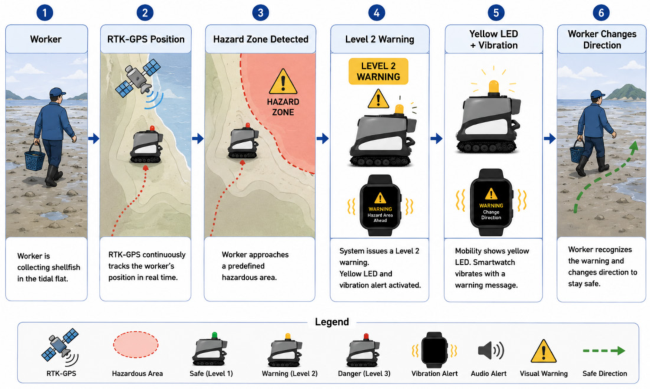
Scenario 1: Approaching a Hazardous Area When a worker approaches a predefined hazardous area, the RTK-GPS module detects the user’s location and classifies the situation as Level 2 (Warning). The system changes the LED indicator to yellow and delivers vibration and visual notifications through the smartwatch, allowing the user to change direction before entering the hazardous zone (Figure 3).
Figure 3: Scenario 1: Hazardous area warning.
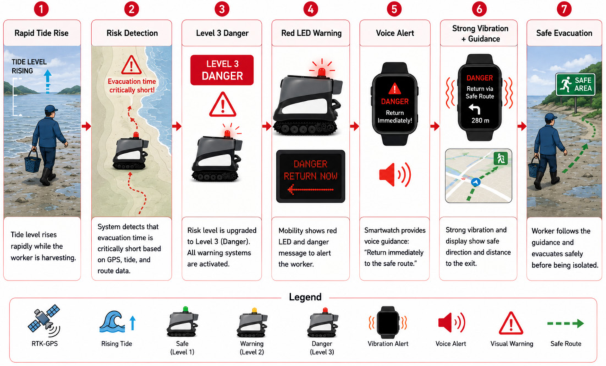
Scenario 2: Rapid Tide Rise When rising tides threaten the user’s evacuation route, the system upgrades the warning to Level 3 (Danger). Red LED warnings, strong vibration, voice guidance, and emergency messages are simultaneously activated to provide immediate evacuation guidance and safe return directions (Figure 4).
Figure 4: Scenario 2: Rapid tide evacuation.
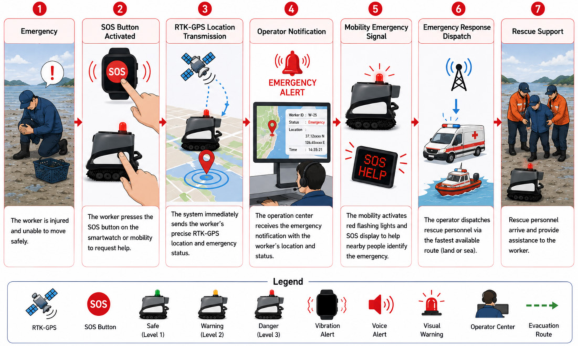
Scenario 3: Emergency Situation If the user experiences an emergency, activating the emergency button immediately transmits RTK-GPS location information and emergency status to the operation center. At the same time, the mobility activates emergency warning lights to support rapid rescue coordination (Figure 5).
Figure 5: Scenario 3: Emergency response.
The three scenarios illustrate how the proposed interface adapts its warning strategy according to environmental risk. Early warnings support hazard avoidance, progressive multi-modal alerts facilitate timely evacuation, and emergency communication enables rapid rescue coordination (Morgan et al., 2018). Together, these scenarios illustrate how integrating RTK- GPS positioning with progressive multi-modal interaction may support situational awareness and safer decision-making during coastal harvesting activities (Endsley, 1995). To obtain preliminary evidence of the proposed design, a scenario-based expert review was conducted with eight specialists in ergonomics, service design, and coastal safety management. The experts reviewed the overall interface configuration, the three-level warning strategy, and the three representative safety scenarios in terms of usability, safety, and operational applicability. Overall, the proposed design received positive assessments across these criteria, supporting its conceptual feasibility as a safety interface for coastal harvesting mobility. However, the evaluation represents expert-based preliminary validation rather than empirical verification with elderly coastal harvesters.
DISCUSSION AND CONCLUSIONS This study proposed a human-centered multi-modal safety interface for an RTK-GPS-based coastal harvesting mobility system to improve the safety of elderly users in dynamic tidal environments. Unlike previous studies that primarily focused on mobility platforms, positioning technologies, or service operation models, this study emphasized human-machine interaction by integrating user characteristics, environmental risks, and progressive warning strategies into a unified interface framework.
A major contribution of this study is the development of a progressive multi-modal warning strategy that combines visual, auditory, and haptic feedback according to the detected risk level (Morgan et al., 2018). Rather than relying on a single communication channel, the proposed interface delivers redundant safety information through multiple sensory modalities,
1172 Lee and Jung which is intended to support hazard perception and reduce reliance on a single sensory channel (Endsley, 2024; ISO 9241–210, 2019). In addition, the integration of RTK-GPS positioning with intuitive, action-oriented warnings is designed to support timely user responses by providing clear guidance, such as evacuation directions and safe return routes, instead of simply indicating the presence of danger (Lee et al., 2025).
The scenario-based application illustrated the potential applicability of the proposed interface in representative coastal harvesting situations, including hazardous area approach, rapid tide rise, and emergency response. These scenarios illustrate how real-time positioning, environmental monitoring, intelligent mobility, and wearable interaction can work together to provide continuous safety support throughout harvesting activities.
This study has several limitations. Although the proposed interface was preliminarily evaluated through expert review, it has not yet been validated through extensive field testing involving elderly harvesters. In addition, the warning strategies were not evaluated through quantitative usability, cognitive workload, or situational awareness experiments. Future research should conduct field-based user studies to validate interface effectiveness under real harvesting conditions and investigate AI-based personalized warning strategies that adapt to individual users and changing environmental conditions.
In conclusion, this study presents a human-centered safety interface that integrates RTK-GPS positioning, environmental information, wearable interaction, and progressive multi-modal warnings for coastal harvesting mobility. The proposed framework provides a conceptual basis for supporting situational awareness and timely decision-making and offers practical design guidelines for future intelligent coastal mobility systems for elderly users.
ACKNOWLEDGMENT
This research was supported by the ANCHOR program through the Chungcheongnam-do ANCHOR Center, funded by the Ministry of Education (MOE) and the Chungcheongnam-do, Republic of Korea. (2026-ANCHOR-12–022).
REFERENCES
Abi Akle, A., Borgiel, K., Minel, S. and Merlo, C. (2014). Recommendations for usercentered design of interfaces for seniors in the context of health care, Proceedings of the 5th International Conference on Applied Human Factors and Ergonomics. Deusdado, P., Pinto, E., Guedes, M., Marques, F., Rodrigues, P., Lourenço, A.,
Mendonça, R., Silva, A., Santana, P., Corisco, J., Almeida, M., Portugal, L., Caldeira, R., Barata, J. and Flores, L. (2016). An aerial-ground robotic team for systematic soil and biota sampling in estuarine mudflats, In Reis, L.P., Moreira, A.P., Lima, P.U., Montano, L. and Muñoz-Martinez, V. (Eds.), Robot 2015: Second Iberian Robotics Conference, Advances in Intelligent Systems and Computing, Vol. 418, Springer, Cham, 15–26. Eckart, P., Knöll, M., Lanzendorf, M. and Vöckler, K. (2022). Mobility Design: Shaping Future Mobility. Volume 2: Research, JOVIS, Berlin.
Human-Centered Design of a Multi-Modal Safety Interface 1173 Endsley, M.R. (1995). Toward a theory of situation awareness in dynamic systems,
Human Factors, 37(1), 32–64. Endsley, M.R. (2024). Situation awareness oriented design: From user-centered to mission-centered system design, International Journal of Human–Computer Interaction, 40(7), 1487–1504. Hatano, M., Senzaki, M., Kawasaki, H., Takasu, C., Yamazaki, M. and Hoshigami,
Y. (2024). Robots traveling on muddy terrain for sampling bottom sediment in tidal flats, Artificial Life and Robotics, 29(1), 155–160. ISO 9241–210 (2019). Ergonomics of Human-System Interaction—Part 210: Human-Centred Design for Interactive Systems, International Organization for Standardization, Geneva. Kang, S.B. (2025). The tradition and changing patterns of “Haerujil” on Korea’s
west coast: Focus on Wonsando, DBpia, Retrieved September 3. Kim, Y., Lee, S., Hwang, T. and Choi, I. (2024). An analysis of conflict issues in marine leisure activities surrounding Haerujil (recreational fishery), Journal of the Korean Regional Development Association, 36(5), 151–174. Morgan, P.L., Voinescu, A., Alford, C. and Caleb-Solly, P. (2018). Exploring the
usability of a connected autonomous vehicle human-machine interface designed for older adults, In Advances in Human Aspects of Transportation, Springer, 591–603. Norman, D.A. (2013). The Design of Everyday Things, Revised and Expanded Edition, Basic Books, New York. Parasuraman, R., Sheridan, T.B. and Wickens, C.D. (2000). A model for types and
levels of human interaction with automation, IEEE Transactions on Systems, Man, and Cybernetics-Part A, 30(3), 286–297. Wickens, C.D., Lee, J.D., Liu, Y. and Gordon-Becker, S. (2004). An Introduction to Human Factors Engineering, 2nd ed., Pearson, Boston. Lee, D., Seo, S., Lee, Y. and Jung, K. (2025). Human-centered smart mobility system
for worker safety and reduced physical strain, Proceedings of the Applied Human Factors and Ergonomics International Conference. Lee, Y. and Jung, K. (2026). Development of service scenarios and operation models for coastal harvesting support mobility, Journal of Information Technology and Architecture, 23(2), pp. 163–177.
SEARCH THE AHFE DIGITAL BOOKSTORE BY ISBN
Explore the complete digital volume
Human Factors in Design, Engineering, and Computing
Read this individual research paper free through the original publisher, or explore the full digital proceedings book.