Peta L. Chirgwin (2026). Redesigning Work in Industrial Control Rooms With Intelligent System Interfaces That Preserve Human Decision Authority While Maintaining Efficiency. In: Human Factors in Design, Engineering, and Computing. AHFE Open Access, vol. 238, pp. 1262–1272. https://doi.org/10.54941/ahfe1008355
While significant research has focused on the technical performance of intelligent systems and the design of human-machine interfaces, comparatively little attention has been given to the redesign of work itself. This introduces emerging sociotechnical risks, including authority ambiguity, skill degradation, automation complacency, reduced situational engagement, and diminished adaptive capacity during abnormal operating conditions. This paper introduces Human Authority-Centred Work Design (HACWD), a methodology that treats human authority as a property of the whole work system rather than as an individual trait or a final approval step. HACWD extends the author's previously developed Human Authority Index (HAI), which conceptualises human authority as a measurable sociotechnical property comprising four domains: Decision Clarity, Cognitive Sustainability, Psychosocial Safety and Work Design. Where the HAI assesses the extent to which intelligent systems preserve meaningful human authority, HACWD translates these principles into a work design model built around four interdependent design domains: Interface Design, Work Design, Capability Design and Authority Design. Using autonomous mining operations as an illustrative context, the paper examines how intelligent systems may reshape conventional control-room roles and proposes the human authority engineer or decision architect as an example of a future operational role. This is research in progress: the HAI weightings, items and interpretation bands are preliminary and are the subject of ongoing field, psychometric and cross-sector validation. The paper positions human authority as a critical organisational capability and argues that future operational success will depend not only on technological sophistication, but on the ability of organisations to redesign work, workforce capability and decision structures around effective human-machine collaboration.The research investigates: 'How should work, roles, and decision authority be redesigned in intelligent industrial operations to preserve and enhance human capability while realising the benefits of automation and AI?'
Industrial control rooms are becoming integrated decision environments in which artificial intelligence (AI), autonomous equipment, advanced analytics and distributed sensing perform functions that were previously undertaken
Redesigning Work in Industrial Control Rooms With Intelligent System Interfaces 1263 through direct human control and fragmented manual coordination. In mining, energy, transport, manufacturing and process industries, these technologies can improve prediction, consistency and exposure reduction. Yet technological capability does not automatically produce safe or effective joint performance. Automation can shift operators away from continuous control while leaving them accountable for rare, ambiguous and high-consequence events, precisely when system knowledge, situational understanding and practised intervention are most important (Bainbridge, 1983; Endsley, 2017).
This tension is often approached as an interface or trust problem: provide a better display, add an explanation, keep a person “in the loop”, or train the user to rely on automation appropriately. These interventions are necessary but incomplete. They do not, by themselves, determine whether the correct role classification is being applied, whether the correct capabilities, whether the current work design appropriate, who owns a decision, who may challenge an algorithmic recommendation, whether an override is usable under time pressure, how expertise is maintained when routine action is automated, or whether workers can influence the systems for which they remain responsible. Function allocation research has long shown that automation should be designed across stages and levels rather than as a binary human-versus- machine choice (Parasuraman, Sheridan and Wickens, 2000). However, many organisational roles, escalation pathways and performance measures still reflect pre-digital operating models.
The result can be an authority-accountability gap: people retain legal, operational or moral responsibility while losing the information, competence, discretion or organisational permission required to alter outcomes. In this paper, human authority is defined as the legitimate, intelligible and practicable capacity of people to shape, challenge, override, escalate and learn from consequential system decisions. Authority is therefore more than nominal control. It depends on technical affordances, work design, competence, governance, social climate and the temporal conditions under which decisions are made.
The research question is: How should work, roles and decision authority be redesigned in intelligent industrial operations to preserve and enhance human capability while realising the benefits of automation and AI? The paper proposes Human Authority-Centred Work Design (HACWD), the flagship methodology of Chameleon Mettle Group, developed from research and practise in mining automation and remote operations, including the author’s earlier field research on the work, skills and human factors of mine controllers in automation control rooms (Chirgwin, 2021b; Chirgwin, 2021a). HACWD extends the Human Authority Index (HAI) from a diagnostic framework into a structured work-redesign methodology. The HAI is a composite assessment developed by integrating multiple established measures that, when applied independently, do not fully capture the dimensions of human authority, decision making, and interaction within intelligent systems. HACWD builds on this diagnostic foundation by translating assessment findings into a systematic process for redesigning work, roles, decision rights and human-technology interaction. The contribution is primarily conceptual and design-oriented synthesising established principles from human factors,
1264 Chirgwin sociotechnical systems and work design into a coherent methodology for supporting effective human integration with increasingly intelligent systems. The work reported here is research in progress; empirical validation of the framework and its diagnostic instrument is ongoing.
THEORETICAL FOUNDATIONS OF HUMAN AUTHORITY Sociotechnical joint optimisation. Sociotechnical systems theory rejects the assumption that organisational performance can be optimised by improving technology independently of the social system. Intelligent technologies change coordination, autonomy, roles and work design (Baxter and Sommerville, 2011; Parker and Grote, 2022). Contemporary sociotechnical approaches emphasise compatibility with human values, the integrated design of social and technical systems, boundary management and the active participation of those who perform the work (Baxter and Sommerville, 2011; Parker and Grote, 2022). HACWD applies this tradition to intelligent systems by treating decision authority as an emergent property of interactions among technology, organisation and people.
Joint cognitive work. Industrial operations are joint cognitive systems in which people and artefacts perceive, interpret, anticipate and act together (Hollnagel and Woods, 2005). Cognitive work analysis similarly directs attention to constraints, functions, strategies and competencies rather than assuming a single prescribed task sequence (Vicente, 1999). These perspectives are important because AI changes not only task execution but also what becomes observable, which options appear available, how uncertainty is represented and where coordination is required. An apparently accurate model may still weaken system performance if its recommendations arrive without sufficient context, if the operator cannot interrogate their basis, or if interface logic obscures cross-system consequences.
Automation ironies, trust and skill. The classic ironies of automation remain relevant: designers automate the activities people perform well, then depend on those same people to recover when automation reaches its limits (Bainbridge, 1983). Reduced active involvement can produce out-of-the- loop performance problems, slower problem detection and degraded manual skill (Endsley, 2017). Confusion about system modes, situational awareness and automation intent can further undermine control (Endsley, 2017), and patterns of use, misuse, disuse and abuse of automation are well documented (Parasuraman and Riley, 1997). The objective is not maximum or minimum trust, but calibrated reliance based on observable capability, limits and uncertainty (Lee and See, 2004). Meta-analytic evidence indicates that trust depends on system performance, process transparency and purpose, as well as individual and environmental factors (Hancock et al., 2011). HACWD therefore links explainability to decision rights and practised action rather than treating explanation as an informational add-on.
Resilience and cognitive sustainability. Resilience engineering focuses on the capacity to anticipate, monitor, respond and learn under variable conditions (Hollnagel, Woods and Leveson, 2006). In highly automated operations, adaptive capacity can be weakened when operators receive too
Redesigning Work in Industrial Control Rooms With Intelligent System Interfaces 1265 little meaningful activity during normal conditions and excessive demand during disturbances. Cognitive sustainability describes whether a role can maintain attention, operational skill, systems understanding and decision quality over time. It requires calibrated demand, opportunities to practise, role integrity and sufficient exposure to the underlying process. This is distinct from designing only for average workload; it addresses the temporal pattern of underload, interruption, alarm bursts and high-consequence exception management.
Work design and psychosocial safety. Digital technologies can either augment or constrain work depending on how tasks, discretion, learning and monitoring are configured (Parker and Grote, 2022). Work-design research shows that autonomy, task significance, social support and manageable demands shape performance, learning and wellbeing (Parker, Morgeson and Johns, 2017). Algorithmic systems may also become mechanisms of control by directing, evaluating and disciplining work through opaque rules or pervasive monitoring (Kellogg, Valentine and Christin, 2020). Psychosocial safety is therefore integral to human authority: people must be able to raise concerns, question recommendations, report uncertainty and influence system change without disproportionate penalty. ISO 45003 situates psychosocial risk within occupational health and safety management, while ISO 6385 frames work-system design as an integrated ergonomic activity (ISO, 2016; ISO, 2021).
Governance across the lifecycle. Human-centred design standards require understanding users, tasks and environments, iterative evaluation and multidisciplinary participation (ISO, 2019). Control-centre standards address the ergonomic design of displays and controls (ISO, 2008), while contemporary AI governance standards and frameworks emphasise risk management, accountability and continual improvement (ISO/IEC, 2023a; ISO/IEC, 2023b; NIST, 2023). HACWD connects these governance requirements to operational work. It asks whether formal responsibility is matched by usable authority at the point of action and whether governance arrangements continue to function during degraded, novel and time-critical situations.
RESEARCH APPROACH This is a conceptual, theory-informed design paper rather than an empirical validation study. The method was an integrative synthesis intended to translate established knowledge into an applied redesign architecture. Sources were selected from sociotechnical systems theory, cognitive systems engineering, resilience engineering, automation and trust research, work design, algorithmic management, mining human factors and relevant international standards. Autonomous and remote mining operations were used as the primary sensitising context because they combine distributed control, high consequence, complex interdependence and rapidly increasing automation (Horberry, Burgess-Limerick and Steiner, 2011; Lynas and Horberry, 2011). The synthesis is also grounded in the author’s prior published field research, comprising six years of in situ observation, interviews and audits across
1266 Chirgwin Australian mining control rooms, which documented unclear role definition, task overload, skill and training gaps and under-considered psychosocial risk among mine controllers transitioning to autonomous operations (Chirgwin, 2021b; Chirgwin, 2021a).
The synthesis proceeded through four design moves. First, recurrent failure conditions were identified: nominal rather than usable authority; unclear ownership and escalation; loss of operational skill; demand imbalance; fragmented roles and information; and unsafe or punitive challenge cultures. Second, these conditions were grouped into diagnostic system properties. Third, intervention levers were derived for authority, capability, work and interface design. Fourth, the framework was tested for internal coherence through an illustrative abnormal-operating scenario. The analysis does not claim completeness or validated causal effects; it develops propositions and a structured basis for field evaluation.
HUMAN AUTHORITY-CENTRED WORK DESIGN HACWD is a lifecycle methodology for designing work, roles, decision authority, governance, capability and technology integration in AI-enabled organisations. Its central proposition is that efficiency and human authority are not opposing objectives when the work system is jointly designed. Intelligent systems should remove avoidable exposure and low-value effort while strengthening the human capacity to set intent, interpret context, manage trade-offs, intervene in exceptions and remain accountable for consequential outcomes. The practical design test is not simply whether a human can technically intervene, but whether the human knows when intervention is required, understands the situation, has the competence and time to act, is authorised to act, and can do so without creating unmanaged secondary risk.
HACWD is guided by the following principles; authority should be proportional to consequence; accountability should not exceed practical influence; explanations should support action rather than merely disclosure; competence should be maintained through meaningful participation and rehearsal; affected workers should participate in design and change; and every intervention should include feedback, learning and revision. These principles make authority observable through work-system features rather than treating it as an abstract ethical commitment.
The HACWD cycle. The methodology comprises six iterative stages. (1) Context and consequence framing defines operational purpose, system boundaries, affected groups, hazards, dependencies and the decisions whose failure would matter. (2) Work-as-done and decision mapping traces how information, goals, constraints and informal coordination actually produce action, including the points at which automated recommendations enter the workflow. (3) HAI diagnosis establishes a baseline of authority strengths and fragilities using document review, observation, interviews, surveys and scenario evidence. (4) Co-design develops interventions across four levers: Authority Design, Capability Design, Work Design and Interface and Information Design. (5) Scenario-based verification tests the redesigned
Redesigning Work in Industrial Control Rooms With Intelligent System Interfaces 1267 system against normal variability, degraded modes, conflicting goals and time pressure. (6) Governance and learning embeds ownership, leading indicators, competence assurance, change control and periodic reassessment.
The intervention levers are deliberately cross-cutting. Authority Design allocates decision rights, override permissions, escalation thresholds and accountability. Capability Design specifies systems thinking, AI literacy, manual and diagnostic skill, team coordination and decision-assurance competence. Work Design configures role outline, tasks, role boundaries, staffing, temporal demands, handovers and participation. Interface and Information Design makes system state, uncertainty, rationale, dependencies and available actions perceptible at the point of need. A weakness in one diagnostic domain may require interventions across several levers; for example, poor explainability may demand interface redesign, revised escalation rules, new competence and changes to procurement assurance.
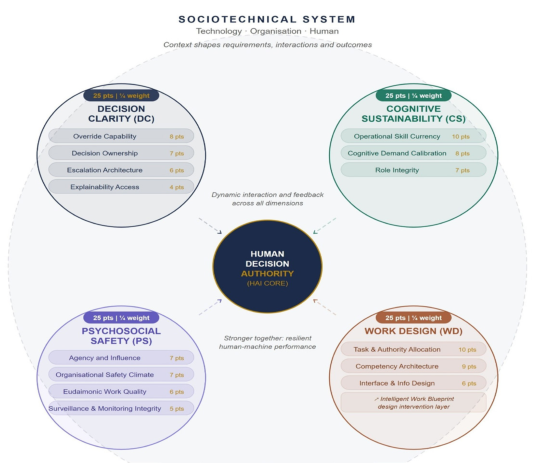
THE HUMAN AUTHORITY INDEX The HAI is the diagnostic architecture within HACWD. It measures the design of a work system, not the performance or psychological quality of an individual worker. The current instrument contains 30 statements rated on a five-level response scale and organised into four equally weighted domains, each contributing a maximum of 25 points to a 100-point composite. The 14 dimensions and their proposed point allocations are shown in Table 1. The allocations reflect consequence-oriented design judgement and are hypotheses to be calibrated through field evidence, not validated universal constants.
Table 1: Human authority index domains, dimensions and proposed weights (author developed).
Table available in the original PDF paper.
Domain Dimensions and Maximum Points Core Design Question Decision Clarity (DC)
Can people understand, own, challenge and alter consequential decisions? Cognitive Sustainability (CS)
Can people remain capable, engaged and ready across normal and abnormal conditions? Psychosocial Safety (PS)
Agency and Influence 7; Organisational Safety Climate 7; Eudaimonic Work Quality 6; Surveillance and Monitoring Integrity 5
Can people speak, influence, contribute and be monitored with dignity and legitimacy? Work Design (WD)
Task and Authority Allocation 10; Competency Architecture 9; Interface and Information Design 6
Does the operating model align tasks, authority, capability and information?
Equation reproduced from the original PDF.
points
HAI = DC + CS + PS + WD (each domain scored from 0 to 25) Weighted HAI = 100 × [sum of (domain weight × domain score / 25)] / sum
of domain weights
Figure 1: Human Authority Index sociotechnical architecture and proposed domain weightings (author-developed).
ILLUSTRATIVE APPLICATION: AUTONOMOUS MINING CONTROL ROOM Consider a remote operations centre supervising an autonomous haulage fleet. A predictive dispatch system recommends closing a haul route after detecting an emerging interaction among road condition, vehicle health and congestion. The recommendation is plausible but uncertain because one sensor stream is degraded and the system does not represent a concurrent maintenance constraint. In a legacy design, the controller may see a high-priority alert without the model assumptions, may be unsure whether production or maintenance owns the decision, and may need several approvals to deviate from automated dispatch. Routine automation has also reduced direct exposure to haul-cycle behaviour. The person is nominally responsible but lacks timely, practised and socially supported authority.
A HACWD intervention begins by mapping the consequential decision rather than redesigning the alert alone. The team identifies who sets intent, who owns the decision at each time horizon, what evidence is required, who can override, what secondary systems are affected and when escalation becomes mandatory. The interface is then reorganised around the event: confidence and data quality are visible; competing operational constraints are presented together; the system shows the consequence of accepting, modifying or rejecting the recommendation; and the controller can record a reasoned override without leaving the decision workspace. Escalation is time-bounded and responsibility transfers are explicit.
Redesigning Work in Industrial Control Rooms With Intelligent System Interfaces 1269 Capability and work are redesigned at the same time. Controllers participate in regular scenario rehearsals and short periods of meaningful direct diagnostic work so that operational skill remains current. Staffing and role rotation address prolonged underload and predictable bursts of demand. Performance measures recognise safe challenge, recovery quality and learning, not only adherence to automated recommendations or production throughput. Cross-functional information is brought into an integrated decision cell rather than exchanged through sequential functional silos.
Redesign of this kind also reshapes conventional roles beyond the controller. As intelligent systems integrate operational, planning, engineering, geospatial, safety and maintenance information into unified decision environments, traditional boundaries between mine controllers, supervisors, planners, engineers and surveyors become increasingly blurred. Rather than simply automating existing tasks, this convergence creates opportunities for new operational professions focused on integrated system governance, decision assurance and human-AI collaboration, supporting the transition from role-based organisational structures toward capability- based operating models centred on human authority and adaptive decision-making.
A human authority engineer or decision architect is proposed as a role archetype for mature intelligent operations. The role is not a substitute for line accountability or a new person required in every control room. It is a bundle of capabilities that may be assigned to an existing operational leader, assurance function or rotating team role. Its responsibilities include monitoring authority fragilities, maintaining decision and escalation architectures, coordinating scenario verification, assuring that overrides and explanations remain usable, reviewing surveillance practises, and converting operational exceptions into design and governance learning. The concept illustrates a broader shift from supervising individual machines toward assuring the quality of human-machine decision systems.
Table 2: Example transition from legacy automation design to HACWD (author developed).
Table available in the original PDF paper.
Legacy Condition HACWD Redesign Intended Effect Fragmented alerts and hidden assumptions Faster sensemaking and calibrated reliance Event-centred display of state, uncertainty, data quality, rationale and cross-system consequences
Nominal override and unclear escalation
Authority-accountability alignment
Explicit decision rights, usable override, time-bounded escalation and logged transfer of accountability
Passive monitoring with skill decay
Cognitive sustainability and recovery capacity
Scenario rehearsal, purposeful manual/ diagnostic exposure and demand- aware role rotation
Functional silos and throughput-only metrics
Joint optimisation and adaptive learning
Integrated decision cell, participatory review and measures of challenge, learning and safe recovery
DISCUSSION
HACWD makes three contributions. First, it reframes human authority as a measurable sociotechnical property rather than the presence of a human approval gate. This directs attention to the combined conditions of knowledge, permission, competence, time, interface access and psychosocial legitimacy. Second, it connects diagnosis to redesign. The HAI identifies patterns of fragility, while HACWD provides a lifecycle for changing authority, capability, work and interfaces and verifying those changes under realistic scenarios. Third, it broadens the objective of intelligent-system design from task automation to sustained organisational decision quality.
The framework also clarifies the automation-augmentation paradox. Technologies can simultaneously extend human analytic reach and narrow human discretion (Raisch and Krakowski, 2021). HACWD does not prescribe that humans retain every decision. It requires that function allocation be consequence-sensitive and that transferred functions do not silently remove the human capacity needed for governance, exception management and learning. Low-consequence, stable and well-bounded decisions may be highly automated; authority provisions should intensify as uncertainty, irreversibility, interdependence and potential harm increase.
For organisations, the implications extend beyond control-room operations. Procurement specifications should include authority and work- design requirements, not only model accuracy and interface usability. Management systems should define ownership for decision architectures and human capability degradation. Competence assurance should test reasoning and intervention in realistic scenarios rather than completion of generic AI awareness training. Workforce consultation should occur before roles are reduced to monitoring or surveillance arrangements are introduced. Regulatory reporting may also become more reliable where roles, decision rights, escalation and evidence trails are explicit, because responsibility is traceable to the actual operating model rather than an assumed hierarchy.
Several limitations are material. The framework reflects an integrative conceptual synthesis and the author’s mining automation experience; it has not yet been validated as a causal intervention model, and the research program remains in progress. The HAI dimensions, items, weights and interpretation bands require content validation, reliability testing and calibration across sectors and consequence classes. Self-report data may be affected by local climate and fear of identification. A composite score may also conceal critical single-point failures, such as an unusable emergency override. For this reason, domain and dimension profiles, qualitative evidence and scenario results should take precedence over ranking organisations by a single number.
Future research should include expert Delphi review and cognitive interviewing; pilot studies comparing worker, supervisor and independent assessor ratings; analysis of factor structure, internal consistency and inter- rater agreement; convergent and discriminant validity against work-design, safety-climate and automation-reliance measures; and longitudinal field
Redesigning Work in Industrial Control Rooms With Intelligent System Interfaces 1271 studies testing whether HACWD interventions improve decision quality, recovery, learning, wellbeing and operational performance. Cross-sector benchmarking should be undertaken only after measurement invariance and contextual comparability are examined.
CONCLUSION
Intelligent industrial operations require more than accurate technologies and usable interfaces. They require work systems in which people retain meaningful capacity to understand, influence and govern consequential decisions. HACWD provides a theory-informed methodology for redesigning authority, capability, work and information around that requirement, while the HAI offers a preliminary diagnostic structure across Decision Clarity, Cognitive Sustainability, Psychosocial Safety and Work Design. The central proposition is practical: humans should not remain accountable for outcomes they are no longer equipped, informed or authorised to influence. By treating authority as a sociotechnical design property, organisations can pursue efficiency while preserving the expertise, participation and adaptive capacity on which safe intelligent operations ultimately depend.
DECLARATION OF INTEREST The author is the developer of HACWD and the HAI and is affiliated with Chameleon Mettle Group, which provides related research, advisory and training services.
REFERENCES
Bainbridge, L. (1983) Ironies of automation. Automatica, 19(6), 775–779.
doi:10.1016/0005-1098(83)90046-8. Baxter, G. and Sommerville, I. (2011) Socio-technical systems: From design methods to systems engineering. Interacting with Computers, 23(1), 4–17. doi:10.1016/j. intcom.2010.07.003. Chirgwin, P. (2021a) In control with higher education through work-based learning.
Journal of Higher Education Theory and Practice, 21(15), 43–52. doi:10.33423/ jhetp.v21i15.4890. Chirgwin, P. (2021b) Skills development and training of future workers in mining automation control rooms. Computers in Human Behavior Reports, 4, 100115. doi:10.1016/j.chbr.2021.100115. Endsley, M.R. (2017) From here to autonomy: Lessons learned from human–automation
research, Human Factors, 59(1), 5–27. doi:10.1177/0018720816681350. Hancock, P.A., Billings, D.R., Schaefer, K.E., Chen, J.Y.C., de Visser, E.J. and Parasuraman, R. (2011) A meta-analysis of factors affecting trust in human-robot interaction. Human Factors, 53(5), 517–527. doi:10.1177/0018720811417254. Hollnagel, E. and Woods, D.D. (2005) Joint Cognitive Systems: Foundations of
Cognitive Systems Engineering. Boca Raton, FL: CRC Press. Hollnagel, E., Woods, D.D. and Leveson, N. (eds.) (2006) Resilience Engineering: Concepts and Precepts. Aldershot: Ashgate.
Design, Operation, and Maintenance of Mining Equipment. Boca Raton, FL: CRC Press. International Organization for Standardization (ISO) (2008) ISO 11064-5:2008 Ergonomic Design of Control Centres - Part 5: Displays and Controls. Geneva: ISO. International Organization for Standardization (ISO) (2016) ISO 6385:2016
Ergonomics Principles in the Design of Work Systems. Geneva: ISO. International Organization for Standardization (ISO) (2019) ISO 9241-210:2019 Ergonomics of Human-System Interaction - Part 210: Human-Centred Design for Interactive Systems. Geneva: ISO. International Organization for Standardization (ISO) (2021) ISO 45003:2021
Occupational Health and Safety Management - Psychological Health and Safety at Work - Guidelines for Managing Psychosocial Risks. Geneva: ISO. International Organization for Standardization and International Electrotechnical Commission (ISO/IEC) (2023a) ISO/IEC 23894:2023 Information Technology - Artificial Intelligence - Guidance on Risk Management. Geneva: ISO. International Organization for Standardization and International Electrotechnical
Commission (ISO/IEC) (2023b) ISO/IEC 42001:2023 Information Technology - Artificial Intelligence - Management System. Geneva: ISO. Kellogg, K.C., Valentine, M.A. and Christin, A. (2020) Algorithms at work: The new contested terrain of control. Academy of Management Annals, 14(1), 366–410. doi:10.5465/annals.2018.0174. Lee, J.D. and See, K.A. (2004) Trust in automation: Designing for appropriate
reliance. Human Factors, 46(1), 50–80. doi:10.1518/hfes.46.1.50_30392. Lynas, D. and Horberry, T. (2011) Human factor issues with automated mining equipment. The Ergonomics Open Journal, 4, 74–80. doi:10.2174/1875934301 104010074. National Institute of Standards and Technology (NIST) (2023) Artificial Intelligence
Risk Management Framework (AI RMF 1.0), NIST AI 100-1. Gaithersburg, MD: NIST. doi:10.6028/NIST.AI.100-1. Parasuraman, R. and Riley, V. (1997) Humans and automation: Use, misuse, disuse, abuse. Human Factors, 39(2), 230–253. doi:10.1518/001872097778543886. Parasuraman, R., Sheridan, T.B. and Wickens, C.D. (2000) A model for types and
levels of human interaction with automation. IEEE Transactions on Systems, Man, and Cybernetics - Part A: Systems and Humans, 30(3), 286–297. doi:10.1109/3468.844354. Parker, S.K. and Grote, G. (2022) Automation, algorithms, and beyond: Why work design matters more than ever in a digital world. Applied Psychology, 71(4), 1171–1204. doi:10.1111/apps.12241. Parker, S.K., Morgeson, F.P. and Johns, G. (2017) One hundred years of work design
research: Looking back and looking forward. Journal of Applied Psychology, 102(3), 403–420. doi:10.1037/apl0000106. Raisch, S. and Krakowski, S. (2021) Artificial intelligence and management: The automation-augmentation paradox. Academy of Management Review, 46(1), 192–210. doi:10.5465/amr.2018.0072. Vicente, K.J. (1999) Cognitive Work Analysis: Toward Safe, Productive, and Healthy
Computer-Based Work. Mahwah, NJ: Lawrence Erlbaum Associates.
SEARCH THE AHFE DIGITAL BOOKSTORE BY ISBN
Explore the complete digital volume
Human Factors in Design, Engineering, and Computing
Read this individual research paper free through the original publisher, or explore the full digital proceedings book.