Sejal Shah, Ryan Mohammadian, Elham Morshedzadeh, Amin Alipour, Pei-Fen Chang (2026). AI-Assisted Augmented Reality System for Home-Based Upper-Extremity Stroke Rehabilitation. In: Human Factors in Design, Engineering, and Computing. AHFE Open Access, vol. 238, pp. 2189–2198. https://doi.org/10.54941/ahfe1008445
Stroke is a leading cause of long-term disability worldwide, frequently resulting in upper-extremity motor impairments that restrict daily activities. While repetitive, task-oriented rehabilitation is essential for recovery, home therapy faces major hurdles: limited access, transportation barriers, high costs, reduced motivation, and an absence of real-time progress feedback. To address these limitations, this project investigates how artificial intelligence (AI) and augmented reality (AR) can be integrated into home-based upper-extremity stroke rehabilitation.A human-centered design methodology was employed, encompassing a literature review, analysis of current rehabilitation technologies, and consultations with clinical professionals. The research identified key user requirements: enhanced motivation during repetitive exercises, immediate movement feedback, personalized guidance, progress tracking, and seamless continuity between clinical and home care.These findings directly informed ReachGuide, an AI-AR interactive companion designed for home rehabilitation. ReachGuide pairs evidence-based exercises with real-time visual feedback, interactive guidance, and remote connectivity features to bridge patient-clinician communication. Designed as a conceptual framework to complement conventional therapy, this system is intended to support independent exercise and extend rehabilitation beyond clinical settings. As a human-centered design and prototype study, ReachGuide has not yet been evaluated with stroke survivors. Future work will involve empirical usability testing with a stroke-survivor cohort and clinical evaluation to validate system interaction feasibility and therapeutic utility.
Stroke affects millions of individuals annually and represents one of the primary causes of adult disability worldwide (Feigin et al., 2021, 2022). Upper-extremity motor impairments manifesting as muscle weakness, loss of fine motor coordination, spasticity, restricted range of motion, and abnormal
synergic muscle activation directly impede fundamental daily activities such as eating, reaching, dressing, and object manipulation (Campbell & Khatri, 2020; Langhorne et al., 2009).
Effective motor recovery following cortical brain injury relies on mechanisms of experience-dependent neural plasticity, which require high- dose, repetitive, and task-specific movement practice over extended temporal horizons (Kleim & Jones, 2008; Krakauer, 2006; Nudo, 2013). Central to this motor learning process is extrinsic performance feedback, encompassing Knowledge of Performance (KP) regarding movement kinematics and Knowledge of Results (KR) regarding outcome success. This feedback is fundamental to motor skill re-learning, enabling continuous error detection, movement correction, and positive reinforcement (Schmidt & Lee, 2019; Subramanian et al., 2010; Winstein et al., 2016).
To address these challenges, this paper presents the human-centered design methodology and system architecture of ReachGuide—an AI-assisted AR conceptual platform for home-based upper-extremity stroke rehabilitation. This study focuses on establishing the design requirements and prototype implementation; formal usability and clinical evaluations with stroke survivors remain reserved for subsequent research phases.”
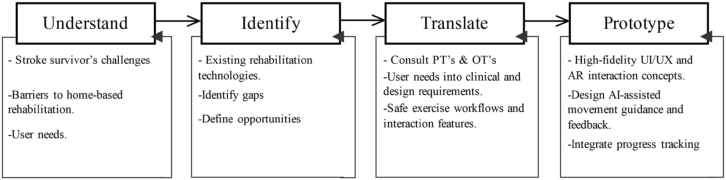
METHODOLOGY AND USER NEEDS To ensure that the proposed interactive rehabilitation support system addresses user needs while maintaining clinical relevance, the system development process followed a four-stage iterative Human-Centered Design (HCD) framework. The methodology was informed by ISO 9241-210 human-centered design principles for interactive systems (International Organization for Standardization, 2019) and the Technology Acceptance Model (Davis, 1989). The design process comprised four interconnected phases: Understand, Identify, Translate, and Prototype Requirements. These phases integrated neurorehabilitation literature, comparative technology analysis, and clinical consultations to establish a foundation for developing an accessible, engaging, and clinically informed home-based upper-extremity rehabilitation system. As illustrated in Figure 1., the four-stage framework outlines the systematic progression from understanding the rehabilitation context to translating research findings into functional prototype requirement.
Figure 1: Study data collection, analysis and design stages.
AI-Assisted Augmented Reality System 2191 The first phase, Understand, focused on examining the physical, cognitive, and emotional challenges experienced by stroke survivors during the transition from clinical care to home-based rehabilitation. A review of existing literature provided insights into the rehabilitation process, including the importance of repetitive, task-oriented practice and the challenges associated with maintaining consistent exercise engagement outside supervised clinical environments (Langhorne et al., 2011). Particular attention was given to psychological factors such as isolation, anxiety, reduced motivation, and declining self-efficacy, alongside practical barriers including transportation limitations, therapy costs, and restricted access to professional guidance. These findings informed an understanding of the contextual factors influencing adherence to independent rehabilitation.
The second phase, Identify, involved a comparative analysis of existing digital rehabilitation technologies to examine their functional capabilities, usability limitations, and opportunities for improvement. The analysis considered exercise guidance, movement sensing, real-time feedback, performance tracking, and clinical communication. By mapping these functions across available solutions, the study identified opportunities to improve integration between therapeutic instruction, movement monitoring, and patient–clinician interaction. This phase also highlighted the importance of reducing interface complexity and minimizing the cognitive demands placed on users during exercise performance. These insights helped define the functional gaps that the proposed system aimed to address.
The third phase, Translate, focused on converting the identified user needs and technological opportunities into clinically informed design considerations. Consultations with occupational and physical therapy professionals provided insights into appropriate exercise workflows, movement targets, and safety considerations for home-based upper-extremity rehabilitation. Particular attention was directed toward safe joint range of motion, appropriate exercise intensity, recognition of compensatory movement patterns, and the role of professional supervision. Clinical input was integrated with the findings from the literature and comparative analysis to establish design priorities that balance therapeutic objectives with usability, accessibility, and patient engagement.
The fourth phase, Prototype Requirements, synthesized the findings from the preceding stages into seven functional requirements that guided the development of the proposed system. The first requirement, clear guidance, emphasized intuitive, step-by-step visual instructions and spatial cues to support accurate movement execution. The second, immediate feedback, focused on providing real-time movement information to help users recognize and correct execution errors. The third, personalized interaction, addressed the need to accommodate individual recovery trajectories through adaptable exercise intensity, movement range, and repetition goals. The fourth, low cognitive burden, prioritized a simplified interface that minimizes distracting information and allows users to concentrate on physical movement. The fifth, visible progress, emphasized accessible progress-tracking features that communicate functional improvements and support continued engagement.
The sixth, professional connectivity, considered secure sharing of rehabilitation data to facilitate communication between patients and clinical teams. Finally, the seventh requirement, a complementary role, established that the system should support independent home practice while extending, rather than replacing, conventional therapist-led rehabilitation.
Across the four phases, the synthesis of neurorehabilitation literature, comparative technology analysis, and clinical consultations identified five foundational user needs: motivation, guidance, feedback, progress, and connection. Motivation was recognized as essential for sustaining engagement in repetitive motor practice, with goal-oriented and interactive interventions offering opportunities to improve adherence and reinforce a sense of achievement (Essery et al., 2017). Guidance emerged as a requirement for supporting appropriate motor execution through clear visual and spatial instructions that users can interpret within their physical exercise environment (Jia et al., 2025). Feedback was identified as important for facilitating motor relearning by providing timely, understandable information about movement performance and potential execution errors (Subramanian et al., 2010). Progress tracking was considered necessary to help users interpret their rehabilitation achievements over time and maintain engagement with longer-term recovery goals (Argent et al., 2018; Essery et al., 2017). Finally, clinical connection was emphasized as a means of supporting continuity of care through communication and remote monitoring between patients and rehabilitation professionals (Cramer et al., 2019; Laver et al., 2020). Together, these five user needs informed the functional requirements and provided the conceptual foundation for developing the interactive rehabilitation support system for home-based upper-extremity stroke rehabilitation
SYSTEM DESIGN AND DEVELOPMENT The platform is conceptualized as an AI-assisted AR rehabilitation companion organized around a continuous interactive cycle:
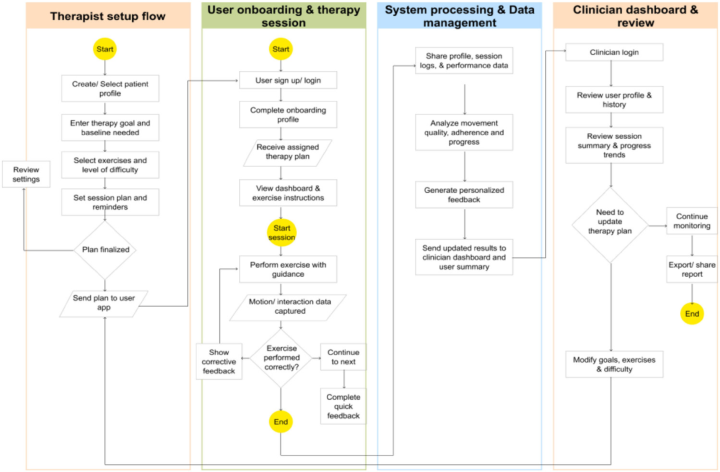
Based on the identified user and clinical requirements, the proposed rehabilitation support system was structured as an interconnected workflow linking therapist configuration, patient interaction, system-level processing, and clinician review. As illustrated in Figure 2, the system architecture is organized into four primary stages: therapist setup, user onboarding and therapy sessions, system processing and data management, and clinician dashboard review. This structure establishes a continuous information loop in which rehabilitation parameters defined by the therapist inform the patient’s exercise experience, session data are processed and recorded by the system, and relevant performance information is subsequently made available to the clinician for review.
Within this architecture, augmented reality (AR) provides spatial movement guidance by presenting movement trajectories, reach targets, and exercise boundaries within the patient’s physical environment. AI-assisted
AI-Assisted Augmented Reality System 2193 movement interpretation operates alongside this visual layer as a non-invasive analytical component, evaluating upper-extremity movement and identifying potential compensatory patterns such as trunk lean or shoulder elevation without independently diagnosing medical conditions or modifying clinical prescriptions (Rahman et al., 2023; Wang et al., 2022).
Figure 2: System architecture and interaction flow of the proposed rehabilitation support system, illustrating therapist setup, patient onboarding and therapy sessions, system processing and data management, and clinician review.
The architecture further incorporates adaptive interaction logic, progress tracking, and patient-clinician connectivity. Exercise parameters such as target distance, repetition goals, and visual guidance can be adjusted according to user performance, while session information contributes to longitudinal progress monitoring. Relevant rehabilitation data can subsequently be communicated through the clinician-facing interface, supporting continuity between independent home exercise and therapist-supervised rehabilitation (Cramer et al., 2019; Laver et al., 2020).
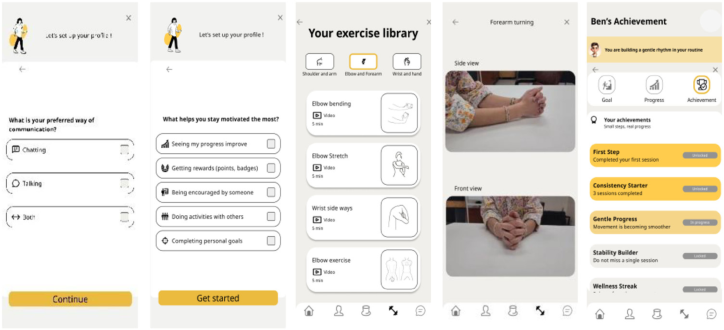
PROTOTYPE IMPLEMENTATION The interaction framework was translated into a high-fidelity digital prototype to define how users would experience the rehabilitation workflow. Figure 3 illustrates the patient-facing interface developed in Figma, including onboarding and preference configuration, exercise selection, guided rehabilitation activities, and progress and achievement tracking.
The onboarding process allows users to configure communication preferences and identify factors that support motivation, enabling the interface to provide a more personalized rehabilitation experience. Users can
subsequently access an exercise library in which rehabilitation activities are organized through simple visual representations and concise instructions. During exercise preparation, the interface provides visual demonstrations of the required movement from multiple viewpoints to improve understanding before the activity begins.
Figure 3: High-fidelity user interface prototype illustrating patient onboarding, motivational preference setup, exercise selection, movement guidance, and rehabilitation progress tracking.
The prototype was designed with the goal of reducing unnecessary interaction during rehabilitation sessions. Rather than requiring users to continuously navigate through menus or interpret detailed numerical information, the interface design prioritizes clear visual guidance, immediate feedback, and simplified progress indicators. Quantitative usability can be assessed using the System Usability Scale (SUS), task-completion time, and interaction error rates, while wearable eye-tracking technology such as Tobii Glasses 3 may be used to examine gaze fixation, visual search behavior, and attention toward rehabilitation cues. These measures can be complemented by perceived workload, fatigue, confidence, and qualitative feedback collected through post-session interviews.
RESULT AND DISCUSSION
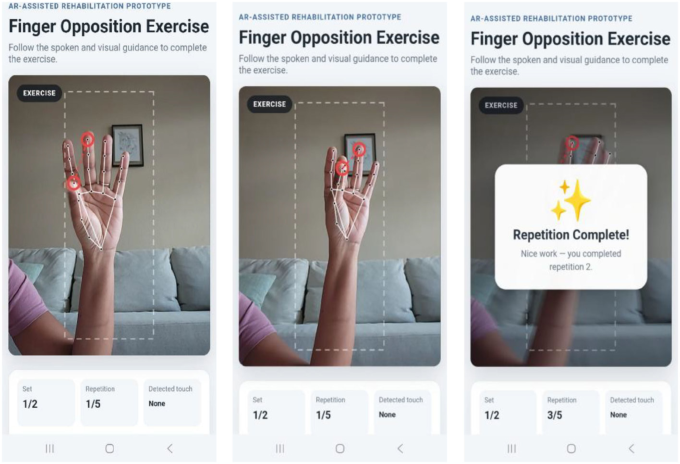
The Human-Centered Design process resulted in the development of an interactive rehabilitation support system that integrates spatial guidance, movement monitoring, adaptive feedback, progress tracking, and clinician connectivity within a unified rehabilitation workflow. While Figure 2 established the system architecture and Figure 3 translated the architecture into the intended user experience. As shown in Figure 4, the implemented prototype uses the device camera to observe the user’s hand while presenting an AR-assisted finger-opposition exercise. Visual hand landmarks identify relevant finger and joint positions, while the interface provides the exercise
AI-Assisted Augmented Reality System 2195 instruction, set number, repetition count, and detected interaction state. This implementation demonstrates how spatial rehabilitation guidance and movement interpretation can be integrated directly into the exercise environment rather than requiring the user to alternate attention between their physical movement and a separate instructional display.
Figure 4: Working implementation of the AR assisted rehabilitation prototype demonstrating real-time hand tracking and finger opposition exercise guidance with repetition and session monitoring.
These results should be interpreted as evidence of design and prototype implementation rather than clinical effectiveness. At the current stage, the prototype demonstrates the feasibility of combining AR-assisted guidance, computer-vision-based movement interpretation, and rehabilitation session monitoring within a single user workflow. Further usability testing with target users and rehabilitation professionals is required to determine usability, perceived workload, accuracy of feedback, user acceptance, and clinical feasibility.
Overall, the progression from the system architecture in Figure 2, to the high-fidelity interaction design in Figure 3, and finally to the functional prototype shown in Figure 4 demonstrates how the identified rehabilitation needs were systematically translated from design requirements into an implemented interactive rehabilitation experience.
Limitations and Future Work While this study demonstrates the technical feasibility and human-centered design rationale of the ReachGuide prototype, several key limitations must be noted. Most notably, although the framework was informed by clinical
consultations and stroke rehabilitation literature, the system has not yet been evaluated with a representative stroke-survivor cohort. Consequently, user acceptance, physical workload, movement tracking accuracy under impaired motor control (such as altered muscle tone or spasticity), and long- term therapeutic efficacy remain untested. Future research will focus on conducting empirical usability testing with stroke survivors across varying functional recovery levels evaluating System Usability Scale (SUS) scores, task completion rates, and gaze dynamics via wearable eye tracking alongside clinical trials in home environments to measure motor recovery outcomes.
CONCLUSION
Developing home-based digital interventions for upper-extremity stroke rehabilitation requires embedding human-centered design and human factors principles directly into system design. By synthesizing clinical input, neurorehabilitation literature, and technology analyses, this study presented a conceptual AI-assisted AR framework tailored for home-based motor practice. From this design process, three core human factors principles emerged for digital neurorehabilitation:
Feedback should support confidence rather than add complexity: Visual and movement guidance must remain simple, intuitive, and encouraging to avoid cognitive overload during physical movement.
AI should complement clinical care rather than replace clinicians: Autonomous guidance should facilitate independent home practice while preserving therapist oversight and patient–clinician connection.
Progress tracking should reinforce long-term motivation: Tracking mechanisms should highlight sustained engagement and functional milestone progress rather than focusing exclusively on isolated rep counts
REFERENCES
Argent, R., Daly, A., & Caulfield, B. (2018). Patient involvement with home-based exercise programs: Can connected health interventions influence adherence? JMIR mHealth and uHealth, 6(3), e47. https://doi.org/10.2196/mhealth.9218 Brooke, J. (1996). SUS: A ‘quick and dirty’ usability scale. In P. W. Jordan, B. Thomas,
I. L. McClelland, & B. Weerdmeester (Eds.), Usability evaluation in industry (pp. 189–194). Taylor & Francis. Campbell, B. C. V., & Khatri, P. (2020). Stroke. The Lancet, 396(10244), 129–142.
https://doi.org/10.1016/S0140-6736(20)31179-X Chen, J., Jin, W., Zhang, X. X., Xu, W., Liu, X. N., & Ren, C. C. (2025). Effect of home-based virtual reality training on upper extremity recovery in patients with stroke: Systematic review. Journal of Medical Internet Research, 27, e54321. Coupar, F., Pollock, A., Legg, L. A., Sackley, C., & van Vliet, P. (2012). Home-
based therapy programmes for upper limb functional recovery following stroke. Cochrane Database of Systematic Reviews, (5), CD006755. https://doi. org/10.1002/14651858.CD006755.pub2
AI-Assisted Augmented Reality System 2197 Cramer, S. C., Dodakian, L., Le, V., See, J., Augsburger, R., McKenzie, A., ... &
Zhou, R. J. (2019). Efficacy of home-based telerehabilitation vs in-clinic therapy for adults after stroke: A randomized clinical trial. JAMA Neurology, 76(9), 1079– 1087. https://doi.org/10.1001/jamaneurol.2019.1604 Davis, F. D. (1989). Perceived usefulness, perceived ease of use, and user acceptance of information technology. MIS Quarterly, 13(3), 319–340. https://doi. org/10.2307/249008 Dobkin, B. H. (2004). Strategies for stroke rehabilitation. The Lancet Neurology,
3(9), 528–536. https://doi.org/10.1016/S1474-4422(04)00851-8 Essery, R., Geraghty, A. W. A., Kirby, S., & Yardley, L. (2017). Predictors of adherence to home-based physical therapies: A systematic review. Disability and Rehabilitation, 39(6), 519–534. https://doi.org/10.3109/09638288.2016. 1152601 Feigin, V. L., Brainin, M., Norrving, B., Martins, S., Sacco, R. L., Hacke, W.,
... & Lindsay, P. (2022). World Stroke Organization (WSO): Global Stroke Fact Sheet 2022. International Journal of Stroke, 17(1), 18–29. https://doi. org/10.1177/17474930211065917 Feigin, V. L., Stark, B. A., Johnson, C. O., Roth, G. A., Bisignano, C., Abady, G. G., ... & Murray, C. J. (2021). Global, regional, and national burden of stroke and its risk factors, 1990–2019: A systematic analysis for the Global Burden of Disease Study 2019. The Lancet Neurology, 20(10), 795–820. https://doi.org/10.1016/ S1474-4422(21)00252-0 French, B., Thomas, L. H., Coupe, J., McMahon, N. E., Connell, L., Harrison, J., ... &
Roddam, H. (2016). Repetitive task training for improving functional ability after stroke. Cochrane Database of Systematic Reviews, (11), CD006073. https://doi. org/10.1002/14651858.CD006073.pub3 International Organization for Standardization. (2019). Ergonomics of humansystem interaction Part 210: Human-centred design for interactive systems (ISO Standard No. 9241-210:2019). https://www.iso.org/standard/77520.html Jia, C., Liu, X., Ning, L., & Ge, L. (2025). The effects of augmented reality on
rehabilitation of stroke patients: A systematic review and meta-analysis with trial sequential analysis. Journal of Clinical Nursing, 34(11), 4578–4589. https://doi. org/10.1111/jocn.17730 Karimi, M. E., & Aminzadeh, M. (2026). Home-based virtual reality for upper limb stroke rehabilitation: Supervised vs. unsupervised approaches—a systematic review with meta-analysis. Disability and Rehabilitation, 48(2), 112–126. https:// doi.org/10.1080/09638288.2026.2673294 Kleim, J. A., & Jones, T. A. (2008). Principles of experience-dependent neural plasticity:
Implications for rehabilitation after brain damage. Journal of Speech, Language, and Hearing Research, 51(1), S225–S239. https://doi.org/10.1044/1092- 4388(2008/018) Krakauer, J. W. (2006). Motor learning: Its relevance to stroke recovery and neurorehabilitation. Current Opinion in Neurology, 19(1), 84–90. https://doi. org/10.1097/01.wco.0000200544.29915.cc Kwakkel, G., Kollen, B. J., & Krebs, H. I. (2008). Effects of robot-assisted therapy
on upper limb recovery after stroke: A systematic review. Neurorehabilitation and Neural Repair, 22(2), 111–121. https://doi.org/10.1177/1545968307305457 Langhorne, P., Bernhardt, J., & Kwakkel, G. (2011). Stroke rehabilitation. The Lancet, 377(9778), 1693–1702. https://doi.org/10.1016/S0140-6736(11)60325-5
Langhorne, P., Coupar, F., & Pollock, A. (2009). Motor recovery after stroke: A systematic review. The Lancet Neurology, 8(8), 741–754. https://doi.org/10.1016/ S1474-4422(09)70150-4 Laver, K. E., Adey-Wakeling, Z., Crotty, M., Lannin, N. A., George, S., &
Sherrington, C. (2020). Telerehabilitation services for stroke. Cochrane Database of Systematic Reviews, (1), CD010255.https://doi.org/10.1002/14651858. CD010255.pub3 Laver, K. E., Lange, B., George, S., Deutsch, J. E., Saposnik, G., & Crotty, M.
(2017). Virtual reality for stroke rehabilitation. Cochrane Database of Systematic Reviews, (11), CD008349. https://doi.org/10.1002/14651858.CD008349.pub4 Levin, M. F., Kleim, J. A., & Wolf, S. L. (2009). What do motor ‘recovery’ and ‘compensation’ mean in patients following stroke? Neurorehabilitation and Neural Repair, 23(4), 313–319. https://doi.org/10.1177/1545968308328727 Maier, M., Ballester, B. R., & Verschure, P. F. M. J. (2019). Principles of
neurorehabilitation after stroke based on motor learning and brain plasticity mechanisms. Frontiers in Systems Neuroscience, 13, 74. https://doi.org/10.3389/ fnsys.2019.00074 Nudo, R. J. (2013). Recovery after brain injury: Mechanisms and principles. Frontiers in Human Neuroscience, 7, 887. https://doi.org/10.3389/fnhum.2013.00887 Rahman, S., Sarker, S., Haque, A. K. M. N., Uttsha, M. M., Islam, M. F., &
Deb, S. (2023). AI-driven stroke rehabilitation systems and assessment: A systematic review. IEEE Transactions on Neural Systems and Rehabilitation Engineering, 31, 1012–1023. https://doi.org/10.1109/TNSRE.2022.3219085 Schmidt, R. A., & Lee, T. D. (2019). Motor control and learning: A behavioral emphasis (6th ed.). Human Kinetics. Subramanian, S. K., Massie, C. L., Malcolm, M. P., & Levin, M. F. (2010). Does
provision of extrinsic feedback result in improved motor learning in the upper limb poststroke? Neurorehabilitation and Neural Repair, 24(2), 113–124. https:// doi.org/10.1177/1545968309349941 Veerbeek, J. M., van Wegen, E., van Peppen, R., van der Wees, P. J., Hendriks, E., Rietberg, M., & Kwakkel, G. (2014). What is the evidence for physical therapy poststroke? A systematic review and meta-analysis. PLoS ONE, 9(2), e87987. https://doi.org/10.1371/journal.pone.0087987 Wang, X., Fu, Y., Ye, B., Babineau, J., Ding, Y., & Mihailidis, A. (2022). Technology-
based compensation assessment and detection of upper extremity activities of stroke survivors: Systematic review. Journal of Medical Internet Research, 24(10), e39128. https://doi.org/10.2196/39128 Ward, N. S., Brander, F., & Kelly, K. (2019). Intensive upper limb neurorehabilitation in chronic stroke: Outcomes from the Queen Square programme. Journal of Neurology, Neurosurgery & Psychiatry, 90(5), 498–506. https://doi.org/10.1136/ jnnp-2018-319925 Winstein, C. J., Stein, J., Arena, R., Bates, B., Cherney, L. R., Cramer, S. C., ... &
Zorowitz, R. D. (2016). Guidelines for adult stroke rehabilitation and recovery: A guideline for healthcare professionals from the American Heart Association/ American Stroke Association. Stroke, 47(6), e98–e169. https://doi.org/10.1161/ STR.0000000000000098
SEARCH THE AHFE DIGITAL BOOKSTORE BY ISBN
Explore the complete digital volume
Human Factors in Design, Engineering, and Computing
Read this individual research paper free through the original publisher, or explore the full digital proceedings book.