Meghan DeClue, Scott Marriner, Lavina Burman, Iris Matthews, K. Blake Mitchell, Ericka Rovira, Hyegjoo E. Choi-Rokas (2026). Assessment of Curved Body Armor Plate Designs for Improved Protection and Mobility in Soldiers. In: Human Factors in Design, Engineering, and Computing. AHFE Open Access, vol. 238, pp. 1364–1372. https://doi.org/10.54941/ahfe1008365
This study aimed to increase warfighter survivability and operational capacity. Reported discomfort and mission performance from poor anthropometric fit (Mitchell et al., 2023) suggests that body armor design for female warfighters warrants further refinement. Alternative body armor designs were evaluated to improve fit, performance, and comfort by better accommodating female anthropometry. Three systems were tested (A) the Army standard issue ESAPI, (B) a novel sizing system, and (C) the enhanced female curvature with B’s sizing. Participants also completed the tasks in a baseline with no plate. Thirty-four female participants were classified into two breast volume groups (Small and Large) based on the difference between Chest and Chest at under Breast Circumferences. Participants underwent anthropometric measurements for plate sizing, plate fitting, performance assessments (including range of motion (ROM) and treadmill running), and subjective ratings of comfort, pain and fit. However, objective performance benefits were observed only for standing trunk flexion. Seated trunk flexion and cross body reach did not differ significantly among plate configurations. No significant effects of breast volume or interactions between breast volume and plate configuration were observed, although descriptive trends suggested greater improvements in standing trunk flexion among participants with larger breast volumes. Pain ratings did not differ significantly among plate configurations, potentially due to the short wear duration. Future research should evaluate longer wear periods and a broader range of Soldier relevant tasks to better understand the operational benefits of plate designs with enhanced curvatures.
Female soldiers make up 19.5% of our total armed forces and serve in every branch and specialty (Department of Defense, 2024). The US Army has begun implementing updated body armor for females, but it still does not have a full issued set across the service (Hessert, 2023). Historically, female measurements were often viewed as being equivalent to that of a small man. However, multiple surveys have found that female soldiers are experiencing performance issues at the hands of ill-fitting equipment (Mitchell et al., 2023).
Assessment of Curved Body Armor Plate Designs 1365 During Operation Enduring Freedom and Operation Iraqi Freedom, female combatants faced a higher mortality rate for traumatic injuries at 35.9%, compared to 17% for their male counterparts (Cross et al., 2011). It is essential for mission effectiveness and the survivability of our troops that all combatants are outfitted in personal protective equipment (PPE) that fits properly according to their body measurements.
Female Soldiers typically report issues with body armor centering around poor fit, pain, and impacts on soldier performance. Studies across multinational forces have found that between 40 and 60 percent of females soldiers report poor fitting body armor (Coltman et al., 2020; Mitchell et al., 2023). These findings mirror other research that has shown that female body armor is typically too large for its user and not available in the correct ranges for female body dimensions (An, 2011; Coltman et al., 2020; Coltman et al., 2021; Brisbine et al., 2026). In addition to poor fit, female Soldiers typically report physical pain especially in their shoulders, lower backs, and hips (Coltman et al., 2020). Lastly, surveys of female Soldiers have associated poor fitting body armor with interference on key Soldiering tasks like running, jumping, shouldering a weapon, and navigating obstacles (Mitchell et al., 2023).
To address these shortcomings in fit, comfort, and performance, the US Army has begun to develop prototype body armor addressing female anthropometric dimensions. Specifically, the US Army Combat Capabilities Development Command Soldier Center developed different prototypes of curved body armor to account for the female torso shape, specifically breast size and shape (Li et al, 2023). The iterative nature of the prototyping allowed the researchers to address other potential friction points including pressure on female Soldiers’ sternums.
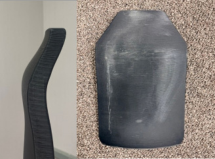
RESEARCH GOAL AND HYPOTHESES The goal of this research was to evaluate alternative body armor designs intended to improve the fit, comfort, and performance of female Soldiers. Alternative designs sought to change either the sizing available to female Soldiers or the curvature of the plate itself. To reach this goal, our team evaluated three different types of body armor design (see Figure 1) in addition to a baseline configuration:
A. ESAPI: the Army standard issue Enhanced Small Arms Protective Inserts (ESAPI), consisting of five sizes, each with a unique combination of width and length (one length per width) B. Prototypes: a novel sizing system that accommodates female
anthropometry through 11 sizes and five widths, each available in two or three lengths (Short, Regular, and Long) with an ESAPI curvature C. Curved Prototypes: the same novel 11-size system with enhanced curvature (35mm), intended to better fit the female torso D. Baseline: no body armor system was worn
Based on this design, we hypothesized that: 1) The Curved Prototypes will retain a greater ROM and be deemed better fitting than the ESAPI and Prototypes and 2) The Curved Prototypes will increase the comfort level for larger breasted female participants.
Figure 1: Profile Comparison of Standard Issue ESAPI plates (left) with Prototype novel sizing plates (center) and Curved prototype plates (right).
METHODS
Participants Thirty-four female Soldiers (see Table 1), including 29 cadets and five officers from a U.S. service academy volunteered and participated in the study. All participants met height and weight standards as well as physical fitness standards for the U.S. Army. This study was approved by the local Institutional Review Board. All participants provided verbal consent for study participation.
Table 1: Characteristics of the participants (n = 34) who completed the study.
Table available in the original PDF paper.
Mean Standard Deviation Age (Years) 21.5 4.4
Height (mm) 1652 77.3 Weight (Kg) 66.5 9.01
Experimental Design A mixed-design experiment was conducted to evaluate the effects of body armor plate configuration on ROM. Each participant completed all ROM tasks while wearing the three plate configurations (ESAPI, Prototype, and Curved), making plate configuration the within-subject factor. Participants were also classified into two breast volume groups based on the difference between chest and underbust circumference: Small (< 4 in.) and Large (≥ 4 in.), which served as the between-subject factor. A 4-in. threshold was selected because it provides a practical distinction between relatively smaller and larger breast volumes while maintaining balanced group sizes for statistical comparison.
There are three categories of dependent variables. The first category of dependent variables is the anthropometric measurements used to determine correct plate sizing and validate the range of coverage for each plate.
Assessment of Curved Body Armor Plate Designs 1367 Researchers used a variety of anthropometric equipment to measure twelve anthropometric dimensions: Stature, Weight, Suprasternale Height, Chest Height, Waist Height at Omphalion, Chest Breadth, Chest Depth, Chest Depth below Breast, Chest Circumference, Chest Circumference below Breast, Waist Circumference at Omphalion, and Waist Front Length. Chest Breadth and Waist Front Length were used to determine correct plate sizes across the three different body armor plate variants. All anthropometric measurements were collected following the measurement procedures established in the U.S. Army Anthropometric Surveys (ANSUR) conducted in 2012 (Gordon et al., 2015) and 1988 (Gordon et al., 1989).
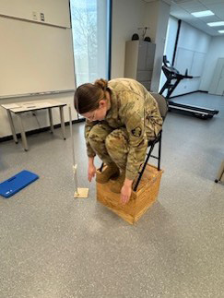
The second category of dependent variables is the ROM measurements, measured in mm, including Seated Trunk Flexion and Standing Trunk Flexion. The Forward Cross Body Reach was measured in degree (see Figure 2).
Finally, participants completed a series of subjective measures to capture their subjective comfort and pain (category three). Following each ROM task participants completed a 5-point restriction rating to assess overall comfort and fit. Comfort was also tested through a two-minute treadmill run at a conversational pace. Following the treadmill run participants completed a mannikin assessment to indicate location of pain and discomfort (McWilliams et al., 2024), as well as an 11-point pain scale to assess the severity of the pain experienced during the treadmill.
Figure 2: Battery of ROM tasks including standing trunk flexion task (left), sitting trunk flexion task (center), and cross body reach task (right).
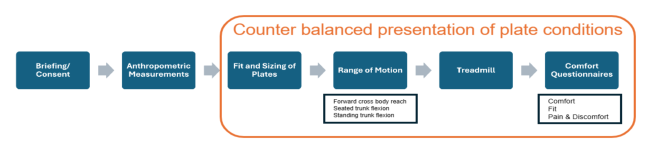
Procedure Following consent, anthropometric measurements were taken with the use of an anthropometer, spreading calipers, a tape measure, and a digital scale. After being fit with their body armor configuration, participants completed ROM task measurements and culminated with the treadmill run. Researchers counterbalanced the order of the plates between participants to mitigate the effects of fatigue and muscle stretching (see Figure 3). The study lasted no more than 55 minutes.
Figure 3: Flowchart of data collection procedure.
Statistical Analysis ROM was normalized to each participant’s maximum ROM measured under the baseline condition, such that values less than 1.0 represented reduced ROM, whereas values greater than 1.0 indicated greater ROM than baseline. Standing trunk flexion, seated trunk flexion, and cross body reach were analyzed separately using two-factor mixed-design ANOVA. Plate configuration (ESAPI, Prototype, and Curved) was treated as the within-subject factor, and breast volume group (Small vs. Large) was treated as the between-subject factor. Mauchly’s test was used to assess the assumption of sphericity. When the assumption was violated, Greenhouse- Geisser corrections were applied. Significant main effects or interactions were followed by Bonferroni-adjusted pairwise comparisons. Statistical significance was established at p < .05, and partial eta squared (ηp²) was reported as the measure of effect size.
RESULTS
Table 2 presents the descriptive statistics for objective and subjective outcome measures by plate configuration and breast volume group. Objective measures include normalized ROM performance relative to the no-plate baseline, while subjective measures include ratings of perceived restriction.
Range of Motion Standing Trunk Flexion was the only ROM task significantly affected by plate configuration. Mauchly’s test indicated that the assumption of sphericity was met; therefore, sphericity-assumed results were reported. A significant main effect of plate configuration was observed, F(2, 64) = 4.74, p = .012, ηp² = .129, whereas neither the main effect of breast volume, F(1, 32) = 1.01, p = .322, ηp² = .031, nor the Plate × Breast Volume interaction, F(2, 64) = 0.53, p = .590, ηp² = .016, was significant. Pairwise comparisons indicated that the Curved plate (M = 98.38%) resulted in significantly greater standing trunk flexion than both the ESAPI plate (M = 94.41%; p = .045) and the Prototype plate (M = 93.05%; p = .002), whereas the ESAPI and Prototype plates did not differ significantly. For seated trunk flexion, Mauchly’s test indicated that the assumption of sphericity was met. No significant main effect of plate configuration was observed, F(2, 64) = 0.52, p = .599, ηp² = .016. Likewise, neither the main effect of breast volume, F(1, 32) = 1.37, p = .250, ηp² = .041, nor the Plate × Breast Volume interaction, F(2, 64) = 0.15,
Assessment of Curved Body Armor Plate Designs 1369 p = .861, ηp² = .005, reached significance. Pairwise comparisons showed no significant differences among the three plate configurations. For cross body reach, Mauchly’s test indicated that the assumption of sphericity was violated; therefore, Greenhouse-Geisser corrected results were reported. No significant main effect of plate configuration was found, F(1.50, 47.88) = 1.68, p = .201, ηp² = .050. Similarly, the main effect of breast volume, F(1, 32) = 0.01, p = .918, ηp² < .001, and the Plate × Breast Volume interaction, F(1.50, 47.88) = 1.49, p = .236, ηp² = .044, were not significant. Pairwise comparisons indicated no significant differences among the ESAPI, Prototype, and Curved plate configurations.
Subjective Ratings of Restriction Subjective ratings of restriction showed task dependent differences across the ROM and running tasks. Significant overall differences across the plates were found for two tasks. For standing trunk flexion, participants rated the curved plate as the least restrictive and the ESAPI plate as the most restrictive, χ² (3) = 6.45, p = .04 (see Table 2). A significant overall difference was also found for Seated Trunk Flexion, χ²(3) = 11.20, p < .01, with the curved plates rated as the least restrictive and the ESAPI plates rated as the most restrictive. No significant overall differences among conditions were found for the cross body reach task or treadmill running task. However, pairwise comparisons indicated a significant difference between the ESAPI and curved body armor plates for both the cross body reach (p = .05) and Treadmill run task (p = .02).
Table 2: Descriptive statistics for objective and subjective outcome measures by plate configuration and breast volume group (A = ESAPI, B = Prototypes, C = Curved Prototypes).
Table available in the original PDF paper.
Groups Small Breast Group (n = 17) Large Breast Group (n = 17) Configurations A B C A B C Trunk Flexion Standing
Cross Body Reach Performance Mean (%) (SD %) 97.73 (2.32)
97.55 (2.26)
98.57 (2.58)
97.51 (1.56)
98.14 (2.44)
97.96 (3.40)
Comfort Mean (SD)
1.59 (0.62)
1.35 (0.49)
1.35 (0.61)
1.59 (0.62)
1.65 (0.61)
1.47 (0.62)
Subjective Ratings of Pain There were no significant findings to suggest that there is a strong difference in the amount of pain felt while wearing each of the body armor plates during the running task. Each plate type produced an average pain rating below two on the ten-point scale. The lack of differentiation may be due to either the short task duration or short wear duration, often less than 15 minutes overall, of each body armor type.
DISCUSSION AND CONCLUSION This study evaluated whether a curved body armor plate design better preserves ROM and reduces perceived restriction compared with the standard ESAPI and Prototype plates, and whether these benefits are greater for females with larger breast volumes. Overall, the Curved prototype generally demonstrated the highest normalized ROM and was consistently rated as less restrictive and better fitting than the ESAPI plate across most tasks. The results partially supported the first hypothesis but did not support the second hypothesis.
Objective ROM measurements demonstrated that the Curved Prototype improved standing trunk flexion compared with both the ESAPI and Prototype plates, whereas seated trunk flexion and cross body reach did not differ significantly among the three plate configurations. The absence of significant differences for seated trunk flexion and cross body reach suggests that the influence of plate geometry on objective ROM is movement-specific and most apparent during tasks requiring substantial anterior torso flexion.
Subjective ratings demonstrated a more consistent benefit of the Curved Prototype than the objective ROM measures alone. Participants rated the Curved Prototype as significantly less restrictive than the ESAPI plate during both standing and seated trunk flexion. Although no overall differences were observed for cross body reach or treadmill running, pairwise comparisons indicated that the Curved Prototype was also perceived as less restrictive than the ESAPI plate during these tasks. Together, these findings indicate that the Curved Prototype provided a more accommodating fit and reduced the perception of movement restriction across a broader range of functional activities than was reflected by objective ROM measurements alone. This difference between objective and subjective outcomes likely reflects improvements in anatomical conformity and pressure distribution that reduce the sensation of restriction without necessarily producing measurable changes in ROM.
The second hypothesis was not supported. Neither breast volume nor its interaction with plate configuration significantly affected ROM, and the perceived reduction in restriction associated with the Curved Prototype was not greater among females with larger breast volumes. However, descriptive trends in the standing trunk flexion data suggest that participants with larger breast volumes may have derived greater functional benefit from the Curved Prototype than those with smaller breast volumes. Relative to the ESAPI plate, normalized standing trunk flexion increased from 93.21% to 95.34% (+2.13%) in the small breast volume group and from 95.62% to 101.38%
Assessment of Curved Body Armor Plate Designs 1371 (+5.76) in the large breast volume group. Although the Plate by Breast Volume interaction was not statistically significant, this pattern is consistent with the design rationale that increased anatomical conformity may reduce interference between the plate and the anterior torso in individuals with greater breast volume. The lack of statistical significance likely reflects the limited sample size, and this trend should be interpreted cautiously until confirmed in a larger cohort.
Overall, these findings suggest that incorporating anatomical curvature into female body armor plates can improve functional mobility during standing trunk flexion while consistently reducing the perceived restriction associated with body armor use. Although the objective ROM benefits were movement-specific, participants consistently perceived the Curved Prototype as less restrictive across multiple functional tasks, supporting the ergonomic value of anatomically contoured plate designs. Further evaluation with a larger and more diverse female population is warranted to determine whether the apparent trend toward greater benefits among women with larger breast volumes represents a true interaction between body morphology and plate geometry.
LIMITATIONS Several limitations should be considered when interpreting these findings. First, the study included a relatively small sample size (17 participants per breast volume group), which limited the statistical power to detect interaction effects between plate configuration and breast volume. Although descriptive trends suggested that participants with larger breast volumes experienced greater improvements in standing trunk flexion with the Curved Prototype, these trends did not reach statistical significance and should be confirmed in a larger cohort.
Second, ROM was evaluated using standardized laboratory tasks designed to isolate specific functional movements. While standing trunk flexion, seated trunk flexion, and cross body reach represent common occupational movements relevant to body armor use, they do not fully capture the complex and dynamic motions performed during military operations. Additional evaluations using more representative military tasks and prolonged wear conditions would provide a more comprehensive assessment of plate performance.
Third, subjective evaluation focused on perceived movement restriction rather than overall comfort. Although reduced perceived restriction is an important aspect of ergonomic performance, other factors such as localized pressure, thermal comfort, fatigue, and long-term wearability were not assessed and may further differentiate plate designs during extended use.
Finally, the study evaluated a single curved plate design against one standard ESAPI plate and one novel ESAPI curved prototype. The findings therefore reflect the performance of these specific designs and should not be generalized to all anatomically contoured body armor plates. Future work should investigate additional plate geometries, materials, and sizing configurations across a broader range of female body morphologies to further optimize body armor design.
ACKNOWLEDGMENT
This study was conducted collaboratively between the U.S. Army DEVCOM Soldier Center (DEVCOM SC) and the United States Military Academy (USMA) as a capstone project. The opinions or assertions contained herein are the private views of the authors, and are not to be construed as official, or as reflecting true views of the US Department of Defense (DoD). The investigators have adhered to the policies for protection of human subjects as prescribed in AR 70–25. The appearance of DoD visual information does not imply or constitute DoD endorsement.
REFERENCES
An, S. K. (2010). Laboratory assessment of range of motion and pressure associated with female soldiers wearing a ballistic vest. Oklahoma State University. Brisbine, B. R., Molloy, R. H., Carstairs, G. L., & Coltman, C. E. (2026). Soldiers
experience fit issues, musculoskeletal pain, and equipment and mobility interference with military body armour. Applied Ergonomics, 130, 104645. Coltman, Celeste. E., Brisbine, Brooke. R., Molloy, Richard. H., Ball, Nick. B., Spratford, Wayne. A., & Steele, Julie. R. (2021). Identifying problems that female soldiers experience with current-issue body armour. Applied Ergonomics, 94, 103384. https://doi.org/10.1016/j.apergo.2021.103384 Coltman, C. E., Steele, J. R., Spratford, W. A., & Molloy, R. H. (2020). Are female
soldiers satisfied with the fit and function of body armour? Applied Ergonomics, 89. https://doi.org/10.1016/j.apergo.2020.103197 Cross, J. D., Johnson, A. E., Wenke, J. C., Bosse, M. J., & Ficke, J. R. (2011). Mortality in female war veterans of operations enduring freedom and Iraqi freedom. Clinical Orthopaedics and Related Research®, 469(7), 1956–1961. Gordon, C.C., Blackwell, C.L., Bradtmiller B., Parham, J.L., Hall, LTC R.M.,
Paquette, S.P., Corner, B.D., Carson, J.M., Hodge, B.M., Barrientos, P. Hotzman, J., Venezia, J.C. and Anderson, D (2014). 2012 Anthropometric survey of U.S. Army personnel (ANSUR II): Methods and summary statistics. (Technical Report (Natick/TR-15/007)). Natick, MA: U.S. Army Natick Research, Development and Engineering Center. Gordon, C.C., Bradtmiller, B., Clauser, C.E., Churchill, T., McConville, J.T., Tebbetts, I., & Walker, R.A. (1989). 1987–1988 Anthropometric Survey of U.S. Army Personnel: Methods and Summary Statistics. (Technical Report (RT-89-044) (ADA225 094)). Natick, MA: U.S. Army Natick Research, Development and Engineering Center. Li, P., Choi-Rokas, H., Mitchell, B., Tashjian, A., & Hurley, M. (2023). An iterative
and anthropometrically driven approach to body armor plate design for females. Digital Human Modeling and Applied Optimization, 76. https://doi.org/10.54941/ ahfe1003349 McWilliams, D. F., Georgopoulos, V., Patel, J., Millar, B., Smith, S. L., & Walsh, D. A. (2024). Validation of a questionnaire for central nervous system aspects of joint pain: the CAP questionnaire. Rheumatology. https://doi.org/10.1093/ rheumatology/keae342 Mitchell, B., Garlie, T., Johnson, W., Choi- Rokas, H., Hennessy, E. (2023).
Relationship between subjective ratings of fit and performance for female Soldiers. U.S. Army Combat Capabilities Development Command Soldier Center, USA. U.S. Department of Defense (2024). 2024 demographics report: Profile of the military community. Military OneSource. https://www.militaryonesource.mil/ data-research-and-statistics/military-community-demographics/
SEARCH THE AHFE DIGITAL BOOKSTORE BY ISBN
Explore the complete digital volume
Human Factors in Design, Engineering, and Computing
Read this individual research paper free through the original publisher, or explore the full digital proceedings book.