Hao Shi, Yaqi Li (2026). Evaluation of Gesture Separability and Stability Based on Surface Electromyography for General Interaction Design. In: Human Factors in Design, Engineering, and Computing. AHFE Open Access, vol. 238, pp. 155–163. https://doi.org/10.54941/ahfe1008250
With the increasing demand for natural human-computer interaction, surface electromyography (sEMG)-based gesture recognition has become an important topic in intelligent interfaces and wearable technologies. Compared with conventional input methods, sEMG provides a non-invasive and relatively responsive means of capturing muscle activation associated with movement intention, which makes it suitable for virtual reality control, rehabilitation support, and assistive systems. In practical applications, however, system performance depends not only on the recognition algorithm, but also on the inherent separability of the selected gestures and their consistency across users. This study investigates the sEMG characteristics of representative hand gestures using the public NinaPro DB1 dataset (Atzori et al. 2014), with a focus on gesture separability and inter-subject stability. Root Mean Square (RMS) features are extracted from three subjects and visualized using Principal Component Analysis (PCA) to examine the distribution of six representative gestures (Jolliffe and Cadima, 2016). In addition, boxplot analysis is used to compare RMS variations across subjects. The results suggest that large-scale wrist motions, such as wrist flexion and wrist extension, show clearer clustering patterns and greater consistency both within and across subjects. In contrast, fine finger gestures, such as fist clenching and interphalangeal pinch, exhibit stronger overlap and larger inter-subject variability. Based on these findings, this study proposes a gesture selection strategy for generalized sEMG interaction systems, emphasizing gestures with higher separability and stability while suggesting supplementary features or user calibration for more ambiguous gestures.
With the continued development of wearable computing and muscle- controlled interaction, sEMG-based gesture recognition has emerged as a promising direction in human-computer interaction (Oskoei and Hu, 2007; Jiang et al., 2014). sEMG signals are non-invasive and reflect muscular activation associated with intended movement. As a result, they have been widely explored in virtual reality control, rehabilitation training, and intelligent prosthetic devices. However, the practical performance of a gesture
156 Shi and Li recognition system is not determined solely by the classification algorithm; it is also constrained by the separability of the selected gestures and their consistency across users.
Existing studies can be broadly divided into two categories. One line of work relies on handcrafted time-domain and frequency-domain features, such as RMS, MAV, and spectral energy, combined with shallow classifiers such as Support Vector Machines and Linear Discriminant Analysis (Oskoei and Hu, 2007). Another line of work uses deep learning models, including convolutional and recurrent neural networks, to improve recognition performance for more complex gestures (Atzori et al., 2016; Xia et al., 2021). The former is relatively simple and interpretable, but its representational capacity is limited; the latter often achieves higher accuracy but requires larger datasets and greater computational resources. In interaction design, however, high classification accuracy alone does not guarantee usability. If a gesture is intrinsically difficult to separate, or if it varies substantially across users, even a more complex model may not provide reliable performance.
The present study aims to evaluate gesture separability and stability from a data-analysis perspective and to provide evidence for gesture selection in generalized sEMG interaction systems. Specifically, this study uses the public NinaPro DB1 dataset (Atzori et al., 2014) to extract RMS features from six representative gestures, applies PCA to visualize inter-gesture feature distributions, and compares RMS variation across three subjects. The objective is to identify which gestures are more suitable as core interaction gestures and which ones may require user calibration or additional feature support. The contribution of this study is to propose a gesture-screening approach for interaction systems from two dimensions, namely separability and stability, and to provide descriptive evidence of the distinct sEMG characteristics of large wrist motions and fine hand movements. The overall research flow is as follows: (1) select a public sEMG dataset and a set of representative gestures; (2) extract RMS features from multi-channel signals for each gesture trial; (3) project the feature vectors onto a two-dimensional principal- component space to inspect inter-gesture separation; and (4) compare the RMS distributions of each gesture across subjects with boxplots to assess inter-subject stability. The remainder of the paper describes each step and discusses the design implications of the results.
METHODOLOGY
sEMG signals are electrical activity generated during muscle contraction and recorded via surface electrodes. They are typically non-stationary, noisy, and highly sensitive to individual differences. Because they reflect muscular activation, sEMG signals are often used to infer movement intention. Common time-domain features include Root Mean Square (RMS), Mean Absolute Value (MAV), and Zero Crossing rate. In this study, RMS is selected as the primary feature for three reasons. First, it provides a simple and robust measure of muscle activation intensity and is well suited to real-time analysis (Jiang et al., 2014). Second, RMS is a widely reported descriptor in the sEMG literature, which facilitates comparison with existing studies. Third, its scalar
Evaluation of Gesture Separability and Stability 157 nature per channel allows a compact feature vector to be constructed across channels, which is convenient for low-dimensional visualization. It should be noted that RMS captures only the energy of the signal and discards temporal and spectral structure; this limitation is revisited in the discussion.
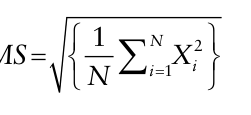
The RMS feature is computed as:
1 1 N
i i RMS X N
Equation reproduced from the original PDF.
where ix denotes the signal amplitude at the i-th sample and N is the number of samples in a signal segment.
To visualize the distribution of gestures in a lower-dimensional space, PCA is applied to the multi-channel RMS feature vectors (Jolliffe and Cadima, 2016). PCA projects high-dimensional data onto directions of maximal variance and allows the main structure of the data to be observed in two dimensions. In this study, PCA is used only for exploratory analysis of cluster separation, rather than for classification. The choice of a descriptive, visualization-based approach is deliberate: at the current stage of the research, the goal is to characterize the intrinsic structure of the feature space before committing to a particular classifier, thereby avoiding the risk of overstating discriminability on the basis of a small and subject-specific sample. A quantitative complement (e.g., class-separability indices or classification accuracy) would strengthen the analysis, but is deferred to future work with a larger sample.
DATASET AND PARTICIPANTS This study is based on the NinaPro DB1 dataset, which provides standardized sEMG recordings and synchronized motion data (Atzori et al., 2014). Three subjects, coded as S1, S5, and S10, were selected for analysis. These subjects were chosen because their recordings include all six target gestures with complete and well-segmented trials, which makes them suitable for comparative evaluation. Although the sample size is limited, it is sufficient for identifying general trends in gesture separability and inter-subject variability in an exploratory study. Nevertheless, the small number of subjects means that the results cannot be generalized to the broader population without further validation, and this caveat is emphasized throughout the paper.
GESTURE SELECTION Six representative gestures were selected: gesture 5 (finger abduction), gesture 6 (fist clenching), gesture 13 (wrist flexion), gesture 14 (wrist extension), gesture 11 (three-finger grasp), and gesture 15 (interphalangeal pinch). These gestures cover both large-scale wrist motions and fine finger movements. This selection allows comparison between gestures that are generally easier to separate and those that are more likely to overlap in sEMG feature space.
DATA PROCESSING The dataset’s “restimulus” labels were used to extract valid gesture segments, as they provide a more accurate alignment with the actual onset and offset of movement than the original stimulus labels. For each valid segment, the RMS value was computed on a per-channel basis across the 10 sEMG channels, yielding a 10-dimensional feature vector that summarizes the activation intensity of the recorded muscles during the movement. No additional windowing was applied within a segment, so each trial contributes one feature vector; this choice keeps the analysis tractable and focuses the comparison on gesture-level differences rather than intra-movement dynamics. The resulting feature vectors were then submitted to PCA. Because RMS features from different channels can differ in scale, the feature matrix was standardized before PCA so that each channel contributes comparably to the principal components. The first two principal components were retained for two-dimensional visualization, as they typically capture a large share of the variance while remaining interpretable. In addition, boxplots were generated to compare the RMS distributions of the same gesture across S1, S5, and S10, in order to assess inter-subject stability. The boxplot was chosen for this purpose because it summarizes the location, spread, and presence of outliers in a compact form, which makes it well suited to comparing the same gesture across a small number of subjects without imposing distributional assumptions. All processing and visualization were completed in MATLAB R2024a.
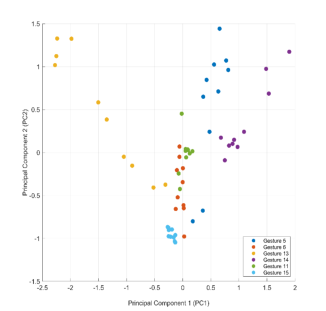
DESCRIPTIVE ANALYSIS The PCA results show a broadly consistent pattern across the three subjects. For Subject S1, wrist flexion and wrist extension form relatively distinct clusters in the two-dimensional feature space, suggesting that these two gestures can be separated more clearly than the others based on RMS features alone (see Figure 1). By contrast, fist clenching, three-finger grasp, and interphalangeal pinch exhibit more visible overlap, indicating that fine finger gestures are more difficult to distinguish using RMS features only. Gesture 5, finger abduction, lies between these two extremes and shows moderate separation.
Figure 1: PCA visualization of sEMG RMS features for six gestures (subject S1).
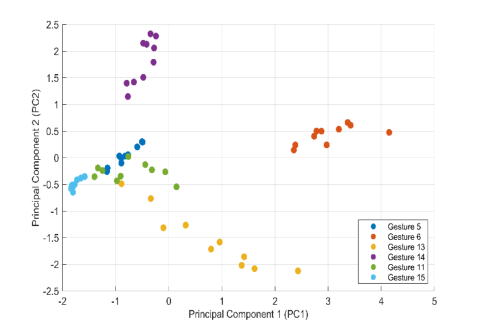
Evaluation of Gesture Separability and Stability 159 A similar tendency is observed in Subject S5. As shown in Figure 2, wrist flexion and wrist extension remain clearly separated, while gesture 11 and gesture 15 still partially overlap. Gesture 6 appears relatively compact, which suggests more consistent execution; however, a more concentrated distribution does not necessarily imply stronger discriminability. In this sense, stability and separability should be treated as related but not identical properties.
Figure 2: PCA visualization of sEMG RMS features for six gestures (subject S5).
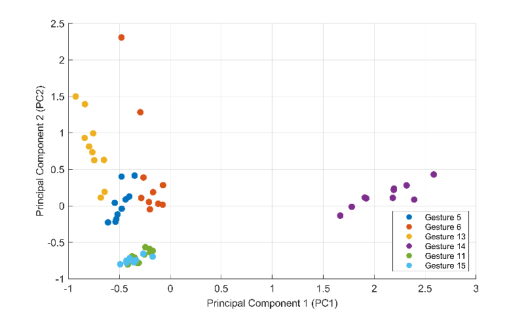
For Subject S10, the overall PCA distribution becomes slightly more compact, yet the same general pattern remains evident (see Figure 3). Wrist flexion and wrist extension are still clearly distinguishable, whereas gesture 11 and gesture 15 are close in feature space and show substantial overlap. Gesture 6 displays a wider spread, implying greater variation in muscular activation during execution. Taken together, the PCA results suggest that large wrist movements tend to produce more distinctive sEMG patterns, while fine finger movements are more susceptible to overlap and inter-individual variation.
Figure 3: PCA visualization of sEMG RMS features for six gestures (subject S10).
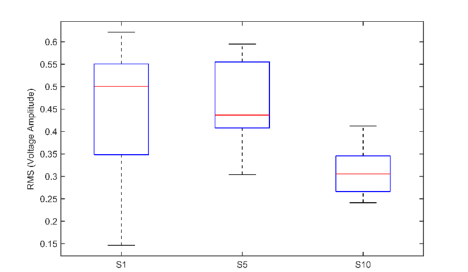
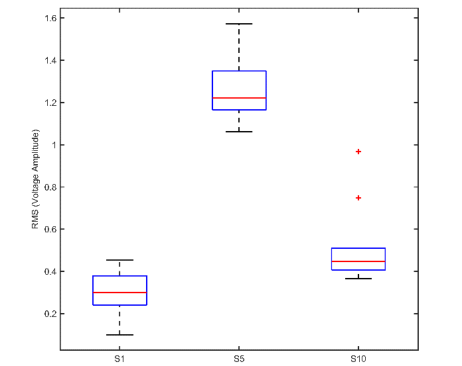
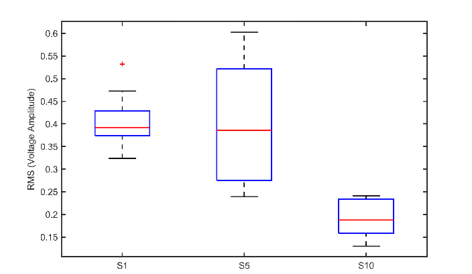
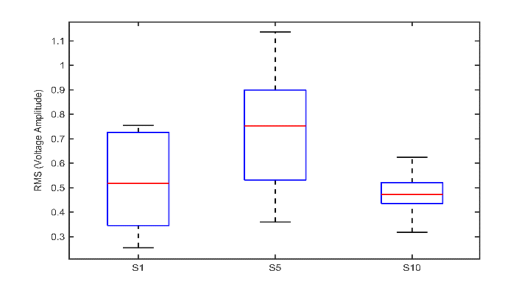
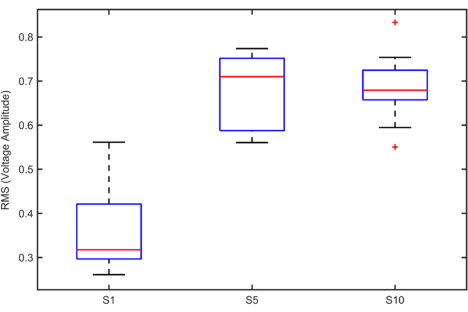
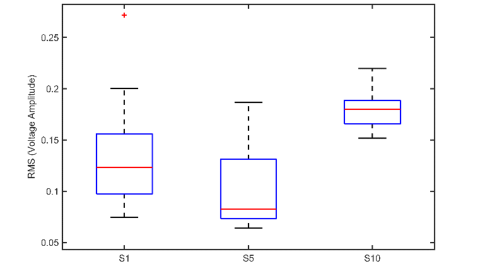
160 Shi and Li The boxplot analysis further supports this observation. Gesture 5 shows moderate differences across the three subjects, with S10 presenting a lower median and a narrower spread than S1 and S5 (see Figure 4). Gesture 6 exhibits a wider distribution and more outliers, indicating weaker cross- subject stability (see Figure 5). Gesture 11 displays an intermediate pattern, with subject-level differences that are noticeable but not extreme (see Figure 6). By contrast, gesture 13 shows closely aligned medians and relatively narrow interquartile ranges across the three subjects, suggesting strong inter-subject consistency (see Figure 7). Gesture 14 also demonstrates stable distribution patterns, although its overall RMS values are slightly lower (see Figure 8). Gesture 15 shows the largest variability among the six gestures, with a broader spread and more pronounced subject-level differences (see Figure 9).
Figure 4: RMS distribution of gesture 5 across subjects S1, S5, and S10.Figure 5: RMS distribution of gesture 6 across subjects S1, S5, and S10.Figure 6: RMS distribution of gesture 11 across subjects S1, S5, and S10.Figure 7: RMS distribution of gesture 13 across subjects S1, S5, and S10.Figure 8: RMS distribution of gesture 14 across subjects S1, S5, and S10.Figure 9: RMS distribution of gesture 15 across subjects S1, S5, and S10.
From an interaction-design perspective, gestures with stronger cross- subject stability are more suitable as core commands in generalized systems because they are more likely to be learnable and robust across different users. Gestures with greater individual variation are better treated as secondary or personalized gestures, particularly when the system incorporates user calibration or additional feature support. In this regard, a compact gesture set composed of stable and well-separated motions may be preferable to a larger set with weaker reliability.
The analysis also suggests that RMS alone is not sufficient to fully characterize all gesture types. For gestures with stronger overlap, frequency- domain, time-frequency, or multimodal features may help improve discrimination. Therefore, RMS should be regarded as a practical starting point for gesture screening rather than a complete description of gesture structure.
CONCLUSION AND DISCUSSION This study examined the separability and stability of sEMG-based gestures using the NinaPro DB1 dataset. By extracting RMS features and applying PCA and boxplot analysis, the study found that, in the three subjects examined, large wrist motions, particularly wrist flexion and wrist extension, generally exhibit clearer feature separation and greater inter-subject consistency than fine finger gestures. Fine finger movements, such as fist clenching and interphalangeal pinch, show stronger overlap and greater individual variation, which may reduce their suitability for generalized interaction systems.
The main contribution of this work is a gesture-screening perspective that considers both separability and stability as joint criteria. Rather than focusing only on recognition accuracy, this perspective emphasizes whether a gesture is inherently suitable for interaction design. The results of this exploratory study suggest that core gesture sets should prioritize movements that are both easy to distinguish and relatively consistent across users, although this recommendation is conditional on validation with larger samples. Such a strategy may reduce calibration cost, improve robustness, and support more practical sEMG-based interfaces.
Evaluation of Gesture Separability and Stability 163 This study has several limitations that should be acknowledged. First, the analysis is based on an offline public dataset rather than real-time interaction data, so the effects of posture changes, environmental interference, and execution style were not directly tested. Second, only RMS features were used, which limits the ability to capture richer temporal and spectral structure. Third, no classification model was constructed, so the study evaluates gesture structure rather than final recognition performance. Fourth, the analysis is descriptive and relies on visual inspection of PCA projections and boxplots; no inferential statistics (e.g., significance tests or effect sizes) were computed, and the conclusions are therefore qualitative. Fifth, the number of subjects is small and the gesture set is limited to six movements, so the observed patterns may not extend to other populations, electrode configurations, or gesture vocabularies. These limitations should be taken into account when interpreting the findings.
Future work may extend this framework in three directions. First, additional features such as frequency-domain and time-frequency descriptors may be introduced to improve the separability of more ambiguous gestures, and quantitative separability indices (e.g., Fisher-based ratios or silhouette scores) could complement the visual inspection used here. Second, classification models and cross-validation procedures should be used to verify the practical recognition performance of the recommended gesture set; this would also allow the separability and stability criteria proposed here to be validated against end-to-end performance. Third, real-world user studies should be conducted to evaluate learnability, comfort, and interaction efficiency in applied settings. Overall, this study provides a data-driven starting point for gesture screening in sEMG-based interaction systems and offers a basis for further design-oriented research in wearable human-computer interaction, with the caveat that the present evidence is preliminary.
REFERENCES
Atzori, M., Gijsberts, A., Castellini, C., Caputo, B., Hager, A.-G.M., Elsig, S., Giatsidis, F., Bassetto, F. and Müller, H. (2014) ‘Electromyography data for non- invasive naturally-controlled robotic hand prostheses’, Scientific Data, 1, 140053.
Atzori, M., Cognolato, M. and Müller, H. (2016) ‘Deep learning with convolutional neural networks applied to electromyography data: A resource for the classification of hand movements’, Frontiers in Neurorobotics, 10, 9.
Geng, Y., Zhou, P. and Li, G. (2016) ‘Gesture recognition by instantaneous surface EMG images’, Scientific Reports, 6, 36571. Jiang, N., Rehbaum, H., et al. (2014) ‘The extraction of neural information from the surface EMG for the control of upper-limb prostheses: Emerging avenues and challenges’, IEEE Transactions on Neural Systems and Rehabilitation Engineering, 22(4), pp. 797–809.
Jolliffe, I.T. and Cadima, J. (2016) ‘Principal component analysis: A review and recent developments’, Philosophical Transactions of the Royal Society A: Mathematical, Physical and Engineering Sciences, 374(2065), 20150202.
Oskoei, M.A. and Hu, H. (2007) ‘Myoelectric control systems: A survey’, Biomedical Signal Processing and Control, 2(4), pp. 275–294.
Xia, P., Hu, J. and Peng, Y. (2021) ‘EMG-based estimation of limb movement using deep learning with recurrent convolutional neural networks’, Artificial Intelligence in Medicine, 112, 102021.
SEARCH THE AHFE DIGITAL BOOKSTORE BY ISBN
Explore the complete digital volume
Human Factors in Design, Engineering, and Computing
Read this individual research paper free through the original publisher, or explore the full digital proceedings book.