Alaa Abdou, Mohamed Zaghloul, Sahar Makky, Yousef Abdou (2026). From Success Factors to Structured Judgement: A Preliminary Web-Based Decision Support System for Early-Stage Real Estate Readiness Assessment. In: Human Factors in Design, Engineering, and Computing. AHFE Open Access, vol. 238, pp. 1748–1760. https://doi.org/10.54941/ahfe1008403
1 Healthy and Sustainable Built Environment Research Center (HSBERC), College of Architecture, Art and Design (CAAD), Ajman University, Ajman, United Arab Emirates ↗
2 College of Engineering, University of Alexandria, Alexandria, Egypt ↗
Early-stage real estate development decisions commit substantial capital and define project parameters before objective performance data are available, yet they remain largely intuitive and unstructured in practice. This paper proposes the Real Estate Initiation Support System (REISS), a preliminary conceptual web-based Decision Support System (DSS) designed to support structured readiness assessment at the pre-commitment stage of commercial real estate development. Building on a preliminary framework of Critical Success Factors (CSFs) and Key Competitiveness Indicators (KCIs) established in the first phase of this research, REISS integrates both frameworks into a three-module evaluation architecture targeting CSF readiness, organisational performance, and individual capability. The Analytic Hierarchy Process (AHP) is employed to derive expert-based weights for each factor, which are combined with user self-assessment scores to generate readiness scores and ranked recommendations. The system is delivered through a three-tier web-based architecture comprising a wizard-style user interface, a model management system, and a database management system. The paper presents the conceptual design of REISS and discusses its potential contribution to more consistent and evidence-informed early-stage decision-making in the UAE real estate market. Empirical validation, AHP weight derivation, and prototype development are planned for subsequent research phases.
The early stages of real estate development, encompassing market research, site selection, feasibility assessment, financial planning, and risk management, are widely recognised as the most consequential phase of the development lifecycle. Decisions taken at this stage commit substantial capital and define the strategic parameters of a project long before objective performance data are available. Despite their significance, these decisions remain largely intuitive and unstructured in practice, particularly in high-growth markets
From Success Factors to Structured Judgement 1749 such as Dubai, where market volatility and regulatory complexity amplify the consequences of poor early-stage judgement (Green, 1988; Nallathiga et al., 2012).
The academic literature has given increasing attention to the identification of Critical Success Factors (CSFs) for real estate development, and to the development of decision support tools for the built environment. However, existing Decision Support Systems (DSSs) are predominantly oriented toward post-initiation phases, including design optimisation, construction management, and financial modelling, leaving the pre-commitment stage largely unsupported (Druzdzel & Flynn, 2018; Hammond et al., 2021).
This paper addresses that gap. It reports the second phase of an ongoing research project on early-stage decision-making in commercial real estate development in Dubai. The first phase, reported in Abdou and Makky (2025), established a preliminary framework of CSFs through a comprehensive literature review. The present paper builds on that foundation to propose the Real Estate Initiation Support System (REISS), a conceptual web-based DSS that structures and weights the judgements developers must make before committing to a project.
The paper is organised as follows. Section 2 summarises the preliminary CSF and Key Competitiveness Indicator (KCI) frameworks. Section 3 reviews relevant DSS tools and identifies the gap REISS addresses. Sections 4 and 5 present the REISS conceptual proposal and its AHP-based decision modelling approach. Section 6 describes the system architecture. Sections 7 and 8 discuss the contribution and outline future work. Section 9 concludes.
CSF AND KCI FRAMEWORK FOR EARLY-STAGE DECISION-MAKING In the first phase of this research project, the authors conducted a comprehensive literature review to establish a preliminary framework of Critical Success Factors (CSFs) for the early stage of commercial real estate development (Abdou & Makky, 2025). The review identified factors across six core development processes that define the initiation stage. These factors are presented in Table 1 as an initial overview, subject to empirical validation in subsequent research phases.
Table 1: Preliminary critical success factors by development process (developed based on (Abdou & Makky, 2025)).
Table available in the original PDF paper.
Development Process Preliminary Critical Success Factors Market research and analysis
Market demand forecasting; Competitive landscape analysis; Regulatory and zoning compliance; Economic and demographic trend analysis; Location and accessibility assessment
Site selection and acquisition
Site suitability assessment; Environmental impact evaluation; Land cost and value analysis; Infrastructure availability; Legal due diligence and title verification Feasibility studies Technical feasibility assessment; Economic and financial viability analysis; Market absorption rate estimation; Stakeholder needs assessment; Risk-return trade-off evaluation
(Continued)
Table 1: Continued.
Table available in the original PDF paper.
Development Process Preliminary Critical Success Factors Project brief development
Alignment of project scope with market demand; Definition of design and quality standards; Establishment of project objectives and KPIs; Stakeholder consultation and brief validation; Regulatory pre-approval and compliance mapping
Financial planning and funding
Capital structure and funding strategy; Cash flow forecasting and sensitivity analysis; Return on investment modelling; Identification of funding sources and financing terms; Financial risk assessment and contingency planning Risk management Risk identification and categorisation; Qualitative and quantitative risk assessment; Risk mitigation strategy development; Contingency planning and reserve allocation; Ongoing risk monitoring framework
The same study also identified Key Competitiveness Indicators (KCIs) to assess readiness at two levels: organisational and individual. These indicators reflect the capabilities that real estate companies and their personnel must demonstrate to operate effectively in competitive markets. In high-risk development environments such as Dubai, where capital commitments are large and market conditions volatile, weaknesses at either level, whether in the company’s strategic and financial capabilities or in the technical and interpersonal skills of key personnel, can translate directly into project failure. The preliminary KCIs are presented in Table 2, subject to empirical validation in subsequent research phases.
Table 2: Preliminary key competitiveness indicators by readiness level (developed based on (Abdou & Makky, 2025; Singla & Samanta, 2022; Zhang et al., 2010)).
Table available in the original PDF paper.
Readiness Level Preliminary Key Competitiveness Indicators Organisational readiness Capital and operations management; Market intelligence and research capability; Strategic planning and management; Project management capability; Legal and regulatory compliance; Technology and innovation adoption; Stakeholder and partnership management; Brand equity and market reputation; Human resource capability; Financial risk management; Sustainability and ESG integration
Individual readiness
Real estate market knowledge; Financial analysis and investment appraisal; Legal and regulatory understanding; Project management skills; Negotiation and deal-making ability; Leadership and team management; Risk assessment and decision-making under uncertainty; Communication and stakeholder engagement
DECISION SUPPORT SYSTEMS IN THE EARLY STAGE OF REAL ESTATE PROJECT DEVELOPMENT: A REVIEW Decision Support Systems (DSSs) integrate data, analytical models, and user interfaces to support both structured and unstructured decision- making (Druzdzel & Flynn, 2018). In real estate development, DSSs have been applied in diverse contexts including brownfield redevelopment
From Success Factors to Structured Judgement 1751 (Hammond et al., 2021), housing markets (Dawood & Alshawi, 2009), and smart city planning (Chichernea, 2014), with functions ranging from reducing uncertainty and improving decision accuracy to facilitating multi- stakeholder collaboration and incorporating real-time data and artificial intelligence (Green, 1988).
In early-stage real estate development, DSSs have been applied across six key process areas, from market research and site selection through to feasibility assessment, project brief development, financial planning, and risk management. Table 3 summarises these tools and their main functions. As shown in Table 3, each tool addresses a specific process area, with varying levels of analytical sophistication, from GIS-based spatial analysis and AHP-weighted evaluation to big data integration and risk modelling.
Despite this range of applications, most existing DSS focus narrowly on project-level decisions, with limited attention to organisational readiness and individual capability factors. There is therefore a clear need for a DSS framework integrating CSFs with KCIs to evaluate both organisational and individual readiness, enabling more consistent and context-responsive early- stage decision-making in the UAE real estate market.
Table 3: DSS tools mapped against early-stage development processes.
Table available in the original PDF paper.
Main Process Name Source Main Functions Remarks Market research and analysis big data analytics, Integrates market, financial, policy, socio- economic datasets DSS-BD (Sun, 2023) Real-time data integration, dynamic market monitoring, performance indicators.
Uses AHP for integrated quantitative and qualitative analysis
Site screening and evaluation, multi-criteria site suitability analysis, alternative ranking
DSS (Komeily & Srinivasan, 2015)
The system supports early-stage feasibility analysis as well
GIS-based site assessment, connectivity and infrastructure analysis, environmental constraints
(Continued)
Table 3: Continued.
Table available in the original PDF paper.
Main Process Name Source Main Functions Remarks Feasibility studies DSSVenture (Leelarasamee, 2005) Supports investment and risk-aware screening Feasibility analysis, comparative assessment of alternative development strategies
IDSS (Lin et al., 1996)
Integrates feasibility with market analysis
Economic feasibility evaluation, Development cost estimation and accounting
Includes market and spatial analysis
DSS-HE (Natividade- Jesus et al., 2007)
GIS-based, value– quality–based feasibility screening, Multicriteria ranking and classification of housing alternatives,
Project brief development
SDSS (Peterson, 1993)
Supports participatory and model-based design processes
Spatial/non-spatial data integration, spatial analysis and visualization, iterative decision- making DSS-G (Jankowski et al., 1997)
Enables collaborative alignment and comparison
Group-based decision-making, prioritization, and validation of decision alternatives HCDSS (Abdou et al., 2013)
Tailored to early-stage medical real estate
Space programming, alternative evaluation, cost estimation with risk
DSS (Valverde, 1999)
Financial planning and funding
Supports investment risk management and pricing analysis
Investment financial analysis and valuation, Financing choice evaluation,
RIDSS (Salah & Erzaij, 2025)
Supports investment risk awareness.
Capital budgeting, sensitivity-based financial robustness analysis, Discounted cash-flow investment evaluation
(Continued)
Table 3: Continued.
Table available in the original PDF paper.
Main Process Name Source Main Functions Remarks Risk management DSS (Dawood & Alshawi, 2009) Evaluates payment schemes Risk-informed project selection, profitability assessment under uncertainty
RM-DSS (Valverde, 2011)
Developed for California market context
Risk identification, model-based risk analysis, data- driven reporting and evaluation
THE REAL ESTATE INITIATION SUPPORT SYSTEM (REISS): CONCEPTUAL PROPOSAL The Real Estate Initiation Support System (REISS) is proposed as a preliminary conceptual web-based DSS designed to support early-stage readiness assessment in commercial real estate development. It is designed as a practical tool for developers and their teams, enabling structured self- assessment before committing resources to a project. The system integrates the CSF and KCI frameworks presented in Section 2 into a single evaluation architecture, using the Analytic Hierarchy Process (AHP) to weight factors according to expert-derived relative importance.
REISS is designed around three core objectives:
To guide decisionmakers through the key early-stage development processes by assessing the extent to which each Critical Success Factor is present and practised, identifying readiness gaps prior to project commitment.
To evaluate the organisation’s competitive readiness against Key Competitiveness Indicators (KCIs), generating ranked recommendations to support strategic positioning and market entry decisions.
To detect skill gaps among key personnel and recommend development plans that improve overall project preparedness at the individual level.
These represent intended design objectives, subject to empirical validation in subsequent research phases. The REISS platform is proposed as a web- based application, offering key advantages of accessibility, scalability, and operational efficiency. The system does not replace professional judgement; rather, it structures and makes explicit the judgements that developers and their teams are already making, enabling more consistent, transparent, and evidence-informed decision-making at the initiation stage.
AHP Method and Its Use in Decision Modelling The Analytic Hierarchy Process (AHP), developed by Saaty (1980), is a widely used multi-criteria decision-making technique that decomposes complex problems into a hierarchical structure and derives priority weights through pairwise comparisons of criteria (Rogers, 2001). For example, Budawara (2009) developed an AHP-based framework to assess design performance in the Canadian construction sector using Key Performance Indicators (KPIs), enabling both project-level and organisational-level benchmarking. Similarly, Fong and Choi (2000) applied AHP to a contractor selection process in Hong Kong using 68 evaluation criteria, demonstrating its effectiveness in high- dimensional decision problems. Its ability to transform expert judgement into quantitative, consistent weights makes it particularly suited to early-stage real estate decisions, where criteria are multiple, interrelated, and difficult to measure objectively (Ho, 2008).
Within the REISS framework, AHP will be applied through a three-level hierarchical structure. At the first level sits the overall goal: assessing early- stage development readiness. At the second level are the six early-stage development processes and the two KCI categories (organisational and individual) as main criteria. At the third level are the individual CSFs and KCIs as sub-criteria. The full AHP implementation will be conducted in the next phase. Expert ratings collected through a structured questionnaire survey will be used to construct pairwise comparison matrices, from which AHP weights for each CSF and KCI will be mathematically derived and readiness thresholds calibrated. Findings will be reported in future publications.
REISS System Architecture The preliminary system architecture of REISS consists of three integrated components: a User Interface (UI), a Model Management System (MMS), and a Database Management System (DBMS). Together, these layers enable structured data input, systematic evaluation, and actionable output generation.
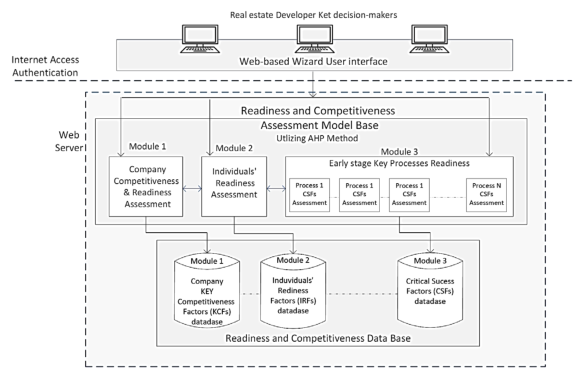
The User Interface All user interaction takes place through secure, browser-based web pages, accessible only via password-protected login credentials to ensure data security and user confidentiality. The interface adopts a wizard-style navigation flow, guiding users step by step through the system’s three evaluation modules. This design is particularly important for non-technical users, as structured navigation supports ease of use and encourages system adoption (Bidgoli, 1990). The wizard-style navigation flow across these three modules is illustrated in Figure 1.
Figure 1: The preliminary system architecture.
The three modules are designed to support comprehensive evaluation at both organisational and individual levels. The CSF Readiness Evaluation module assesses the presence and maturity of CSFs across the six early-stage development processes, using a 1-to-5 scoring scale to identify deficiencies and determine readiness levels. The Organisational Performance Evaluation module assesses the company’s current performance against core KCIs, identifying strategic strengths and weaknesses in relation to market readiness and competitiveness. The Individual Capability Assessment module evaluates the technical knowledge, soft skills, and overall readiness of key personnel, supporting targeted training and human resource planning. Figure 1. The preliminary system architecture illustrating the wizard-style navigation flow across the three modules.
The Model Management System The MMS forms the analytical core of REISS, processing user inputs, applying decision logic, and generating results to guide early-stage decision-making. It performs three main functions: storing AHP-derived factor weights, calculating readiness scores, and presenting outputs to users.
AHP-derived weights, based on expert judgement, are assigned to each CSF and KCI and stored in system tables. When users submit their self- assessment scores on the 1-to-5 scale, the MMS multiplies each score by its corresponding AHP weight using the formula: Factor Index = User Score × AHP Weight. Summing these indices provides overall readiness scores at the process, organisational, and individual levels. The system then classifies readiness into low, moderate, and high bands to identify priority improvement areas. The specific threshold values delimiting these bands will be established in the next phase, alongside the derivation of AHP weights from expert judgement. Results are delivered through the UI as visual outputs, including readiness percentages and ranked actionable recommendations.
The Database Management System (DBMS) The DBMS serves as the middle layer of the proposed architecture, ensuring secure, scalable, and reliable storage and retrieval of system data. It plays a dual role. First, as a knowledge base, it stores the validated CSF priority vectors and AHP-derived weights that form the static decision logic of the system; these weights can be periodically recalibrated based on new expert input, ensuring the system remains responsive to changing market conditions. Second, as a transactional hub, it manages the dynamic flow of user data, retrieving relevant weights when users submit assessments, passing them to the MMS for calculation, and storing both raw inputs and computed outputs in a historical data module. This historical repository supports trend analysis, performance monitoring, and retrospective validation of the framework over time.
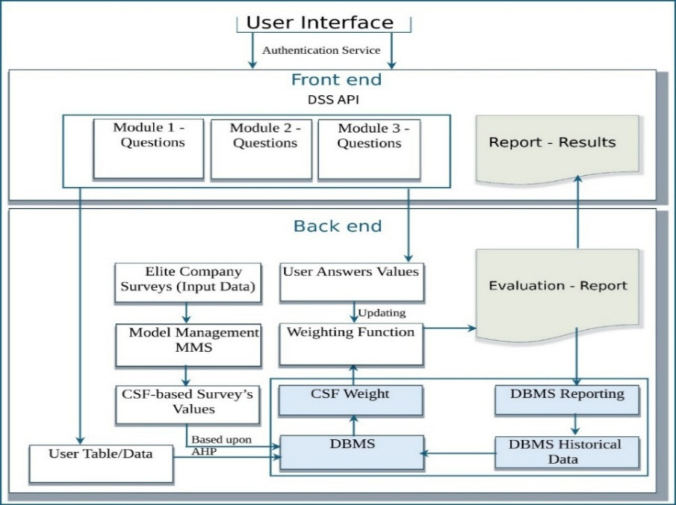
Figure 2: System architecture and data flow between the proposed DSS interface and the DBMS.
As illustrated in Figure 2, the system operates across two layers. At the front end, users authenticate and progress through the three assessment modules, with results displayed via the DSS API. At the back end, user inputs are passed to the Weighting Function, where AHP-derived CSF weights stored in the DBMS are applied to calculate evaluation scores. The DBMS handles data extraction, aggregation, and formatting to generate the Evaluation Report, which is returned to the front end for display. Each assessment session is recorded in the DBMS Historical Data module, capturing user inputs, readiness scores, and ranked CSFs as the core reference for tracking readiness over time.
DISCUSSION
The REISS conceptual framework proposed in this paper addresses a recognised gap in early-stage real estate decision support. Existing DSS tools reviewed in Section 3 are predominantly focused on post-initiation phases, including design optimisation, construction management, and financial modelling, leaving the pre-commitment stage largely unsupported. REISS is designed specifically for this underserved stage, offering a structured mechanism through which developers and their teams can assess readiness before committing resources to a project.
The integration of AHP into REISS provides a structured, evidence- based weighting mechanism that moves beyond subjective checklists. By mathematically deriving factor weights from expert judgement, the system ensures that assessments reflect established domain knowledge rather than arbitrary scoring. This is particularly relevant given the dual focus on organisational and individual readiness, where the relative importance of factors may differ significantly across development contexts.
It is important to acknowledge the preliminary nature of the current work. The CSFs and KCIs identified in this paper are based on a literature review and have not yet been empirically validated. The AHP weights, threshold values for readiness classification, and the full system implementation remain as planned outputs of subsequent research phases. The current paper therefore presents a conceptual proposal, a structured design blueprint, rather than a tested system.
Despite these limitations, the value of the conceptual contribution lies in its structured synthesis: translating published CSF and KCI frameworks into a coherent, operable system design that is ready for empirical testing. This positions REISS as a viable candidate for prototype development and expert validation in the next phase of research.
FUTURE WORK
The present paper establishes the conceptual foundation for REISS. The next stage of this research will focus on empirical validation of the preliminary CSF and KCI frameworks through structured interviews and questionnaire surveys with experienced real estate professionals and academics in the UAE. This will yield consensus-based priority weights for each factor, refine the framework to the Dubai and UAE market context, and establish the threshold values required for the system’s readiness classification bands.
Building on this validated framework, the subsequent stage will involve the development and deployment of a functional REISS prototype, a working web-based system accessible to real estate practitioners. The prototype will implement the validated weights and enable structured readiness assessments for early-stage development projects in practice.
The final stage will involve empirical testing and validation of the deployed prototype, collecting user feedback and system performance data to evaluate usability, accuracy, and practical value. Findings will inform final refinements to both the framework and the system, and will be reported in a dedicated journal publication. The system will also incorporate a mechanism
for periodic updating of CSF weights, ensuring responsiveness to evolving market conditions.
CONCLUSION
This paper presented the Real Estate Initiation Support System (REISS), a preliminary conceptual proposal for a web-based decision support system designed to assist developers and real estate professionals in assessing their readiness for early-stage project initiation. The system addresses a recognised gap in existing DSS tools, which predominantly support post-initiation phases while leaving the pre-commitment stage underserved.
REISS is structured around three evaluation modules, namely the CSF Readiness Evaluation, the Organisational Performance Evaluation, and the Individual Capability Assessment, each targeting a distinct dimension of development readiness. These modules are delivered through a three- tier architecture: a wizard-style User Interface that guides users through a structured self-assessment, a Model Management System that applies AHP-derived expert weights to produce readiness scores and actionable recommendations, and a Database Management System that manages both the static decision logic and the dynamic flow of user data. Together, these components translate expert knowledge into a transparent, accessible tool for non-technical users at the earliest and most consequential stage of the development process.
ACKNOWLEDGMENT
The authors express their sincere gratitude to Ajman University for its funding and support of this research project. This support will facilitate future investigations and the development of this study to achieve its research objectives.
REFERENCES
Abdou, A., Lewis, J., & Zarooni, S. A. (2013). The evaluation of a web-based decision support system for healthcare project appraisal. International Journal of Project Organisation and Management, 5, 69–90. Abdou, A., & Makky, S. (2025). Critical Success Factors for the Early Stage of
Commercial Real Estate Development. Selected Articles from the 8th International Conference on Architecture and Civil Engineering, Singapore. Bidgoli, H. (1990). Designing a user-friendly interface for a decision support system.
Information Age archive, 12, 148–154. Budawara, N. (2009). Key performance indicators to measure design performance in construction ProQuest, UMI Dissertations Publishing]. Chichernea, V. (2014). The Use of Decision Support Systems (DSS) in Smart City
Planning and Management. Journal of Information Systems and Operations Management, 8, 238–251. Dawood, I., & Alshawi, M. (2009). Decision Support Systems (DSS) Model for the Housing Industry. 2009 Second International Conference on Developments in eSystems Engineering, 29–37.
From Success Factors to Structured Judgement 1759 Druzdzel, M. J., & Flynn, R. R. (2018). Decision Support Systems. Management of
Information Systems. Fong, P. S.-W., & Choi, S. K.-Y. (2000). Final contractor selection using the analytical hierarchy process. Construction Management and Economics, 18(5), 547–557. https://doi.org/10.1080/014461900407356 Green, G. H. (1988). Strategic Management Practices of Real Estate Developers in a
Volatile Economic Climate. Journal of Real Estate Research, 3, 63–72. Hammond, E. B., Coulon, F., Hallett, S. H., Thomas, R., Hardy, D., Kingdon, A., & Beriro, D. J. (2021). A critical review of decision support systems for brownfield redevelopment. The Science of the total environment, 785, 147132. https://www. sciencedirect.com/science/article/pii/S0048969721022026?via%3Dihub Ho, W. (2008). Integrated analytic hierarchy process and its applications: A literature
review. European Journal of Operational Research, 186(1), 211–228. https://doi. org/10.1016/j.ejor.2007.01.004 Jankowski, P. L., Nyerges, T. L., Smith, A., Moore, T. J., & Horvath, E. (1997).
Spatial Group Choice: A SDSS Tool for Collaborative Spatial Decision-Making. Int. J. Geogr. Inf. Sci., 11, 577–602. Komeily, A., & Srinivasan, R. S. (2015). GIS-Based Decision Support System for Smart Project Location. Leelarasamee, Y. (2005). A decision support system for income-producing real estate
development feasibility analysis and alternative assessment. Lin, R.-S., Wang, Q.-Y., Hu, J., Gao, L., & Lu, L. (1996). An intelligent decision support system applied to the investment of real estate. Proceedings of the IEEE International Conference on Industrial Technology (ICIT’96), 801–805. Mcintyre, C., & Parfitt, M. K. (1998). Decision Support System for Residential Land
Development Site Selection Process. Journal of Architectural Engineering, 4, 125–131. Nallathiga, R., Kumar, M. A., Kumar, D., & Kumar, G. A. (2012). Determinants of the Success of Real Estate Projects: A Study of Selected Firms in Hyderabad. Journal of Real Estate, Construction & Management, 27(2–3), 38–52. https://doi. org/10.1177/2977657020120204 Natividade-Jesus, E., Coutinho-Rodrigues, J. M., & Antunes, C. H. (2007).
A multicriteria decision support system for housing evaluation. Decis. Support Syst., 43, 779–790. Peterson, K. (1993). Spatial Decision Support Systems for Real Estate Investment Analysis. Int. J. Geogr. Inf. Sci., 7, 379–392. Rogers, M. (2001). Engineering Project Appraisal: The Evaluation of Alternative
Development Schemes. Wiley. https://books.google.ae/books?id=rR49otWVIhYC Saaty, T. L. (1980). The Analytic Hierarchy Process. Wiley. https://books.google.ae/ books?id=lfDXAAAAMAAJ Salah, A. M., & Erzaij, K. (2025). Development and Application of an Investment
Decision Support System Based on Life Cycle Cost Analysis: A Case Study on Residential Complexes. Journal of Engineering. Singla, H. K., & Samanta, P. K. (2022). Identification of critical success factors (CSFs) for real estate developers (REDs) in India. Journal of Financial Management of Property and Construction, 27(1), 76–90. https://doi.org/10.1108/JFMPC-04- 2020-0028 Sun, Z. (2023). Research on Product Decision of Real Estate Project Based on Big
Data Analysis. Frontiers in Business Economics and Management, 11(2), 220–223. https://doi.org/10.54097/fbem.v11i2.12593 Valverde, R. (1999). A Design and Implementation of a Decision Support System for the Real Estate Industry. Real Estate eJournal.
Valverde, R. (2011). A Risk Management Decision Support System for the Real Estate Industry. Zavadskas, E. K., Kaklauskas, A., & Banaitis, A. (2010). Real estate’s knowledge and
device-based decision support system. International Journal of Strategic Property Management, 14, 271–282. Zhang, X., Shen, L., Skitmore, M., & Xia, B. (2010). Key competitiveness indicators for new real estate developers. Journal of Financial Management of Property and Construction, 15(2), 143–157. https://doi.org/10.1108/13664381011063430
SEARCH THE AHFE DIGITAL BOOKSTORE BY ISBN
Explore the complete digital volume
Human Factors in Design, Engineering, and Computing
Read this individual research paper free through the original publisher, or explore the full digital proceedings book.