Amir Milad Moshref Javadi, Tekalign Mengistu, Natnael Takele, Steven Xiaochun Jiang, Ali Karimoddin (2026). Trust Calibration in Semi-Automated Rural Driving Under Reduced Visibility: Effects of Visibility and Collision-Warning Context on Driver Reliance. In: Human Factors in Design, Engineering, and Computing. AHFE Open Access, vol. 238, pp. 2009–2019. https://doi.org/10.54941/ahfe1008428
Advanced driver assistance systems (ADAS) increasingly support vehicle control while requiring drivers to monitor system behaviour and remain prepared to intervene as operating conditions change. Appropriate reliance is therefore particularly important in rural environments, where degraded visibility and unexpected roadway hazards may increase uncertainty surrounding automated support. This study examined scenario-level ADAS reliance and related system perceptions during repeated rural driving. Ten licensed drivers completed twelve counterbalanced simulator-based scenarios in a 3 × 2 × 2 within-subject design crossing visibility (low, medium, high), driving mode (manual, ADAS-supported), and collision-warning alarm condition (off, on). The present analysis focused on the six ADAS-supported conditions in which repeated ADAS-perception measures were collected. A linear mixed-effects model examined reliance as a function of visibility, alarm condition, and their interaction while accounting for repeated observations within drivers. Under low visibility, alarm activation was associated with substantially lower reliance (β = −1.70, 95% CI [−2.70, −0.70], p = 0.001). Visibility contrasts within the Alarm-Off reference condition were not statistically reliable, and the Visibility × Alarm interaction contrasts did not reach the conventional significance threshold. Multidimensional questionnaire profiles further showed that reliance, perceived safety, competence, predictability, explicit trust, and error awareness were related but non-equivalent aspects of ADAS perception. These findings highlight the importance of evaluating driver reliance as a dynamic and multidimensional response to environmental and interface context.
Advanced driver assistance systems (ADAS) increasingly perform vehicle- control tasks while requiring drivers to supervise conditions, interpret system behaviour, and intervene when needed Skirnewskaja et al. (2026). Therefore, safe operation depends not only on technical capability but also on appropriate driver trust and reliance. Trust calibration, defined as alignment between user expectations, reliance, and system capability,
remains a central challenge in human-cantered automation design. Lee & See (2004) conceptualized trust in automation as an attitude that an automated agent will help an individual achieve goals in situations characterized by uncertainty and vulnerability. Importantly, their framework emphasizes appropriate reliance rather than maximization of trust. Hoff & Bashir (2015) subsequently distinguished dispositional, situational, and learned components of trust, emphasizing that trust reflects both relatively stable individual characteristics and dynamic responses to changing operating conditions. Trust in automated driving can also change during interaction as drivers gain experience with system behaviour, Kraus et al. (2020). Together, these findings suggest that scenario-level changes in reliance should not automatically be interpreted as measurement noise. Instead, within-driver variation may reflect meaningful responses to changes in environmental and interface context. Related work using the broader rural-driving experiment found that reduced visibility significantly increased perceived workload, highlighting the cognitive demands associated with degraded visual conditions Javadi et al. (2026a). Rural driving provides a particularly useful environment for investigating such dynamics. Rural roadways may combine low traffic density, limited illumination, extended monotonous road segments, restricted sight distance, and unexpected animal crossing hazards Walker & Stanton (2017). Prior rural-driving research has also shown that reduced visibility can complicate hazard detection and increase attentional demands, particularly around unexpected animal-crossing events Javadi et al. (2025). Related work further indicates that unexpected animal crossing events require visual and cognitive reorientation as drivers restore attention and control following hazard onset Javadi et al. (2026b). Visibility degradation from fog or low illumination further decreases the visual information available to the driver. These environmental changes may affect how drivers evaluate automated assistance even when the technical capability of the automation itself is not directly manipulated. Reduced visibility may therefore influence not only perceptual demand but also the driver’s confidence in, and willingness to rely upon ADAS De Winter et al. (2014). Collision-warning alerts introduce an additional component of the driver-automation relationship Mehrotra et al. (2022). Warnings communicate hazards and the need for attention, but they may also influence how drivers interpret system status. Prior research shows that automation uncertainty and interface communication can affect trust and interaction with automated systems (Beller et al., 2013; Helldin et al., 2013). The effect of an alert may therefore depend on environmental context. If warning presentation produces comparable changes in reliance across visibility levels, its influence may be relatively context-independent. Conversely, if the warning effect differs between low, medium, and high visibility, driver reliance may reflect an interaction between environmental uncertainty and interface feedback. Trust in automation is also multidimensional. A driver’s willingness to rely on ADAS may be related to perceived predictability, safety, competence, explicit trust, and awareness of possible system errors without being identical to any one of
Trust Calibration in Semi-Automated Rural Driving 2011 those evaluations Körber et al. (2018). Heterogeneous questionnaire items were retained as separate measures rather than combined into a single composite score. Reliance (1–7) was treated as the primary outcome, while the remaining ADAS-perception dimensions were analyzed descriptively. Although the broader experiment used a 3 × 2 × 2 within-subject design, the present analysis focused on the six ADAS-supported Visibility × Alarm conditions because repeated perception ratings were collected only during ADAS operation. The analysis examined whether reliance varied with visibility and warning context and how reliance related to other ADAS- perception dimensions. Given the modest sample size, interpretation emphasized effect estimates, confidence intervals, within-driver structure, and descriptive patterns.
METHOD
Participants Twelve individuals were recruited from a southeastern public university. Two were excluded due to incomplete participation or eligibility considerations, resulting in ten licensed drivers in the final analysis. Participants were male, ranged from 21 to 45 years of age, and had an average of 7.0 years of driving experience. Six participants reported previous simulator experience. All participants reported normal or corrected-to-normal vision and provided informed consent. The within-subject design allowed condition-related changes to be evaluated while accounting for repeated observations within drivers.
Apparatus Data were collected using a high-fidelity vehicle-in-the loop/human-in-the- loop (VIL/HIL) driving simulator configured to reproduce rural roadway conditions and controlled animal-crossing events. The simulator incorporated realistic steering, accelerator, and brake controls together with a visual displays presenting the roadway environment and visibility manipulation. The broader experimental platform also incorporated a 32-channel Brain Vision electroencephalogram (EEG) system and Tobii Pro Glasses 3 eye- tracking instrumentation. These systems were synchronized with simulator data acquisition as part of the larger experimental protocol. Physiological and ocular outcomes, however, are not analyzed in the present trust-focused study. instrumentation. We used the controlled simulator environment to maintain consistent vehicle, roadway, and animal hazard conditions across participants. Although physiological instrumentation was synchronized with the simulator, the present analysis focuses specifically on repeated scenario- level ADAS perceptions.
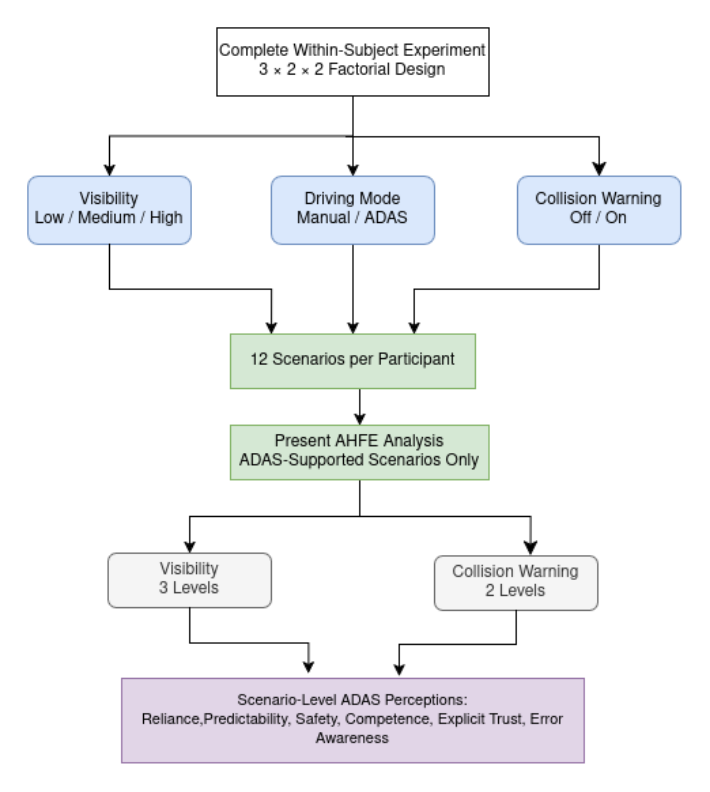
Design The complete experiment employed a 3 (Visibility: low, medium, high) × 2 (Driving Mode: manual, ADAS-supported) × 2 (Collision-Warning Alarm: off, on) within-subject factorial design. The design produced 12 scenarios
per participant and 120 condition-level trials across the ten participants included in the final dataset. Visibility was manipulated by adjusting simulated fog density. Driving mode determined whether participants manually controlled longitudinal vehicle behavior or completed the scenario with ADAS support. Alarm status determined whether a collision- warning alert was presented. All participants experienced the experimental conditions in counterbalanced order to reduce systematic order effects. Rest periods were provided between scenario blocks. Repeated ADAS- perception ratings were collected following the six ADAS-supported scenarios. Consequently, the present trust-focused analysis used the 3 Visibility × 2 Alarm subset, producing a maximum of six repeated ADAS perception observations per participant.
Figure 1: Experimental apparatus used during the rural driving study. The VIL/HIL simulator provided controlled rural roadway scenarios, ADAS-supported operation, and synchronized driver-monitoring instrumentation.
Trust Calibration in Semi-Automated Rural Driving 2013 Procedure
Participants first completed informed-consent procedures and were familiarized with the simulator and experimental equipment. EEG and eye-tracking equipment were fitted and calibrated as part of the broader study protocol, after which participants completed a familiarization drive. Each participant then completed the twelve counterbalanced experimental scenarios. Subjective assessments were administered following the relevant scenarios. NASA Task Load Index (NASA-TLX) and Situation Awareness Rating Technique (SART) assessments were collected as components of the broader experimental protocol, whereas the six ADAS-perception items examined in the present manuscript were administered following ADAS-supported trials. At the end, participants completed demographic and post-experiment questionnaires after the simulator protocol.
Measures Scenario-Level Reliance: the primary dependent variable was the repeated statement: “I could rely on the ADAS to act appropriately.”
Responses were recorded on a 1–7 scale following ADAS-supported scenarios. The item was selected as the primary graded outcome because it directly represents willingness to rely upon the automated assistance and provides repeated variation across all Visibility × Alarm combinations. Additional ADAS-Perception Measures: five additional scenario-level measures captured complementary evaluations of the automated system: Predictability, Perceived Safety, Perceived Competence, Explicit Trust, and Error Awareness. The response formats were not identical across these measures. Reliance used a 1–7 response scale, Safety used an ordinal numeric scale, and the remaining dimensions were represented as binary agreement responses in the analysis dataset. Accordingly, the six raw questionnaire measures were not averaged into a single composite trust score. Each dimension was retained on its original scale for descriptive reporting.
Analysis Statistical analyses were conducted at the scenario level while accounting for repeated observations within drivers. The primary Reliance analysis used a linear mixed-effects model: Reliance ∼ Visibility × Alarm+(1 ∣ Participant) Participant-specific random intercepts accounted for within- driver dependence. Low visibility and Alarm Off were used as reference conditions, with interaction terms representing changes in the alarm effect across visibility levels. Model interpretation emphasized fixed-effect estimates, 95% confidence intervals, and exact p values. Descriptive statistics were calculated for the six ADAS-perception dimensions using their original response formats. For visualization, dimensions were normalized to a 0–1 scale only for the radar plot and were not combined into a composite score or used in inferential modeling. Associations among dimensions were examined descriptively using Spearman rank-order correlations due to heterogeneous response formats.
Table 1: Descriptive profile of scenario-level ADAS perceptions across visibility conditions.
Table available in the original PDF paper.
Measure Scale Valid N Overall Low Medium High Reliance 1–7 59 4.19 ± 1.99 3.85 ± 2.03 4.24 ± 1.88 4.45 ± 2.09
Error Awareness Note. Continuous/ordinal responses are reported as M ± SD. Binary responses are reported as percentages of affirmative responses. Measures were retained in their original response scales and were not combined into a composite score. The correlation matrix was treated as an exploratory representation of monotonic association. Because multiple scenario-level observations were contributed by the same participants, ordinary pairwise significance tests from the matrix were not interpreted as independent confirmatory hypothesis tests.
RESULTS
ADAS-Perception Dataset Ten participants contributed 59 usable repeated observations to the Reliance analysis, with nine participants providing six observations and one participant providing five due to a missing response. Descriptive statistics for the six ADAS-perception measures are presented in Table 1. Reliance increased descriptively from Low (M = 3.85, SD = 2.03) to Medium (M = 4.24, SD = 1.88) and High visibility (M = 4.45, SD = 2.09). The remaining dimensions showed different patterns, indicating that ADAS perceptions were related but non-identical. Low visibility and Alarm Off were used as reference conditions for the mixed-effects model.
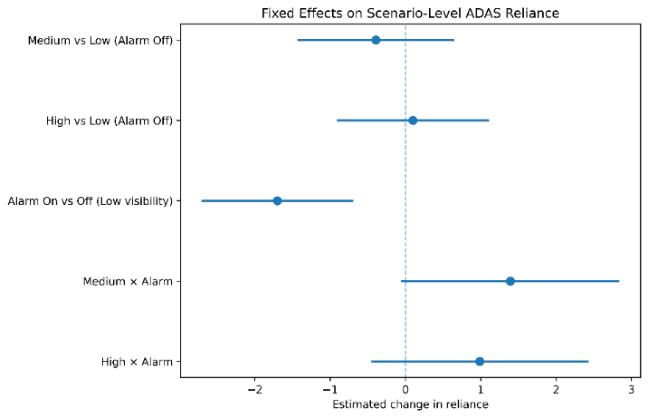
Effects of Visibility and Alarm on Scenario-Level Reliance The mixed-effects model results are summarized in Table 2 using 59 observations from ten participants. Under the Low visibility–Alarm Off reference condition, estimated Reliance was 4.70 (SE = 0.60, 95% CI [3.53, 5.87], p < 0.001). Visibility contrasts within Alarm-Off conditions were not statistically reliable for Medium versus Low visibility (β = −0.40, p = 0.453) or High versus Low visibility (β = 0.10, p = 0.845). Under Low visibility, Alarm On was associated with lower Reliance relative to Alarm Off (β = −1.70, SE = 0.51, 95% CI [−2.70, −0.70], p = 0.001). The Visibility × Alarm interactions were positive but not statistically reliable (Medium: β = 1.40, p = 0.057; High: β = 1.00, p = 0.166). Thus, the alarm- related reduction in Reliance was largest under Low visibility, although the interaction results do not establish a statistically reliable visibility- dependent alarm effect.
Table 2: Linear mixed-effects model of scenario-level ADAS reliance.
Table available in the original PDF paper.
Effect β SE 95% CI p Intercept 4.700 0.597 [3.529, 5.871] < 0.001 Medium vs. Low −0.396 0.527 [−1.429, 0.638] 0.453 High vs. Low 0.100 0.511 [−0.901, 1.101] 0.845 Alarm On vs. Off −1.700 0.511 [−2.701, −0.699] 0.001 Medium × Alarm On 1.396 0.734 [−0.043, 2.834] 0.057
High × Alarm On 1.000 0.722 [−0.415, 2.415] 0.166 Note. Low visibility and Alarm Off are the reference conditions. N = 59 observations from 10 participants.
Figure 2: Fixed effects on scenario-level ADAS reliance. Points represent estimated coefficients from the linear mixed-effects model, and horizontal lines represent 95% confidence intervals. Low visibility and Alarm Off serve as the reference conditions; the dashed vertical line indicates no estimated change.
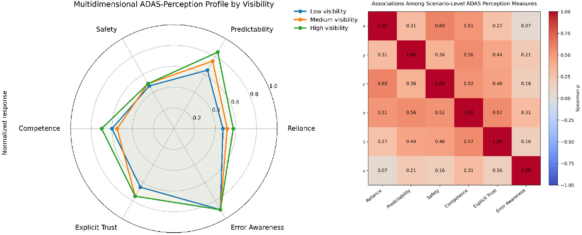
Multidimensional ADAS-Perception Profile The questionnaire dimensions were examined descriptively to evaluate whether changes in Reliance occurred alongside broader ADAS perceptions. The normalized profiles across visibility conditions are shown in Figure 2. Predictability increased from 65.0% affirmative responses under Low visibility to 85.0% under High visibility. Explicit Trust increased from 65.0% to 75.0%, and Competence increased from 60.0% to 70.0%, although Competence was lower under Medium visibility (55.0%). In contrast, Safety remained stable (1.95–2.00), and Error Awareness remained constant at 90.0% across visibility conditions. These patterns indicate that visibility did not influence all ADAS-perception dimensions uniformly. Because normalization was used only for visualization across different response scales, radar differences should be interpreted descriptively rather than as comparable effect sizes.
Associations Among ADAS-Perception Dimensions Associations among ADAS-perception dimensions are summarized in Figure 3. Reliance showed the strongest associations with Safety (ρ = 0.60) and Competence (ρ = 0.51), with weaker relationships to Predictability (ρ = 0.31) and Explicit Trust (ρ = 0.27), and minimal association with Error Awareness (ρ = 0.07). Competence was also moderately associated with Explicit Trust, Predictability, and Safety. Overall, the patterns suggest that Reliance is related to, but distinct from, other ADAS perceptions, while Error Awareness represents a comparatively independent evaluation.
DISCUSSION
This study examined how environmental visibility and collision-warning context relate to scenario-level ADAS Reliance during repeated semi- automated rural driving. The revised analysis focuses specifically on the contextual sensitivity and multidimensional structure of driver perceptions of automation. Three observations are particularly important. First, Reliance increased descriptively from Low to High visibility, but Medium-versus- Low and High-versus-Low contrasts were not statistically reliable under the Alarm-Off reference condition. The descriptive gradient therefore should not be interpreted as evidence that visibility independently determines Reliance in the present sample. This finding illustrates why repeated scenario-level trust data should be interpreted using both estimated effect sizes and their uncertainty rather than relying solely on condition means. Second, collision- warning context was strongly associated with Reliance under Low visibility. Alarm activation was associated with an estimated 1.70-point reduction in Reliance relative to Alarm Off in the Low-visibility reference condition. The positive Medium × Alarm and High × Alarm coefficients indicate that this negative alarm-related difference was smaller under improved visibility. However, the interaction contrasts themselves did not cross the conventional significance threshold. The statistically defensible conclusion is therefore bounded: warning presentation was associated with lower Reliance under the most visually degraded condition, but the present data do not establish a statistically reliable differential alarm effect across all visibility levels. Several interpretations remain possible. A collision warning could reinforce perceptions of system monitoring because the automation successfully detected a hazard. Alternatively, it could indicate that increased driver supervision or intervention is required. The present experiment did not directly measure how participants interpreted the warning. Consequently, the psychological mechanism underlying the observed Reliance reduction cannot be determined from these data. Third, the multidimensional questionnaire results demonstrate that Reliance is related to, but not equivalent to, other evaluations of ADAS. Reliance was most strongly associated with perceived Safety and Competence, whereas Error Awareness remained comparatively independent. Similarly, the radar profile showed that the visibility-related pattern was not uniform across all questionnaire dimensions. These results argue against treating all automation-related questionnaire items as interchangeable manifestations of one undifferentiated construct.
Figure 3: (left) Normalized ADAS perception profile across visibility conditions. (Right) Spearman associations among ADAS perception dimensions.
Collision Warnings as Automation Communication Collision warnings function not only as hazard notifications but also as information generated by the automated system. The pronounced reduction in Reliance observed under Low visibility therefore raises an important human-automation question: warning presentation may influence how drivers interpret automation at precisely the point when environmental uncertainty is greatest. The present findings should not be interpreted as evidence that warnings are harmful. Instead, they indicate that warning presentation may have perceptual consequences beyond immediate hazard notification. Future experiments should manipulate warning semantics, reliability, and communicated system confidence to determine whether drivers interpret warnings as reassurance of successful detection, evidence of system limitation, or a request for increased supervision.
Multidimensional Nature of ADAS Perception The radar and correlation analyses further illustrate that ADAS perception cannot be reduced to a single homogeneous construct. Reliance, Predictability, Safety, Competence, Explicit Trust, and Error Awareness exhibited different visibility-related profiles and different interrelationships. The relatively strong association between Reliance and Safety suggests that willingness to depend on ADAS is related to perceived safety in the driving context. Associations among Competence, Predictability, and Explicit Trust similarly suggest that evaluations of system capability and behavioral consistency contribute to explicit trust judgments. Error Awareness remained high and comparatively stable across visibility levels. This may indicate that participants’ confidence in their ability to recognize an automation error is more stable than their willingness to rely on the system itself. Because these dimensions were measured using heterogeneous response formats and the association analysis was exploratory, these interpretations should be considered preliminary.
Limitations Several limitations should be considered. The small and homogeneous sample limits generalizability. The analysis focused on ADAS-supported scenarios
and retained questionnaire dimensions separately due to differences in response scales. Given the small sample size, the findings should be interpreted cautiously. In addition, ADAS reliability was not directly manipulated, and simulator results may not fully represent real-world driving.
CONCLUSION
This study examined ADAS Reliance and related perceptions during semi- automated rural driving under varying visibility and collision-warning conditions. Reliance did not differ statistically across visibility levels under Alarm-Off conditions, whereas alarm activation under Low visibility was associated with reduced Reliance. The multidimensional profile showed that Reliance was related to, but distinct from, other ADAS perceptions, particularly Safety and Competence. These findings highlight trust and reliance as dynamic responses to environmental and interface context and motivate further research with larger samples and experimentally controlled automation reliability.
ACKNOWLEDGMENT
The authors gratefully acknowledge the participants who contributed their time to this study and the research personnel who supported simulator operation and data collection. The authors also acknowledge the institutional research facilities that enabled the experimental work.
FUNDING This work was supported by the U.S. Department of Transportation, Office of the Assistant Secretary for Research and Technology (OST-R), University Transportation Centers Program, through the Center for Regional and Rural Connected Communities (CR2C2) under Grant No. 69A3552348304. The lead author also received financial support through the National Science Foundation Research Traineeship (NRT) Program, Project No. 2346017, at North Carolina A&T State University.
REFERENCES
Beller, J., Heesen, M. & Vollrath, M. (2013), ‘Improving the driver–automation interaction: An approach using automation uncertainty’, Human factors 55(6), 1130–1141. De Winter, J. C., Happee, R., Martens, M. H. & Stanton, N. A. (2014), ‘Effects of
adaptive cruise control and highly automated driving on workload and situation awareness: A review of the empirical evidence’, Transportation research part F: traffic psychology and behaviour 27, 196–217. Helldin, T., Falkman, G., Riveiro, M. & Davidsson, S. (2013), Presenting system uncertainty in automotive uis for supporting trust calibration in autonomous driving, in ‘Proceedings of the 5th international conference on automotive user interfaces and interactive vehicular applications’, pp. 210–217.
Trust Calibration in Semi-Automated Rural Driving 2019 Hoff, K. A. & Bashir, M. (2015), ‘Trust in automation: Integrating empirical evidence
on factors that influence trust’, Human factors 57(3), 407–434. Javadi, A. M. M., Jiang, S. X., Martha, S. R. P., Karimoddini, A., Kebria, P. M. & Khorsandroo, S. (2025), Analyzing driver behavior distraction during animal crossing on rural roads: Insights from eye tracking and vehicle-in-the-loop driving simulation, in ‘IISE Annual Conference. Proceedings’, Institute of Industrial and Systems Engineers (IISE), pp. 1–6. Javadi, A. M. M., Martha, S. R. P., Takele, N., Jiang, S. X. & Karimoddini, A.
(2026a), Eyes on the road, mind elsewhere: Cognitive disengagement in manual and adas rural driving during low-visibility animal-crossing hazards, in ‘IISE Annual Conference. Proceedings’, Institute of Industrial and Systems Engineers (IISE), pp. 1–6. Javadi, A. M. M., Martha, S. R. P., Takele, N., Jiang, S. X. & Karimoddini, A. (2026b), Regaining focus: Visual and cognitive recovery after low-visibility animal-crossing events in manual and adas rural driving, in ‘IISE Annual Conference. Proceedings’, Institute of Industrial and Systems Engineers (IISE), pp. 1–6. Körber, M., Baseler, E. & Bengler, K. (2018), ‘Introduction matters: Manipulating trust
in automation and reliance in automated driving’, Applied ergonomics 66, 18–31. Kraus, J., Scholz, D., Stiegemeier, D. & Baumann, M. (2020), ‘The more you know: Trust dynamics and calibration in highly automated driving and the effects of take-overs, system malfunction, and system transparency’, Human factors 62(5), 718–736. Lee, J. D. & See, K. A. (2004), ‘Trust in automation: Designing for appropriate
reliance’, Human factors 46(1), 50–80. Mehrotra, S., Wang, M., Wong, N., Parker, J., Roberts, S. C., Kim, W., Romo, A.
& Horrey, W. J. (2022), ‘Human-machine interfaces and vehicle automation: a review of the literature’, Accident Analysis & Prevention 109, 18–28. Skirnewskaja, J., Roozbehani, M. & Dahleh, M. A. (2026), ‘Behaviorally adaptive and inclusive advanced driver-assistance systems’, Advanced Intelligent Systems p. e70505. Walker, G. H. & Stanton, N. A. (2017), Human factors in automotive engineering
and technology, CRC Press.
SEARCH THE AHFE DIGITAL BOOKSTORE BY ISBN
Explore the complete digital volume
Human Factors in Design, Engineering, and Computing
Read this individual research paper free through the original publisher, or explore the full digital proceedings book.