Che Liang-Yuan, Chen Chien-Hsiung (2026). Effects of Virtual Agent Style and Decision Control on Sense of Agency and Trust in AI-Enabled Telecare. In: Human Factors in Design, Engineering, and Computing. AHFE Open Access, vol. 238, pp. 413–423. https://doi.org/10.54941/ahfe1008274
AI-enabled telecare agents are shifting from information providers to decision-making partners, yet how agent presentation and the allocation of decision authority jointly shape users' psychological experience remains unclear. This study examined the effects of virtual agent style and decision control mode on sense of agency and trust. In a 2 × 3 mixed design, 60 participants interacted with an expert or partner agent (between-subjects) under AI-led, user-led, and user–AI negotiation modes (within-subjects), completing five simulated telecare tasks per mode. Participants rated positive and negative sense of agency (SoPA, SoNA) and trust and distrust. Compared with the AI-led mode, the user-led and user–AI negotiation modes yielded higher trust and lower distrust, and user–AI negotiation yielded the highest SoPA and the weakest negative sense of agency. Agent style had no main effects but interacted with decision control mode for SoPA, SoNA, and trust: the expert agent supported sense of agency under the AI-led mode, whereas the partner agent elicited higher trust under user–AI negotiation. Telecare agents should align role presentation with how decision authority is shared.
Taiwan is approaching a super-aged society, with people aged 65 and over accounting for 19.9% of the population by October 2025 (Department of Statistics, Ministry of the Interior, 2025), and caregiver shortages have become a pressing challenge in many countries (OECD, 2023). Telecare systems also expanded rapidly during the COVID-19 Public Health Emergency of International Concern, from January 2020 to May 2023 (WHO, 2023).
As AI is integrated into telecare, virtual agents increasingly explain health information, provide recommendations, and support decisions (Winkler et al., 2025). An agent’s appearance, form of address, and tone may shape how users interpret its social role (Nass and Moon, 2000), while who proposes options and how the final plan is reached concern the division of decision-making between people and the system (Parasuraman et al., 2000). Relationship-building and communication cues can affect how users evaluate agents, but these effects may depend on design conditions (Bickmore and
414 Liang-Yuan and Chien-Hsiung Picard, 2005; Huang and Ki, 2024). Virtual agent style and decision control mode therefore need to be examined together, using trust and sense of agency to capture users’ evaluations of the system and of their own influence beyond usability or acceptance.
This study therefore used a 2 (virtual agent style: expert, partner) × 3 (decision control mode: AI-led, user-led, user–AI negotiation) mixed design. Sense of agency was measured with an adapted Sense of Agency Scale (SoAS), distinguishing positive (SoPA) and negative (SoNA) sense of agency, and trust with the Trust in Automation Scale (TIAS), including trust and distrust items. Accordingly, this study has three objectives: (1) to examine whether virtual agent style affects users’ sense of agency and trust when AI virtual agents are integrated into telecare systems; (2) to examine whether decision control mode affects users’ sense of agency and trust; and (3) to examine whether virtual agent style and decision control mode interact in their effects on sense of agency and trust. The findings are intended to inform the design of AI virtual agents for future telecare systems.
LITERATURE REVIEW
Virtual Agents and Agent Style in Telecare Virtual agents are increasingly used in home telecare for health monitoring, assessment, behavioral guidance, and the delivery of health interventions, and some studies report improvements in adherence, satisfaction, and clinical outcomes (Winkler et al., 2025). As agents begin to recommend and take part in decisions, how users understand the agent’s role becomes an important design question. According to the Computers Are Social Actors (CASA) paradigm, people apply social rules and role expectations to computers even when they know the system is not a person (Nass and Moon, 2000). Cues such as appearance, form of address, and tone may therefore shape whether users see an agent as professional, friendly, or trustworthy, so this study treats agent style as an interaction design factor rather than a purely visual choice. Expertise cues help users judge whether an agent is qualified to give advice, whereas cues of closeness and support shape how users feel about the relationship. Bickmore and Picard (2005) found that an agent using relationship-building behaviors was liked and trusted more than a task-only agent, and users were more willing to keep interacting with it; Huang and Ki (2024) found that the effect of warm versus competent communication styles on trust in healthcare chatbots depended on anthropomorphic cues. Building on this work, this study contrasts an expert style (formal address, professional appearance, knowledge-oriented expression) with a partner style (familiar address, supportive tone, companion-like role). Each style is an overall role presentation combining visual and verbal cues, not a separate manipulation of competence or warmth.
Decision Control and Levels of Automation Parasuraman et al. (2000) distinguished four automation functions— information acquisition, information analysis, decision and action selection,
Effects of Virtual Agent Style and Decision Control on Sense of Agency 415 and action implementation—each of which can be automated to a different degree, so a system that analyzes information need not hold authority over the final decision. In healthcare, shared decision-making involves making patients aware that a choice exists, presenting the options, and supporting them in reaching a decision (Elwyn et al., 2012). Drawing on these views, this study defines three decision control modes that differ in who proposes options and how the final plan is reached: AI-led (the AI mainly sets the decision direction), user-led (the user forms the decision), and user–AI negotiation (the plan is developed through discussion between the user and the AI). These modes compare forms of participation; they are not equivalent to specific levels of automation or to complete clinical shared decision-making.
Sense of Agency Sense of agency refers to the feeling of initiating one’s actions and of outcomes following from one’s own intentions. Tapal et al. (2017) developed the Sense of Agency Scale (SoAS), which distinguishes positive sense of agency (SoPA), the feeling that actions arise from one’s own will and are under one’s control, from negative sense of agency (SoNA), the feeling that actions are not self- initiated, are governed by external forces, or are disconnected from their outcomes. The two are related but are not treated as opposite ends of one dimension. Sense of agency also differs from autonomy, which concerns whether an action reflects personal endorsement and volition (Ryan and Deci, 2000): offering options or a confirmation button does not necessarily make users feel influential, and accepting an AI recommendation does not necessarily mean losing sense of agency.
Trust and Distrust in Automation When users cannot fully understand how a complex system works, trust influences whether they rely on it; trust is an attitude toward the system, whereas reliance is the behavior of adopting its recommendations (Lee and See, 2004). As AI-enabled telecare takes part in decisions, the design goal is appropriate rather than maximal trust. This study measured trust attitudes by questionnaire and did not observe reliance behavior. The Trust in Automation Scale (Jian et al., 2000) contains trust and distrust items that were originally treated as opposite ends of one continuum, but Scharowski et al. (2025) found that a two-factor model separating trust and distrust performed better in an AI context. Trust and distrust were therefore analyzed separately.
Research Framework and Hypotheses In sum, virtual agent style concerns the social role the system presents, whereas decision control mode concerns how users participate in decisions. Agent style may affect perceived expertise and relational positioning, and decision control mode may affect users’ perceived influence over the decision process and outcome. Because users’ expectations of an agent’s role may depend on how much they take part in the decision, the effect of agent style
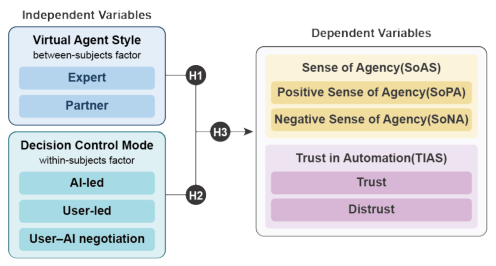
416 Liang-Yuan and Chien-Hsiung may also vary with decision control mode. The research framework is shown in Figure 1.
Based on the above, the following hypotheses are proposed: H1: In AI-enabled telecare systems, virtual agent style will significantly affect
users’ sense of agency and trust. H2: In AI-enabled telecare systems, decision control mode will significantly affect users’ sense of agency and trust. H3: In AI-enabled telecare systems, virtual agent style and decision control
mode will interact significantly in their effects on users’ sense of agency and trust.
Figure 1: Research framework.
METHODOLOGY
Experimental Design A 2 × 3 mixed design was used. Virtual agent style (expert, partner) was a between-subjects factor, and decision control mode (AI-led, user-led, user–AI negotiation) was a within-subjects factor.
Participants were randomly assigned to one virtual agent style group (30 per group) and completed all three decision control modes with the same agent style. To reduce order effects, the order of the three modes was counterbalanced.
Participants and Apparatus Sixty participants with normal or corrected-to-normal vision, right- handedness, and no color blindness were recruited online through convenience sampling, and their experience with AI assistants, smart health applications, and mobile devices was recorded. Participation was voluntary, written informed consent was obtained, and all data were de-identified. Each session was conducted individually in a quiet laboratory on an 11-inch iPad Pro. Animated virtual agents were created with D-ID, and a high-fidelity telecare prototype was built in Figma; agent responses and decision flows followed pre-written scripts so that all participants received consistent stimuli.
Effects of Virtual Agent Style and Decision Control on Sense of Agency 417 The expert style used a formal form of address, professional visual presentation, and a formal advisory tone, whereas the partner style used a familiar form of address, supportive expressions, and a companion-like visual presentation; within each mode, both styles kept the same task goals, health information, and decision authority. The AI-led mode presented a default plan for the user to confirm, the user-led mode presented information or recommendations from which the user selected a plan, and the user–AI negotiation mode let the user negotiate with the AI while retaining the final choice.
The experiment included five telecare tasks: abnormal blood pressure monitoring, medication side effects and adjustment, chronic disease follow-up scheduling, symptom assessment, and healthy lifestyle intervention. The tasks were based on the telecare agent functions summarized by Winkler et al. (2025), including monitoring, assessment, guidance, and health intervention, and were adapted into simulated scenarios for this study. Each task kept the same background and goal across the three modes; the main difference lay in how the plan was formed and confirmed. Before the formal test, two human–computer interaction experts reviewed the materials for task representativeness, flow logic, and operational appropriateness. The tasks are listed in Table 1.
Table 1: Experimental tasks (each handled according to the assigned decision control mode).
Table available in the original PDF paper.
Task No. Description Task Type Task 1 Respond to a detected high blood pressure reading Monitoring
Medication adjustment
Task 2 Address medication-related dizziness with a simulated prescription adjustment
Follow-up appointment
Task 3 Schedule a chronic-condition follow-up appointment Task 4 Assess symptoms reported by the user Symptom judgment
Task 5 Intervene in a habit of staying up late Lifestyle intervention
Measures Sense of agency was measured with a context-specific questionnaire adapted from the concepts and items of Tapal et al. (2017). Items were grouped into a positive sense of agency subscale (SoPA) and a negative sense of agency subscale (SoNA). Item wording was adapted to the AI telecare context so that participants rated the decision control mode they had just completed. The questionnaire contained 10 items, five each for SoPA and SoNA, rated on a 7-point Likert scale from 1 (strongly disagree) to 7 (strongly agree). SoPA was scored as the mean of its five raw item scores. The five SoNA items were reverse-scored (8 − raw score) and then averaged, so higher SoNA scores indicate less negative sense of agency.
Trust in AI was measured with the 12-item Trust in Automation Scale (TIAS; Jian et al., 2000), with the virtual care agent as the target and the same 7-point scale. Following the two-factor view of Scharowski et al. (2025),
418 Liang-Yuan and Chien-Hsiung trust (mean of items 6–12) and distrust (items 1–5) were analyzed separately. Unlike Scharowski et al. (2025), distrust items were reverse-scored (8 − raw score) and averaged so that higher scores on all four measures indicate a more favorable experience; this reverse-scored distrust index therefore reflects lower distrust.
Procedure After giving informed consent, participants completed a demographic and technology-use questionnaire and received the same task instructions, and were told that they would interact with a virtual agent in a simulated telecare scenario. They then completed the three decision control modes in their assigned order, each comprising five tasks in a fixed order. Immediately after each mode, participants completed the SoAS and TIAS to rate their overall interaction experience in that mode. The session took about 30 minutes.
Data Analysis Separate 2 × 3 mixed ANOVAs were conducted for four dependent variables, namely the SoPA and SoNA subscales of the SoAS and the trust and distrust subscales of the TIAS, to test the two main effects and their interaction. Analyses were performed in IBM SPSS. Homogeneity of variance and sphericity were assessed with Levene’s and Mauchly’s tests, respectively; when sphericity was violated, Greenhouse–Geisser corrections were applied to the relevant within-subjects effects. When an interaction was significant, simple main effects were examined. Pairwise comparisons used Fisher’s LSD method and were conducted only after a significant omnibus effect or interaction (protected LSD); because the within-subjects factor had three levels, this procedure keeps the familywise error rate at the nominal level, so no further correction was applied. The significance level was α = .05.
RESULTS
Demographics A total of 60 participants were included (32 men, 53.3%; 28 women, 46.7%). Most were aged 18–30 years (n = 56, 93.3%); 44 (73.3%) had a university education and 16 (26.7%) a graduate education or above. Regarding technology use, 49 participants (81.7%) used AI assistants several times a week or daily, 26 (43.3%) had never used a smart health or medical application, and mean self-rated proficiency with smartphones or tablets was high (6.08 on a 7-point scale).
Sense of Agency First, for SoPA, the main effect of agent style was not significant, whereas the main effect of decision control mode (F(2, 116) = 16.78, p < .001, ηp² = .22) and the interaction (F(2, 116) = 8.43, p < .001, ηp² = .13) were both significant. LSD comparisons showed that scores in the user–AI negotiation mode (M = 4.12, SD = 0.57) were higher than those in the user-led mode (M = 3.91, SD = 0.73), and both were higher than those in the AI-led mode
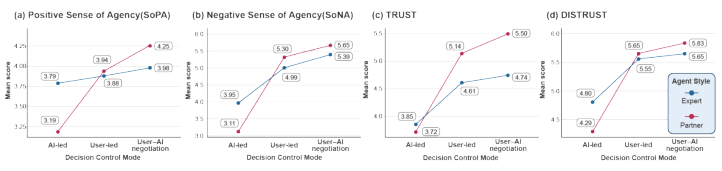
Effects of Virtual Agent Style and Decision Control on Sense of Agency 419 (M = 3.49, SD = 0.72). Simple main effects analysis showed that, in the AI-led mode, the expert group (M = 3.79, SD = 0.54) scored significantly higher than the partner group (M = 3.19, SD = 0.76) (F(1, 58) = 12.39, p < .001, ηp² = .18), whereas the group difference was not significant in the other two modes. In addition, scores in the expert group did not differ significantly across the three modes, whereas scores in the partner group did (F(2, 57) = 21.37, p < .001, ηp² = .43): user–AI negotiation (M = 4.25) was higher than user-led (M = 3.94), and both were higher than AI-led (p ≤ .034). Overall, the decrease in positive sense of agency under the AI-led mode occurred mainly in the partner group.
Second, for SoNA, the main effect of agent style was not significant, whereas the main effect of decision control mode (F(1.47, 85.17) = 57.91, p < .001, ηp² = .50) and the interaction (F(1.47, 85.17) = 5.44, p = .012, ηp² = .09) were both significant. LSD comparisons showed that scores in the user–AI negotiation mode (M = 5.52, SD = 0.97) were higher than those in the user-led mode (M = 5.15, SD = 1.10), and both were higher than those in the AI-led mode (M = 3.53, SD = 1.56), indicating less negative sense of agency in the user–AI negotiation mode. Simple main effects analysis showed that, in the AI-led mode, the expert group (M = 3.95, SD = 1.50) scored significantly higher than the partner group (M = 3.11, SD = 1.53) (F(1, 58) = 4.62, p = .036, ηp² = .07), whereas the group difference was not significant in the other two modes. In addition, scores differed significantly across the three modes in both groups (expert: F(2, 57) = 11.80, p < .001, ηp² = .29; partner: F(2, 57) = 33.52, p < .001, ηp² = .54), with the lowest scores in the AI-led mode in both groups; the difference between user–AI negotiation and user-led was significant only in the expert group (p = .027). Overall, the increase in negative sense of agency under the AI-led mode was more pronounced in the partner group.
Trust and Distrust First, for trust, the main effect of agent style was not significant, whereas the main effect of decision control mode (F(2, 116) = 40.34, p < .001, ηp² = .41) and the interaction (F(2, 116) = 4.29, p = .016, ηp² = .07) were both significant. LSD comparisons showed that trust in the user–AI negotiation mode (M = 5.12, SD = 1.34) and the user-led mode (M = 4.87, SD = 1.15) was higher than that in the AI-led mode (M = 3.79, SD = 1.32), with no significant difference between the former two. Simple main effects analysis showed that, in the user–AI negotiation mode, the partner group (M = 5.50, SD = 1.16) reported significantly higher trust than the expert group (M = 4.74, SD = 1.42) (F(1, 58) = 5.21, p = .026, ηp² = .08), whereas the group difference was not significant in the other two modes. In addition, trust differed significantly across the three modes in both groups (expert: F(2, 57) = 7.69, p = .001, ηp² = .21; partner: F(2, 57) = 29.94, p < .001, ηp² = .51), with the lowest trust in the AI-led mode in both groups; the difference between user–AI negotiation and user-led was not significant in either group.
Second, for distrust, the main effect of agent style was not significant, the main effect of decision control mode was significant (F(1.66, 96.10) = 29.41, p < .001, ηp² = .34), and the interaction was not significant. LSD
420 Liang-Yuan and Chien-Hsiung comparisons showed that scores in the user–AI negotiation mode (M = 5.74, SD = 1.15) and the user-led mode (M = 5.60, SD = 1.10) were higher than those in the AI-led mode (M = 4.55, SD = 1.64), indicating lower distrust in the former two modes; the difference between user–AI negotiation and user- led was not significant.
Table 2: Mixed ANOVA results for sense of agency, trust, and distrust.
Table available in the original PDF paper.
Source SS df MS F p ηp² Post Hoc Agent style 0.119 1 0.119 0.638 .428 .011 Decision control mode 12.376 2 6.188 16.775 <.001* .224 NG > UL > AL
Decision control modea 133.781 1.47 91.108 57.905 <.001* .500 NG > UL > AL SoNA 12.565 1.47 8.557 5.439 .012* .086 Agent style × Decision control modea
Agent style 2.243 1 2.243 2.089 .154 .035 Decision control mode 60.445 2 30.223 40.343 <.001* .410 UL, NG > AL
Decision control modea 51.241 1.66 30.925 29.413 <.001* .336 UL, NG > AL Distrust
4.195 1.66 2.532 2.408 .105 .040
Agent style × Decision control modea Note: AL = AI-led; UL = user-led; NG = user–AI negotiation. aGreenhouse–Geisser corrected. *p < .05.
Figure 2: Interaction diagrams for SoPA, SoNA, trust and distrust.
In summary, H1 was not supported, as the main effect of agent style was not significant for any of the four dependent variables; H2 was supported, as decision control mode had a significant effect on all four dependent variables; and H3 was partially supported, as significant interactions were
Effects of Virtual Agent Style and Decision Control on Sense of Agency 421 found for SoPA, SoNA, and trust but not for distrust. Simple main effects (Figure 2) showed that, under the AI-led mode, the expert group reported higher positive sense of agency and less negative sense of agency, whereas under user–AI negotiation, the partner group reported higher trust. The style differences in SoNA (p = .036, ηp² = .07) and trust (p = .026, ηp² = .08) were smaller than that in SoPA (p < .001, ηp² = .18) and should be interpreted with caution.
DISCUSSION
Decision control mode affected all four measures, whereas agent style mattered only in specific modes and dimensions, so evaluating care agents requires considering both how users participate in decisions and how the agent presents its role. The lower negative sense of agency in the user–AI negotiation mode may reflect that users could help form the plan, express preferences, and receive responses, retaining influence over the decision while receiving AI support; this is consistent with the emphasis of Elwyn et al. (2012) on information exchange, discussion of options, and exploration of preferences. In the AI-led mode, by contrast, the system set the main course of action, which may make users feel passive or directed. This pattern was clearer in the partner group: positive sense of agency did not differ across modes in the expert group but was clearly lower under the AI-led mode in the partner group. Because trust did not differ between the user–AI negotiation and user-led modes, user–AI negotiation cannot be considered superior on every dimension. In addition, the actual level of automation and the perceptibility of control were not manipulated separately; future studies could keep automated functions constant while varying how preferences are entered, confirmed, and fed back.
Agent style effects depended on context: under the AI-led mode, the expert group reported higher positive and less negative sense of agency, whereas under the user–AI negotiation mode, the partner group reported higher trust. Ratings in the partner group also varied more across decision control modes than in the expert group, with larger effect sizes. One possible explanation, not directly tested here, is the match between role presentation and decision arrangement: when the AI holds the decision direction, the companionship conveyed by the partner style may conflict with the actual arrangement, whereas expert cues make the agent’s guiding role easier to understand; when users help discuss the plan, supportive and familiar expressions better fit a collaborative relationship. This extends the finding of Bickmore and Picard (2005) that relationship-building cues build trust, suggesting that such cues should be interpreted together with how users participate in decisions. Because role expectations were not measured and trust did not differ between styles under the AI-led mode, these interpretations require verification through manipulation checks and measures of role expectations.
Theoretical and Practical Implications This study addresses the research gaps identified earlier. First, by examining agent style and decision control mode together, this study shows that agent style had no consistent main effect but interacted with decision control mode
422 Liang-Yuan and Chien-Hsiung for SoPA, SoNA, and trust, so comparing expert and partner styles alone may overlook the user’s role in decision-making. Second, assessing sense of agency alongside trust complements usability- or acceptance-based evaluations by revealing whether users feel passive or controlled, and separating trust and distrust (Scharowski et al., 2025) showed that the interaction emerged for trust only. However, the two dimensions were not directly compared, the adapted questionnaires’ factor structure was not verified, and without a mediation test, sense of agency cannot be inferred as the mechanism linking decision control to trust. In practice, four design recommendations follow: (1) use user–AI negotiation as a starting point for decision support, offering option comparisons and preference input while letting users choose their level of involvement; (2) match role expression to the decision process, using supportive responses in negotiation and clearly presenting the basis and scope of autonomous actions; (3) allow users to modify, cancel, or override actions, and explain and confirm irreversible actions in advance; and (4) evaluate trust, distrust, and experienced control together, aiming for reliance appropriate to system capabilities (Lee and See, 2004) rather than maximal trust. These recommendations still need validation in real care workflows.
CONCLUSION
This study found that user-led and user–AI negotiation modes produced higher trust and lower distrust than the AI-led mode, with user–AI negotiation also yielding the strongest sense of agency. Agent style mattered only in specific contexts: the expert style supported sense of agency under AI-led control, and the partner style elicited higher trust under user–AI negotiation. Telecare agents should therefore align role presentation with how decision authority is shared. These findings are limited by a young, digitally proficient sample, a single session with a scripted prototype, agent styles that combined visual and verbal cues, adapted scales that still require validation, and pairwise comparisons that were not corrected for multiplicity. Future studies should include older adults and patients, track trust calibration over time with behavioral measures such as overrides, and add manipulation checks.
REFERENCES
Bickmore, T.W. and Picard, R.W. (2005) ‘Establishing and maintaining long-term human-computer relationships’, ACM Transactions on Computer-Human Interaction, 12(2), pp. 293–327. doi: 10.1145/1067860.1067867. Department of Statistics, Ministry of the Interior (2025) Weekly bulletin of interior
statistics, week 48 of 2025: 4.57 million people aged 65 and over at the end of June 2025, 25.8% living alone [in Chinese]. Taipei: Ministry of the Interior. Available at: https://www.moi.gov.tw/News_Content.aspx?n=2905&s=334815 (Accessed: 26 October 2026). Elwyn, G., Frosch, D., Thomson, R., Joseph-Williams, N., Lloyd, A., Kinnersley, P., Cording, E., Tomson, D., Dodd, C., Rollnick, S., Edwards, A. and Barry, M. (2012) ‘Shared decision making: a model for clinical practice’, Journal of General Internal Medicine, 27(10), pp. 1361–1367. doi: 10.1007/s11606-012-2077-6.
Effects of Virtual Agent Style and Decision Control on Sense of Agency 423 Huang, M. and Ki, E.-J. (2024) ‘Examining the effect of anthropomorphic design cues
on healthcare chatbots acceptance and organization-public relationships: Trust in a warm human vs. a competent machine’, International Journal of Human–Computer Interaction, 40(24), pp. 8781–8793. doi: 10.1080/10447318.2023.2290378. Jian, J.-Y., Bisantz, A.M. and Drury, C.G. (2000) ‘Foundations for an empirically determined scale of trust in automated systems’, International Journal of Cognitive Ergonomics, 4(1), pp. 53–71. doi: 10.1207/S15327566IJCE0401_04. Lee, J.D. and See, K.A. (2004) ‘Trust in automation: Designing for appropriate
reliance’, Human Factors, 46(1), pp. 50–80. doi: 10.1518/hfes.46.1.50_30392. Nass, C. and Moon, Y. (2000) ‘Machines and mindlessness: Social responses to computers’, Journal of Social Issues, 56(1), pp. 81–103. doi: 10.1111/0022- 4537.00153. OECD (2023) Beyond applause? Improving working conditions in long-term care.
Paris: OECD Publishing. doi: 10.1787/27d33ab3-en. Parasuraman, R., Sheridan, T.B. and Wickens, C.D. (2000) ‘A model for types and levels of human interaction with automation’, IEEE Transactions on Systems, Man, and Cybernetics – Part A: Systems and Humans, 30(3), pp. 286–297. doi: 10.1109/3468.844354. Ryan, R.M. and Deci, E.L. (2000) ‘Self-determination theory and the facilitation of
intrinsic motivation, social development, and well-being’, American Psychologist, 55(1), pp. 68–78. doi: 10.1037/0003-066X.55.1.68. Scharowski, N., Perrig, S.A.C., von Felten, N., Aeschbach, L.F., Opwis, K., Wintersberger, P. and Brühlmann, F. (2025) ‘To trust or distrust AI: A questionnaire validation study’, in Proceedings of the 2025 ACM Conference on Fairness, Accountability, and Transparency (FAccT ‘25). New York: ACM, pp. 361–374. doi: 10.1145/3715275.3732025. Tapal, A., Oren, E., Dar, R. and Eitam, B. (2017) ‘The Sense of Agency Scale: A
measure of consciously perceived control over one’s mind, body, and the immediate environment’, Frontiers in Psychology, 8, 1552. doi: 10.3389/fpsyg.2017.01552. Winkler, A., Kutschar, P., Pitzer, S., van der Zee-Neuen, A., Kerner, S., Osterbrink, J. and Krutter, S. (2025) ‘Avatar and virtual agent-assisted telecare for patients in their homes: A scoping review’, Journal of Telemedicine and Telecare, 31(2), pp. 207–221. doi: 10.1177/1357633X231174484. World Health Organization (WHO) (2023) Statement on the fifteenth meeting of
the International Health Regulations (2005) Emergency Committee regarding the coronavirus disease (COVID-19) pandemic, 5 May. Geneva: WHO. Available at: https://www.who.int/news/item/05-05-2023-statement-on-the-fifteenth-meeting- of-the-international-health-regulations-(2005)-emergency-committee-regarding- the-coronavirus-disease-(covid-19)-pandemic (Accessed: 26 October 2026).
SEARCH THE AHFE DIGITAL BOOKSTORE BY ISBN
Explore the complete digital volume
Human Factors in Design, Engineering, and Computing
Read this individual research paper free through the original publisher, or explore the full digital proceedings book.