Che Liang-Yuan, Chien-Hsiung Chen (2022). User Experience and Service Mode of Telecare System with Handheld Devices. In: Usability and User Experience. AHFE Open Access, vol. 39, pp. 78–85. https://doi.org/10.54941/ahfe1001693
In developed countries, aging, chronic diseases, and preventive health management have been important topics of concern. Many entrepreneurial have entered the start-up market, trying to integrate design concepts related to medical institutions, wearable devices, health services, cloud computing to build a better and more convenient platform. How to realize online medical services of traditional medical institutions through a handheld user interface and provide users with friendly and reassuring medical services is a thorny problem faced by interactive designers. This study focuses on telecare systems' user experience and service mode with handheld devices. The research methodology uses the concepts of co-creation workshops and the discount usability engineering. In this study, six experts with relevant telecare or interaction knowledge were invited to participate in a co-creation workshop. A persona and customer journey map were created after the workshop. Existing applications were then used to integrate typical tasks. Participants would use the think-aloud technique to simultaneously manipulate the tasks and speak their thoughts when conducting heuristic evaluations. Researchers recorded their task operations and conduct brief interviews to help investigate their internal feelings. This stage is to sort out the relationship between the relevant stakeholders in the service process and help summarize the user's in-depth interaction needs in terms of user experience.
Since the global spread of the epidemic began in late 2019, most internatio- nal medical resources have been focused on treating infected patients. Many patients expected to be enrolled in medical programs have had to postpone treatment or enter home care management (WHO,2020). The epidemic has also accelerated the introduction of technology into the medical industry for home care systems. That led to a transformation of hospitals into digitiza- tion, to move into the era of the Internet of Medical Things. In the era of lack of demand for long-term care staffing and heavy medical burden, how to change people’s medical behavior and provide online consultation and care information through technology and medical digitization, and through the opportunity of the epidemic and the review of medical care regulations would be the crucial issues of this study.
This study focuses on telecare systems’ user experience and service mode with handheld devices, including the discussion of relevant stakeholders. It
User Experience and Service Mode of Telecare System with Handheld Devices 79
applies the service design process to study user needs from a user experience- oriented design perspective. In this study, we would observe the user’s viewpoint on the existing medical consultation and care needs and the rea- sons that affect the user’s willingness to use. This study focuses on telecare systems’ user experience and service mode with handheld devices, including the discussion of relevant stakeholders. It applies the service design process to study user needs from a user experience-oriented design perspective. We observed the user’s viewpoint on the existing medical consultation and care needs and the reasons that affect the user’s willingness to use. The purpose of this study identified existing issues, target user groups, and service processes, and the researchers provided an application to create a typical task to guide the experts to conduct a heuristic evaluation, think-aloud technique, and to present their thoughts on the prototype.
RESEARCH BACKGROUND Telemedicine and Telecare Consultation
According to a study published by Rock Health (2020), digital health care investments has increased more than 12 times in the past decade. With the development of the epidemic and the popularity of vaccines, digital health consultation and care have leaped from a niche investment area to the inter- national stage. The inability to go outside and the fear of infection and other risk factors have led to an extensive increase in demand for digital medical consultation and care. The most significant advantage of telecare consulta- tion is that it breaks the old concept of time and space and puts digital medical consultation and care into remote needs (Bakar, Mejah, & Amat, 2020). Not only would it earn patients’ time and provide the most immediate help, but it would also make the expertise of doctors and caregivers available to people in more remote areas (Wood, Khong, Dirlikov, & Shem, 2021). This type of service would also address the future need for long-term care at home. Existing telemedicine consultation and care issues are wide-ranging, inclu- ding the matching of professionals, integration of resources, financial flows, and regulations. This study tried to solve the problem of home care by using digital medical consultation and care.
Service Design and Service Innovation Rapid population growth, the prevalence of chronic diseases, and rising health care expenditures worldwide are putting a constant strain on govern- ment finances. Many countries are moving toward digital health advice and care (e-Health) as an innovative service. In the past decade, the impact of an aging society on health advice and care services has been even more signifi- cant. Health services have also shifted from being patient-driven to bringing more comprehensive services and upgrading their strategies. Stickdorn and Schneider (2018) believe that service design integrates tangible and intangi- ble objects to construct a complete and sophisticated service process. Service design aims to provide users with a complete service design that can combine online and offline related industries to create an industrial advantage. Service
80 Liang-Yuang and Chien-Hsiung
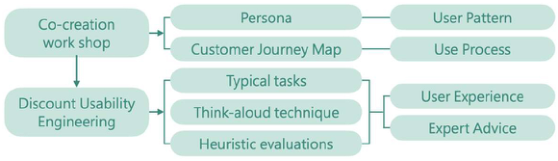
Figure 1: Research framework.
innovation is a necessary way to transform industries, and service innovation is also a means for companies to re-sell their products. In Taiwan, because of the small land, high population density, dense medical institutions, flexible branding strategy, excellent medical consultation and care team technology, and an extensive and complete health database, it is easy to carry out medical big data analysis, which can have excellent conditions for the development of telecare.
User Experience and Interactive Design Interactive design is the discipline that covers most fields in user experience design, and interactive design is not only the exchange of information betw- een entities. When interaction occurs in different combinations of people, machines, and systems, different combinations would be created, and intera- ctive design refers to the process of information exchange. It is also because interactive design involves a wide range of fields. In contrast, the interactive design focuses more on the relationship between technology and interaction. User experience, on the other hand, is not only about the relationship betw- een individuals and information but also about the user experience and the process of sharing interaction with others. User-centered design thinking is an interactive design method that explores user needs and usage goals, under- stands users’ thoughts and inner feelings through observation and interviews, and depicts the core values that products and services should bring to users.
METHOD
A total of six experts were invited to participate in this study: two experts in telecare and four experts in interaction design knowledge. The process was be divided into two phases: co-creation workshop and discount usability engine- ering. To ensure that the experiment is not affected by environmental factors, the first phase of the co-creation workshop was conducted in a classroom at the National Taiwan University of Science and Technology. The second phase was conducted in a stable laboratory. The research framework is illustrated in Figure 1.
Co-creation Workshop At the beginning of the study, the researcher invited participants to give a brief self-introduction and explain the purpose and process of the study. All par- ticipants was Asked to write down their aspirational design goals on sticky
User Experience and Service Mode of Telecare System with Handheld Devices 81
notes. The content should include “who do we need to help? In what envi- ronment? What problems are we solving?” We would then invite everyone to post their answers on the wall for discussion and finally come to a more deve- loped conclusion that everyone agrees. The result of this session is significant because the clearer the relationship is, the clearer the value of the subsequ- ent design. In the second part, the researcher provided three A4 biography sheets. The first page is the basic information, the second page is the event flow, and the third page is the storyboard. The six participants were asked to discuss and draw a hypothetical prototype of the target users according to those who needed help in the previous session to simulate their lives. This result of this session would help understand the needs and characteristics of the users more clearly. The goal was to set clear design goals by identifying the target population. Finally, the researcher provided an A0 poster with the design goals discussed in the first phase and pasted them on the top of the poster as the goals to be solved. Next, the participants were invited to discuss the customer journey map according to the second session of the persona. All opinions were written on sticky notes, which the participant could discuss and post at any time. The participants were asked to write down the possible emotions and stakeholders of the person when the event occurred and discuss the specific solution and how satisfied they might be after the solution.
Discount Usability Engineering Nielsen (1994) proposed the Technique of Discount Usability Engineering, and this study was conducted concerning that foundation. In order to ensure the consistency of network and system compatibility during operation, the operation was mainly based on the IOS system. Then, four typical represen- tative tasks are performed for the actual browsing operation. Three research methods were adopted: User and task observation, think-aloud technique, and Heuristic evaluation. The purpose was to sort out the relationship betw- een the stakeholders in the service process. In this study, the typical work in this phase was developed through the persona and customer journey maps discussed in the previous phase. The telecare system evaluated in this study is mainly based on the existing Med-Net platform in Taiwan, and the related equipment and experimental operation mode are described as follows.
Simple Situation Analysis. Ms. Chen is 65 years old and often feels pain in her knees because of the cold weather, and also due to mobility problems, she usually moves around at home. Because she has a chronic disease, she needs to go to the hospital regularly to follow up on her condition. However, with the development of the epidemic, Ms. Chen does not want to spend time wai- ting for treatment at the hospital. Therefore, her return to the hospital was delayed. Ms. Chen’s daughter was very worried about her health and told her that the “med-net”mobile app had a telecare consultation function that could provide professional advice, and convinced Ms. Chen to try it. After logging into the system, Ms. Chen started to enter the search information (depar- tment, consultation date, service area). She saw a few helpful counselors and proceeded to make an appointment (confirming the date, time slot, text description of symptoms, and filling out communication information). Next,
82 Liang-Yuang and Chien-Hsiung
she went to the payment page (choose credit card payment or online pay- ment, receipt/invoice type). The system sends reminder messages before the appointment time arrives (one day before, four hours before, and 30 minu- tes before). After the telecare consultation began, Ms. Chen went online for a face-to-face video consultation with the health care provider. After informing the staff of her physiological measurements for the past few weeks, she was relieved to know that she was okay.
Typical tasks and steps. After the above situation analysis and focus group discussion, the four typical tasks were set as follows: “finding a coun- selor, making an appointment, making a payment, and remote care and counseling.”
Browse test (User and task observation and Thinking Aloud Method). Participants used the Thinking Out Loud method during the manipulation. During the test, the researcher was observed and recorded what the partici- pant was saying and doing and analyze the usability problems the participant is facing. Finally, the participants were asked to recall a process, discuss difficulties encountered, and interview their past experiences and habits in-depth.
Heuristic evaluation. The study invited experts with more than five years of experience in telecare or interaction design to conduct an inspirational evalu- ation. Professional recommendations would be made based on the browsing test results, and the results would be submitted in writing.
RESULTS AND DISCUSSIONS About the Co-Creation Workshop
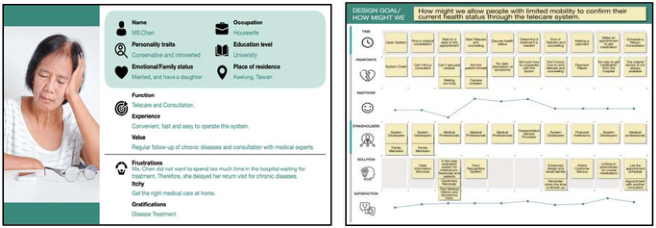
As an extension of the design objectives under the theme of this study, the participants discussed that the most important aspect was how to allow peo- ple with limited mobility to confirm their current health status through the telecare system. Secondly, since two of the invited participants were experts in telecare, another focus was on “how to confirm the user’s current physiologi- cal data and adjust the medication.” Lastly, how can we help psychosomatic patients to conduct online consultations without facing the crowd? It is also because the participants in this study were from both the design and health care fields. It was noted that the target user discussions mainly were focused on the fluency of communication between the user and the consultant. The practical and functional orientation with a human point of departure was still expected. The persona was finalized with attribute tags, such as name, basic information, personality traits, occupation, key solution goals, experience, values, event flow, and storyboard. A sample persona and customer journey map is shown in the Figure 2.
In the process of co-creating the customer journey map, the participants agreed that the emotional curve of “people with mobility impairment”would be minimized in terms of time spent searching for professional counselors and waiting for matchmaking online. It was raised again after the start of the remote care visit and resumed after the consultation. Participants theorized that searching for keywords or professional consultants is a com- plicated and troublesome process for users, so too much information or
User Experience and Service Mode of Telecare System with Handheld Devices 83
Figure 2: Examples of the persona and customer journey map.
complicated design is challenging to operate. In this study, we found that if we can optimize the information structure design and visual design and make good use of the system prompting function, it would help the sub- sequent users use the system continuously. In the “medical professionals” section, the respondents perceived a higher emotional curvature in the dista- nce care stage. The emotional curve was lower during the appointment form review, determining whether the patient was homebound, and finally filling out the consultation record and health education. Participants rea- soned that the online booking function may overlap with on-site patients and may cause scheduling problems. After the consultation, the medical professionals need to fill in the consultation records and provide health edu- cation to the users, which is time-consuming because of the repetition of information.
About the Discount Usability Engineering Finding a consultant. Four of the six participants easily went to the Tele- care and Counseling page. The first participant mentioned that finding a doctor was more troublesome because the first thing that popped up was not “department” but “ popular doctors.” The third participant said that the presentation of departments was a closed menu, which was difficult to find.
Making an appointment. All six participants completed the appointment successfully, but notice popped up that they had not completed the infor- mation during the process. The participants thought that the design of the bottom payment field and the button to confirm the reservation caused the participants to be an oversight.
Making a payment. The system provides online and mobile payment, and all six participants completed the payment smoothly.
Counseling. During the telecare and consultation process, the six parti- cipants found the design of the off-camera icon difficult to understand. In addition, the system only provides 15 minutes of online consultation time per payment. When the consultation time was about to end, users could pay for an additional 30 minutes by clicking on the remaining time in the upper right corner. Participants also reported that this feature was difficult to detect.
84 Liang-Yuang and Chien-Hsiung
CONCLUSION
This study focuses on telecare systems’ user experience and service mode with handheld devices. A co-creation workshop and a discount usability engi- neering method were used to conduct the survey. After the total creative workshop and the simple usability project, we propose the user experience and usability of the handheld device for remote care and consultation. From the “people with limited mobility” customer journey map, it was found that participants felt that a telecare system should have a clear information stru- cture and list of features. Visual distractions on pages should be reduced to increase search efficiency. In particular, there should be a clear division of functions in the “System Functions”and “Find a Consultant”and “Hot Con- sultants”sections. While waiting for a response from a specific consultant, the user can be asked to improve personal information or past medical history. In the “medical professionals” customer journey map, participants felt that the system should have clear online appointment rules to allow medical pro- fessionals to intersperse their work with on-site work. The participant in this study suggest that it is best to understand the content of the consultation (such as health problems, current medication, significant medical history, past medical history) prior to the teleconsultation. In the discount usability engine- ering results using Med-Net, most of the participants felt that the “functional options” were not reasonably categorized. Experts suggest that a more pre- cise and systematic distinction should be made in the system architecture and interface design.
This study is a pilot study of the user experience and service mode of a handheld telecare and counseling system. It was found that matching pati- ents and medical professionals were the system’s primary problem. The low usage of this system is that users find it too complicated and cumbersome to use. This study recommends that future system development departments emphasize the user experience of both medical staff and patients. If the flu- ency of the system is improved, it will increase circulation in the application market in the future.
ACKNOWLEDGMENT
The authors would like to acknowledge the financial support of this study from the Ministry of Science and Technology under the grant number of MOST 108-2410-H-011-008-MY3.
REFERENCES
Bakar, A.Y.A. Mejah, H. & Amat, S. (2020) “Qualitative expert views’ on the feasibility of Tele-counseling services in Malaysia,” Journal of education and e-learning research, 7(3), pp. 270–276. doi: 10.20448/journal.509.2020.73.270.276. COVID-19 significantly impacts health services for noncommunicable diseases (no
date) Who.int. Available at: https://www.who.int/news/item/01–06-2020- covid-19-significantly-impacts-health-services-for-noncommunicable-diseases (Accessed: February 10, 2022). Nielsen, J. (1994) “Guerrilla HCI: Using discount usability engineering to penetrate the intimidation barrier. Cost-justifying usability,” pp. 245–272.
User Experience and Service Mode of Telecare System with Handheld Devices 85
Stickdorn, M. et al. (2018) This is service design doing: Applying service design thinking in the real world. O’Reilly Media. Voice of the Market et al. (2021) H1 2021 digital health funding: Another blo-
ckbuster year…in six months, Rock Health | We’re powering the future of healthcare. Rock Health is a seed and early-stage venture fund that supports star- tups building the next generation of technologies transforming healthcare. Avai- lable at: https://rockhealth.com/insights/h1–2021-digital-health-funding-another- blockbuster-year-in-six-months/ (Accessed: February 10, 2022). Wood, S. et al. (2021) “Nutrition counseling and monitoring via tele-nutrition for healthy diet for people with spinal cord injury: A case series analyses,”The journal of spinal cord medicine, pp. 1–9. doi: 10.1080/10790268.2021.1871824.
LISTED IN THE AHFE DIGITAL BOOKSTORE CATALOGUE
Explore the complete digital volume
Usability and User Experience
Read this individual research paper free through the original publisher, or explore the full digital proceedings book.
ISBN 978-1-958651-15-5
Explore this ISBN in the AHFE Bookstore ↗Listed in the July 2026 bookstore catalogue; search by ISBN to confirm current availability · Digital book purchase optional