Zun-Hwa Chiang, Cheng-Yun Wu, Wei-Wei Su (2026). Reducing Nursing Communication Burden Through a Digital Health Passport Platform: A Patient-Centered UX Design Approach. In: Human Factors in Design, Engineering, and Computing. AHFE Open Access, vol. 238, pp. 2089–2098. https://doi.org/10.54941/ahfe1008435
1 Ming Chi University of Technology, Department of Industrial Design, New Taipei City, Taiwan ↗
2 Ming Chi University of Technology, International Ph.D. Program in Innovative Technology of Biomedical Engineering and Medical Device, New Taipei City, Taiwan ↗
During outpatient visits, patients are often unable to fully describe their symptoms due to limited consultation times. Furthermore, the complexity and highly specialized nature of medical information frequently lead to comprehension difficulties and cognitive overload for patients post-consultation. This, in turn, increases the workload and stress of nursing staff, who must repeatedly explain procedures and provide health education. To address these challenges, this study proposes a "Digital Health Passport" service framework centered on personal health data linked via the National Health Insurance (NHI) card, integrating authorized medical data. Through an AI-assisted pre-consultation feature, the system helps patients organize their symptoms and health information prior to their appointments. Post-consultation, the system transforms diagnostic results, medication instructions, and care recommendations into easily understandable digital content, enabling continuous tracking and management for both patients and caregivers. Ultimately, this study aims to develop a smart healthcare App platform grounded in UI/UX design, integrating functions such as health data management, AI consultation assistance, medical information visualization, and caregiving collaboration. By doing so, it seeks to improve patients' health literacy, optimize the efficiency of doctor-patient communication, and alleviate the care burden on nursing staff and caregivers, thereby serving as a vital reference for the innovative design of future smart healthcare services.
Taiwan’s National Health Insurance (NHI) possesses a highly robust information infrastructure. While the NHI card and integrated Electronic Health Record (EHR) systems grant clinicians instant access to cross- institutional patient data, the “information gap” and “communication barriers” between doctors and patients remain critical clinical pain points. In fast-paced outpatient workflows, limited consultation periods and patient anxiety often prevent the accurate and complete description of symptoms.
Furthermore, healthcare systems universally face structural workforce shortages. Post-consultation, patients often encounter diagnostic results, complex medication instructions, and care recommendations filled with professional jargon. This frequently leads to severe comprehension difficulties and “Cognitive Load.” This information disconnect, stemming from insufficient Health Literacy, reduces medical compliance and directly transfers pressure onto frontline nursing staff. The resulting “Communication Burden”—requiring nurses to repeatedly explain instructions and provide health education—demonstrates that optimizing provider-side systems alone is insufficient to resolve these practical communication challenges.
To drive healthcare transformation, this exploratory pilot study shifts from traditional, provider-centered interfaces to a human-AI collaborative UI/UX workflow. By integrating Generative AI with NHI medical data, we propose a conceptual “Digital Health Passport” framework. This design transforms the NHI card from a passive ID into an active portal for health management and doctor-patient communication. Ultimately, this system aims to lower patients’ cognitive thresholds, alleviate the nursing communication burden, and lay a solid foundation for future clinical validation. The specific objectives of this study encompass the following four points:
1. Construct a conceptual prototype of an “AI-Assisted Pre-Consultation Interface” based on NHI authorization: Through progressive interactive design, assist patients in organizing their symptoms and medical histories prior to their consultation, thereby reducing expression barriers and improving preliminary communication efficiency. 2. Develop a conceptual prototype of an “AI-Driven Information
Translation and Visualization Interface” to reduce cognitive load: Utilize AI summarization and visualization technologies to translate complex medical instructions into patient-friendly, plain-language content and charts, ultimately enhancing health literacy. 3. Establish an evaluation framework for the impact on “Doctor-Patient Communication Efficiency” and “Nursing Burden”: Based on this pilot prototype, plan subsequent usability and user experience evaluation protocols, with the future expectation of verifying whether the platform can improve patients’ grasp of their medical conditions and substantively reduce the repetitive health education pressure on nursing staff. 4. Preliminarily summarize and propose practical UX design guidelines
for a “Patient-Centered Smart Healthcare App” based on the concept development process.
LIMITATIONS Several limitations exist as this study remains in the prototype phase. First, lacking real-world clinical validation, the actual reduction in nursing workload cannot currently be quantified. Second, to ensure patient safety, AI-generated medical translations will always require a final review by physicians (a human-in-the-loop approach) and cannot replace professional medical judgment.
LITERATURE REVIEW
Doctor-Patient Communication Barriers and Nursing Communication Burden Outpatient clinics suffer from severe communication gaps. Due to rushed consultations and technical medical contexts, patients face immense anxiety and struggle to accurately express symptoms, often resulting in missed clinical information (Fradgley et al., 2015). Post-consultation, patients also struggle to absorb instructions. Notably, up to 62.4% of digital “After- Visit Summaries (AVS)” remain unopened because complex medical jargon exceeds public health literacy, leading to alienation and information rejection (Halvorson et al., 2026).
This comprehension gap directly increases the communication burden on nursing staff. Nurses must repeatedly explain medication instructions and basic health education within tight timeframes. This constant “repetitive information transfer” severely depletes resources and is a primary driver of emotional dissonance and burnout among nurses (Dall’Ora et al., 2020), trapping them in a cycle of overwork.
To resolve this, digital tools and visual interfaces are urgently required. Leveraging AI to translate repetitive medical information and utilizing visualization can transform complex data into clear “Actionable Insights” for patients (Card, Mackinlay, & Shneiderman, 1999; Rosling, 2006). Integrating AI-driven plain-language translations and dynamic charts into a digital health passport effectively bridges the health literacy gap. This approach empowers patients and directly reduces the nursing burden of repetitive education, establishing a win-win clinical care model.
Development of Pre-Consultation Systems and AI-Assisted Translation As digital healthcare advances, sharing medical data across systems has become a global trend. In Taiwan, “My Health Bank (MHB)” is a highly valuable Personal Health Record (PHR) database. Studies show that converting data using the FHIR standard (Lee et al., 2025) and providing a transparent authorization interface (UX) (Yang et al., 2026) creates a solid foundation for AI-driven healthcare. Built on this, AI pre-consultation systems show great potential. Using AI symptom checkers on mobile devices during wait times turns passive waiting into efficient symptom collection, taking only 7 to 8 minutes (Knitza et al., 2024). Furthermore, using Retrieval-Augmented Generation (RAG) reduces the risk of AI “hallucinations” (Donner et al., 2025). By using a patient’s NHI data as a dedicated database, AI can ask highly customized questions based on real medical history, greatly improving pre-consultation communication.
Beyond pre-consultations, AI is also crucial for translating professional medical texts. Research shows AI can extract valuable information from complex reports (like radiology imaging) and turn them into patient-friendly “specific action instructions” (Hatef et al., 2024). Additionally, AI-generated “Plain Language Summaries (PLS)” lower the reading difficulty of medical
texts and soften the rigid tone of traditional instructions, making information delivery more empathetic and friendly (Šuto Pavičić et al., 2025).
Standardized, authorized health data is essential for implementing AI pre- consultations and translation. Combining “customized pre-consultations” with “AI plain-language translation” turns complex medical concepts into simple information, effectively reducing patient cognitive load. This approach streamlines medical staff’s communication time before and after diagnosis, elevating overall healthcare quality while maintaining data security.
Patient-Centered Digital Health Interfaces and Information Empowerment Design As AI pre-consultations develop, the success of the Digital Health Passport depends more on frontend UX design than backend data integration. Its core philosophy is being “patient-centered,” giving data ownership back to patients to achieve continuous care (Johnson and Lee, 2024). However, poorly designed interfaces with complex logic can frustrate patients, especially the elderly, making them unwilling to use the system (Ruan et al., 2026). “Family collaboration interfaces” and “information visualization” are key to solving this. Platforms should support family caregivers, not just individual patients (Yuan et al., 2025). By allowing digitally literate family members to manage complex settings, elderly patients get a simpler, more intuitive interface. This bridges the digital divide and provides substantive “Caregiver Empowerment.” Simultaneously, data visualization turns massive medical data into intuitive charts, helping patients and families quickly understand conditions and become active health managers.
Regarding privacy and trust, traditional “blanket consent” hinders data sharing. Patients fear losing control over sensitive information. Therefore, modern interfaces need “Progressive Authorization” and “Dynamic Consent” designs (Phuyal et al., 2026). Systems should replace complex legal jargon with plain-language, step-by-step guides explaining the value of data sharing. They must also offer granular control, allowing patients to review, change, or revoke data access at any time (Keller et al., 2026). Ensuring patients know “who is using their data, what is being used, and how to stop it” builds trust and secures data flow.
In summary, existing literature validates the value of AI translation, dynamic authorization, and care collaboration. However, most research focuses on single technologies or ethics, rarely combining them into practical UI/UX guidelines. Specifically for outpatients with high cognitive load, there is a clear need to integrate “AI information translation,” “progressive privacy authorization,” and “care collaboration” into a single interface. Using UI/UX strategies to lower cognitive load and proving their clinical effectiveness is a crucial research gap that must be filled.
RESEARCH METHOD This study integrates generative AI with National Health Insurance (NHI) data to serve as a bridge for design reasoning and doctor-patient collaboration. Through systematic data translation and the construction of a dual-sided
Reducing Nursing Communication Burden 2093 interface prototype, this research explores how AI’s abstract computation and data analysis can intervene in the healthcare service workflow. By utilizing precise information triage and the visualization of medical instructions, it aims to alleviate the communication burden on nursing staff and provide UX/UI decision support that enhances doctor-patient trust.
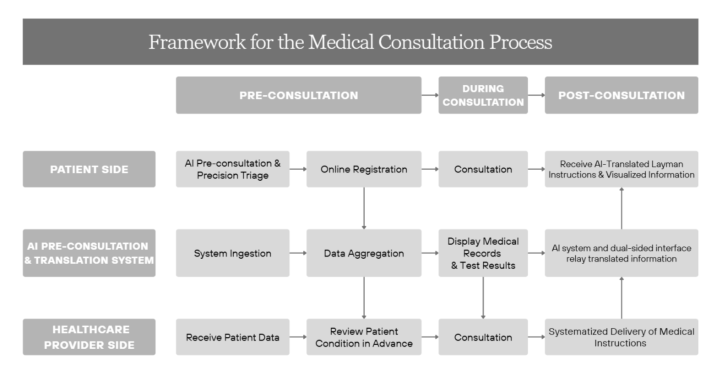
Research Methodology Framework At the AI application level, this study breaks away from the framework of a single user interface by adopting a “Dual-sided Service Design” strategy to construct a research prototype. This framework comprehensively connects the doctor-patient information flow across three stages: pre-consultation, during consultation, and post-consultation (Figure 1).
Figure 1: Framework for the medical consultation process.
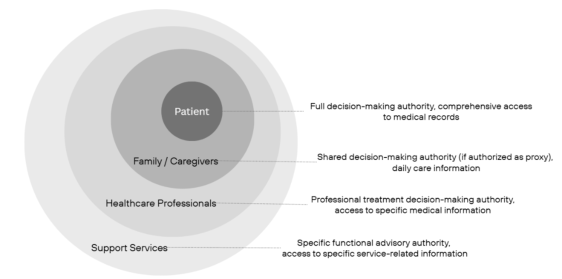
Furthermore, to clarify the permission relationships among different roles within the system, this study proposes a patient-centered “Circle of Care” concept. In the design of the system’s mechanisms, the closer the stakeholders are to the core, the higher their level of information completeness and system authorization (Figure 2).
Figure 2: Circle of care.
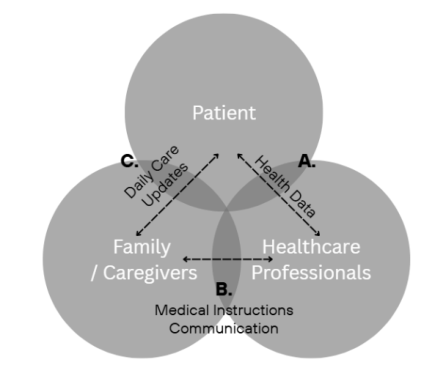
Concurrently, this study delineates the information transmission pathways among various stakeholders through an interaction relationship diagram (Figure 3). Patients, family members, and nursing staff share a high degree of information overlap and synchronization needs, with nursing staff acting as a crucial bridge in doctor-patient communication and the delivery of medical instructions. This clear pathway of information transmission provides a definitive design foundation for the information translation mechanism of the subsequent “AI dual-sided interface.” The specific framework is detailed as follows:
Figure 3: Interaction relationship and information flow diagram of the healthcare team.
Based on the interaction relationship diagram constructed in Figure 3, this study organizes the information exchange nodes among various stakeholders within the care ecosystem into three core interaction pathways. These pathways serve as the foundation for the subsequent design of the dual-sided interface: A. Patient and Healthcare Professionals – Health Data and Pre-Consultation
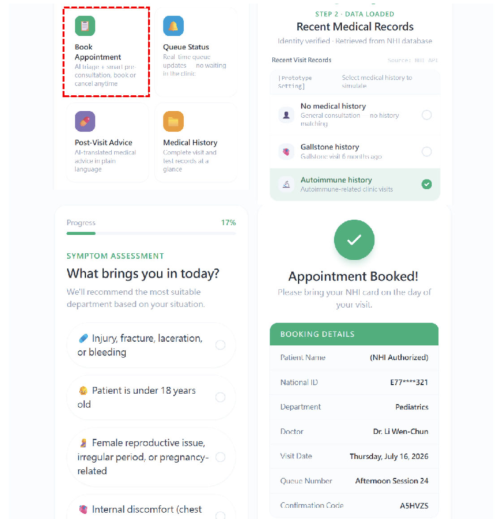
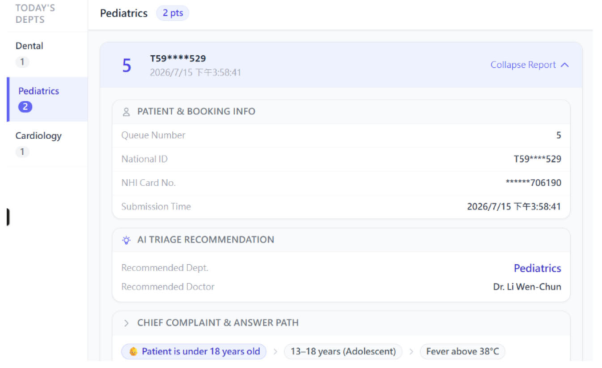
Pathway: This pathway focuses on the flow of information (Health Data) prior to and during the consultation. Through the interface, patients aggregate their pre-consultation responses along with personal health data accessed from the National Health Insurance (NHI) cloud database, transmitting them accurately to the medical provider side. (Figure 4).
Figure 4: Health data and pre-consultation pathway (patient-side).
Medical staff, in turn, conduct professional assessments based on this objective data, thereby enhancing the efficiency of preliminary communication and the overall quality of the consultation (Figure 5).
Figure 5: Information preview and consultation summary dashboard (provider-side).
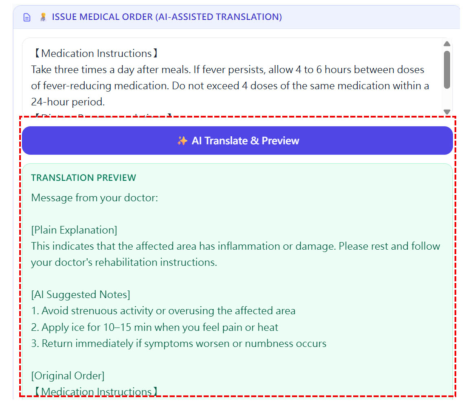
B. Healthcare Professionals and Family/Caregivers - Medical Instruction Translation and Communication Pathway: This pathway aims to resolve the information comprehension gap following a consultation (Medical Instructions Communication). It explores how professional medical instructions and consultation results can be translated into standardized
information that is easy for caregivers to understand. This thereby reduces the communication burden of repetitive explanations on nursing staff and empowers family members to precisely grasp the focal points of subsequent care (Figure 6).
Figure 6: Medical instruction translation (provider-side).
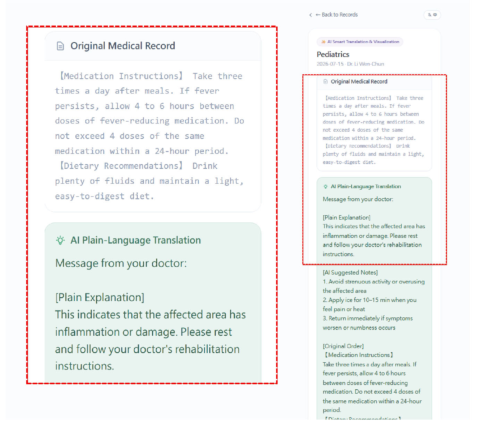
C. Family/Caregivers and Patient - Daily Care and Status Synchronization Pathway: This encompasses continuous care after the patient leaves the medical setting (Daily Care Updates). It focuses on how family members or informal caregivers assist patients in implementing medical instructions, and how they utilize the system to record and synchronize daily health statuses, forming a complete and closed loop of care information (Figure 7).
Figure 7: Care information (patient-side).
DISCUSSION AND FUTURE PLANNING Despite current limitations, this study has successfully utilized UI/UX design methodologies and AI technology to preliminarily structure and optimize interactions and information flow within the healthcare ecosystem. To address the current lack of empirical data, formal user testing will be conducted in subsequent phases. The evaluation will adopt a Mixed-Methods Research approach: for quantitative assessment, tools such as system usability and cognitive load scales will be introduced to objectively measure operational performance; for qualitative assessment, semi-structured interviews will be conducted to gather in-depth user feedback. Future testing will involve task- oriented scenarios specifically designed for both the patient and healthcare provider sides to verify the actual clinical benefits of the AI dual-sided interface in translating medical instructions and reducing communication- related cognitive load. In conclusion, future research will be dedicated to the system integration and field validation of the AI-assisted pre-consultation for patients, medical instruction translation for providers, and daily health synchronization by caregivers based on the translated content.
ACKNOWLEDGMENT
This research was supported by the National Science and Technology Council (NSTC) of Taiwan under grant agreement No. 115-2410-H-131-003.
REFERENCES
Card, S.K., Mackinlay, J.D. and Shneiderman, B. (1999) Readings in information visualization: Using vision to think. San Francisco: Morgan Kaufmann.
Chen, Y., Lin, H. and Wu, T. (2024) ‘Patient health record smart network challenges and trends for a smarter world’, Healthcare Technology Letters, 11(2), pp. 45–56.
Dall’Ora, C., Ball, J., Reinius, M. and Griffiths, P. (2020) ‘Burnout in nursing: A theoretical review’, Human Resources for Health, 18(1), p. 41.
Donner, S., Knauer, P., Kienzle, A., Dinneen, J., Burger, J., Perka, C. and Donner, S. (2025) ‘Exploring patient perspectives, engagement, and output quality in doctor- supervised use of artificial intelligence during informed consent consultation with ChatGPT and retrieval augmented generation (RAG): Quantitative exploratory study’, Journal of Medical Internet Research, 27, p. e73717. Fradgley, E. A., Paul, C. L., and Bryant, J. (2015) ‘A systematic review of barriers to optimal outpatient specialist clinic clinical care: Patients’ perspectives’, International Journal for Equity in Health, 14(1), p. 52.
Halvorson, T. et al. (2026) ‘Trends and disparities in patient engagement with digital After Visit Summaries: A large-scale outpatient analysis’, Journal of the American Medical Informatics Association, 33(4).
Hatef, E., Rastegar-Mojarad, M., Sedghi, N., Singh, R., Singh, S., Elnahal, S. M., Wang, Y., Rastegar, A., Chen, J. H. and Blecker, S. (2024) ‘Evaluation of GPT-4 ability to identify and generate patient instructions for actionable incidental radiology findings’, Journal of the American Medical Informatics Association, 31(9), pp. 1983–1991.
Johnson, A. and Lee, K. (2024) ‘The impact of patient access to electronic health records on health care engagement: Systematic review’, Journal of Medical Internet Research, 26, p. e56473.
Keller, M. S., Nguyen, A. T., Leder, C., Chen, Y., Morse, B., Schilling, L. M., Hu, D., SooHoo, S. and Ohno-Machado, L. (2026) ‘Exploring patient motivations and preferences for medical data sharing with researchers: A simulation study using the iAgree platform’, Journal of the American Medical Informatics Association, ocag060. Knitza, J., Tascilar, K., Fuchs, F., Mohn, J., Kuhn, S., Bohr, D., Muehlensiepen, F., Bergmann, C., Labinsky, H., Morf, H., Araujo, E., Englbrecht, M., Vorbrüggen, W., von der Decken, C., Kleinert, S., Ramming, A., Distler, J., Bartz-Bazzanella, P., Vuillerme, N., Schett, G., Welcker, M. and Hueber, A. (2024) ‘Diagnostic accuracy of a mobile AI-based symptom checker and a web-based self-referral tool in rheumatology: Multicenter randomized controlled trial’, Journal of Medical Internet Research, 26, p. e55542.
Lee, H., Huang, J., Huang, S., Chen, W., Marcelo, A., Aljibe, M. and Hsu, C. (2025) ‘Implementing a cross-border next-generation personal health record in the Philippines and Taiwan: An implementation case report using Health Level 7 International Fast Healthcare Interoperability Resources’, JMIR Formative Research, 9, p. e56272.
Phuyal, S., Bhandari, M., Bista, R. and Ferreira, J. (2026) ‘Blockchain-based dynamic and revocable consent for secondary health data use: systematic review’, JMIR Medical Informatics, 14, p. e88536.
Rosling, H. (2006) The best stats you’ve ever seen. [video] TED. Available at: https:// www.ted.com/talks/hans_rosling_the_best_stats_you_ve_ever_seen (Accessed: 6 July 2026).
Ruan, Y. et al. (2026) ‘Experiences of home-dwelling older adults and their family caregivers with digital health services: qualitative study’, Journal of Medical Internet Research, 28, p. e89496.
Smith, A., Jones, B. and Brown, C. (2024) ‘Interoperability and data exchange in modern healthcare systems: The role of FHIR’, Journal of Health Informatics, 15(4), pp. 112-128. Šuto Pavičić, J., Marušić, A. and Buljan, I. (2025) ‘Using ChatGPT to improve the presentation of plain language summaries of Cochrane systematic reviews about oncology interventions: Cross-sectional study’, JMIR Cancer, 11, p. e63347.
Wang, L., Davis, M. and Taylor, R. (2025) ‘Integrating artificial intelligence, electronic health records, and wearables for predictive, patient-centered decision support in healthcare’, Healthcare, 13(21), p. 2753.
Yang, A., Pan, M., Lu, H., Lien, C., Wang, D., Chen, C., Tarng, D., Niu, D., Chiou, S., Wu, C., Sun, Y., Chen, S., Wang, S., Sheu, W. and Lin, C. (2026) ‘Assessing the evolution and influence of medical open databases on biomedical research and health care innovation: A 25-year perspective with a focus on privacy and privacy-enhancing technologies’, Journal of Medical Internet Research, 28, p. e58954.
Yuan, Q. et al. (2025) ‘Supporting informal dementia caregivers through an iSupport web-based primary health care intervention: Hybrid effectiveness-implementation mixed methods study’, Journal of Medical Internet Research, 27, p. e77688.
SEARCH THE AHFE DIGITAL BOOKSTORE BY ISBN
Explore the complete digital volume
Human Factors in Design, Engineering, and Computing
Read this individual research paper free through the original publisher, or explore the full digital proceedings book.