Rosane Sampaio, Alexandre Carrança, João Oliveira, Joana Andrade, Emanuel Sousa (2026). Acceptance and User Experience of a Serious Game for Independent Home- Based Rehabilitation in Older Adults. In: Human Factors in Design, Engineering, and Computing. AHFE Open Access, vol. 238, pp. 2216–2226. https://doi.org/10.54941/ahfe1008448
The success of home-based digital rehabilitation depends not only on clinical effectiveness but also on older adults’ willingness and ability to use such technologies independently. This study examined older adults’ perceived usability of Vida no Campo (“Country Life”), a serious game for autonomous rehabilitation that uses the Gripwise handheld sensing device, together with acceptance-related responses (motivation, intention to continue or repeat, and perceived autonomy) during an initial session. Sixteen older adults (M = 71 years, SD = 8.0), recruited from a senior university, took part individually at the university, in a familiar, controlled setting; participants’ homes were not evaluated. Data combined unstructured observation with spontaneous verbalisations (a lightweight think-aloud approach) and a post-session questionnaire comprising the UMUX (Usability Metric for User Experience) and complementary items on instructional clarity, ease of learning, confidence, motivation and time perception. Perceived usability was high (mean UMUX score = 86.2), with favourable motivation and intention-to-repeat responses. Half of the participants (50%) perceived time as passing faster than usual and none as passing slowly. In total, 81.3% reported feeling fully capable of using the game independently, and none reported needing supervision. Unstructured observation identified interaction issues across four core usability categories: visual and haptic affordances, instructional content, system pacing, and system logic, suggesting targeted design improvements. The findings provide preliminary evidence of favourable perceived usability and autonomy among a digitally active sample of older adults. They do not establish safe or sustained independent use at home.
Adherence to home-based rehabilitation programmes remains a persistent challenge in physiotherapy, with non-adherence to prescribed home exercise estimated at up to 50% and potentially harming clinical outcomes (Argent et al., 2018). Reported barriers include low self-efficacy, depression, anxiety
Acceptance and User Experience of a Serious Game 2217 and increased pain during exercise (Jack et al., 2010), and shoulder pain, in particular, is a common musculoskeletal complaint (Luime et al., 2004).
Serious games and gamified digital systems have been proposed to address these limitations (Burke et al., 2009; Laver et al., 2017) by offering interactive feedback, structured progression and engagement that support autonomous exercise outside clinical settings. However, independent use at home requires more than clinical efficacy: a system must be understandable, learnable and perceived as safe, which are usability and acceptance concerns (Holden and Karsh, 2010; Yusif et al., 2016), especially for older adults, who differ widely in technology experience (Czaja et al., 2006; Fisk et al., 2009). Evaluating usability in the lived environment has been argued to be essential for rehabilitation technologies (Bhattacharjya et al., 2021), yet evidence remains limited on how older adults interpret instructions and feedback while exercising with such systems.
This study examines the perceived usability, interaction issues and acceptance-related responses (motivation, intention to continue or repeat, and perceived autonomy) of Vida no Campo after an initial session with older adults in a familiar, controlled university setting. We ask: How do older adults perceive the usability, clarity and potential for independent use of the system after first exposure?
RELATED WORK
Serious Games for Rehabilitation Game-based rehabilitation has been explored since commercial motion-sensing platforms such as the Nintendo Wii and Microsoft Kinect became available, showing the feasibility of interactive environments for supporting motor exercise in clinical and home settings (Laver et al., 2017). Serious games typically combine real-time feedback, adaptive difficulty and goal-based progression (Burke et al., 2009). Evidence on effectiveness is promising but mixed (Laver et al., 2017; Seron et al., 2021) and mostly concerns supervised use.
Usability and Acceptance of Digital Health Usability, the extent to which specified users can achieve specified goals with effectiveness, efficiency and satisfaction (ISO, 2018), is a central determinant of the adoption and sustained use of digital health technologies (Holden and Karsh, 2010; Yusif et al., 2016). The System Usability Scale (SUS; Brooke, 1996) is the most widely used instrument, with a mean of approximately 70 across a large collection of studies (Bangor et al., 2008). The UMUX (Finstad, 2010) is a shorter four-item alternative aligned with the ISO definition, which correlated strongly with the SUS in its validation (r = .96), although later work did not consistently replicate the similarity of their magnitudes (Borsci et al., 2015); SUS benchmarks are therefore used here only as an approximate reference.
Older Adults and Evaluation Context Older adults are a primary target group for home rehabilitation, yet research on ageing in HCI has often framed older people through decline and deficit (Vines et al., 2015). Age-related changes in cognition, vision, hearing and fine motor control can nevertheless affect learning, error recovery, the legibility of on-screen content and input accuracy (Hawthorn, 2000), while older adults use well-designed systems effectively and heterogeneity within the group is large (Czaja et al., 2006). Guidelines emphasise larger text, higher contrast, simplified navigation and consistent feedback on system state (Fisk et al., 2009). Contextual methods (Beyer and Holtzblatt, 1998) offer higher ecological validity at the cost of experimental control (Dumas and Redish, 1999); here, a supervised session approximated the physical demands of use, but not the home context.
SYSTEM DESCRIPTION Vida no Campo is a serious game designed to support autonomous rehabilitation exercises by older adults at home, with playful tasks set on a farm that each stimulate a functional movement required for the rehabilitation plan. The exercises are independent of one another, with no mandatory sequence. In a fully deployed product, the plan is individualised and prescribed by a healthcare professional; for the evaluation, participants performed the predefined set of exercises corresponding to levels L1 to L5.2 (Table 1).
Table 1: Predefined set of exercises used in the evaluation.
Table available in the original PDF paper.
Level Exercise Functional Movement L1 Milk the Cow Hand-grip strength
L2 Paint the Fence Shoulder flexion and extension L3 Water from the Well Horizontal shoulder adduction and abduction
L4 Feed the Chickens Medial and lateral shoulder rotation L5.1 Upper Bath Shoulder medial rotation and adduction—upper functional reach
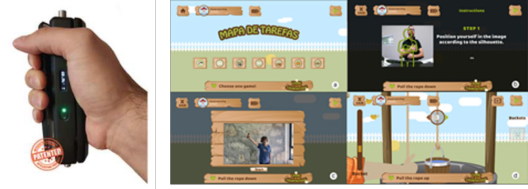
L5.2 Lower Bath Shoulder medial rotation and adduction—lower functional reach The application runs on an Android tablet with a touchscreen and an RGB camera, combining serious-game activities, exercise-specific validation rules, computer-vision monitoring and tele-rehabilitation capabilities. Participants interact primarily through the Gripwise handheld sensing unit (Figure 1a), which streams grip-force and upper-limb motion data (two load cells and a six-axis inertial measurement unit) via Bluetooth Low Energy at 100 Hz. Each exercise begins with an instructional video and a start prompt. During execution, visual feedback, including a circular filling indicator, guides participants through holding phases, while on-screen prompts signal exercise initiation and hand changes (Figure 1b). The tablet camera uses MediaPipe
Acceptance and User Experience of a Serious Game 2219 Pose and Hands (Lugaresi et al., 2019; Bazarevsky et al., 2020) to monitor posture, estimate shoulder joint angles and check hand visibility without arm-worn sensors.
Figure 1: Vida no Campo system: (a) Gripwise handheld sensing device; (b) task selection; (c) computer vision calibration; (d) exercise guidance; (e) monitored exercise execution.
METHOD
Design and Participants A single-session, mixed-methods usability evaluation was conducted at a senior university in a familiar, controlled setting; participants’ homes were not assessed. Participants completed the predefined set of exercises (L1 to L5.2; Table 1) to approximate the physical and interaction demands of independent home use. The game was evaluated as a standalone system, with no comparative condition.
Sixteen participants (14 women, 2 men; M = 71 years, SD = 8.0; range = 57–85) took part. Inclusion criteria required participants to be older adults aged 55 or above, with preserved cognitive capacity to follow simple instructions and the ability to use basic digital devices; exclusion criteria were moderate or severe cognitive impairment, motor limitations incompatible with the exercises, and acute pain or clinical conditions contraindicating exercise. Most (81.3%) held secondary or higher education; all used digital devices daily or almost daily and rated their ability to learn new technology as at least moderate (68.8% very or fully capable); 75% had prior physiotherapy or rehabilitation experience.
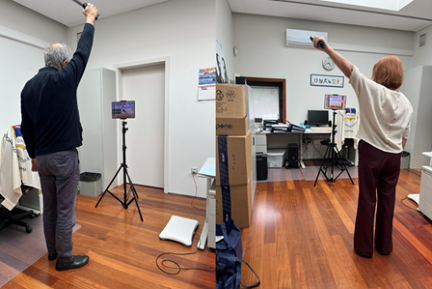
Procedure and Instruments Sessions were individual, conducted in Portuguese, and video-recorded to support observational analysis. Each session lasted approximately 30 minutes. After a verbal explanation and written informed consent (including photo and video recording), participants completed a demographic and digital literacy questionnaire (five-point scales for frequency of device use and ability to learn new technology; rehabilitation history) and then performed the exercises without prior training to assess the self-explanatory quality of the system under conditions representative of first-time use. The tablet was mounted on a tripod (Figure 2) with the distance customised based on the participant’s height to allow the computer vision system to capture the
entire body. The researcher intervened only for safety or when asked. A full concurrent think-aloud was not applied because speaking while exercising could compromise safety; participants were instead encouraged to verbalise spontaneously (Olmsted-Hawala et al., 2010). Observational data were recorded directly by the session facilitator using unstructured, free-form field notes. The facilitator organically documented all observed behaviours, including requests for external help, verbalised comprehension difficulties, and specific interface elements or operational stages associated with user confusion or incorrect actions.
Figure 2: Usability testing session with older adult participants at the senior university, in a familiar yet controlled setting.
Immediately afterwards, participants completed the post-session questionnaire. Perceived usability was assessed using the Usability Metric for User Experience (UMUX; Finstad, 2010), comprising four items rated on a seven-point Likert scale (1 = strongly disagree, 7 = strongly agree). The original response scale was retained for data collection; responses were subsequently recoded according to the UMUX scoring procedure to ensure that higher values consistently represented better perceived usability. Positively worded items (Q1 and Q3) were recoded as X − 1, while negatively worded items (Q2 and Q4) were reverse-scored as 7 − X, producing item scores ranging from 0 to 6. The four recoded scores were then summed, divided by the maximum possible total (24), and multiplied by 100 to obtain an overall UMUX score ranging from 0 to 100. This transformation provides a standardised overall score, while individual item results can be reported on the recoded 0–6 scale. The UMUX was selected because of its alignment with ISO 9241-11.
Seven author-developed items, rated on a 7-point scale and analysed individually, addressed: (1) clarity of on-screen instructions (“Were the instructions and information that appeared on the screen easy to understand?”); (2) ease of learning the game and movements (“Was it easy to learn how to play the game and perform the movements?”); (3) perceived safety for exercising alone at home (“Do you feel safe doing these exercises alone at home using this game?”); (4) motivation and interest (“I felt motivated and interested in the activity”); (5) wish to continue (“I felt like continuing to do the exercises”); (6) loss of track of time (“I lost track of
Acceptance and User Experience of a Serious Game 2221 time while exercising”); and (7) intention to repeat (“I intend to repeat this in the future”). Perceived passage of time was rated on a five-point scale from much slower to much faster than usual; together with item 6, it is treated as an experiential indicator, not as a measure of flow (Csikszentmihalyi, 1990; Agarwal and Karahanna, 2000). Perceived exertion was recorded once, immediately after the exercises, with the Borg CR10 scale (Borg, 1998). Perceived autonomy was assessed with a single categorical item (“Capable of using this game alone for rehabilitation”) with three options: ‘Totally capable’, ‘With some doubts’ or ‘Requires supervision’. No validated multi- item acceptance scale was administered; motivation, intention to continue or repeat, and perceived autonomy were analysed as separate, author-developed indicators of acceptance.
Ethics and Data Analysis Participation was voluntary, with the right to withdraw at any time, and data were anonymised. Written informed consent explicitly covered video and photographic recording, as well as the publication of anonymised images in academic outlets. Recordings were used to verify observational coding. Physical safety was monitored throughout, and any verbal report of significant discomfort was an immediate stopping criterion. The protocol was approved by the Ethics Committee for Research in Social and Human Sciences of the University of Minho (CEICSH-098/2026).
Descriptive statistics were computed for the UMUX and the supplementary items; given N = 16 and ordinal scales, no inferential tests were applied. UMUX scores were compared with SUS benchmarks (Sauro and Lewis, 2016): ≥ 80.3 (top 10% of products), 68.0–80.2 (average to above average) and 51.0–67.9 (below average), used only as an approximate reference (Borsci et al., 2015). Observation data were analysed thematically and categorised into four primary interaction dimensions: Visual & Haptic Affordance, Instructional Content, System Pacing & Timing, and System Logic & Content Separation. These findings were triangulated with self-reports using a convergent mixed- methods approach (Creswell and Plano Clark, 2018). Technical problems (e.g. connectivity failures, hardware or software errors) were excluded to isolate usability perceptions from implementation constraints.
RESULTS
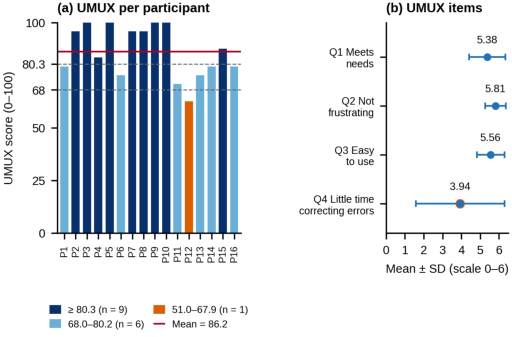
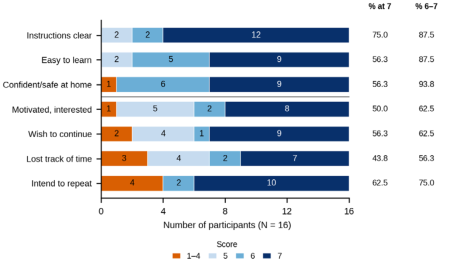
Perceived Usability The mean UMUX score was 86.2 (SD = 12.2; median = 85.4; range = 62.5– 100). Nine participants (56.3%) scored ≥ 80.3, six (37.5%) scored 68.0–80.2 and one (6.3%) scored 51.0–67.9; none scored below 51 (Figure 3a). Q1–Q3 were high (M = 5.38, 5.81 and 5.56 of 6), whereas Q4 (time spent correcting errors) had the lowest mean (3.94/6) and the greatest variability (SD = 2.35), indicating heterogeneous experiences with error correction and recovery (Figure 3b). Among the supplementary items (Figure 4), instruction clarity had the highest mean (M = 6.63, SD = 0.72), followed by ease of learning (M = 6.44, SD = 0.73) and perceived safety at home (M = 6.44, SD = 0.81; 93.8% rated 6 or 7).
Figure 3: (a) UMUX score per participant (N = 16) with SUS benchmark thresholds; (b) adjusted UMUX item scores (0–6), mean ± SD.
Motivation, Exertion and Autonomy Motivation and interest (M = 6.06, SD = 1.06) and wish to continue (M = 6.06, SD = 1.18) were high. Intention to repeat had M = 5.94 (SD = 1.77): ten participants (62.5%) scored 7, three (18.8%) scored 4 and one scored 1. Loss of track of time was the most dispersed item (M = 5.31, SD = 2.15; seven participants scored 7 and three scored 1–3). On the time- passage question, eight participants (50.0%) reported time passing as usual, five (31.3%) a little faster and three (18.8%) much faster; none reported it passing more slowly.
Perceived exertion was assessed once, after the full set of exercises. Eleven participants (68.8%) reported CR10 scores of 0–2 (4 ‘None’, 7 ‘Very light’), two (12.5%) scored 3–4 (moderate) and three (18.8%) scored 6, 9 and 10 (M = 2.56, Md = 1.0, SD = 3.16). No session was paused or interrupted, and no participant requested assistance or required a safety intervention. Thirteen participants (81.3%) rated themselves ‘Totally capable’ of using the game alone for rehabilitation, three (18.8%) reported ‘With some doubts’, and none ‘Requires supervision’.
Figure 4: Distribution of responses to the supplementary usability and motivation items (1–7 scale; counts; N = 16).
Acceptance and User Experience of a Serious Game 2223 Observed Interaction Problems
Observation and field notes identified seven interaction issues, which were structured into four main categories (Table 2): Visual & Haptic Affordance (e.g., unrecognised holding-time indicator and device squeeze interaction), Instructional Content (e.g., misleading bath exercise videos and dual-arm execution), System Pacing & Timing (e.g., premature movements and missed prompts), and System Logic & Content Separation (e.g., repetition-counting glitches and shared video logic). These findings point to targeted design improvements in both the rehabilitation activities and system flow.
Table 2: Interaction issues identified through structured observation, with design recommendations.
Table available in the original PDF paper.
Category Issue Observed Design Recommendation
Unrecognised circular holding-time
Explain static holding via audio/
Visual & Haptic Affordance
indicator.
Unclear squeeze interaction on the
text; make animations prominent.
Explicitly instruct squeezing in
physical device.
onboarding and start prompts.
Misleading video for L5.1/L5.2
Re-record demonstration videos
Instructional Content
causing execution errors.
Incorrect dual-arm movement in
with the correct sequence.
Reinforce resting the inactive hand;
Milk the Cow (L1).
adjust calibration carry-over.
Premature movement skipping the
Insert a visual pre-exercise
System Pacing & Timing
start prompt.
Missed hand-change pop-up due to
countdown.
Extend pop-up duration and add
immediate action.
a mandatory short pause between sides.
Shared video across L5.1/L5.2, short
Provide distinct videos per level,
System Logic & Content Separation
cooldown, and repetition-counting glitch during side change.
extend cooldown duration, and fix repetition counting logic.
DISCUSSION
Perceived Usability and Autonomy The mean UMUX score of 86.2 exceeds the benchmark commonly associated with the top 10% of products (80.3), used here only as an approximate interpretive reference (Sauro & Lewis, 2016). However, although UMUX and SUS are strongly correlated, their score magnitudes are not always equivalent (Borsci et al., 2015), so this comparison should be interpreted as indicative rather than as a direct benchmark classification. For unsupervised home use, usability matters because errors cannot be recovered with external help. Moreover, 81.3% of participants rated themselves fully capable of using the game alone for rehabilitation, and none reported needing supervision, in line with the design intent; perceived safety (93.8% rated 6 or 7) and instruction clarity (75.0% rated 7) were also high. These ratings indicate a positive perception of autonomy, but they do not establish that the system can be used safely without supervision at home, where use was not evaluated.
The sample also reflects daily technology users, unlike the wider older adult population, in which low digital literacy is well documented (Czaja et al., 2006; Yusif et al., 2016); less experienced samples may score lower, particularly on error recovery (Q4).
Motivation and Engagement Intention to repeat (62.5% at the maximum; 75.0% rated 6–7) and wish to continue (56.3% at the maximum) are positive signals, although not uniform: three participants were neutral on intention to repeat, and one scored 1. Longitudinal evidence is needed to show that intention translates into adherence. Half of the participants perceived time as passing faster than usual and none as slower; the absence of slow time perception, which would signal boredom, is arguably as relevant as acceleration (Csikszentmihalyi, 1990; Agarwal and Karahanna, 2000). Both time measures are treated only as experiential indicators. Exertion was low for most participants, but three reported 6, 9 and 10 on the CR10 scale, which warrants individual calibration and monitoring in future studies of unsupervised use.
Implications for Design The observed interaction problems span four key design domains. First, regarding Visual & Haptic Affordance, cues such as the circular holding-time indicator and device squeeze interaction lacked clear signifiers (Norman, 2013); redundant multimodal coding (audio and text accompaniment) is required to clarify these mechanics (Fisk et al., 2009; Hawthorn, 2000). Second, Instructional Content showed failures in demonstration validity, where the Upper/Lower Bath video induced systematically incorrect movements, emphasising the need for unambiguous video modelling in unsupervised settings. Third, issues in System Pacing & Timing (premature actions and missed prompts) indicate a need for enforced pauses and visual countdowns to align system state with user readiness. Finally, System Logic & Content Separation flaws—such as shared videos and repetition- counting glitches during side changes—highlight the necessity of robust state management and level-specific content.
Limitations The sample (N = 16) is within the range accepted for formative studies but limits generalisability, and the analysis is descriptive. It was digitally literate, predominantly female (87.5%) and recruited from a senior university rather than a clinical population, so findings may differ for patients and for less experienced users. A single session captures first-contact perceptions only; results rely on self-report and observation without objective performance metrics (task time, error rate); the number of participants affected by each issue was not quantified; technical problems were excluded; and the supervised university setting may have introduced social desirability effects.
CONCLUSION
Vida no Campo elicited favourable initial perceptions of usability, motivation and autonomy among this digitally active sample of older adults. Observations also identified interaction issues across visual and haptic affordances, instructional content, system pacing, and system logic that should be addressed before further evaluation. Because the study involved a single supervised session at a university, the findings do not establish safe, unaided or sustained use at home. Future studies should evaluate the revised system in participants’ homes and over repeated sessions, include older adults with a wider range of digital experience, and measure objective performance and safety outcomes.
ACKNOWLEDGMENT
The authors would like to acknowledge the project HfPT – Health from Portugal, co-financed by the RRP (Recovery and Resilience Plan) and the Next Generation EU Funds: Notice 2022-C05i0101-02 Mobilizing Agendas/ Alliances for Reindustrialisation, Project no. C630926586-00465198.
REFERENCES
Agarwal, R. and Karahanna, E. (2000) ‘Time flies when you’re having fun: Cognitive absorption and beliefs about information technology usage’, MIS Quarterly, 24(4), pp. 665–694.
Argent, R., Daly, A. and Caulfield, B. (2018) ‘Patient involvement with home-based exercise programs: Can connected health interventions influence adherence?’, JMIR mHealth and uHealth, 6(3), e47. doi: 10.2196/mhealth.8518.
Bangor, A., Kortum, P.T. and Miller, J.T. (2008) ‘An empirical evaluation of the System Usability Scale’, International Journal of Human–Computer Interaction, 24(6), pp. 574–594.
Bazarevsky, V. et al. (2020) ‘BlazePose: On-device real-time body pose tracking’, arXiv preprint arXiv:2006.10204.
Beyer, H. and Holtzblatt, K. (1998) Contextual design: Defining customer-centered systems. San Francisco: Morgan Kaufmann.
Bhattacharjya, S. et al. (2021) ‘Usability, usefulness, and acceptance of a novel, portable rehabilitation system (mRehab) using smartphone and 3D printing technology: Mixed methods study’, JMIR Human Factors, 8(1), e21312.
Borg, G. (1998) Borg’s perceived exertion and pain scales. Champaign, IL: Human Kinetics.
Borsci, S. et al. (2015) ‘Assessing user satisfaction in the era of user experience: Comparison of the SUS, UMUX, and UMUX-LITE as a function of product experience’, International Journal of Human–Computer Interaction, 31(8), pp. 484–495.
Brooke, J. (1996) ‘SUS: A quick and dirty usability scale’, in Jordan, P.W. et al. (eds) Usability evaluation in industry. London: Taylor & Francis, pp. 189–194.
Burke, J.W. et al. (2009) ‘Serious games for upper limb rehabilitation following stroke’, in 2009 Conference in Games and Virtual Worlds for Serious Applications. IEEE, pp. 103–110. doi: 10.1109/VS-GAMES.2009.17.
Creswell, J.W. and Plano Clark, V.L. (2018) Designing and conducting mixed methods research. 3rd edn. Thousand Oaks, CA: SAGE.
Csikszentmihalyi, M. (1990) Flow: The psychology of optimal experience. New York: Harper & Row.
Czaja, S.J. et al. (2006) ‘Factors predicting the use of technology: Findings from the Center for Research and Education on Aging and Technology Enhancement (CREATE)’, Psychology and Aging, 21(2), pp. 333–352.
Dumas, J.S. and Redish, J.C. (1999) A practical guide to usability testing. Rev. edn. Exeter: Intellect Books.
Finstad, K. (2010) ‘The Usability Metric for User Experience’, Interacting with Computers, 22(5), pp. 323–327.
Fisk, A.D. et al. (2009) Designing for older adults: Principles and creative human factors approaches. 2nd edn. Boca Raton, FL: CRC Press.
Hawthorn, D. (2000) ‘Possible implications of aging for interface designers’, Interacting with Computers, 12(5), pp. 507–528.
Holden, R.J. and Karsh, B.-T. (2010) ‘The technology acceptance model: Its past and its future in health care’, Journal of Biomedical Informatics, 43(1), pp. 159–172.
ISO (2018) ISO 9241-11:2018 Ergonomics of human-system interaction—Part 11: Usability: Definitions and concepts. Geneva: International Organization for Standardization.
Jack, K. et al. (2010) ‘Barriers to treatment adherence in physiotherapy outpatient clinics: A systematic review’, Manual Therapy, 15(3), pp. 220–228.
Laver, K.E. et al. (2017) ‘Virtual reality for stroke rehabilitation’, Cochrane Database of Systematic Reviews, 11, CD008349.
Lugaresi, C. et al. (2019) ‘MediaPipe: A framework for building perception pipelines’, arXiv preprint arXiv:1906.08172.
Luime, J.J. et al. (2004) ‘Prevalence and incidence of shoulder pain in the general population: A systematic review’, Scandinavian Journal of Rheumatology, 33(2), pp. 73–81.
Norman, D.A. (2013) The design of everyday things. Revised and expanded edn. New York: Basic Books.
Olmsted-Hawala, E.L. et al. (2010) ‘Think-aloud protocols: A comparison of three think-aloud protocols for use in testing data-dissemination web sites for usability’, in Proceedings of CHI 2010. New York: ACM, pp. 2381–2390.
Sauro, J. and Lewis, J.R. (2016) Quantifying the user experience: Practical statistics for user research. 2nd edn. Cambridge, MA: Morgan Kaufmann.
Seron, P. et al. (2021) ‘Effectiveness of telerehabilitation in physical therapy: A rapid overview’, Physical Therapy, 101(6), pzab053.
Vines, J. et al. (2015) ‘An age-old problem: Examining the discourses of ageing in HCI and strategies for future research’, ACM Transactions on Computer-Human Interaction, 22(1), Article 2.
Yusif, S., Soar, J. and Hafeez-Baig, A. (2016) ‘Older people, assistive technologies, and the barriers to adoption: A systematic review’, International Journal of Medical Informatics, 94, pp. 112–116.
SEARCH THE AHFE DIGITAL BOOKSTORE BY ISBN
Explore the complete digital volume
Human Factors in Design, Engineering, and Computing
Read this individual research paper free through the original publisher, or explore the full digital proceedings book.