Iara Margolis, Eduardo Santos, Francisco Silva, Carlos Costa, Miguel Nunes, Alexandre Ferreira, Andreia Mendes, Alexandre Carrança, Arabela Fabre, Diogo Silva, Carolina Pimenta, Ana Alves, José Rocha, Nuno Sousa (2026). Beyond Immersion: The Influence of Interactivity on User Experience in VR-Based Robotics Learning. In: Human Factors in Design, Engineering, and Computing. AHFE Open Access, vol. 238, pp. 229–239. https://doi.org/10.54941/ahfe1008257
This study presents an empirical evaluation of an immersive virtual reality experience designed to support learning and training in industrial robotics. The experience comprised three modules combining playful introduction, guided conceptual learning, and simulation-based problem-solving. Ninety-one participants were distributed across the modules. Usability, intrinsic motivation, simulator sickness, perceived workload, recommendation intention, XR experience quality, and open-ended feedback were assessed. Results indicated an overall positive reception, with usability scores within an acceptable-to-good range and no statistically significant differences between modules. The motivational profile, including Interest/Enjoyment, Perceived Competence, and Value/Usefulness, was also comparable across modules. Nevertheless, the simulation module showed slightly higher descriptive tendencies in Interest/Enjoyment and recommendation intention. Simulator sickness symptoms were low for most participants, although isolated cases of discomfort occurred. Workload results suggested that the simulation module required greater cognitive involvement without increasing frustration or temporal pressure. Qualitative feedback showed that participants particularly valued interactivity, hands-on exploration, and 3D visualization, whereas more passive instructional segments generated more suggestions for improvement. The findings indicate that the value of VR in industrial robotics training does not derive from immersion alone, but from the integration of meaningful interaction, narrative purpose, instructional clarity, user comfort, and active experiential learning.
Virtual reality (VR) is increasingly used for industrial training because it enables safe and reproducible practice in situations where access to equipment may be expensive, restricted, or potentially dangerous.
Research has demonstrated positive effects of VR-based training on behavioural, cognitive, and affective outcomes, while also revealing considerable variation in intervention design and evaluation approaches (Bödding et al., 2025). Systematic evidence similarly indicates that immersive procedural training can support knowledge transfer, although learning success depends more strongly on the design of the training activity than on immersion alone (Jongbloed et al., 2024). In industrial contexts, the organisation of instructions and practical tasks may also influence performance, learning, and perceived workload (Wolfartsberger et al., 2023).
Interactivity is therefore a central component of immersive learning. It can influence agency, situational interest, embodied learning, and cognitive load, shaping how users engage with and interpret the training experience (Petersen et al., 2022). Instructional approaches such as direct manipulation, guidance cues, narrative framing, analogies, and pedagogical support may further affect performance, motivation, and perceived value (Calvert and Hume, 2023; Zhang et al., 2024). However, the benefits of interactivity depend not only on the instructional content, but also on the usability, clarity, and comfort of the immersive environment.
Navigation and locomotion are particularly relevant because limited user control, visually induced motion, and sensory mismatches may affect comfort, presence, and task performance. Poorly designed movement can cause disorientation and cybersickness, potentially distracting users or preventing session completion (Kennedy et al., 1993; Saredakis et al., 2020). Simulator sickness may also reduce perceived usability, while navigation control and sensory congruence influence the relationship between comfort and presence (Voinescu et al., 2023). Consequently, usability, workload, navigation comfort, and cybersickness should be considered alongside motivational and learning-related outcomes.
Despite the growing use of VR in industrial education, limited evidence has examined how narrative framing, instructional guidance, interactivity, and movement-related comfort jointly shape the user experience of robotics learning. To address this gap, the present study assesses an immersive industrial robotics programme comprising three modules: a playful introduction using humour and informal tutor communication; a guided conceptual module based on analogies and step-by-step explanations; and a simulation module focused on experimentation, problem-solving, and active interaction. The study examines module-level patterns in usability, intrinsic motivation, workload, simulator sickness, recommendation intention, XR experience quality, and qualitative feedback to investigate how different combinations of narrative, instruction, and interactivity contribute to the perceived value of VR-based robotics learning.
METHOD
This study consisted of an empirical evaluation of an immersive VR experience designed to support learning and training in industrial robotics. The evaluation examined the experience in terms of usability, intrinsic
Beyond Immersion: The Influence of Interactivity 231 motivation, simulator sickness symptoms, perceived workload, perceived learning support, XR experience quality, recommendation intention, and open-ended user feedback.
Procedure Participants were welcomed individually or in small groups and informed about the study objectives, the voluntary nature of participation, and the anonymous treatment of their responses. After providing informed consent, they received a brief introduction to the VR equipment and interaction procedures, followed by an initial questionnaire including demographic questions and the pre-exposure Simulator Sickness Questionnaire (SSQ). Participants then experienced one of the three VR learning modules related to industrial robotics.
After completing the assigned module, participants filled in a post-experience questionnaire composed of standardized scales and complementary evaluation items. The questionnaire included measures of usability, cybersickness symptoms, intrinsic motivation, perceived workload, perceived learning support, instructional clarity, familiarity with industrial environments, robotics, and XR technologies, XR environment quality, and recommendation intention. Open- ended questions were also included to gather participants’ perceptions of the most positive aspects of the experience, the main difficulties encountered, and possible improvements.
Participants were informed about the study objectives, voluntary participation, their right to withdraw, and the anonymous treatment of their responses. Informed consent was obtained before participation, with parental/legal guardian and institutional authorization for participants under 18 years of age. All data were anonymized before analysis.
Narrative Design The VR experience comprised three learning modules: M1, M2, and a Simulation Module (SM). Each module addressed a distinct stage of the learning process, progressing from conceptual introduction to structured explanation and practical application.
M1 introduced fundamental concepts in industrial robotics, including robot classifications, industrial automation, collaborative robotics, actuators, and sensors. Due to the introductory nature of the content, the narrative strategy was designed to capture attention and lower initial engagement barriers. Humour, playful interactions, direct communication, and an informal tutoring style were used to stimulate curiosity and support learners’ first contact with robotics concepts.
M2 addressed foundational topics related to programming, positioning systems, sensors, cameras, tools, and safety. Since several of these concepts involve abstract or less visible processes, the narrative relied on analogies, everyday examples, and step-by-step explanations. This approach was intended to support the construction of mental models by connecting unfamiliar technical content to familiar experiences. Compared with M1, M2 placed greater emphasis on structured content delivery and progressive conceptual development.
SM focused on the practical application and consolidation of concepts introduced across the previous modules. Topics such as obstacle avoidance, triangulation, robotic manipulation, and payload handling were explored through interactive challenges and simulation-based tasks. In this module, narrative guidance was intentionally reduced, with the tutor assuming a facilitator role. Learning was primarily supported through experimentation, task execution, and problem-solving, encouraging active engagement with the virtual environment and reinforcing previously acquired concepts through hands-on experience.
Participants A total of 91 participants from Portugal took part in the study reported in this paper, distributed across M1 (n = 35), M2 (n = 33), and SM (n = 23). Participants were aged between 15 and 56 years (M = 32.30, SD = 12.55), and the sample included 66 male and 25 female participants. Most participants were right-handed (95.6%); two were left-handed, two were ambidextrous, and one reported colour vision deficiency. The sample was intentionally heterogeneous in terms of educational background and professional profile. Participants included secondary education graduates (35.2%), bachelor’s degree holders (30.8%), master’s degree holders (24.2%), doctoral degree holders (3.3%), and a smaller proportion with lower secondary or equivalent qualifications. Occupationally, the sample included students and robotics trainees (34.1%), industrial, production, operations, and maintenance professionals (23.1%), engineering, robotics, digital, and technical R&D professionals (16.5%), project, business, and organisational roles (13.2%), research, UX, academic, and training profiles (9.9%), and other complementary profiles (3.3%). This diversity supported the evaluation of the VR experience from the perspectives of novice learners, technically oriented users, and professionals with industrial or educational experience.
Measures The questionnaire combined standardized instruments and complementary Likert-scale items. Perceived usability was assessed using the Usability Metric for User Experience (UMUX), a four-item instrument rated on a seven-point Likert scale (Finstad, 2010). Negatively worded items were reverse-coded, and scores were normalized to a 0–100 scale following the original UMUX scoring procedure. This approach provides usability scores designed to be comparable to those of the System Usability Scale (SUS), as discussed by Lewis (2018), with higher scores indicating better perceived usability. Simulator sickness symptoms were assessed using the Simulator Sickness Questionnaire (SSQ), which provides Nausea, Oculomotor, Disorientation, and Total scores (Kennedy et al., 1993). The SSQ was administered before and after the VR experience to account for pre-existing symptoms and post-exposure discomfort.
Intrinsic motivation was assessed using selected dimensions of the Intrinsic Motivation Inventory (IMI), namely Interest/Enjoyment, Perceived Competence, and Value/Usefulness, grounded in Self-Determination Theory (Ryan, 1982). Recommendation intention was assessed using the Net
Beyond Immersion: The Influence of Interactivity 233 Promoter Score (NPS), classifying participants as promoters, passives, or detractors according to their likelihood of recommending the experience (Reichheld, 2003). Perceived workload was assessed using an adapted Raw NASA-TLX approach, covering Mental Demand, Physical Demand, Temporal Demand, Performance, Effort, and Frustration (Hart and Staveland, 1988). Each dimension was rated and analyzed independently, without pairwise weighting or calculation of a global workload score. The Performance item was positively oriented, with higher scores indicating greater perceived task success, unlike the original NASA-TLX scoring direction.
Complementary items assessed perceived familiarity with industrial environments, industrial robot operation and programming, and XR technologies, as well as perceptions of visual quality and realism, interaction quality, navigation comfort, language clarity, and training procedure clarity. Open-ended questions were included to collect participants’ perceptions of positive aspects, difficulties, discomfort, and suggestions for improvement.
Statistical Analysis Quantitative data were analysed using descriptive and inferential statistics. Descriptive analyses included means, standard deviations, medians, quartiles, minimum and maximum values, depending on the nature and distribution of each measure. Module-level comparisons focused on the three analysed modules: M1, M2, and SM. Welch’s ANOVA was used to compare usability scores across modules due to unequal group sizes. For intrinsic motivation, a MANOVA examined whether the overall IMI profile differed across modules, considering Interest/Enjoyment, Perceived Competence, and Value/Usefulness jointly. A MANOVA was also conducted for the workload dimensions, with follow-up univariate ANOVAs interpreted cautiously as complementary analyses. Pillai’s Trace was used as the multivariate test statistic due to its robustness. NPS and complementary Likert-scale items were analysed descriptively. SSQ results were interpreted primarily through medians, quartiles, means, and distributional patterns, given the skewed nature of simulator sickness data. Open-ended responses were analysed thematically, focusing on recurring comments related to strengths, difficulties, discomfort, and suggestions for improvement.
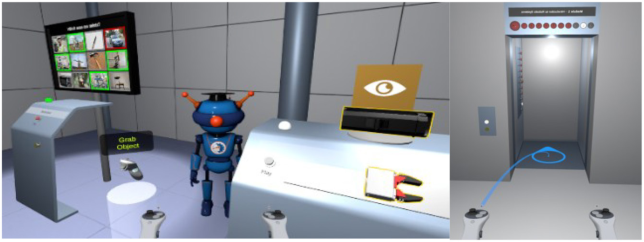
Environment and Equipment The VR experience was deployed on Meta Quest 3 headsets as an Android standalone application developed in Unity 6000.0 and integrated with the VIROO 3.0 runtime environment. The system included an onboarding area, a lobby structured around elevator-based access to the learning modules, and module-specific training floors with instructional content, interactive stands, diagnostic and final evaluation activities. Participants navigated the environment using controller-based locomotion, including continuous movement and teleportation, and interacted with virtual objects, buttons, sliders, robotic elements, and tutor-guided activities. Virtual tutors supported the learning experience by guiding participants through the module content and triggering narrative, visual, and interactive elements according to the
progression of each activity. Figure 1 illustrates the VR environment and the virtual tutor avatar.
Figure 1: VR learning environment and virtual tutor avatar.
RESULTS AND DISCUSSION
Cybersickness: Post-exposure SSQ results indicated generally low simulator sickness across the three analysed modules. Median scores remained below 10 across all dimensions, with values of 0 for Nausea and Disorientation, 8 for Oculomotor symptoms, and 7 for the Total Score. The first quartile was also equal to zero across all dimensions. This pattern suggests that most participants reported no or only limited discomfort after the VR experience. However, mean scores were higher than the medians across all dimensions: Nausea (M = 15.52), Oculomotor symptoms (M = 19.91), Disorientation (M = 26.00), and Total Score (M = 22.65). This indicates right-skewed distributions, particularly for Disorientation and the Total Score, suggesting that discomfort was concentrated in a small number of participants rather than reflecting the overall sample pattern. Consistent with this interpretation, one participant experienced nausea during the SM session, which prevented him from completing the activity.
Usability scores indicated a positive perception of the VR learning experience across the three analysed modules. A Welch ANOVA showed no statistically significant differences between modules, Welch’s F(2, 56.03) = 2.38, p = 0.102, suggesting that perceived usability remained relatively stable across M1, M2, and SM. Descriptively, M1 obtained the highest usability scores (M = 78.93, SD = 15.78; Md = 83.33), followed by SM (M = 72.46, SD = 13.97; Md = 75.00) and M2 (M = 70.58, SD = 18.01; Md = 70.83). Although M1 showed a stronger descriptive usability pattern, all three modules remained within an acceptable-to-good usability range. This suggests that the VR experience was generally perceived as usable across different learning formats, despite variations in content density and interaction style.
Intrinsic Motivation results indicated positive motivational responses across the three analysed modules. A MANOVA was conducted to examine whether the overall motivational profile differed across modules, considering Interest/Enjoyment, Perceived Competence, and Value/Usefulness jointly. The multivariate effect of module was not statistically significant, Pillai’s
Beyond Immersion: The Influence of Interactivity 235 Trace = 0.035, F(6, 174) = 0.511, p = 0.800, indicating that motivational responses were broadly comparable across M1, M2, and SM.
Descriptively, Interest/Enjoyment was high across all modules, with SM obtaining the highest mean score (M = 5.84), followed by M1 (M = 5.62) and M2 (M = 5.40). Perceived Competence also remained stable across modules, with no statistically significant module effect. Value/Usefulness was consistently positive and almost identical across modules, with mean scores of 5.48 in M1, 5.43 in M2, and 5.48 in SM. Overall, these results suggest that the VR experience supported motivation, perceived competence, and perceived value across both conceptual and simulation-based learning activities. Although the SM showed descriptively higher Interest/Enjoyment scores, this pattern should not be interpreted as evidence of a module effect, as the multivariate analysis did not identify statistically significant differences between modules.
Recommendation intention was positive across the three analysed modules. Overall, the experience obtained an NPS of +17.6, with 40.7% of participants classified as promoters, 36.3% as passives, and 23.1% as detractors. At the module level, M1 and M2 showed similar positive NPS values (+17.1 and +15.2, respectively), while SM obtained the highest score (+21.7). The distribution of response categories helps explain this pattern: M1 had the highest proportion of promoters (45.7%) but also the highest proportion of detractors (28.6%); M2 had fewer detractors (21.2%) but the largest proportion of passive responses (42.4%); and SM showed the lowest proportion of detractors (17.4%), with 39.1% promoters and 43.5% passives. This suggests that the simulation-based module may have reduced negative recommendation responses, although a substantial proportion of passive ratings indicates room for improvement. Overall, NPS results reinforce the broader evaluation pattern, indicating a generally positive perception of the VR experience while highlighting variability in recommendation intention across modules.
Perceived workload was examined as a complementary measure across the three analysed modules. A MANOVA indicated a significant multivariate effect of module on workload profile, Pillai’s Trace = 0.241, F(12, 168) = 1.917, p = 0.035. However, follow-up univariate ANOVAs did not reveal statistically significant differences for any individual workload dimension, suggesting that this effect should be interpreted cautiously as reflecting a broader workload profile rather than a single dominant factor. Descriptively, participants reported high perceived performance across modules, with median scores of 7 in M1 and 8 in both M2 and SM, indicating that they generally felt capable of completing the proposed activities. Effort remained moderate, with median scores of 5 across modules and slightly lower mean values in M2 (M = 4.64) and SM (M = 4.43) than in M1 (M = 5.54). Temporal Demand, Frustration, and Physical Demand remained relatively low, with SM showing the lowest mean scores for Temporal Demand (M = 2.39) and Frustration (M = 1.83). Mental Demand was descriptively slightly higher in SM (M = 5.61) than in M1 (M = 5.51) and M2 (M = 5.33). However, given the absence of statistically significant univariate effects, these differences should be interpreted as descriptive patterns rather than evidence of module-specific differences in cognitive demand. The relatively low Temporal Demand and Frustration scores in SM further suggest that participants generally perceived the simulation tasks as manageable.
Perceived Learning, Safety and XR Experience Quality: Complementary Likert-scale items showed generally positive perceptions across the three analysed modules, with some descriptive differences between them. Participants reported that the VR experience contributed to their familiarity with industrial environments, industrial robot operation and programming, and XR technologies, with median scores consistently equal to 4 across M1, M2, and SM. Overall mean scores were positive for industrial environment familiarity (M = 3.76), robot operation and programming familiarity (M = 3.74), and XR technology familiarity (M = 4.03). At the module level, SM obtained the highest means for industrial environment familiarity (M = 3.83) and XR technology familiarity (M = 4.17), whereas M1 obtained the highest score for robot operation and programming familiarity (M = 3.89). These descriptive patterns suggest that participants perceived the modules as contributing to their familiarity with industrial environments, robotics-related concepts, and XR technologies. However, these self-reported perceptions should not be interpreted as objective evidence of knowledge acquisition or learning gains.
Perceptions of the XR environment were also favourable, although some variation emerged across dimensions. Visual Quality and Realism obtained an overall mean of 4.10, with the highest score in SM (M = 4.26), followed by M1 (M = 4.14) and M2 (M = 3.94). Interaction Quality was similarly positive, with an overall mean of 4.13, and slightly higher scores in M2 (M = 4.27) and SM (M = 4.17) than in M1 (M = 3.97). In contrast, Navigation Comfort remained positive but more moderate (M = 3.79), with similar scores across M1 (M = 3.86), M2 (M = 3.79), and SM (M = 3.70). Thus, while the XR environment was positively evaluated in terms of visual and interaction quality, navigation remained the comparatively more sensitive aspect of the experience.
Instructional clarity was also positively evaluated across modules. Language Clarity obtained an overall mean of 4.07, with the highest score in SM (M = 4.22), followed by M1 (M = 4.11) and M2 (M = 3.91). Training Procedure Clarity obtained an overall mean of 3.91, again with the highest score in SM (M = 4.17), followed by M2 (M = 3.91) and M1 (M = 3.74). This pattern suggests that the simulation-based module, despite requiring more active participation, was perceived as clear and well structured. Taken together, these items reinforce the broader pattern of results, indicating that the VR experience was perceived as clear, visually and interactively adequate, and useful for supporting familiarity with robotics and XR-related concepts, with slightly more favourable tendencies in SM across several dimensions.
Open-ended feedback reinforced the quantitative findings. Participants frequently described the VR experience as engaging, educational, innovative, and enjoyable, highlighting interactivity, immersion, realistic 3D visualization, and hands-on exploration as the most valued aspects. Several comments suggested that the environment helped make robotics-related concepts more visible and easier to understand through experiential learning.
The main areas for improvement concerned the need for greater interactivity, especially in modules perceived as more passive or based mainly on videos and verbal explanations. Participants also mentioned long instructional segments, navigation and locomotion difficulties, object manipulation
Beyond Immersion: The Influence of Interactivity 237 issues, audio consistency, visual clarity, and occasional technical problems. Some participants reported discomfort symptoms such as eye strain, dizziness, nausea, and headaches, mainly associated with artificial locomotion and rapid viewpoint transitions. Overall, qualitative feedback suggests that the perceived value of VR was highest when the experience supported active participation and hands-on exploration, whereas passive instructional segments generated more criticism or suggestions for improvement.
CONCLUSION
This study evaluated an immersive VR experience for industrial robotics training across three modules, each employing distinct narrative and instructional strategies. Overall, participants reported favourable usability, motivation, perceived value, instructional clarity, XR environment quality, and recommendation intention. Simulator sickness was low for most participants, although isolated discomfort reinforced the importance of navigation and locomotion design. No statistically significant differences were found between modules in usability or overall motivation, with no evidence of module-level differences in these outcomes. Descriptively, the introductory module showed the strongest usability pattern, while the simulation module presented slightly more favourable tendencies in Interest/ Enjoyment, recommendation intention, XR familiarity, visual quality, and instructional clarity.
The main contribution of this study is the indication that the perceived value of VR does not emerge from immersion alone, but from the integration of narrative, interaction, clarity, comfort, and active participation. Participants particularly valued hands-on exploration, object manipulation, 3D visualization, and experiential learning, whereas passive segments based mainly on verbal explanations or video content generated more suggestions for improvement. Narrative design should therefore support action, decision- making, exploration, and meaning-making rather than function only as a content-delivery mechanism.
Workload results revealed a significant multivariate effect across modules, although no individual workload dimension showed statistically significant differences. Descriptively, SM presented slightly higher Mental Demand and lower Frustration and Temporal Demand scores, suggesting a potentially favourable workload profile that warrants further investigation.
The study has several limitations. Participants experienced only one module, preventing strong causal comparisons between narrative strategies. The heterogeneous sample may also have introduced variability related to previous experience with robotics, XR, and industrial environments. In addition, the study relied mainly on self-reported measures and did not include objective indicators of learning, performance, or retention.
Future studies should employ within-subjects, counterbalanced, or longitudinal designs and include objective learning and performance measures. Future iterations should also refine navigation and locomotion, strengthen onboarding, reduce passive instructional segments, and expand
opportunities for manipulation, problem-solving, and decision-making. Overall, the findings support the potential of VR for industrial robotics learning, while highlighting the importance of the balanced integration of narrative purpose, meaningful interaction, pedagogical clarity, user comfort, and active experiential learning.
ACKNOWLEDGMENT
The XR-GRIT Gamified XR Platform for Robotics Instruction and Training Project has received funding from the European Union’s Horizon Europe research and innovation action programme, via the Open Call #2 – MASTER issued and executed under project MASTER (grant agreement Nr. 101093079).
REFERENCES
Bödding, R., Schriek, S.A., and Maier, G.W. (2025) “A systematic review and meta-analysis of mixed reality in vocational education and training: Examining behavioral, cognitive, and affective training outcomes and possible moderators”, Virtual Reality, 29, Article 44. doi: 10.1007/s10055-025-01118-z. Calvert, J., and Hume, M. (2023) “Improving student learning outcomes using
narrative virtual reality as pre-training”, Virtual Reality, 27, pp. 2633–2648. doi: 10.1007/s10055-023-00830-y. Finstad, K. (2010) “The Usability Metric for User Experience”, Interacting with Computers, 22(5), pp. 323–327. Hart, S.G., and Staveland, L.E. (1988) “Development of NASA-TLX: Results of
empirical and theoretical research”, in: Human Mental Workload, Hancock, P.A., and Meshkati, N. (Eds.). pp. 139–183. North-Holland. Jongbloed, J., Chaker, R., and Lavoué, E. (2024) “Immersive procedural training in virtual reality: A systematic literature review”, Computers & Education, 221, Article 105124. doi: 10.1016/j.compedu.2024.105124. Kennedy, R.S., Lane, N.E., Berbaum, K.S., and Lilienthal, M.G. (1993) “Simulator
Sickness Questionnaire: An enhanced method for quantifying simulator sickness”, The International Journal of Aviation Psychology, 3(3), pp. 203–220. Lewis, J. R. (2018) “Measuring perceived usability: The CSUQ, SUS, and UMUX”, International Journal of Human–Computer Interaction, 34(12), pp. 1148–1156. Petersen, G.B., Petkakis, G., and Makransky, G. (2022) “A study of how immersion
and interactivity drive VR learning”, Computers & Education, 179, Article 104429. doi: 10.1016/j.compedu.2021.104429. Reichheld, F.F. (2003) “The one number you need to grow”, Harvard Business Review, 81(12), pp. 46–54. Ryan, R.M. (1982) “Control and information in the intrapersonal sphere: An
extension of cognitive evaluation theory”, Journal of Personality and Social Psychology, 43(3), pp. 450–461. Saredakis, D., Szpak, A., Birckhead, B., Keage, H.A.D., Rizzo, A., and Loetscher, T.
(2020) “Factors associated with virtual reality sickness in head-mounted displays: A systematic review and meta-analysis”, Frontiers in Human Neuroscience, 14. Voinescu, A., Petrini, K., and Stanton Fraser, D. (2023) “Presence and simulator sickness predict the usability of a virtual reality attention task”, Virtual Reality, 27, pp. 1967–1983.
Beyond Immersion: The Influence of Interactivity 239 Wolfartsberger, J., Zimmermann, R., Obermeier, G., and Niedermayr, D. (2023)
“Analyzing the potential of virtual reality-supported training for industrial assembly tasks”, Computers in Industry, 147, Article 103838. doi: 10.1016/j. compind.2022.103838. Zhang, H., Zhang, Y., Xu, T., and Zhou, Y. (2024) “Effects of VR instructional approaches and textual cues on performance, cognitive load, and learning experience”, Educational Technology Research and Development, 72, pp. 585–607. doi: 10.1007/s11423-023-10313-1.
SEARCH THE AHFE DIGITAL BOOKSTORE BY ISBN
Explore the complete digital volume
Human Factors in Design, Engineering, and Computing
Read this individual research paper free through the original publisher, or explore the full digital proceedings book.